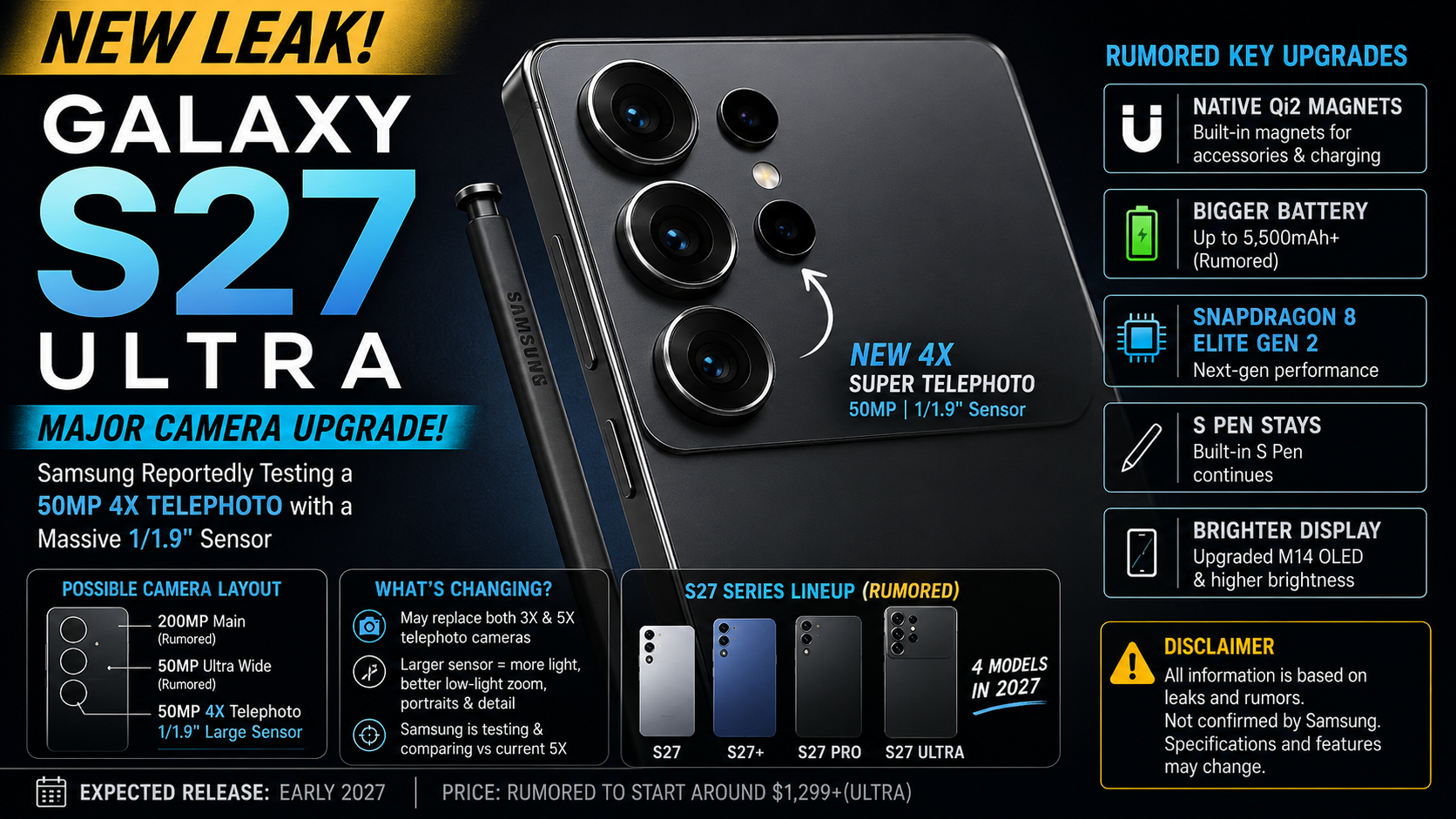

Samsung Galaxy S27 Ultra Camera Leak Points to More Natural Photos and Better Pro Video

Samsung’s Galaxy S27 Ultra may be getting a camera upgrade that is less about headline resolution and more about how photos and video actually look. A fresh leak claims Samsung is revising its image-processing pipeline to produce warmer, more natural-looking photos while also updating Samsung Log and the APV professional video codec for improved dynamic range.

The claims are interesting because they suggest Samsung could focus on computational photography and professional video tools even as some familiar camera hardware remains in place. However, the newest processing details come from a relatively unknown source, so they should be treated as an early rumor rather than a finalized specification.

A New Image-Processing Direction for the Galaxy S27 Ultra
A New Image-Processing Direction for the Galaxy S27 Ultra

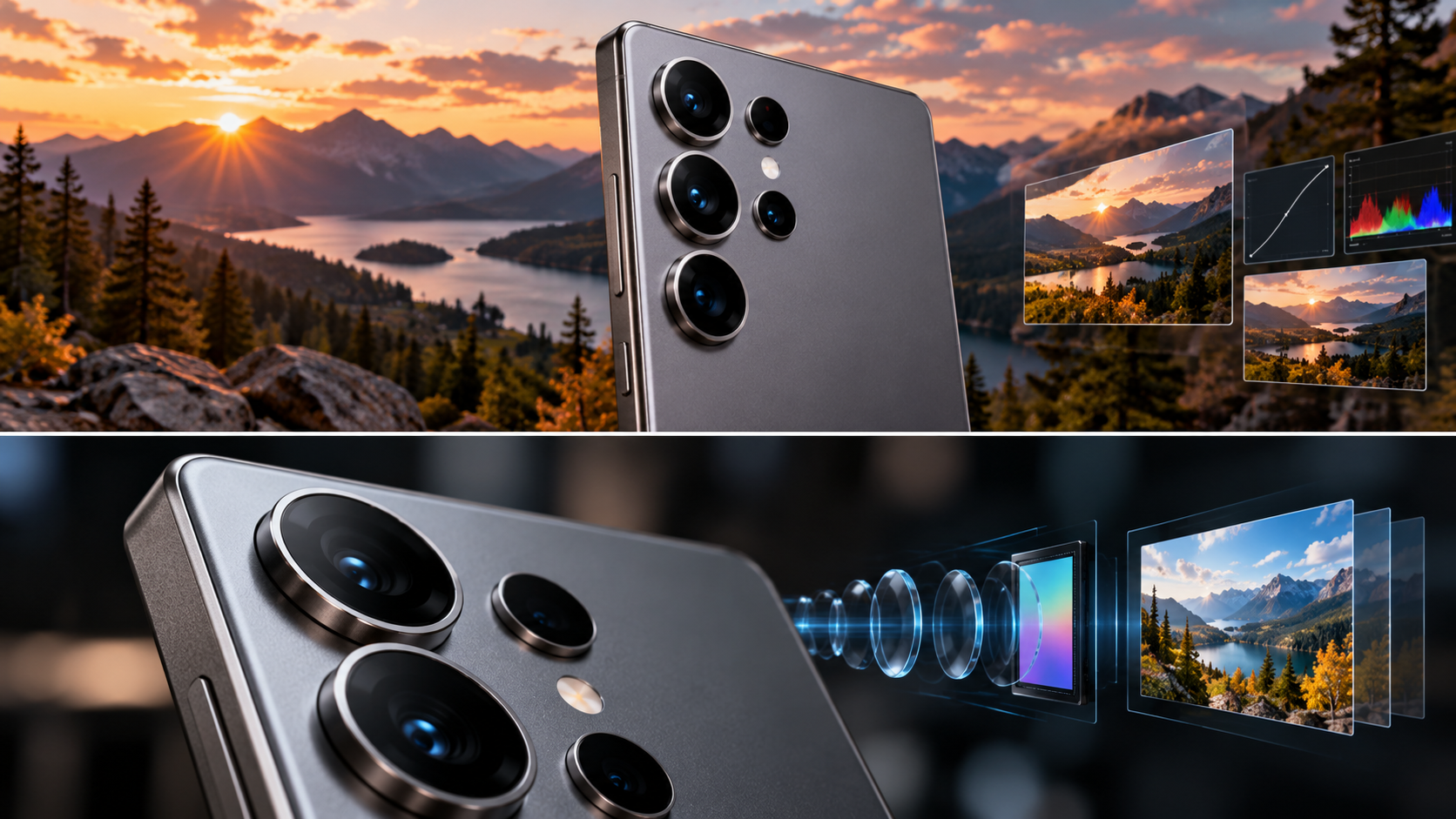
According to reporting from Android Authority and SamMobile, the Galaxy S27 Ultra is rumored to use a revised image-processing pipeline aimed at warmer and more natural color rendering. The current Galaxy S26 Ultra can lean cooler in some scenes, so a deliberate shift in color science could be noticeable even without a dramatic change in megapixel counts.

The leak also points to wider dynamic range. That could matter in difficult scenes such as sunsets, bright windows, backlit portraits, and landscapes where a phone has to preserve highlight detail without crushing darker areas. If Samsung combines improved processing with the other rumored sensor changes, the result could be a more meaningful camera upgrade than the specification sheet alone suggests.

Samsung Log and APV Could Get Better Too

Video is another part of the rumor. Samsung is said to be updating both Samsung Log and APV, or Advanced Professional Video. The goal is reportedly improved dynamic range rather than higher headline recording resolutions. Current reporting still points to 4K recording at up to 120 frames per second and 8K at 30 frames per second.

That would fit Samsung’s recent direction. Samsung Log gives creators a flatter image with more flexibility for color grading, while APV is designed for higher-quality professional workflows. Better dynamic range in those formats could be particularly useful for creators who want more control over highlights, shadows, and color in post-production.

For users who simply record family videos or quick clips, these changes may not be as obvious as a new zoom lens. For creators, however, improvements to Log, codec quality, and dynamic range can have a much larger effect on how far footage can be pushed during editing.

The 5x Telephoto Rumor Has Changed Again

This processing leak arrives while the Galaxy S27 Ultra’s zoom-camera story is also changing. Earlier rumors suggested Samsung was testing a larger 50MP 4x telephoto camera that could potentially replace the familiar 5x unit. More recent information from long-time Samsung leaker Ice Universe disputes that claim.

According to that newer report, Samsung is expected to retain a 5x periscope telephoto camera using a 1/2.52-inch sensor. Android Authority notes that this would be similar in size to the 5x hardware used in recent Galaxy Ultra models. The dedicated 3x telephoto is still rumored to be at risk of disappearing, although Samsung has not confirmed the final camera configuration.

That distinction matters. If Samsung keeps familiar 5x hardware, improvements to processing, color, HDR, and computational zoom become even more important. A camera system does not have to replace every sensor to improve, but Samsung would need its software pipeline to deliver visible gains.

How Credible Is This Leak?

The safest way to read the latest information is to separate the claims by source. The warmer color processing and updated Log/APV details were attributed to WalleGalaxy, an account Android Authority describes as relatively unknown. That makes those specific claims lower-confidence for now.

The 5x telephoto information has somewhat stronger sourcing because it comes from Ice Universe, who has a long history of Samsung-related leaks. Even so, it remains unofficial information about an unreleased phone, and Samsung could still change hardware or software before mass production.

There is also disagreement among current reports about the broader rear-camera layout. Some reports describe a move from four rear cameras to three, while others continue to reference a four-camera setup. Until multiple reliable sources converge—or Samsung announces the device—those details should not be treated as settled.

Why This Could Matter More Than Another Megapixel Increase

Smartphone cameras increasingly depend on the entire imaging pipeline: sensor data, HDR capture, noise reduction, sharpening, white balance, color mapping, and computational fusion. A phone can use excellent hardware and still produce disappointing results if the processing is too aggressive or inconsistent.

That is why the rumored move toward warmer, more natural color could be important. Samsung does not necessarily need every image to look warmer; consistency and believable skin tones are more valuable than simply changing the color temperature. The real question will be whether the company can preserve its punchy Galaxy look while producing more natural results when a scene calls for it.

For video, expanded dynamic range in Log and APV could similarly be more useful than another resolution increase. Many creators already have enough resolution at 4K. What they often need is cleaner tonal information, better highlight retention, and footage that grades predictably.

What We’re Watching Next

The next meaningful evidence would be corroboration from established Samsung sources, firmware or camera-app findings, supply-chain information, or early hardware samples. We will also be watching whether the rumored three-camera layout gains stronger support and whether Samsung really removes the dedicated 3x telephoto.

For now, the most interesting possibility is that the Galaxy S27 Ultra camera upgrade may be as much about image quality and creator tools as it is about new hardware. If the processing leak proves accurate, Samsung could be preparing a more natural photo style and a stronger professional-video workflow for its next Ultra flagship.

Sources

Android Authority — Samsung could give the Galaxy S27 Ultra a major camera processing upgrade

SamMobile — Galaxy S27 Ultra camera could have warmer colors and a wider dynamic range

Android Authority — Could Galaxy S27 Ultra bring zoom camera upgrades? New leak has bad news

Gadgets 360 — Samsung Galaxy S27 Ultra Could Get New Image Processing for More Natural Photos

Galaxy S27 Pro and Ultra Could Get Samsung’s M16 OLED Upgrade, Report Says

Concept image of four Galaxy S27-style phones representing rumored M14 and M16 OLED display tiers.

A new South Korean supply-chain report says Samsung plans to give the rumored Galaxy S27 Pro and Galaxy S27 Ultra its newer M16 OLED material set, while the standard S27 and S27+ move to M14. Samsung has not announced the phones or confirmed these specifications.

What the new report claims

South Korea’s ETNews reported on September 13, 2026 that Samsung Electronics and Samsung Display have decided to use the newer M16 OLED material set for the rumored Galaxy S27 Pro and Galaxy S27 Ultra. If accurate, these would be the first Samsung-branded phones to use M16 panels.

The report says Samsung would differentiate the lineup by giving the standard Galaxy S27 and Galaxy S27+ M14 material sets instead. Those models would still receive an upgrade from the M13 materials reportedly used across the Galaxy S24 through S26 generations, but the Pro and Ultra would keep the newer display tier.

Why M16 matters

M16 is the name of an OLED material set, not a screen resolution or marketing mode. Samsung Display combines different organic materials to determine characteristics such as light-emission efficiency, brightness potential, color performance and panel lifespan. A newer material generation can improve those fundamentals, although ETNews did not provide model-specific brightness, power-consumption or longevity figures.

Potential benefits include:

  • Improved luminous efficiency, which could reduce power use at comparable brightness.
  • More headroom for peak brightness and HDR performance.
  • Longer organic-material lifespan and more consistent color over time.
  • Greater display differentiation between Samsung’s mainstream and premium flagships.

These are expected advantages rather than confirmed Galaxy S27 performance measurements. Real benefits will depend on Samsung’s final panel tuning, refresh-rate behavior and software.

A four-model display hierarchy

ETNews describes four possible Galaxy S27 models and reports the following screen sizes:

  • Galaxy S27: 6.27 inches, M14 OLED.
  • Galaxy S27+: 6.66 inches, M14 OLED.
  • Galaxy S27 Pro: 6.47 inches, M16 OLED.
  • Galaxy S27 Ultra: 6.89 inches, M16 OLED.

That would place the rumored Pro between the standard and Plus models by screen size while giving it the same display-material generation as the Ultra. The lineup and dimensions remain unannounced, so they should be treated as supply-chain reporting rather than final specifications.

Privacy Display and COE could remain premium features

The M16 report also identifies Color Filter on Encapsulation and Privacy Display as technologies Samsung could use to separate the Pro and Ultra from the less expensive models.

COE replaces a conventional polarizer with a color filter integrated into the display stack. The approach can help improve light transmission and reduce panel thickness. Privacy Display restricts off-angle visibility to make sensitive content harder for nearby people to read.

Earlier reporting already pointed to Privacy Display for the Galaxy S27 Pro and Ultra. The M16 material claim is the new development: it suggests Samsung may divide the entire lineup by both OLED generation and premium display features.

Samsung may be using its newest panel later than rivals

ETNews says Samsung Display’s M16 material set is already used in Google’s Pixel 11 series and Apple’s iPhone 18 Pro models. If the report is correct, Samsung’s display division supplied the material to major customers before Samsung’s mobile division adopted it in a Galaxy phone.

That would not be unusual because Samsung Display and Samsung Electronics operate as separate businesses with different product schedules and requirements. It does, however, make the S27 upgrade more notable after several Galaxy S generations using older material sets.


What is confirmed and what is not

Confirmed:

  • Samsung Display develops OLED material generations identified by “M” numbers.
  • M16 is a newer material set than M14 and M13.
  • The Galaxy S27 family has not been officially announced.

Unconfirmed:

  • The four-model Galaxy S27 lineup.
  • M16 panels for the Galaxy S27 Pro and Ultra.
  • M14 panels for the standard S27 and S27+.
  • The reported display sizes, feature split and first-quarter 2027 launch window.

Bottom line

The report points to a meaningful display upgrade across the Galaxy S27 family, with the Pro and Ultra receiving Samsung Display’s newer M16 materials and the two mainstream models stepping up to M14. The possible efficiency and longevity improvements are promising, but Samsung has not confirmed the devices, and no measurable brightness or battery-life gains are available yet.


Sources

Galaxy S27 Ultra could bring Exynos back to the Ultra — a major strategy shift

Galaxy S27 Ultra Exynos leak and Samsung chipset strategy

A meaningful new Samsung Electronics Galaxy S27 Ultra leak has emerged from South Korea. According to a September 1 report from MoneyToday, Samsung has started preparing an Exynos 2700 version of the Galaxy S27 Ultra for selected markets, including South Korea. More significantly, the report says Samsung has already placed an initial order for S27 Ultra motherboards designed around the Exynos 2700.

Exynos could return to the Ultra after five years

This would be a substantial change in Samsung’s flagship strategy. The Galaxy S22 Ultra was the last Ultra generation offered with an Exynos processor. Galaxy S Ultra models from 2023 through 2026 have instead relied exclusively on Snapdragon silicon.

The report claims Samsung originally intended to use Qualcomm’s next-generation Snapdragon platform across the S27 Ultra lineup. Development of that Snapdragon model is reportedly already well advanced, but Samsung’s MX and System LSI divisions are now coordinating development of an additional Exynos 2700 motherboard.

That means the S27 Ultra could once again become a region-dependent phone:

United States: Snapdragon is still expected.
South Korea: Exynos 2700 is now reportedly being prepared.
Other regions: not yet firmly established for the Ultra.

Samsung has not confirmed this regional configuration, so reports claiming that Europe will definitely receive an Exynos S27 Ultra are currently getting ahead of the strongest source.

Exynos 2700 itself just received another interesting leak

A newly reported Exynos 2700 die shot provides additional clues about what Samsung may be developing. The analysis points toward Samsung’s second-generation 2nm SF2P process, a 10-core CPU arrangement with two high-performance tiers, a large NPU, 24MB system-level cache, Xclipse 970 graphics and LPDDR6 support.

The leaked architecture could be especially important for sustained performance and efficiency. However, these are engineering-stage processor details, not confirmed Galaxy S27 Ultra specifications. Support for technologies such as LPDDR6 does not automatically mean the retail S27 Ultra will actually use LPDDR6 memory.

What Ice Universe is saying

There isn’t a new Ice Universe specification leak today that overrides the previous camera, design, battery or S Pen reporting. A September 2 post attributed to Ice Universe instead criticized the S27 series as feeling “tired, bored, exhausted”, suggesting disappointment with the direction of the lineup rather than revealing another hardware specification.

Current S27 Ultra leak picture

The Exynos 2700 Ultra variant is the meaningful new development. The other major reports remain largely where they were: a dramatically redesigned rear camera area, three-camera direction, integrated S Pen, potential native Qi2 magnets, and a larger battery remain under discussion. The recently reported experimental 4x telephoto configuration also remains just that—something reportedly being evaluated rather than a finalized retail camera specification.

Pricing also remains unknown. Reports estimating a price based on the current Ultra should not be treated as an actual S27 Ultra price leak. Current launch expectations remain around early 2027, but Samsung has not announced the Galaxy S27 Ultra, its launch date, pricing, processors or specifications.

The strongest evidence behind today’s development is the Korean supply-chain report about Samsung ordering Exynos 2700 S27 Ultra motherboards. That makes this considerably more interesting than a generic specification rumor, while still stopping short of proving that Exynos-powered retail S27 Ultras will actually ship.