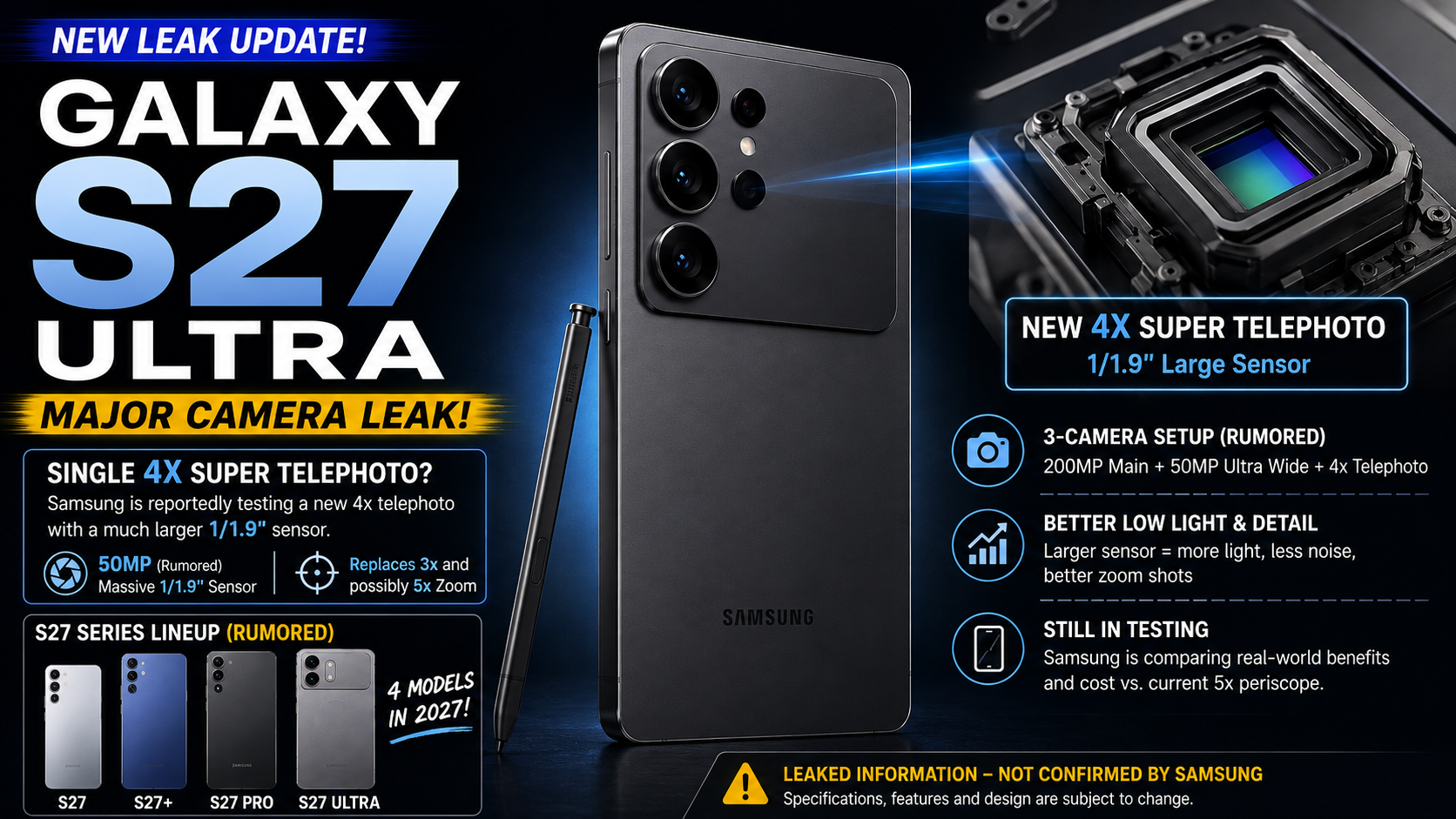
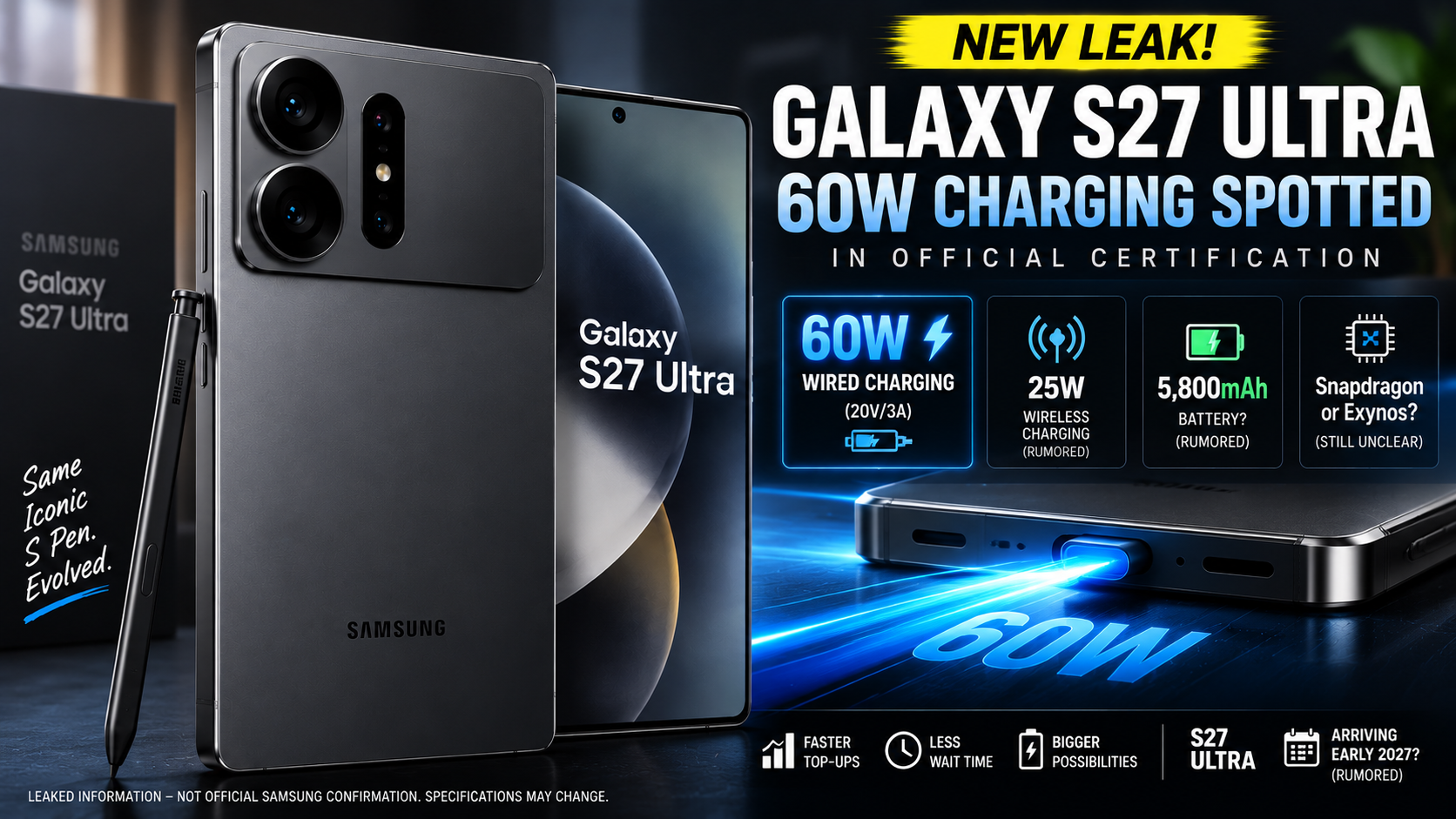
A meaningful new Samsung Electronics Galaxy S27 Ultra development has surfaced. On September 6, 2026, SamMobile reported that Galaxy S27-series variants have appeared in China’s CCC certification database, with the Galaxy S27 Ultra listed for 60W wired charging (20V/3A).
This is more significant than a typical social-media rumor because the information reportedly comes from a regulatory certification listing. However, Samsung itself has not announced the Galaxy S27 Ultra or confirmed its final charging specifications.
What the certification reveals
The reported S27 charging lineup is:
Galaxy S27: 25W
Galaxy S27+: 45W
Galaxy S27 Pro: 60W
Galaxy S27 Ultra: 60W
Interestingly, this would mean the S27 Ultra doesn’t increase wired charging speed over the S26 Ultra. Instead, Samsung appears to be bringing its highest charging tier to the rumored S27 Pro as well.
The same reporting associates the Ultra with 25W wireless charging, although that detail should still be considered part of the pre-release leak picture rather than an official Samsung specification.
Battery rumor gets more interesting
The report also repeats a claim that the Galaxy S27 Ultra could use a 5,800mAh battery, potentially using silicon-carbon anode technology.
I’d treat that capacity with substantially more caution than the 60W charging figure. Earlier reporting has been inconsistent: Ice Universe previously pushed back strongly on unsupported claims of batteries above roughly 5,500mAh.
So at this point:
60W wired charging: relatively strong evidence because of the reported CCC certification.
5,800mAh battery: still a rumor and currently less reliable.
No major new Ice Universe Ultra leak today
I didn’t find a newer Ice Universe disclosure today that materially changes the S27 Ultra camera, S Pen, Qi2, display or processor picture.
His recent case leak remains important because it supports the new raised camera-plateau design on the S27 Ultra and S27 Pro.
Samsung still hasn’t officially announced the Galaxy S27 series, so the design, battery capacity, processor split, cameras and release timing remain subject to change.
Bottom line: the genuinely new development is regulatory evidence pointing to 60W charging for the Galaxy S27 Ultra. That’s credible enough to report, but it also suggests Samsung may focus its S27 Ultra upgrades elsewhere rather than increasing peak wired charging beyond the S26 Ultra.