A head of tonight’s draw, the Powerball lottery has been rises to $900 million. 2016 will be the great start for the person, who wins $900 million dollar. Powerball has a 5 numbers with 1 Powerball number. To win this jackpot, you have to have all 6 numbers matched with the draws number. Tonight, Powerball will be drawn tonight, Saturday. People play this jackpot from 44 states including Washington DC, the U.S. Virgin Islands and Puerto Rico, all but six states require lottery winners to come forward publicly. Therefore, good luck being anonymous if you win. Continue reading “Powerball Lottery Rises $900 million, the largest jackpot in the US History”
We called him the custodian of all living things. If an ant had crawled its way into our kitchen, he’d gently pick it up and carry it out outside to rejoin its family. If he saw a classmate sitting alone, he’d be the first to provide company and comfort. At 7 years old, he cared, he listened, and he loved more deeply than many adults I know. Continue reading “Why the President Obama is taking action today to reduce gun violence”
Arun BudhathokiIf you are a Nepali or know Nepali people and have lived in Nepal then you probably know what it means to wait for petrol, gas, and interviews. While the long queues for petrol, gas and even medicines (hospitals) are a new phenomena resulting from human-made disaster, the culture of making people wait for interviews is perhaps not a new thing, but the result of the culture of disrespecting time. Patience is a virtue people say, but maybe not when it comes to us. I have had the experience while waiting for interviews.
Time is important for all of us, irrespective of who we are, employer or employees. I think it is very rude to make people wait for more than fifteen minutes to do an interview. The employers should keep in mind that the prospective employees are busy too and making them wait only defines their work ethics and attitude towards the unemployed and employed people. This has to change to transform the image of a company and also influence the mind-set of its employers. If the time taken for interviews is such, then the employers shouldn’t accept its employees to be on time and work under pressure for them. Both attitudes of employers and employees should match as none of them are robots and humans can err, which we know, from experiences and research. On the other hand, Nepali people are collectively to be blamed.
In the last three months, we have witnessed how patient Nepalis are when it comes to buying petrol for as high as Rs 300 to 500. They don’t even complain or protest against the government. We patiently wait in the long dull sad queues before the dreary looking petrol pump. We do not even go to Singha Durbar but creatively point at the hundreds of problems but do not provide a single solution. We have become a master of problem finders but a loser in seeking solutions. That’s the key difference between us and people in the western world. However, I disagree to dissuade implementing western solutions—we can at least start repairing our breaking frontiers by respecting time. The culture of disrespecting time is rampant in the governmental sector and everywhere else. It is deeply entrenched in our psyche: yestai cha yaha (It is like this here). And we do nothing about it. We calmly wait for the interviewer to call us and don’t ask when the interview is going to start. We don’t even care to ask the foreign country going ministers who send their kids and relatives to China about their ethical values.
Two days earlier there was twenty fours power-cut hiatus in my locality, Shantinagar, New Baneshwor and I was wondering where I could complain about it. With no idea about it, finally the power came back around 23:30 and it was only the next day I came to know that few people from the locality had gone to the concerned authorities to complain on it. If they hadn’t gone and complained, it seems the government employees would have delayed repairing it. That is the culture here—taking time lightly and delaying everything for tomorrow, next year. While other countries are busy planning space exploration, we are postponing works and delaying important projects.
The psyche of disrespecting time can be seen among our leaders too. Although they are smart enough to make sure that they don’t go hungry and sick after they quit politics. But the same leaders took so much time to pass the Reconstruction Authority bill which was vital to forward the post-quake relief and reconstruction works. There’s no time to wait for the earthquake-hit people who are facing extreme winter. Those living in the capital city already know how it feels to be cold. Do we have extra time to read about our fellow people including the quake-affected, dying of cold?
The culture of disrespecting time needs to change. We need to eradicate it first in our psyche and work for changes in every sector of this country. Or else, with our Human Development Index (HDI) nosediving, we will continue to be one of the poorest countries in South Asia and the rest of the world. Others will move ahead in time, whereas we will continue to live in the time where everything is delayed. Time waits for none.
(Budhathoki is a graduate of International Relations)
Sushma JoshiOn my second day in Myitkyina, Olivier, a French biker who I’ve met at a restaurant, mentioned in a state of high excitement that he’s seen a train full of Burmese soldiers going in the other direction. The rebels are 25 km away, in the Southern part, just where he needs to go to get the boat to Bhamo. He doesn’t know if he will be able to leave the next morning, whether the boat will take off or not. Olivier is going around the world in his motorcycle—Burma is the only country that didn’t allow him to bring in his bike, so he had to fly in. In Pakistan, he was escorted by eight Army officers. He left the country as quickly as possible, he says. We agree this army escort is not the best idea.
“A guy on a bike may draw attention, people may notice that I am white if I drive slowly. But with eight Army officers following me, they definitely noticed!” he says, rather dryly. Continue reading “Kachin-Gorkhas”
Dec 31, 2015- The eventful year 2015 witnessed accidents, natural disasters and political upheavals. The constitution was promulgated after seven years of protracted political disputes, yet it also triggered protests, deaths and unofficial blockade. Continue reading “A year of achievements and mishaps in Nepal in 2015”
Dr. Roshan Bhakta BhandariDespite the losses and disruptions wrought by the Nepal Earthquake 2015, it became increasingly apparent that people and communities could cope with the immediate challenges by drawing upon their own resources. A prominent example was the rising number of self- help groups and community volunteers who positively influenced quick response and relief efforts. This highlighted the potential of people and communities to be resilient. Most recently, the Sendai Framework for Action 2015-2030 developed by the International Strategy for Disaster Risk Reduction, also identified the need to develop this resilient capacity as the key element of a disaster risk reduction (DRR) strategy. Nepal Earthquake provided an opportunity to understand how local capabilities at an individual and societal level helped to overcome the immediate challenges encountered during a massive disaster. Continue reading “Winter of discontent”
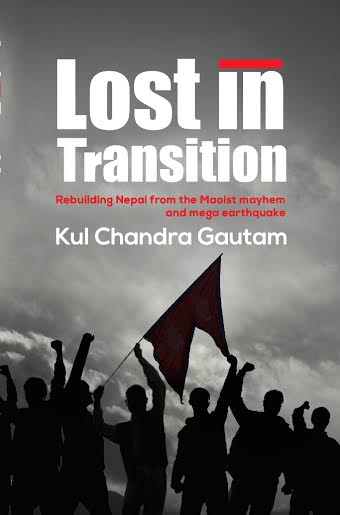
Kul Chandra Gautam print‘Lost in Transition: Rebuilding Nepal from Maoist Mayhem and Mega Earthquake’, a book penned by former senior official of the United Nations Kul Chandra Gautam, was launched at Nepalaya in the capital, on Saturday. Below are excerpts from the book.
Kofi Annan on Madi incident
Although Nepal was not a high priority among the many international crises Secretary-General Kofi Annan had to deal with, he did occasionally show some interest and concern. Among other occasions, I vividly remember meeting him at a reception on 6 June 2005. Earlier that day the UN had issued a press statement expressing deep concern about the Maoist attack the previous day (5 June 2005) on a public passenger bus in Madi in Chitwan district where a large number of innocent passengers were killed and mutilated. Although it was one of many brutal and barbaric acts committed by the Maoists against innocent civilians, I had thought that the UN press statement was probably one of those many pro-forma routine statements that are issued in the name of the Secretary-General, which the UN leader might not even personally know about. Continue reading “Lost in Transition”
The tragic story of Ricky Naputi, one of the world’s fattest men. At nearly 65 stone, bedridden and confined to his home on the Pacific island of Guam, Ricky had limited access to obesity medical care. Even finding a doctor to give him the weight-loss surgery he so desperately needed would prove to be a massive challenge. Ricky lived with Cheryl, his wife of ten years, on a beautiful tropical island, but for the last five years of his life he never would never be able to appreciate it. Continue reading “The Man Who Ate Himself To Death”
What is TPS? Why we need this? Or what is the benefit of having TPS?
According to the USCIS (U.S. Citizenship and Immigration Services), the secretary of Homeland Security may designate a foreign country for TPS due to conditions in the country that temporary prevent the country’s nationals from returning safely, or in certain circumstances, where the country is unable to handle the return of its nationals adequately. USCIS may grant TPS to eligible nationals of certain countries (or parts of countries), who are already in the United States. Eligible individuals without nationality who last resided in the designated country may also be granted TPS. Continue reading “Temporary Protected Status (TPS) Deadline to Register for Nepal has been Closed”
Marriage; it is a promising social act where the two persons meet, fall in love and decide to share their life living together. Life would be easier and peaceful if there is no such thing as marriage. But let’s not forget everyone need someone to hold each others back during old time and be cane if not able to walk properly during 60s’.
I really think marriage is biased regarding the part of role we stand for either being a bride and bride-groom. It is more difficult for woman, she have to give more sacrifices; have to leave her home and should live in husband home considering that this is the real home and should change the surname for rest of her life. When this spouse turns into parent; it is a mother who has to give a full stop in her career in order to stay at home and look after how little ones grow up? And become a full time house manager. I cannot imagine keeping myself in place of my mother. From early morning to late night she even doesn’t have a time to get a life on her own. she wakes up at 5 in the morning, prepares tea and wakes all three of us (me, brother and my sister), goes for walk and about 6, she returns and starts to prepare lunch. In the same time she manages to iron my dresses and clean the home.

 A head of tonight’s draw, the Powerball lottery has been rises to $900 million. 2016 will be the great start for the person, who wins $900 million dollar. Powerball has a 5 numbers with 1 Powerball number. To win this jackpot, you have to have all 6 numbers matched with the draws number. Tonight, Powerball will be drawn tonight, Saturday. People play this jackpot from 44 states including Washington DC, the U.S. Virgin Islands and Puerto Rico, all but six states require lottery winners to come forward publicly. Therefore, good luck being anonymous if you win.