

EverBoard is entering the digital-tabletop market with a 21.5-inch touchscreen built for up to six people, more than 50 games at launch and an AI tool that can turn a spoken or typed idea into a playable game. The system is scheduled to arrive exclusively at Best Buy in the United States during the 2026 holiday season.
Polygon reports a $499.99 price, putting EverBoard in premium-console territory before any ongoing subscription cost. The pitch is appealing: one shared screen, no controllers or loose pieces, familiar Hasbro games and new games that families can create together. But several important buying details—including the EverPass renewal price, exact release date and full hardware specifications—have not yet been announced.
ReaderSpice may earn a commission from qualifying Amazon purchases. Families who prefer a physical game night can compare the CATAN base game while waiting for EverBoard’s launch details.
EverBoard quick facts
- Reported price: $499.99, according to Polygon.
- Display: 21.5-inch touchscreen designed to be used from every side of a table.
- Players: Up to six people on one device, without separate controllers.
- Launch library: More than 50 games through the EverPass service.
- Licensed games: Monopoly, Connect 4, Chutes and Ladders and Scrabble are among the announced Hasbro titles.
- Availability: Best Buy exclusive in the U.S. during the 2026 holiday season; the exact date remains unannounced.
What EverBoard is—and what it is not
EverBoard is a horizontal touchscreen meant to sit on a dining table or coffee table. Players gather around the same display and make moves directly on the screen. EverBoard says the system is intended for children, parents and grandparents, with no controller pairing, physical game pieces or lengthy setup.
The approach is different from playing a board-game app on an iPad. A 21.5-inch shared surface gives multiple players room to participate at once, while the software can automate setup, scoring and rule enforcement. It also removes the need to store boxes of pieces. The tradeoff is obvious: the entire game night depends on one electronic device, its software library and the company’s long-term support.
EverBoard’s September 24 announcement says the launch catalog will combine licensed Hasbro games with puzzles, drawing activities, arcade-style games and original titles. The company says new games will be added monthly, but it has not published a complete launch list.
How EverVibe turns prompts into a game
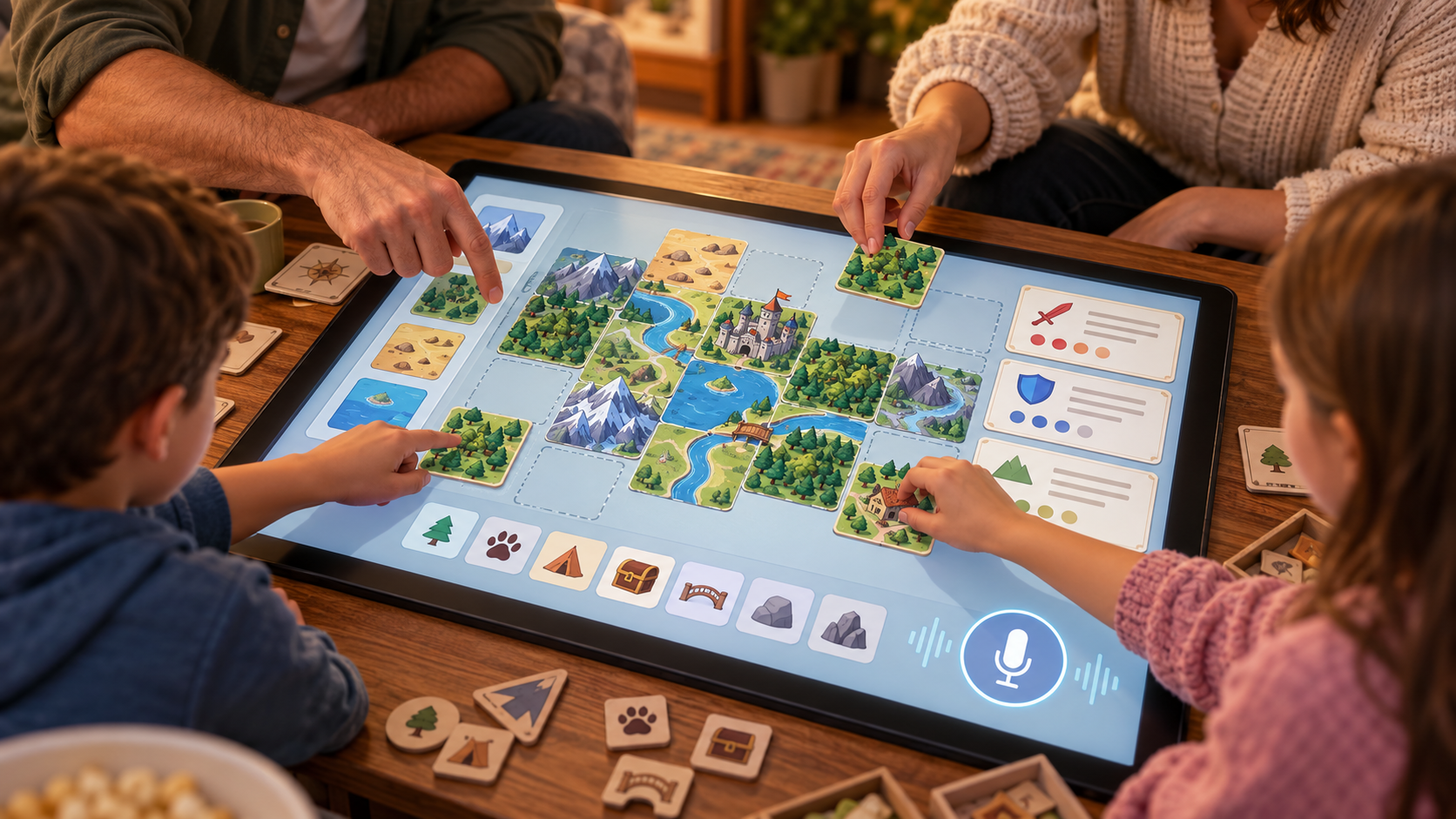
EverVibe Game Creator is the feature that most clearly separates EverBoard from a conventional digital board-game collection. Players can describe a game with voice or text, and the system generates a playable experience from that prompt. That could let a family build a trivia game around a vacation, turn a child’s story into a simple adventure or quickly prototype house rules.
Polygon’s launch interview adds an important safeguard: created games remain private unless an adult approves them for publication. EverBoard’s moderation team then reviews a submitted game before it can be shared publicly. Those controls are reassuring, but parents should still treat generated games as supervised activities until the system’s filters, privacy settings and account tools can be tested in real homes.
The company has not yet explained which AI model powers EverVibe, how prompts or voice recordings are stored, whether generated games work offline or what limits apply to creation. Those questions matter for a product marketed to families and should be answered before purchase.
What the $500 price does—and does not—include
Every EverBoard includes one month of EverPass. The subscription unlocks the full library of more than 50 launch games and, according to Polygon, the game-creation capability. EverBoard has not disclosed EverPass’s monthly or annual price, whether any games remain playable without a subscription, or whether individual titles can be purchased separately.
That missing number is central to the value calculation. A $499.99 device could be reasonable for a household that regularly buys premium board games and uses the system every week. It becomes harder to justify if core features require an expensive recurring plan. Buyers should wait for the renewal price and post-subscription behavior before treating the hardware price as the total cost.
The announcement also leaves basic hardware questions unanswered, including screen resolution, storage, Wi-Fi requirements, ports, warranty length, repair options and whether the display resists spills. EverBoard’s official launch page promises software and security updates until at least March 2029, which is useful to know but represents only a little more than two years of support from the planned holiday 2026 launch.
Five things to verify before ordering
- EverPass renewal price and whether cancellation removes access to downloaded or built-in games.
- The final launch-game list, including which titles support all six players.
- Parental controls, account requirements, data retention and voice-recording settings for EverVibe.
- Hardware details such as resolution, connectivity, spill resistance, warranty coverage and replacement policy.
- A firm on-sale date, return window and whether Best Buy stores will have demonstration units.
A hands-on demo would be especially valuable. Touchscreen latency, viewing angles, glare and how well six people can reach the display are difficult to judge from promotional material. Families should also consider whether they want a screen to replace physical components or merely supplement traditional games.
How EverBoard compares with existing digital gameboards
EverBoard is not the first large touchscreen built for tabletop play. Arcade1Up’s Infinity Game Board and Infinity Game Table established the basic category with digital versions of familiar board games. EverBoard’s differentiator is EverVibe: it is selling creation, not just a catalog.
That makes the product more ambitious, but also less proven. Licensed classics provide a familiar starting point; the long-term appeal will depend on the quality of generated games, the pace of new releases and whether the subscription feels fair. A clever prompt-to-game demo is not the same as a balanced game families will replay.
The absence of controllers and pieces could be a genuine advantage for quick setup and accessibility. It can also flatten the tactile pleasure that makes board games special. EverBoard will need to show that its shared-screen design adds social interaction instead of simply putting another display in the middle of the table.
Early verdict
EverBoard has a clear idea and a credible set of launch hooks: a large shared touchscreen, six-player support, recognizable Hasbro games and a moderated AI creation system. It also arrives with meaningful unknowns. The $499.99 hardware price is only half the buying decision until EverPass pricing, offline access, hardware specifications and the complete launch library are public.
For now, EverBoard is worth watching rather than preordering blindly. Families interested in a holiday purchase should sign up for updates on EverBoard’s official launch page and compare the final subscription terms with the cost—and lasting ownership—of physical games.
Sources
EverBoard Inc. launch announcement