
Apple has confirmed a new product experience for Wednesday, October 28, 2026, in Los Angeles. The company is calling it “Pro and Tell,” a name that points strongly toward professional hardware, but Apple has not published a product list or promised a traditional public keynote.
The event turns several weeks of Mac and iPad reporting into a date worth watching. Bloomberg reports that Apple plans its first touchscreen MacBook Pro, an entry-level MacBook Pro and iMac built around the M6 chip, and a redesigned iPad mini. Those devices remain reported rather than announced. Here is the useful split between what Apple has confirmed, what credible reporting says may arrive and what buyers should avoid assuming.
What Apple has officially confirmed
- Confirmed: an Apple product experience called “Pro and Tell” on Wednesday, October 28.
- Confirmed: the in-person program begins at 10 a.m. Pacific in Los Angeles.
- Not confirmed: a public livestream, prerecorded keynote or exact press-release schedule.
- Not confirmed: product names, specifications, prices, preorder dates or retail availability.
Apple marketing chief Greg Joswiak announced the experience on October 19 with the line “Can’t wait to pro and tell next week.” Reuters separately confirmed the October 28 date. Selected media invitations describe an in-person Los Angeles experience beginning at 10 a.m. Pacific, which is 1 p.m. Eastern and 5 p.m. GMT.
The wording matters. “Pro and Tell” is official branding, but it is not a specifications sheet. Apple could publish product pages and videos around the media session, yet the company has not confirmed where or whether consumers can watch live. Readers should check Apple’s Events and Newsroom pages on October 28 instead of relying on an assumed livestream link.
What reports say Apple may announce
Touchscreen OLED MacBook Pro
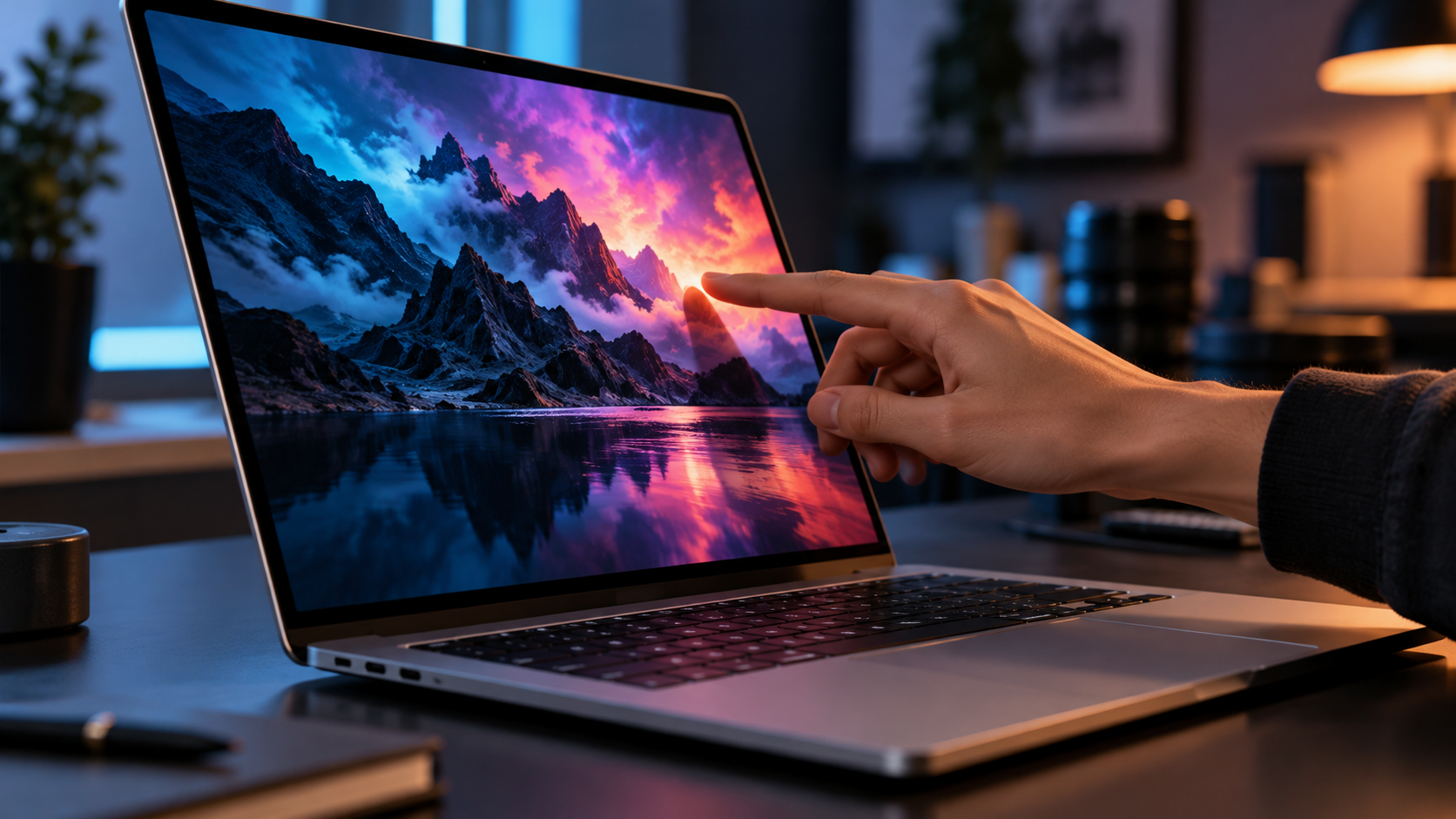
The headline expectation is a redesigned high-end MacBook Pro with an OLED display and direct touch input. Bloomberg reports that 14-inch and 16-inch models are planned with M5 Pro and M5 Max processors, a lighter design and a display cutout described as a Dynamic Island. If accurate, OLED and touch would both be firsts for the Mac.
None of those details is official. Apple has spent years keeping the Mac’s pointer-first interface distinct from the iPad’s touch-first interface, so the important question is not simply whether the display accepts a finger. Buyers should watch for Apple’s explanation of touch targets, window controls, keyboard-and-trackpad use, accessibility, Apple Pencil support and how macOS behaves when the screen is touched for long periods.
OLED could matter even to users who never touch the display. The technology can deliver deeper blacks, higher contrast and more precise control of bright highlights than a conventional backlight. The tradeoffs to test are sustained brightness, reflection handling, power consumption, panel uniformity and long-term image retention. Marketing claims will not answer those questions; hands-on measurements will.
M6 MacBook Pro and iMac
Bloomberg also reports a new entry-level 14-inch MacBook Pro and an updated iMac using Apple’s M6 chip. These machines are expected to keep designs similar to the current versions, which would make the processor and configuration choices more important than exterior changes.
The unusual wrinkle is that the rumored entry-level notebook may use M6 while the redesigned high-end models use M5 Pro and M5 Max. Chip names alone would not establish which Mac is faster. Pro and Max processors normally provide more CPU and GPU cores, memory bandwidth and external-display capability than the base chip. Buyers should compare each announced configuration rather than assuming a higher generation number wins every workload.
OLED iPad mini
A refreshed iPad mini is the other major reported product. Current reporting points to an OLED display, a landscape-oriented front camera and revised speakers. Bloomberg has also described the update as a substantial redesign, but Apple has not confirmed the screen, processor, storage tiers, dimensions or price.
For travelers and readers, display quality and battery life will matter more than benchmark gains. For video calls, the camera’s location could fix the off-center angle created when today’s iPad mini is held horizontally. Anyone planning to reuse a case or keyboard accessory should wait for official dimensions and connector details.
Why the October 28 event matters
Apple has already introduced a broad smart-home lineup this month, including HomeView, HomePod mini 2 and a new Apple TV 4K. A second October experience focused on Macs and iPad would give the company separate stages for home products and professional computing.
The reported touchscreen MacBook Pro would be the strategic change. Touch does not automatically turn a Mac into an iPad, and Apple does not need to merge the operating systems to make direct interaction useful. Creative tools, timeline scrubbing, photo adjustments, signing and accessibility controls could benefit, while precise work would still favor a trackpad, mouse or pen. The strength of Apple’s explanation will matter as much as the hardware.
Timing is also important for buyers. Bloomberg reports that Apple stores are preparing for new products to go on sale Friday, November 6. That date is not confirmed by Apple. If it proves accurate, preorder decisions could arrive quickly after the October 28 announcements, leaving little time between official specifications and retail availability.
What buyers should do before the event
- Do not buy docks, cases or screen protectors based on reported dimensions.
- Do not assume a touchscreen Mac will run iPad apps differently until Apple explains macOS behavior.
- Compare announced prices with current models only after memory and storage configurations are known.
- Wait for independent testing of OLED brightness, battery life, thermal performance and touch ergonomics.
If you need a professional Mac immediately, you can compare current MacBook Pro listings on Amazon, but check the exact processor, memory, storage, seller and return window before purchasing. Waiting until October 28 is the safer choice for most shoppers because even an unchanged current model could receive a price adjustment after new hardware appears.
Disclosure: ReaderSpice may earn a commission from qualifying Amazon purchases made through the link above, at no additional cost to you.
Questions Apple still needs to answer
Apple’s announcement should resolve the product lineup, but several practical questions will determine whether the rumored devices are meaningful upgrades:
- Will the touchscreen models support Apple Pencil, and can the display remain stable during repeated touch input?
- Will OLED be standard across the redesigned MacBook Pro line or limited by size and configuration?
- How will Apple position M6 against M5 Pro and M5 Max for sustained creative workloads?
- Will existing MacBook Pro and iPad mini accessories remain compatible?
- Which products can be ordered immediately, and which regions receive them first?
- Will the Los Angeles experience include a public video, or will Apple rely on press releases and hands-on coverage?
Until Apple answers those questions, the event should be treated as confirmed and the hardware details as credible reporting—not as final specifications.
Bottom line
Apple’s October 28 “Pro and Tell” experience is real, begins at 10 a.m. Pacific in Los Angeles and is likely to focus on professional hardware. A touchscreen OLED MacBook Pro is the most consequential reported announcement, while M6 Macs and an OLED iPad mini could broaden the lineup.
The smartest buying move is to wait. Apple has not confirmed prices, configurations, preorder timing or a livestream, and the reported mix of M6 entry-level Macs with M5 Pro and M5 Max high-end models makes simple chip-name comparisons unreliable. ReaderSpice will separate the final announcements from the pre-event reports when Apple publishes the official details.
Sources
Apple marketing chief Greg Joswiak’s official announcement
Reuters report confirming Apple’s October 28 experience
Bloomberg report on the expected Mac and iPad lineup


