
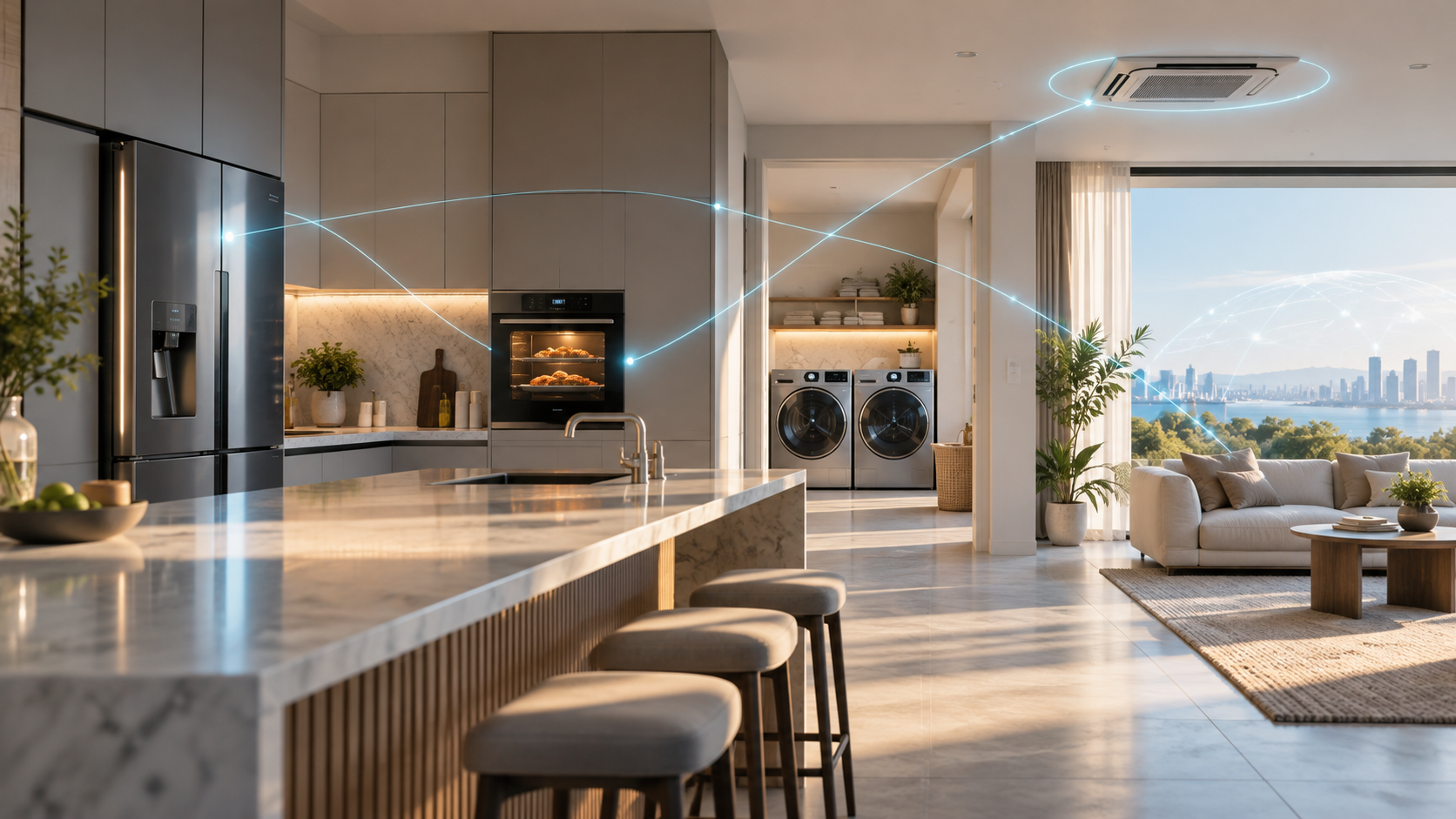
Samsung is turning its appliance AI pitch into a regional strategy rather than one universal product bundle. At its October 20, 2026 “The Brief” events, the company outlined different priorities for North America, Europe, Latin America, Southwest Asia and Southeast Asia—from cameras that identify groceries to energy-saving built-ins, sleep-aware cooling and remote service tools.
The common thread is SmartThings, but the details matter. Many of the headline features require specific appliance models, a Samsung account, Wi-Fi, regional service availability or other Samsung devices. Several are previews rather than products you can buy everywhere today. Here is what Samsung actually announced, what is already relevant in the United States and which claims need a careful reading.
What Samsung announced
Samsung’s global appliance plan has five practical themes:
- North America: more automated food recognition and camera-assisted cooking.
- Europe: lower energy consumption and more integrated built-in appliances.
- Latin America: one SmartThings control layer across refrigerators, washers and air conditioners.
- Southwest Asia: cooling that reacts to sleep data, plus family check-in tools.
- Southeast Asia: AI-equipped appliances, remote diagnostics and a preview of 2027 air conditioners.
Samsung says roughly 270 media and industry participants from 23 countries attended the regional sessions. That makes the event useful as a statement of direction, but it is not a single worldwide launch date or a promise that every feature will reach every market.
Five regions, five different priorities
United States: AI Vision and AI Pro Cooking
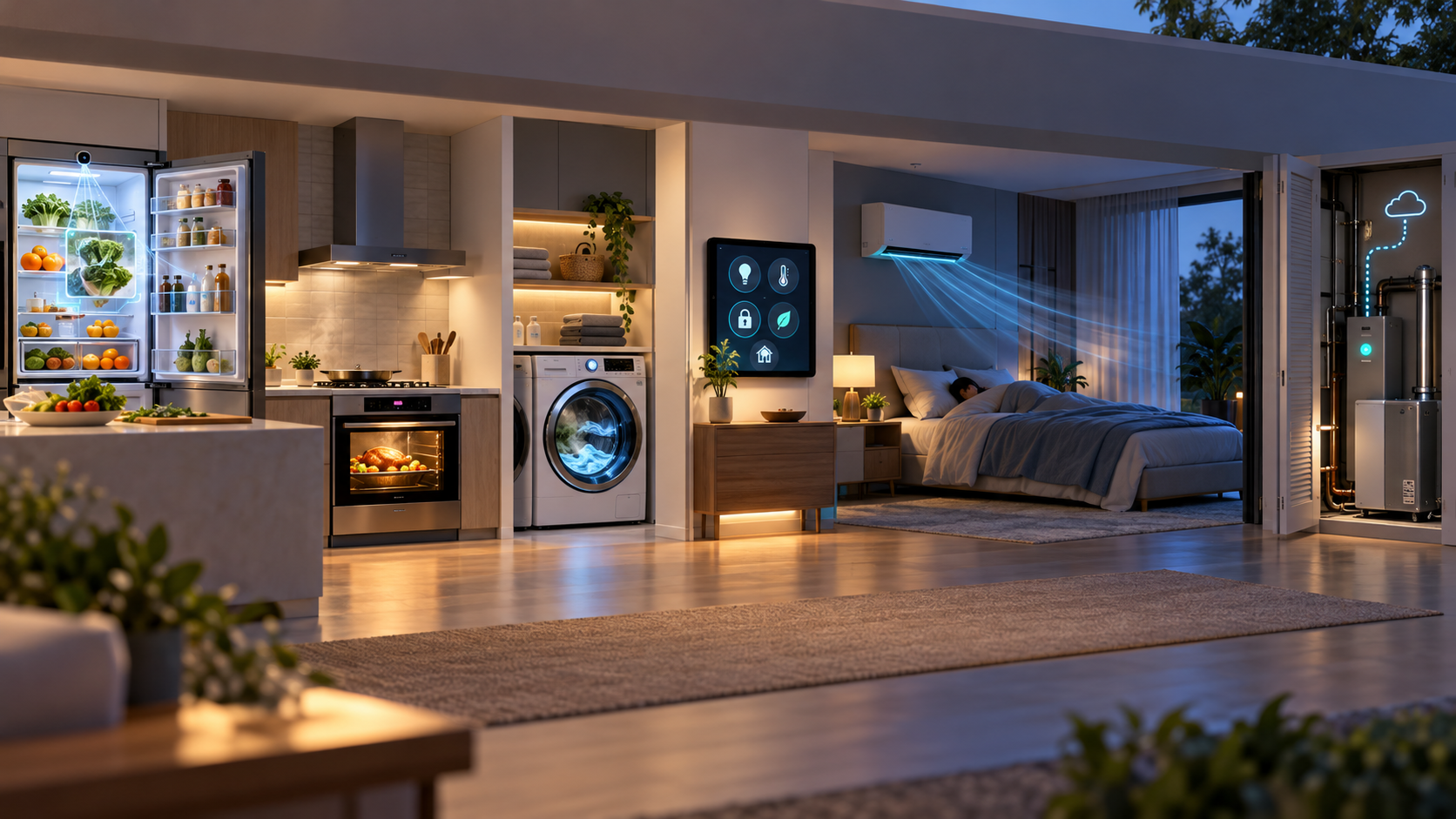
In the United States, Samsung emphasized the kitchen. AI Vision on compatible Bespoke AI Family Hub refrigerators can recognize selected groceries and container labels, then add them to a Food List. AI Pro Cooking uses an oven camera to recognize certain ingredients, suggest settings and watch changes in the food’s appearance while it cooks.
That can reduce small chores, but neither camera replaces a person checking food safety, doneness or expiration. Samsung’s U.S. refrigerator information says AI Vision Inside recognizes and labels 37 unobscured fresh-food items under supported conditions. Other items may need manual names, and recognition can vary with placement and visibility.
Europe: energy efficiency and built-ins
Samsung’s European presentation focused on appliances that fit into a connected kitchen and on energy claims that can be compared against European labels. The company says a Bespoke AI Washer uses 65% less energy than the minimum threshold for EU Energy Efficiency Class A, while an announced dishwasher is up to 20% more efficient than that threshold.
Those percentages are relative to a regulatory baseline, not a promise that every cycle will cut a household’s bill by the same amount. Program choice, load, water temperature, local tariffs and older equipment all affect real savings. Samsung also highlighted its Extractor Induction Hob and AI Precise Cooling as parts of an integrated built-in lineup.
Latin America: SmartThings as the control layer
For Latin America, the story was less about a new appliance category and more about putting refrigerators, washing machines and air conditioners in one SmartThings experience. That approach is useful when the app exposes energy use, maintenance alerts and routines without requiring a different interface for every room.
It also raises the usual platform questions: which functions work locally, which depend on the cloud, how long a model receives updates and what happens if someone changes ecosystems. Buyers should check the exact model page and SmartThings compatibility before assuming every appliance shown at a briefing offers the same controls.
Southwest Asia: sleep-aware cooling and Family Care
Samsung highlighted Motion Wind air conditioners with five airflow modes and a WindFree Wearable Good Sleep feature that can use sleep and body-temperature signals from a Galaxy Watch or Galaxy Ring to adjust cooling. The same regional presentation also connected SmartThings Now and Family Care to household routines.
Family Care is best treated as a consent-based check-in feature, not medical monitoring. Samsung describes notifications based on connected-device activity and reminders for medication or hospital appointments, along with optional location-related alerts. A quiet home or inactive device can have harmless explanations, so a notification should prompt a human check rather than an emergency conclusion.
Southeast Asia: 2027 previews and remote service
In Southeast Asia, Samsung previewed 2027 air conditioners with AI Energy Mode, AI Vision and Bixby-related functions while also stressing longer software support. It says eligible Wi-Fi-enabled appliances can receive software updates for up to seven years after launch, starting with models introduced in 2024.
The phrase “up to” is important. Eligibility, update content and timing vary by product and region. Samsung’s Home Appliance Remote Management program can also use appliance data for diagnostics and guidance, including preventive recommendations, but availability and service scope are not uniform worldwide.
AI Vision still needs human checking
Computer vision is most useful when it shortens inventory work without pretending the inventory is perfect. A refrigerator camera can miss food hidden behind another item, misunderstand packaging or retain an outdated label after something is moved. Samsung’s own material says recognition results vary, and items outside the supported set require manual handling.
Use the Food List as a shopping aid, not a safety record. Confirm allergens, dates and spoiled food yourself. In the oven, verify internal temperature with an appropriate thermometer when it matters; a camera watching browning cannot measure whether the center of every food is safe.
Seven-year updates are useful but conditional
Longer software support matters because a connected appliance can remain in a home far longer than a phone. Seven years of eligible updates could reduce the risk of a still-functional refrigerator or washer losing integrations early. It may also give Samsung time to improve security, accessibility and service tools.
However, the commitment does not mean every old appliance gets seven more years starting today. Samsung says the policy begins with eligible Wi-Fi products launched in 2024, and the maximum period is measured from the product’s launch. Buyers should keep the model number, confirm the original launch year and ask what kinds of updates—security fixes, interface changes or new features—are covered in their country.
What U.S. shoppers can actually buy
Samsung already sells Family Hub and AI Vision Inside refrigerator configurations in the United States, but the global briefing mixes current products, regional demonstrations and future previews. A feature shown in Europe or Southeast Asia should not be treated as a confirmed U.S. feature until it appears on Samsung’s U.S. product or support page for the exact model.
Before buying, check four things:
- The full model number, not only the series name used in marketing.
- Whether the feature runs on the appliance, in SmartThings or through a cloud service.
- Which phone, wearable, hub or Samsung account is required.
- The written warranty and stated software-support window for your country.
That checklist is especially important for appliance bundles. A refrigerator screen, wearable-linked air conditioner and remote diagnostic service may belong to the same ecosystem but still follow different support schedules.
Relevant SmartThings hardware
A separate hub is not required for every Wi-Fi-connected Samsung appliance, and a hub does not add AI Vision or camera features to an appliance that lacks them. For households expanding into Zigbee, Thread or Matter accessories, the Aeotec Smart Home Hub 2 on Amazon is a current SmartThings-compatible option. It does not include Z-Wave, so owners of older Z-Wave locks, switches or sensors should verify migration needs before replacing an existing hub.
As an Amazon Associate, ReaderSpice earns from qualifying purchases.
The bottom line
Samsung’s regional appliance briefings show a more practical AI strategy than a single chatbot pasted onto every screen. Food recognition, energy management, unified control, sleep-aware cooling and remote diagnostics each solve different household problems, and the regional focus makes that clearer.
The tradeoff is fragmentation. Model numbers, accounts, wearables, cloud services and country-specific rollouts decide what actually works. Treat the October 20 announcement as a roadmap, verify the precise product in your market, and keep safety, caregiving and essential appliance controls usable without relying on an AI prediction.
Sources
Samsung Global Newsroom: The Brief global AI appliance announcement
Samsung U.S.: Bespoke refrigerators and AI Vision Inside
Samsung Global Newsroom: SmartThings Family Care update
Samsung Global Newsroom: Seven-year appliance software updates
Samsung Global Newsroom: CES 2026 home companion and remote management