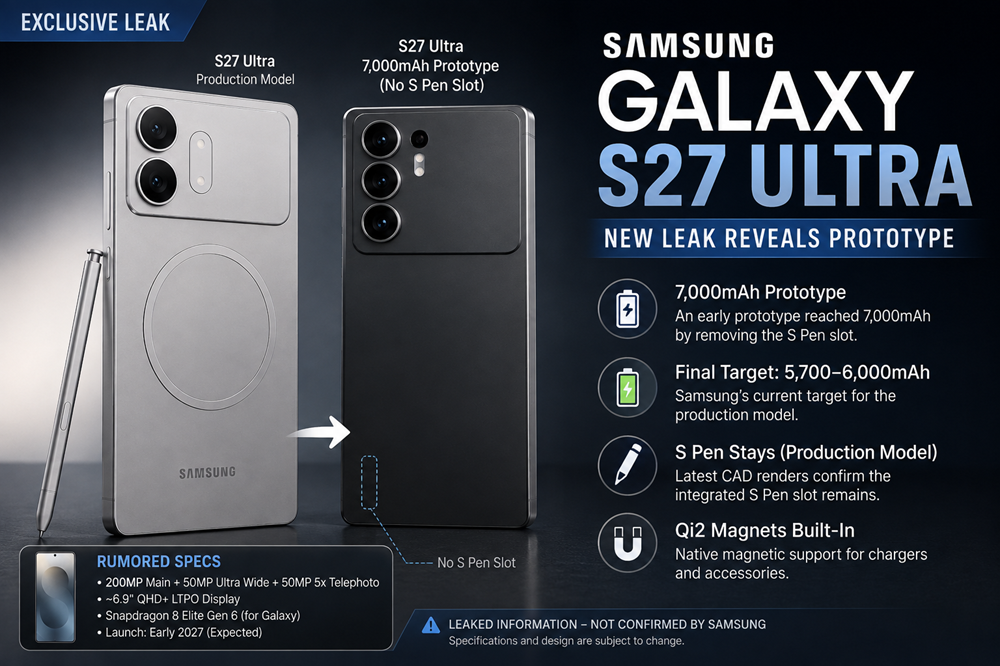

Samsung’s Galaxy S27 Ultra may not receive one of the biometric upgrades previously rumored for the 2027 flagship. A fresh report says Samsung currently has no plans to introduce Metalenz’s Polar ID face-authentication technology on the Galaxy S27 Ultra, potentially leaving the ultrasonic fingerprint reader as the phone’s primary secure biometric option.
The claim is not an official Samsung announcement, so it should be treated as a leak rather than a confirmed specification. Still, it is notable because earlier S27 Ultra coverage had pointed toward Polar ID as a possible major authentication upgrade.
What the New Galaxy S27 Ultra Leak Says
Tipster kro (@kro_roe) claimed on X on September 9 that Samsung currently shows no indication of bringing Polar ID to the Galaxy S27 Ultra. Gadgets 360 reported that Samsung’s earlier Metalenz testing remained experimental. If accurate, Samsung could continue using its established ultrasonic fingerprint system while retaining conventional camera-based face unlock for convenience.
That would make this less of a new feature story and more of a reversal: a previously discussed S27 Ultra upgrade may no longer be part of Samsung’s current plan.
What Is Polar ID?
Polar ID is an advanced facial-recognition approach associated with Metalenz that uses polarization information rather than relying only on a conventional RGB selfie image. The attraction for a flagship phone is stronger authentication without necessarily copying the exact hardware arrangement used by Apple’s Face ID.
However, Samsung has not announced Polar ID for the Galaxy S27 series, and reports that the company experimented with the technology do not mean it was ever guaranteed for a commercial device.
The Bigger Galaxy S27 Picture Is Getting More Interesting
This biometric report arrives as other S27-family leaks continue to build a picture of Samsung’s 2027 lineup. Recent reporting points to a possible Galaxy S27 Pro joining the regular S27, S27+ and S27 Ultra. One UI 9.5 firmware entries associated with the S27 family have also reportedly appeared on Samsung servers, with the sightings attributed to Samsung-focused leaker Tarun Vats.
Charging could be another important upgrade. Ice Universe recently posted information indicating 60W wired charging for both the rumored Galaxy S27 Pro and Galaxy S27 Ultra. That claim remains unofficial until Samsung confirms the devices and specifications, but it would represent a meaningful change if it reaches the final hardware.
These leaks should not be treated equally to an official product announcement. Firmware sightings and regulatory information can provide useful clues, while final hardware, names, features and regional configurations can still change before launch.
Why Samsung Might Skip the Feature
Cost and product priorities may be part of the explanation. Flagship development requires balancing camera hardware, displays, processors, batteries, thermal systems, connectivity and other components. Adding a new biometric system only makes sense if Samsung believes the security and user-experience gains justify the hardware and development cost.
If Polar ID has indeed been dropped from the current S27 Ultra plan, Samsung could redirect resources toward upgrades users interact with more frequently, such as cameras, battery life, charging, performance or display technology. That is an interpretation, however, not something Samsung has confirmed.
What Is Actually Confirmed?
Very little about the Galaxy S27 Ultra is official at this stage. Samsung has not announced the Galaxy S27 lineup, its final specifications, pricing or launch date. Reports currently point toward an early-2027 flagship window, but exact timing remains unconfirmed.
For now, the safest takeaway is straightforward: Polar ID was rumored, but the newest reporting says it may not be coming to the Galaxy S27 Ultra after all.
ReaderSpice Take
The most interesting part of early flagship leak season is watching specifications change as development progresses. The Polar ID story is a good example of why early rumors should never be presented as finished specifications.
The Galaxy S27 Ultra still has plenty of time before an expected 2027 introduction, and Samsung’s final priorities could change again. ReaderSpice will continue tracking Samsung’s development, while separating credible leaks from specifications Samsung actually confirms.
SOURCES
- Gadgets 360 — Galaxy S27 Ultra tipped to skip Polar ID face unlock (September 9, 2026): https://www.gadgets360.com/mobiles/news/samsung-galaxy-s27-ultra-may-skip-advanced-polar-id-face-unlock-leak-12023211
- PhoneArena — Galaxy S27 Ultra release expectations and One UI 9.5 firmware reporting: https://www.phonearena.com/galaxy-s27-ultra-release-date-price-features-news
- Talk Android — Galaxy S27 Pro / 60W charging report citing Ice Universe: https://www.talkandroid.com/530778-galaxy-s27-series-leak/
- kro (@kro_roe) — original Polar ID claim on X: https://x.com/kro_roe/status/2096956019251511544
- Ice Universe (@UniverseIce) — original 60W charging post on X: https://x.com/UniverseIce/status/2096148963145740456
EDITORIAL NOTE
All Galaxy S27 specifications discussed above are leaks, reports or expectations unless explicitly identified as confirmed by Samsung.