Apple iPhone Duo vs Samsung Galaxy Z Fold8: Which Foldable Is Right for You?

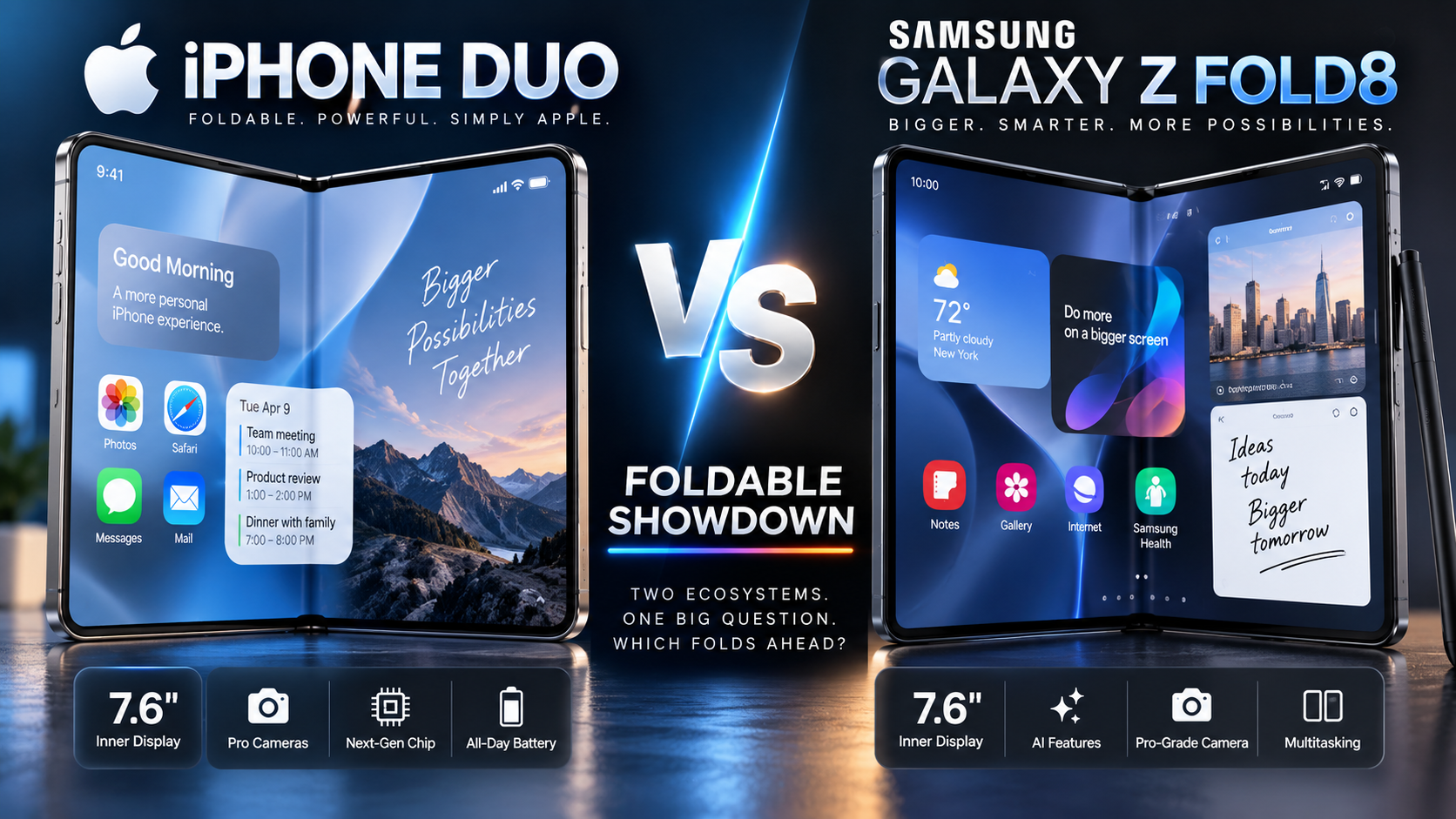
Apple has officially entered the foldable-phone market with the iPhone Duo, putting its first folding iPhone directly against Samsung’s Galaxy Z Fold8. Both use a passport-style book design, both open to a 7.6-inch display, and both target buyers willing to spend flagship-level money for a phone that can become a small tablet.

But these two foldables take noticeably different approaches. Apple emphasizes iOS integration, its A20 Pro chip, Apple Intelligence, Apple Pencil support and continuity between the two displays. Samsung’s Fold8 is dramatically lighter, thinner when unfolded, built around Galaxy AI and Android multitasking, and comes from a company with years of foldable-phone experience.

Here is how the iPhone Duo and Galaxy Z Fold8 compare based on their official specifications and announced features.

Design: Similar Idea, Very Different Weight

The biggest surprise is how similar the basic form factors are. Apple’s iPhone Duo has a 5.4-inch outer display and a 7.6-inch inner folding display. Samsung gives the Galaxy Z Fold8 a 5.5-inch cover display and the same 7.6-inch main-screen size.

The difference becomes much more obvious when you pick up the spec sheet. Samsung says the Galaxy Z Fold8 weighs just 201 grams and measures 4.5 mm thick when unfolded. Apple lists the iPhone Duo at 254 grams and 5.2 mm unfolded.

That makes the Fold8 53 grams lighter. For a device designed to be carried every day, that difference could be meaningful. Apple counters with a grade 5 titanium construction and a precision hinge, while Samsung uses Armor Aluminum, Gorilla Glass, an Armor FlexHinge and its Flex Titanium display reinforcement.

Displays: Both Give You a 7.6-Inch Canvas

Both phones open to a 7.6-inch OLED display with adaptive refresh rates up to 120Hz. Apple’s inner Super Retina XDR panel has a 2670-by-1878 resolution at 430 ppi, while Samsung’s Fold8 uses a 7.6-inch main display designed around a wider 4:3 aspect ratio.

Apple also applies a nano-texture finish to the inner screen to reduce glare. The iPhone Duo supports Apple Pencil (USB-C), which gives Apple an interesting productivity angle for handwritten notes, markup and creative work.

Samsung focuses heavily on side-by-side productivity. Its wide main screen supports Multi Window, and Samsung has spent several generations refining Android apps, drag-and-drop workflows and multitasking for Galaxy Fold devices.

iOS 27 vs Android and Galaxy AI

Software may be the biggest reason to choose one device over the other.

The iPhone Duo ships with iOS 27.1, with Apple redesigning parts of iOS specifically for the foldable form factor. When opened, the Duo can show two Home Screen pages, and Apple has adapted the Dock, navigation controls, Dynamic Island and Live Activities for the larger folding canvas. Content can react as the phone folds, rotates or switches displays.

The Duo also combines Apple Intelligence and Siri AI with the foldable interface. For people already using Macs, iPads, Apple Watches and AirPods, the broader Apple ecosystem may be one of its strongest advantages.

Samsung approaches productivity from the Android side. Galaxy Z Fold8 combines Galaxy AI with Google’s Gemini experiences and Samsung’s mature Multi Window system. Samsung specifically highlights side-by-side productivity and AI workflows on the Fold8’s larger display.

Performance: A20 Pro vs Snapdragon 8 Elite Gen 5 for Galaxy

Apple powers the iPhone Duo with its A20 Pro chip, along with a custom vapor chamber and dual-battery architecture. Samsung uses the Snapdragon 8 Elite Gen 5 for Galaxy, a customized Qualcomm platform with upgraded CPU, GPU and NPU performance.

Raw benchmark numbers will matter once the devices can be tested side by side, but both are positioned as premium flagship processors. In day-to-day use, the larger difference may come from how iOS and Android use the folding display rather than from processor speed alone.

Cameras: Two Different Takes on Foldable Photography

The iPhone Duo includes a 48MP Fusion Main camera and a 48MP Ultra Wide camera, with 2x optical-quality zoom. Apple also uses the folding design for new shooting options, including ways to use the outer display while taking photos and video.

Samsung’s Galaxy Z Fold8 has a 50MP Wide camera and a 50MP Ultra Wide camera, with up to 10x digital zoom. Samsung describes it as a camera system aimed at social-media creators and also takes advantage of the foldable body for flexible shooting positions.

Neither phone should automatically be judged by megapixel count alone. Image processing, video quality, low-light performance and consistency will require real-world testing.

Battery and Charging

Samsung lists a 4,800 mAh typical battery for the Galaxy Z Fold8 and rates it for up to 26 hours of video playback under its test conditions.

Apple does not market the iPhone Duo around a conventional mAh figure on its main product page. Instead, Apple uses a dual-battery architecture and describes the device as delivering all-day battery life. Real-world comparisons will be especially important because foldable battery life can vary significantly depending on how often the large inner screen is used.

Price and Availability

Apple’s iPhone Duo starts at $1,999 in the United States with 256GB of storage. Apple says pre-orders begin October 16, 2026, with availability beginning October 23.

Samsung launched the Galaxy Z Fold8 earlier, with general U.S. availability beginning August 7, 2026. Retail pricing and promotions can change, so buyers should compare current offers rather than relying only on launch pricing.

Amazon Shopping Links

ReaderSpice may earn a commission from qualifying purchases made through affiliate links, at no additional cost to you.

Shop Samsung Galaxy Z Fold8 on Amazon

Shop Apple iPhone models on Amazon

These are standard Amazon links for now and can be replaced with ReaderSpice affiliate links.

Where the iPhone Duo Stands Out

The iPhone Duo is particularly notable for bringing Apple’s ecosystem to a foldable for the first time. It combines the A20 Pro, iOS 27.1, Apple Intelligence, Apple Pencil support, a nano-texture 7.6-inch display and Apple’s familiar app ecosystem in a completely new iPhone form factor.

It is also Apple’s first generation of foldable hardware, which makes independent durability and long-term hinge testing worth watching once the phone reaches customers.

Where the Galaxy Z Fold8 Stands Out

Samsung’s Fold8 has a substantial portability advantage on paper. At 201 grams and 4.5 mm unfolded, it is considerably lighter and thinner than the iPhone Duo. Samsung also brings years of experience developing foldable software, Multi Window workflows and hinge designs.

For users who frequently run multiple apps at once or already use Galaxy and Google services, the Fold8’s Android-based multitasking environment offers a different experience from Apple’s approach.

Which One Fits Your Needs?

The specifications point to two distinct priorities rather than a universal winner. The iPhone Duo brings foldable hardware into Apple’s ecosystem, with iOS 27.1, Apple Intelligence, Apple Pencil support and tight integration with other Apple products. The Galaxy Z Fold8 emphasizes lower weight, a thinner unfolded design, established foldable multitasking and Galaxy AI.

People already invested in either ecosystem may find that software, apps, accessories and connected devices matter more than small differences in specifications. Buyers who are flexible between iOS and Android should also consider portability, multitasking style, cameras, durability and current pricing before deciding.

Sources

Apple Newsroom — Apple unveils iPhone Duo

Apple — iPhone Duo Technical Specifications

Samsung — Galaxy Z Fold8 Features

Samsung Newsroom — Making the Most of Your New Galaxy Z Fold8

9to5Mac — iPhone Duo vs Galaxy Z Fold8 specification comparison
Galaxy S27 Pro and Ultra Could Get Samsung’s M16 OLED Upgrade, Report Says

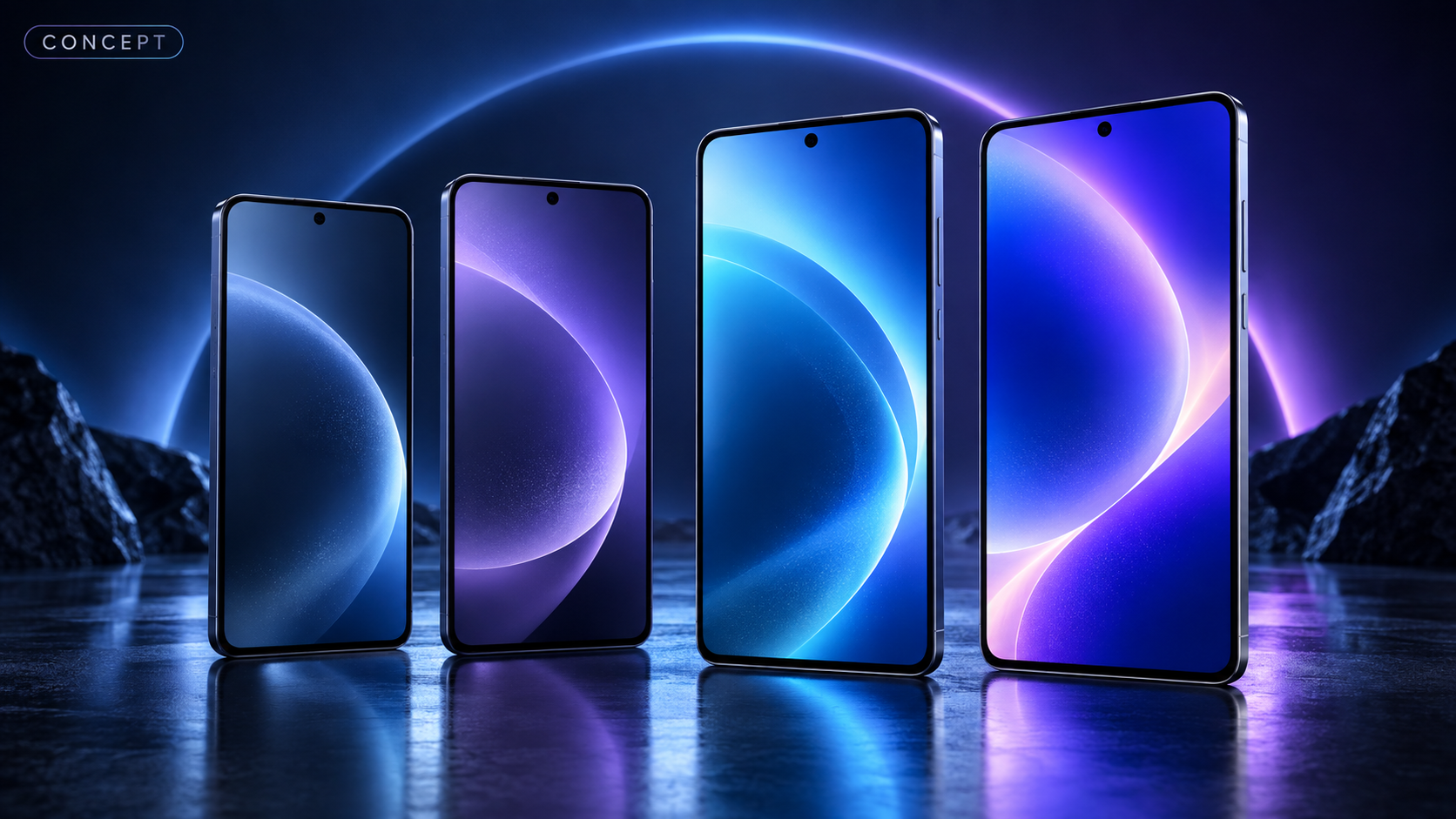
Concept image of four Galaxy S27-style phones representing rumored M14 and M16 OLED display tiers.

A new South Korean supply-chain report says Samsung plans to give the rumored Galaxy S27 Pro and Galaxy S27 Ultra its newer M16 OLED material set, while the standard S27 and S27+ move to M14. Samsung has not announced the phones or confirmed these specifications.

What the new report claims

South Korea’s ETNews reported on September 13, 2026 that Samsung Electronics and Samsung Display have decided to use the newer M16 OLED material set for the rumored Galaxy S27 Pro and Galaxy S27 Ultra. If accurate, these would be the first Samsung-branded phones to use M16 panels.

The report says Samsung would differentiate the lineup by giving the standard Galaxy S27 and Galaxy S27+ M14 material sets instead. Those models would still receive an upgrade from the M13 materials reportedly used across the Galaxy S24 through S26 generations, but the Pro and Ultra would keep the newer display tier.

Why M16 matters

M16 is the name of an OLED material set, not a screen resolution or marketing mode. Samsung Display combines different organic materials to determine characteristics such as light-emission efficiency, brightness potential, color performance and panel lifespan. A newer material generation can improve those fundamentals, although ETNews did not provide model-specific brightness, power-consumption or longevity figures.

Potential benefits include:

  • Improved luminous efficiency, which could reduce power use at comparable brightness.
  • More headroom for peak brightness and HDR performance.
  • Longer organic-material lifespan and more consistent color over time.
  • Greater display differentiation between Samsung’s mainstream and premium flagships.

These are expected advantages rather than confirmed Galaxy S27 performance measurements. Real benefits will depend on Samsung’s final panel tuning, refresh-rate behavior and software.

A four-model display hierarchy

ETNews describes four possible Galaxy S27 models and reports the following screen sizes:

  • Galaxy S27: 6.27 inches, M14 OLED.
  • Galaxy S27+: 6.66 inches, M14 OLED.
  • Galaxy S27 Pro: 6.47 inches, M16 OLED.
  • Galaxy S27 Ultra: 6.89 inches, M16 OLED.

That would place the rumored Pro between the standard and Plus models by screen size while giving it the same display-material generation as the Ultra. The lineup and dimensions remain unannounced, so they should be treated as supply-chain reporting rather than final specifications.

Privacy Display and COE could remain premium features

The M16 report also identifies Color Filter on Encapsulation and Privacy Display as technologies Samsung could use to separate the Pro and Ultra from the less expensive models.

COE replaces a conventional polarizer with a color filter integrated into the display stack. The approach can help improve light transmission and reduce panel thickness. Privacy Display restricts off-angle visibility to make sensitive content harder for nearby people to read.

Earlier reporting already pointed to Privacy Display for the Galaxy S27 Pro and Ultra. The M16 material claim is the new development: it suggests Samsung may divide the entire lineup by both OLED generation and premium display features.

Samsung may be using its newest panel later than rivals

ETNews says Samsung Display’s M16 material set is already used in Google’s Pixel 11 series and Apple’s iPhone 18 Pro models. If the report is correct, Samsung’s display division supplied the material to major customers before Samsung’s mobile division adopted it in a Galaxy phone.

That would not be unusual because Samsung Display and Samsung Electronics operate as separate businesses with different product schedules and requirements. It does, however, make the S27 upgrade more notable after several Galaxy S generations using older material sets.


What is confirmed and what is not

Confirmed:

  • Samsung Display develops OLED material generations identified by “M” numbers.
  • M16 is a newer material set than M14 and M13.
  • The Galaxy S27 family has not been officially announced.

Unconfirmed:

  • The four-model Galaxy S27 lineup.
  • M16 panels for the Galaxy S27 Pro and Ultra.
  • M14 panels for the standard S27 and S27+.
  • The reported display sizes, feature split and first-quarter 2027 launch window.

Bottom line

The report points to a meaningful display upgrade across the Galaxy S27 family, with the Pro and Ultra receiving Samsung Display’s newer M16 materials and the two mainstream models stepping up to M14. The possible efficiency and longevity improvements are promising, but Samsung has not confirmed the devices, and no measurable brightness or battery-life gains are available yet.


Sources

Galaxy S27 Ultra May Skip Polar ID Face Unlock as Samsung Reconsiders Its 2027 Flagship Upgrades

Samsung’s Galaxy S27 Ultra may not receive one of the biometric upgrades previously rumored for the 2027 flagship. A fresh report says Samsung currently has no plans to introduce Metalenz’s Polar ID face-authentication technology on the Galaxy S27 Ultra, potentially leaving the ultrasonic fingerprint reader as the phone’s primary secure biometric option.

The claim is not an official Samsung announcement, so it should be treated as a leak rather than a confirmed specification. Still, it is notable because earlier S27 Ultra coverage had pointed toward Polar ID as a possible major authentication upgrade.

What the New Galaxy S27 Ultra Leak Says

Tipster kro (@kro_roe) claimed on X on September 9 that Samsung currently shows no indication of bringing Polar ID to the Galaxy S27 Ultra. Gadgets 360 reported that Samsung’s earlier Metalenz testing remained experimental. If accurate, Samsung could continue using its established ultrasonic fingerprint system while retaining conventional camera-based face unlock for convenience.

That would make this less of a new feature story and more of a reversal: a previously discussed S27 Ultra upgrade may no longer be part of Samsung’s current plan.

What Is Polar ID?

Polar ID is an advanced facial-recognition approach associated with Metalenz that uses polarization information rather than relying only on a conventional RGB selfie image. The attraction for a flagship phone is stronger authentication without necessarily copying the exact hardware arrangement used by Apple’s Face ID.

However, Samsung has not announced Polar ID for the Galaxy S27 series, and reports that the company experimented with the technology do not mean it was ever guaranteed for a commercial device.

The Bigger Galaxy S27 Picture Is Getting More Interesting

This biometric report arrives as other S27-family leaks continue to build a picture of Samsung’s 2027 lineup. Recent reporting points to a possible Galaxy S27 Pro joining the regular S27, S27+ and S27 Ultra. One UI 9.5 firmware entries associated with the S27 family have also reportedly appeared on Samsung servers, with the sightings attributed to Samsung-focused leaker Tarun Vats.

Charging could be another important upgrade. Ice Universe recently posted information indicating 60W wired charging for both the rumored Galaxy S27 Pro and Galaxy S27 Ultra. That claim remains unofficial until Samsung confirms the devices and specifications, but it would represent a meaningful change if it reaches the final hardware.

These leaks should not be treated equally to an official product announcement. Firmware sightings and regulatory information can provide useful clues, while final hardware, names, features and regional configurations can still change before launch.

Why Samsung Might Skip the Feature

Cost and product priorities may be part of the explanation. Flagship development requires balancing camera hardware, displays, processors, batteries, thermal systems, connectivity and other components. Adding a new biometric system only makes sense if Samsung believes the security and user-experience gains justify the hardware and development cost.

If Polar ID has indeed been dropped from the current S27 Ultra plan, Samsung could redirect resources toward upgrades users interact with more frequently, such as cameras, battery life, charging, performance or display technology. That is an interpretation, however, not something Samsung has confirmed.

What Is Actually Confirmed?

Very little about the Galaxy S27 Ultra is official at this stage. Samsung has not announced the Galaxy S27 lineup, its final specifications, pricing or launch date. Reports currently point toward an early-2027 flagship window, but exact timing remains unconfirmed.

For now, the safest takeaway is straightforward: Polar ID was rumored, but the newest reporting says it may not be coming to the Galaxy S27 Ultra after all.

ReaderSpice Take

The most interesting part of early flagship leak season is watching specifications change as development progresses. The Polar ID story is a good example of why early rumors should never be presented as finished specifications.

The Galaxy S27 Ultra still has plenty of time before an expected 2027 introduction, and Samsung’s final priorities could change again. ReaderSpice will continue tracking Samsung’s development, while separating credible leaks from specifications Samsung actually confirms.

SOURCES

EDITORIAL NOTE

All Galaxy S27 specifications discussed above are leaks, reports or expectations unless explicitly identified as confirmed by Samsung.

Galaxy S27 Ultra charging is now showing up in certification — 60W wired charging spotted

Samsung Galaxy S27 Ultra 60W wired charging certification leak

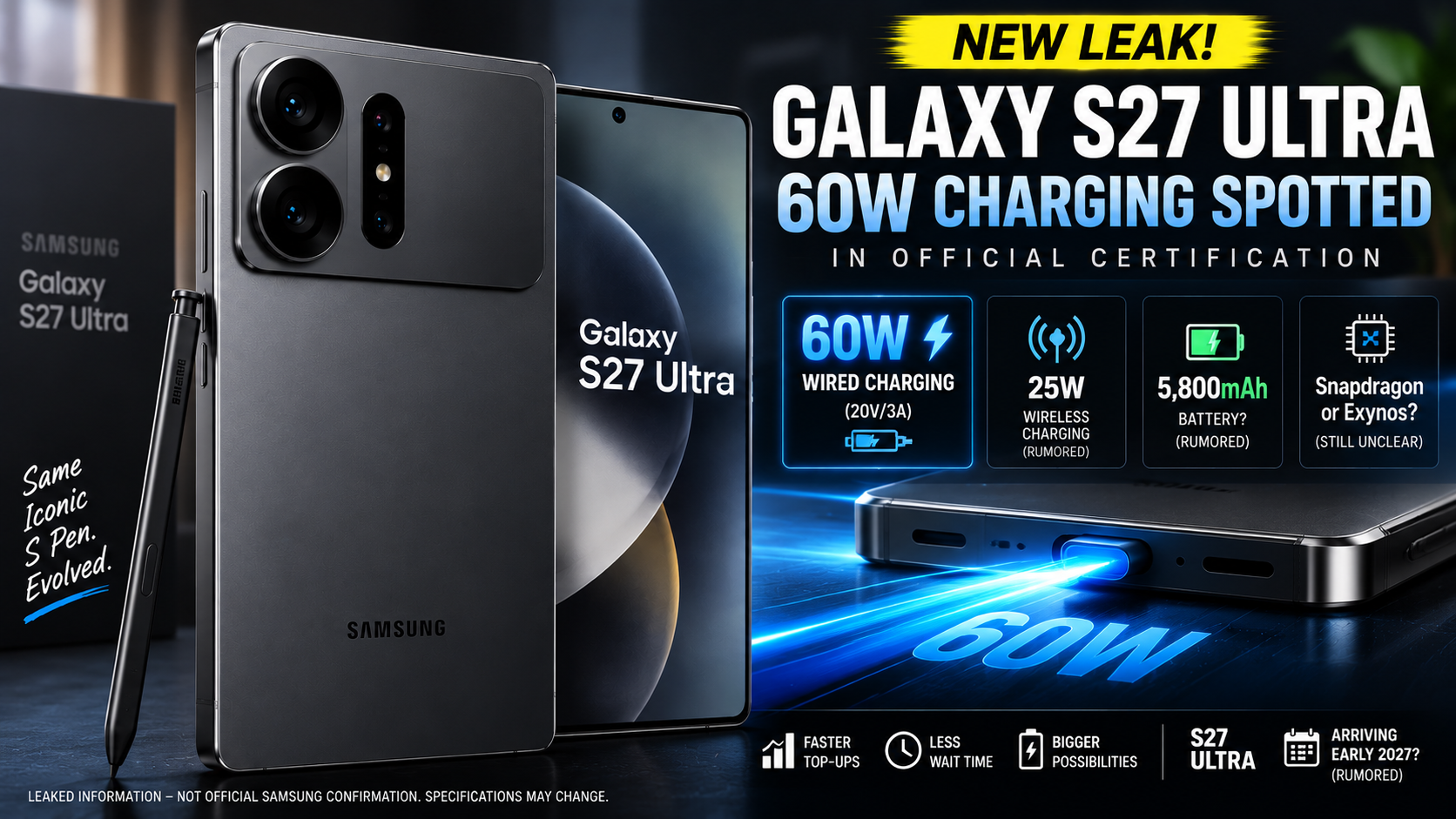
A meaningful new Samsung Electronics Galaxy S27 Ultra development has surfaced. On September 6, 2026, SamMobile reported that Galaxy S27-series variants have appeared in China’s CCC certification database, with the Galaxy S27 Ultra listed for 60W wired charging (20V/3A).

This is more significant than a typical social-media rumor because the information reportedly comes from a regulatory certification listing. However, Samsung itself has not announced the Galaxy S27 Ultra or confirmed its final charging specifications.

What the certification reveals

The reported S27 charging lineup is:

Galaxy S27: 25W

Galaxy S27+: 45W

Galaxy S27 Pro: 60W

Galaxy S27 Ultra: 60W

Interestingly, this would mean the S27 Ultra doesn’t increase wired charging speed over the S26 Ultra. Instead, Samsung appears to be bringing its highest charging tier to the rumored S27 Pro as well.

The same reporting associates the Ultra with 25W wireless charging, although that detail should still be considered part of the pre-release leak picture rather than an official Samsung specification.

Battery rumor gets more interesting

The report also repeats a claim that the Galaxy S27 Ultra could use a 5,800mAh battery, potentially using silicon-carbon anode technology.

I’d treat that capacity with substantially more caution than the 60W charging figure. Earlier reporting has been inconsistent: Ice Universe previously pushed back strongly on unsupported claims of batteries above roughly 5,500mAh.

So at this point:

60W wired charging: relatively strong evidence because of the reported CCC certification.

5,800mAh battery: still a rumor and currently less reliable.

No major new Ice Universe Ultra leak today

I didn’t find a newer Ice Universe disclosure today that materially changes the S27 Ultra camera, S Pen, Qi2, display or processor picture.

His recent case leak remains important because it supports the new raised camera-plateau design on the S27 Ultra and S27 Pro.

Samsung still hasn’t officially announced the Galaxy S27 series, so the design, battery capacity, processor split, cameras and release timing remain subject to change.

Bottom line: the genuinely new development is regulatory evidence pointing to 60W charging for the Galaxy S27 Ultra. That’s credible enough to report, but it also suggests Samsung may focus its S27 Ultra upgrades elsewhere rather than increasing peak wired charging beyond the S26 Ultra.

Read the September 6 SamMobile report⁠

Galaxy S27 Ultra Snapdragon leak: Samsung is already testing Qualcomm’s next flagship chip in the U.S., Korea and Asia-Pacific

Galaxy S27 Ultra Snapdragon leak and Qualcomm flagship chip testing

A meaningful new Samsung Galaxy S27-series processor leak surfaced on September 5, and it adds an important twist to the recent Exynos 2700 story.

According to a leaked Qualcomm project-portal screenshot obtained by Notebookcheck, Samsung Electronics is already validating Galaxy S27 hardware using Qualcomm’s unreleased SM8975 flagship processor across at least three regional builds: Asia-Pacific, South Korea and Verizon in the United States.

Snapdragon testing is further along than we knew

The leaked project entries are reportedly:

SS_SM8975_GS27_AP — Asia-Pacific
SS_SM8975_GS27_KOR — South Korea
SS_SM8975_GS27_VZW — Verizon/U.S.

All three reportedly use Qualcomm’s internal “Snapdragon_Premium_High_2026” software distribution. The existence of a Verizon-specific build is particularly interesting because it suggests Samsung is already doing carrier-specific RF/software validation for the upcoming Galaxy generation.

The SM8975 is expected to become Qualcomm’s highest-end next-generation Snapdragon chip, currently reported under the Snapdragon 8 Elite Extreme Gen 6 name. Qualcomm is expected to formally introduce its next Snapdragon flagship family at Snapdragon Summit, scheduled for September 22–24, 2026.

What does this mean for the Exynos 2700 S27 Ultra leak?

This is where today’s leak becomes particularly important.

Earlier reports said Samsung had begun preparing an Exynos 2700 Galaxy S27 Ultra motherboard for South Korea, potentially bringing Exynos back to an Ultra phone after a five-year absence. Those reports do not necessarily conflict with today’s information.

The new evidence shows that Samsung is simultaneously testing an SM8975 Snapdragon Galaxy S27 build for Korea.

That suggests Samsung may currently be evaluating multiple chipset configurations rather than having finalized which processor every S27 Ultra market will receive.

So claims that the South Korean S27 Ultra is definitely getting Exynos 2700 are premature.

What we can say with higher confidence

The strongest new evidence is that real Galaxy S27 development builds using SM8975 now appear to exist for the U.S./Verizon, Korea and Asia-Pacific regions. That’s more substantial than a generic rumor saying Samsung “plans to use Snapdragon,” although the leaked portal screenshot is still unofficial information.

It also strengthens the likelihood that the U.S. Galaxy S27 Ultra will continue using Qualcomm silicon, particularly given the presence of a dedicated Verizon project.

What it does not establish is whether every Galaxy S27 model represented by those projects uses SM8975, whether Samsung will ultimately ship both Snapdragon and Exynos S27 Ultras, or which regions would receive each processor.

Where the rest of the S27 Ultra leaks stand

There is no comparably strong new development today concerning the S27 Ultra’s cameras, battery, S Pen, Qi2 magnets, display or pricing.

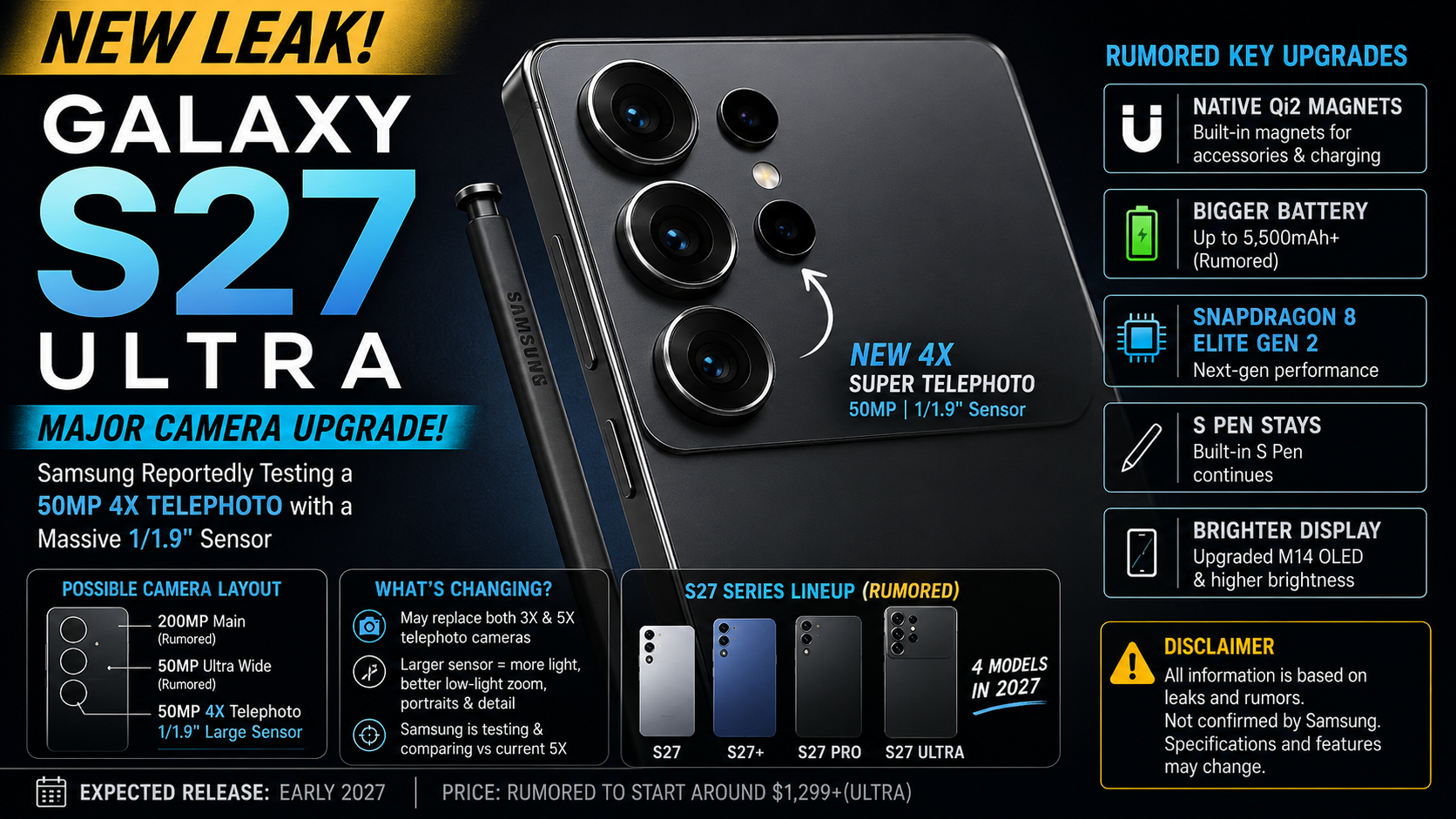
Recent reporting still points toward the dramatic camera-plateau redesign, an integrated S Pen, potential native Qi2 magnets, a possible larger battery, and a reduced three-camera configuration. Those remain leaks rather than confirmed specifications.

Likewise, the experimental 50MP 4x telephoto with a roughly 1/1.9-inch sensor remains something Samsung is reportedly evaluating rather than a finalized retail camera configuration.

Current expectations still place the Galaxy S27 family in early 2027, but Samsung has not announced an Unpacked date or retail launch date.

Confirmed vs. leaked

Confirmed: Samsung has not officially announced the Galaxy S27 Ultra, its processor, specifications, price, cameras, battery capacity or release date.

Leaked: Qualcomm project information reportedly shows Samsung testing SM8975-powered Galaxy S27 hardware in Asia-Pacific, Korea and on Verizon.

Still uncertain: whether the S27 Ultra will ship with Snapdragon everywhere, return to a Snapdragon/Exynos regional split, or whether Samsung is simply evaluating both platforms before making its final decision.

For now, the most interesting takeaway is that Samsung appears to have both Snapdragon and Exynos options in development—and Snapdragon testing is already occurring even in Korea.

Read the September 5 Notebookcheck report

Galaxy S27 Ultra could bring Exynos back to the Ultra — a major strategy shift

Galaxy S27 Ultra Exynos leak and Samsung chipset strategy

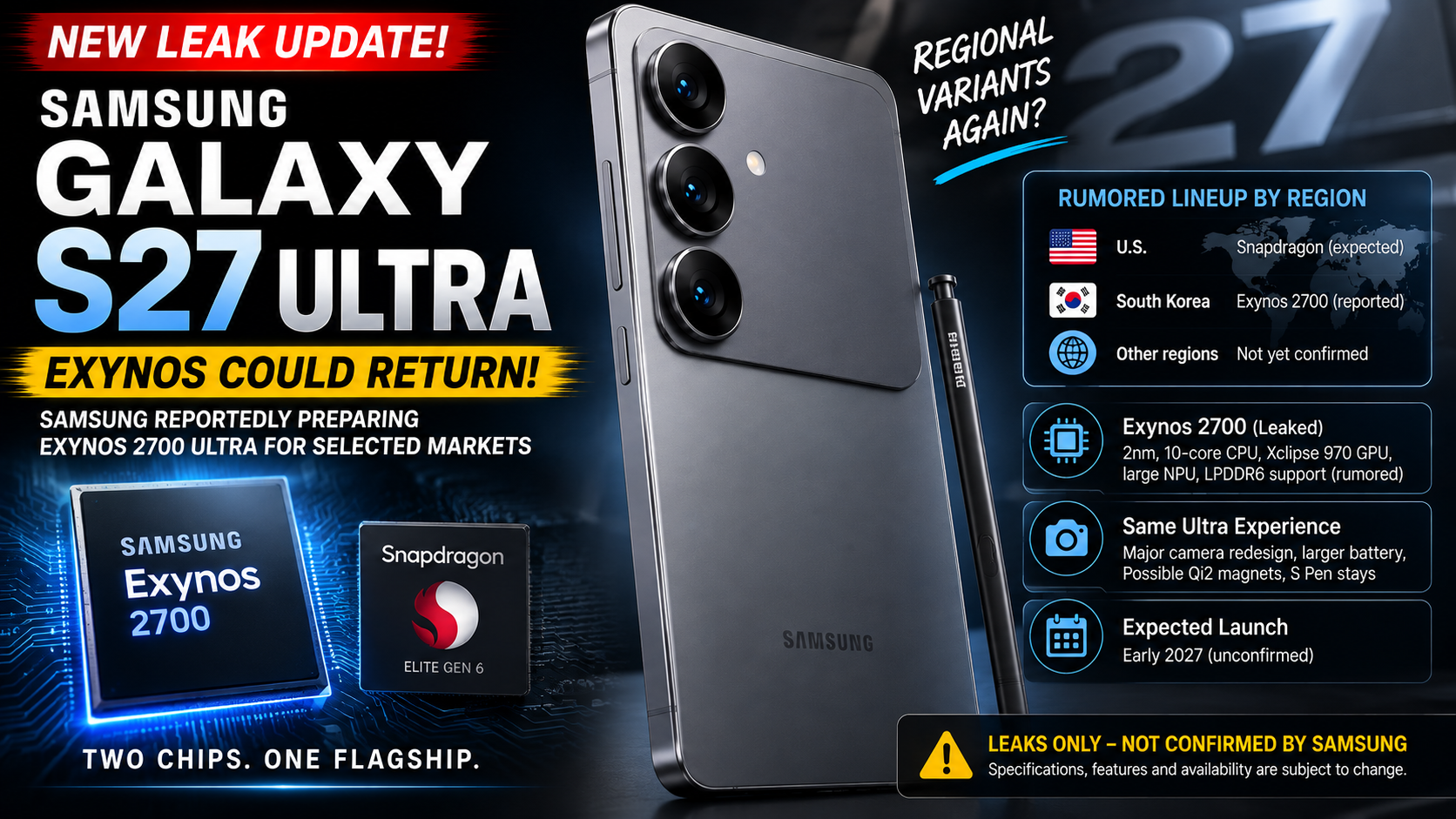
A meaningful new Samsung Electronics Galaxy S27 Ultra leak has emerged from South Korea. According to a September 1 report from MoneyToday, Samsung has started preparing an Exynos 2700 version of the Galaxy S27 Ultra for selected markets, including South Korea. More significantly, the report says Samsung has already placed an initial order for S27 Ultra motherboards designed around the Exynos 2700.

Exynos could return to the Ultra after five years

This would be a substantial change in Samsung’s flagship strategy. The Galaxy S22 Ultra was the last Ultra generation offered with an Exynos processor. Galaxy S Ultra models from 2023 through 2026 have instead relied exclusively on Snapdragon silicon.

The report claims Samsung originally intended to use Qualcomm’s next-generation Snapdragon platform across the S27 Ultra lineup. Development of that Snapdragon model is reportedly already well advanced, but Samsung’s MX and System LSI divisions are now coordinating development of an additional Exynos 2700 motherboard.

That means the S27 Ultra could once again become a region-dependent phone:

United States: Snapdragon is still expected.
South Korea: Exynos 2700 is now reportedly being prepared.
Other regions: not yet firmly established for the Ultra.

Samsung has not confirmed this regional configuration, so reports claiming that Europe will definitely receive an Exynos S27 Ultra are currently getting ahead of the strongest source.

Exynos 2700 itself just received another interesting leak

A newly reported Exynos 2700 die shot provides additional clues about what Samsung may be developing. The analysis points toward Samsung’s second-generation 2nm SF2P process, a 10-core CPU arrangement with two high-performance tiers, a large NPU, 24MB system-level cache, Xclipse 970 graphics and LPDDR6 support.

The leaked architecture could be especially important for sustained performance and efficiency. However, these are engineering-stage processor details, not confirmed Galaxy S27 Ultra specifications. Support for technologies such as LPDDR6 does not automatically mean the retail S27 Ultra will actually use LPDDR6 memory.

What Ice Universe is saying

There isn’t a new Ice Universe specification leak today that overrides the previous camera, design, battery or S Pen reporting. A September 2 post attributed to Ice Universe instead criticized the S27 series as feeling “tired, bored, exhausted”, suggesting disappointment with the direction of the lineup rather than revealing another hardware specification.

Current S27 Ultra leak picture

The Exynos 2700 Ultra variant is the meaningful new development. The other major reports remain largely where they were: a dramatically redesigned rear camera area, three-camera direction, integrated S Pen, potential native Qi2 magnets, and a larger battery remain under discussion. The recently reported experimental 4x telephoto configuration also remains just that—something reportedly being evaluated rather than a finalized retail camera specification.

Pricing also remains unknown. Reports estimating a price based on the current Ultra should not be treated as an actual S27 Ultra price leak. Current launch expectations remain around early 2027, but Samsung has not announced the Galaxy S27 Ultra, its launch date, pricing, processors or specifications.

The strongest evidence behind today’s development is the Korean supply-chain report about Samsung ordering Exynos 2700 S27 Ultra motherboards. That makes this considerably more interesting than a generic specification rumor, while still stopping short of proving that Exynos-powered retail S27 Ultras will actually ship.