

Thanksgiving 2026 will feel crowded even though the national forecast is fractionally below last year. AAA expects 81.5 million Americans to travel at least 50 miles from home between Tuesday, November 24 and Monday, November 30—only 0.1% below 2025. The practical lesson is not that travel will be quiet; it is that millions of trips remain compressed into a seven-day window.
The pressure will not be identical on every mode or every day. AAA projects 72.9 million road travelers and 5.96 million domestic air travelers, while 2.6 million people will use buses, trains, cruises and other modes. Airlines for America separately expects U.S. airlines to carry nearly 29 million passengers from November 20 through November 30, with the heaviest airline volumes at the end of the holiday period. Amtrak is also preparing for another record Thanksgiving season after more than 1.2 million customer trips in 2025.
This guide turns those forecasts into a usable departure plan. It identifies the daily road windows to avoid, explains the air and rail peaks, and covers the TSA identification, liquid and battery rules most likely to create a preventable problem. Forecasts and schedules can change, so confirm the operating carrier, station, airport and highway conditions close to departure.
Thanksgiving 2026 travel at a glance
- AAA holiday window: Tuesday, November 24 through Monday, November 30, 2026.
- Total forecast: 81.5 million travelers going at least 50 miles from home.
- Road volume: 72.9 million travelers, or nearly nine in ten holiday trips.
- Domestic air forecast: 5.96 million travelers under AAA’s methodology.
- Airline operating forecast: nearly 29 million passengers from November 20–30, with Sunday, November 29 and Monday, November 30 expected to be the busiest airline days.
- Rail outlook: Amtrak expects record demand and has added cars and selected Northeast Corridor round trips.
- ID rule: adults need a REAL ID-compliant license or another TSA-accepted ID; ConfirmID is a paid fallback, not a promise of approval.
- Battery rule: power banks and spare lithium batteries belong in carry-on baggage, not checked bags.
Leave before the afternoon road crush
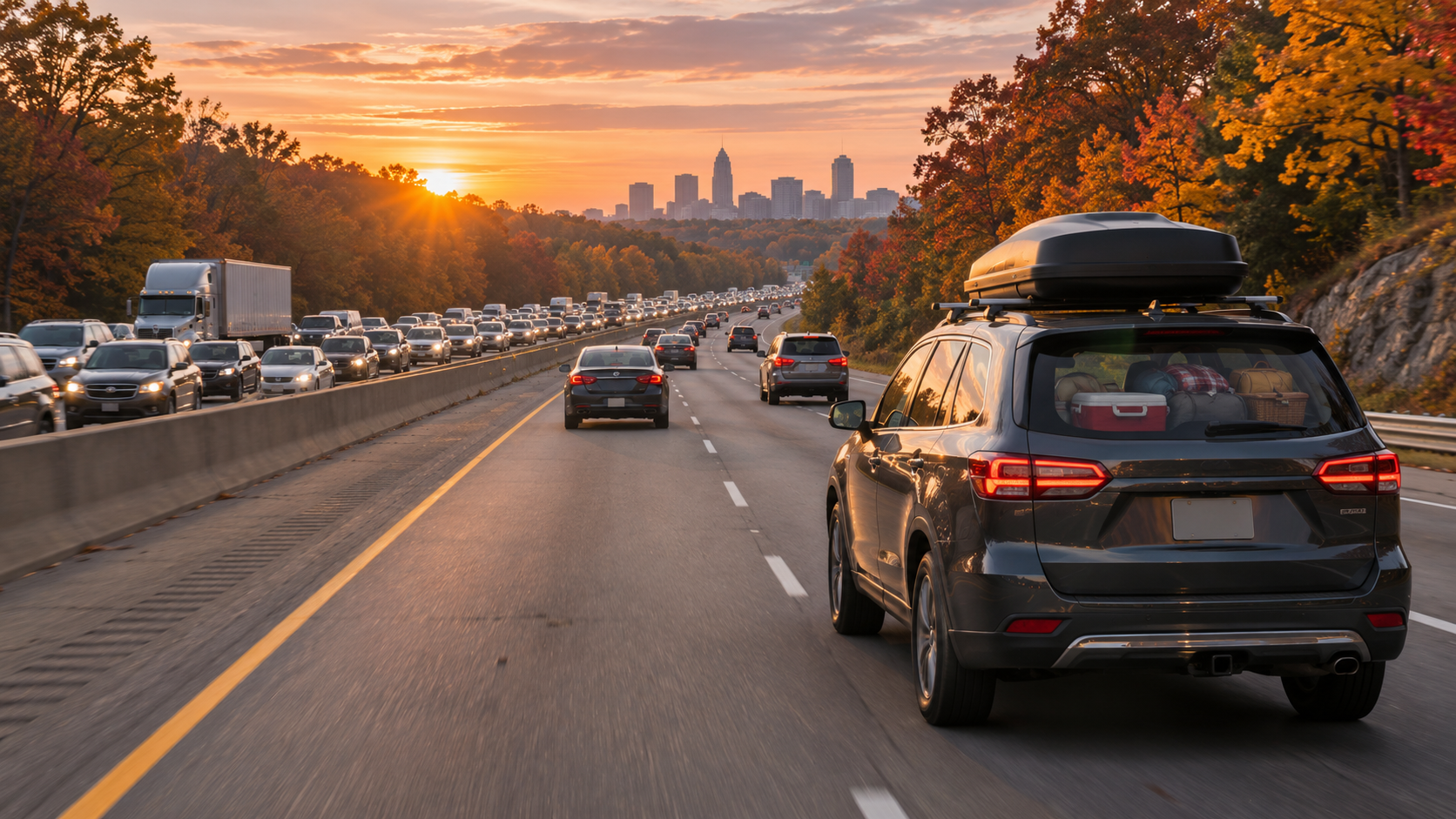
AAA and INRIX expect the busiest outbound road traffic on Tuesday and Wednesday, followed by heavy return traffic on Sunday and Monday. The common pattern is simple: morning departures are usually the lower-stress choice, while afternoons and early evenings produce the widest congestion windows. Local crashes, construction, weather and sporting events can still override the national pattern.
Outbound drive: Tuesday and Wednesday
- Tuesday, November 24: avoid 2–8 p.m. when possible; leave before 1 p.m.
- Wednesday, November 25: avoid noon–7 p.m.; leave before noon.
A driver who cannot leave before the forecast peak should build a deliberate stop plan instead of racing the clock. Check the full route before departure, identify fuel and food stops that will be open, keep the tank comfortably above empty and avoid arriving at an unfamiliar destination exhausted after midnight.
Thanksgiving Day and the long weekend
- Thursday, November 26: minimal traffic is expected nationally, but reduced business hours can make fuel, food and repair stops less reliable.
- Friday, November 27: avoid 1–7 p.m.; leave before noon.
- Saturday, November 28: avoid noon–9 p.m.; leave before 11 a.m.
Return drive: Sunday and Monday
- Sunday, November 29: avoid noon–8 p.m.; leave before 11 a.m.
- Monday, November 30: avoid 2–7 p.m.; leave before 1 p.m.
Times are local to each metro area. In large markets such as New York, Washington, Los Angeles and Boston, AAA says congestion can exceed twice the normal level. A route that looks clear when the car leaves a small town can still meet a long urban bottleneck several hours later, so compare the expected arrival time—not only the departure time—with the peak window.
Prepare for the airport’s two peak return days
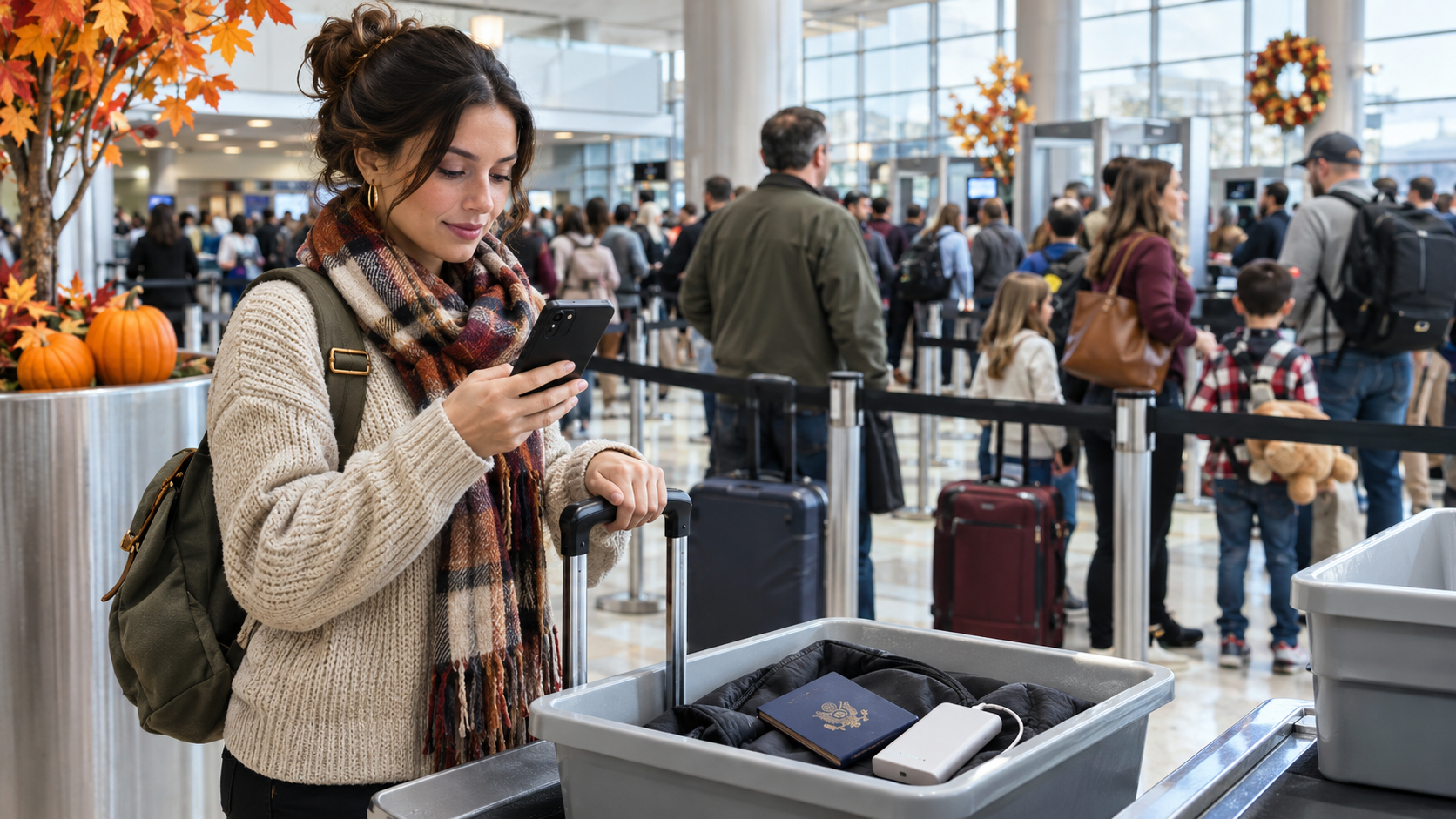
Airlines for America expects nearly 29 million passengers on U.S. airlines between November 20 and November 30, averaging about 2.7 million per day. Carriers are offering roughly 38,000 more seats per day than in 2025, but the trade group still identifies Sunday, November 29 and Monday, November 30 as the busiest airline days. More seats do not eliminate security lines, full overhead bins, gate changes or tight rebooking inventory.
Check in online when the airline permits it, confirm every segment with the operating carrier and review the airport’s current parking, terminal and security information. Do not treat a delayed departure as permission to arrive late: check-in, bag-drop and boarding cutoffs can remain unchanged. Keep medications, identification, keys, one change of clothing and essential chargers in the cabin bag.
Bring an accepted ID—not only a photo of one
Adults 18 and older need a TSA-accepted identity document. Since May 7, 2025, a state license or ID must be REAL ID compliant unless the traveler uses another accepted document such as a passport, passport card, trusted-traveler card or permanent resident card. TSA says expired accepted IDs can currently be used for up to two years after expiration, but travelers should confirm the live list before departure.
A traveler without acceptable ID can pay $45 for TSA ConfirmID before going to the checkpoint. That begins an identity-verification process; it does not guarantee successful verification or entry to the secure area. TSA generally does not require children under 18 to show ID for domestic travel, although airlines can impose their own minor-travel requirements.
Keep power banks in the cabin
FAA rules treat a power bank as a spare lithium battery. Power banks up to 100 watt-hours are normally allowed in carry-on baggage but not checked baggage. Batteries rated 101–160 Wh require airline approval and are limited to two spares per passenger; anything above 160 Wh is forbidden on passenger aircraft unless a specific exception applies. Airlines and international authorities can be stricter.
Protect battery terminals from short circuit, keep the rating label readable and do not travel with a damaged, swollen or recalled battery. If a gate agent requires a carry-on to be checked, remove the power bank and any other spare lithium batteries before surrendering the bag.
Separate liquids from solid holiday food
TSA’s 3-1-1 rule limits carry-on liquids, gels and aerosols to containers of 3.4 ounces or less inside one quart-size clear bag per passenger. Many solid foods can travel in a carry-on, but spreadable, pourable or liquid foods can be treated as liquids. Pack uncertain items where they can be removed easily and use TSA’s current item lookup before heading to the airport.
Know the refund decision before accepting a replacement
If an airline cancels a flight or significantly changes it and the passenger declines the alternative trip, travel credit and other compensation, U.S. Department of Transportation rules can require an automatic refund to the original form of payment. Accepting and taking the replacement trip generally means choosing transportation rather than the ticket refund. Read the full replacement itinerary before accepting it, including airport changes, connection time, cabin and arrival date.
For eligible refunds after a rejected offer, DOT lists seven business days for credit-card purchases and 20 calendar days for other payment methods. Meals, hotels and ground transportation are separate from the ticket refund and can depend on the cause of the disruption and the airline’s customer-service commitments.
Treat rail as reserved travel, not a walk-up fallback
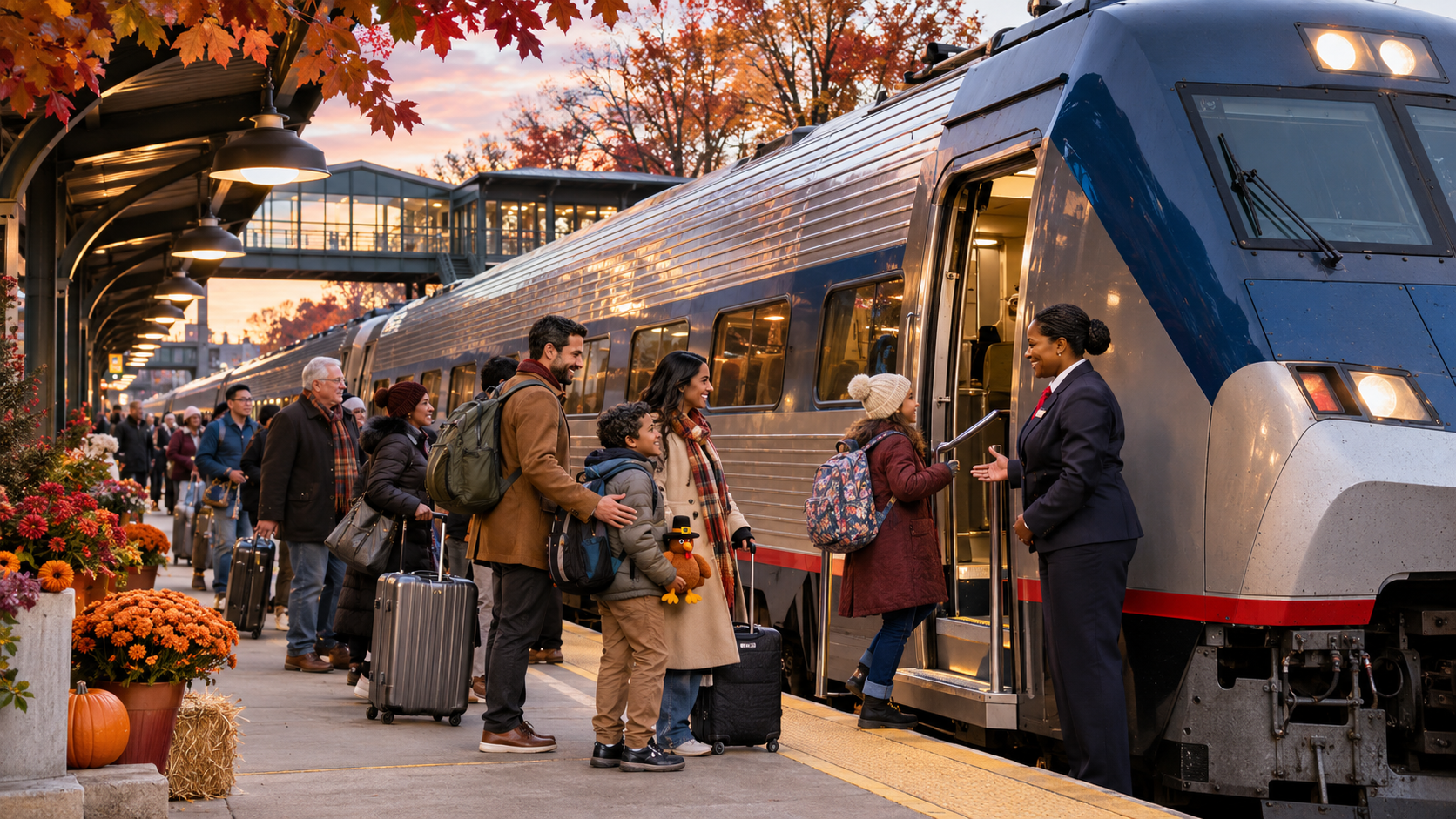
Amtrak says Thanksgiving is its busiest travel season and expects another record year after carrying more than 1.2 million customers during the 2025 holiday period, nearly 6% more than in 2024. Popular trains can sell out, so rail should be booked as a primary plan rather than assumed to be an unlimited backup after a flight or drive becomes difficult.
For November 20–30, Amtrak is adding cars to selected Northeast Regional trains. It also plans two extra round trips between Washington Union Station and New York Penn Station, serving intermediate cities, on November 24–25 and November 28–29. Those additions create capacity, but Amtrak warns that the extra seats can still fill.
Check the exact train number in the Amtrak app or on Amtrak.com before leaving, and review service alerts for reservation requirements or route-specific changes. Some holiday notices affect specific services—such as Keystone Service or Pacific Surfliner—without applying to the entire network. Arrive early enough to find the platform, tag checked baggage where offered and board without separating the group in a crowd.
Choose the mode by failure point, not only ticket price
A road trip offers schedule control but exposes the itinerary to congestion, weather, fatigue and vehicle problems. Flying is fastest across long distances but concentrates risk at security, hubs and peak return days. Rail can avoid road and airport friction on served corridors, yet limited inventory makes last-minute changes difficult. A good choice is the one whose most likely failure you can absorb.
- Driving works best when the group can leave early, share driving and keep the route flexible.
- Flying works best when the time savings still matter after airport transfers, security and a realistic delay buffer.
- Rail works best on a direct or one-transfer corridor with confirmed seats and practical station access at both ends.
- A mixed plan can work—such as rail outbound and a rental car at the destination—but compare cancellation terms and holiday operating hours before booking separate pieces.
A verified carry-on option—after checking your airline
One current verified listing is the Amazon Essentials 21-inch Hardside Carry-On, ASIN B0711DPSXT. Amazon lists its exterior dimensions, including wheels, as 14.8 by 10 by 21.7 inches and says the case can expand by up to 25%. Those specifications make it useful for a short trip, but they do not make it universally compliant with every airline.
Compare the live airline limit with the bag’s full exterior size, including wheels and handles, and measure again after expanding it. Also check the airline’s weight rule and basic-economy allowance. A bag that fits one carrier or aircraft can be gate-checked on another, so keep power banks, medication, identification and valuables in a removable personal-item pouch.
Affiliate disclosure: ReaderSpice may earn a commission from qualifying Amazon purchases made through the link above, at no additional cost to you.
A 48-hour holiday travel checklist
- Confirm every flight, train or driving segment using the operating carrier, Amtrak, airport and state transportation sources—not only a saved itinerary.
- Choose a departure time that avoids the published peak where possible, then add weather, parking, security and meal-stop time.
- Verify the passenger name, date of birth where required and accepted ID; place the physical document in the travel bag.
- Move power banks and spare lithium batteries into the cabin bag, inspect them for damage and keep the Wh rating visible.
- Measure carry-ons after packing, review the airline’s live size and weight limits and identify anything that must be removed if the bag is gate-checked.
- Download airline, Amtrak, maps and weather apps; save reservation numbers and customer-service contacts for offline access.
- Pack medications, keys, chargers, one clothing layer, essential toiletries and a simple snack where they remain accessible during a delay.
- Recheck conditions the morning of travel and make the rebooking-versus-refund decision before accepting a replacement itinerary.
The bottom line
Thanksgiving 2026 is a near-record travel week even without setting a new total-volume record. The best national road strategy is to leave before the afternoon and early-evening peaks, especially Tuesday, Wednesday, Sunday and Monday. For flights, protect the Sunday and Monday return with extra time and a realistic backup. For rail, reserve now rather than assuming an added train will have walk-up space.
The rules that prevent the most avoidable airport problems are straightforward: bring a TSA-accepted ID, keep power banks out of checked baggage, respect the 3-1-1 liquids limit and know whether you would take a replacement flight or choose a refund. A calm trip begins before the holiday crowd reaches the terminal, station or interstate.
Sources
AAA Newsroom: Thanksgiving 2026 travel forecast and mode totals
AAA: Best and worst Thanksgiving driving windows from INRIX
Airlines for America: 2026 Thanksgiving passenger forecast and peak days
TSA: Acceptable identification, REAL ID and ConfirmID
TSA: Travel checklist and the 3-1-1 liquids rule
FAA: Airline passenger battery and baggage-tracker rules
Amtrak: Thanksgiving capacity additions and booking guidance
Amtrak: Current service alerts and holiday reservation notices
U.S. Department of Transportation: Airline cancellation and refund rights
Amazon: Amazon Essentials 21-inch hardside carry-on, ASIN B0711DPSXT
Inline image 1: Thanksgiving road traffic. Alt text: A family vehicle travels toward a city at sunrise while heavy Thanksgiving traffic builds on the interstate.
Inline image 2: Thanksgiving airport preparation. Alt text: A traveler checks a phone beside a carry-on tray with a passport and power bank in a crowded airport terminal.
Inline image 3: Thanksgiving rail boarding. Alt text: Thanksgiving travelers board a modern intercity train at a busy station in late autumn.