

Google and Voltus announced a gigawatt-scale virtual power plant for the PJM electric grid on October 22, 2026. Instead of building one giant generating station, the project will coordinate thousands of smaller resources—such as smart thermostats, home batteries and flexible commercial equipment—so they can reduce demand or supply stored electricity when the grid is strained.
The headline sounds distant from everyday life, but the practical effects could reach households and businesses across parts of 13 states and Washington, D.C. Eligible participants may receive bill savings or cash payments. The tradeoff is that they allow an approved program to adjust connected equipment during a limited number of high-demand events, subject to the program’s rules.
What Google and Voltus announced
- Google’s October 22 post describes an expanded 1-gigawatt virtual power plant across the PJM region, which serves about 67 million people.
- Voltus says the system will aggregate flexible capacity from homes and businesses, including thermostats, batteries and industrial equipment.
- When demand is high, participating assets can temporarily reduce electricity use, shift it to another time or discharge stored power.
- Google is funding the capacity, while Voltus will aggregate and operate the resources and deliver financial benefits to participating customers.
This is an expansion of a June agreement that targeted up to 100 megawatts of flexible capacity each year under a three-year arrangement. Google says the new plan is a tenfold expansion and one of the largest known distributed-capacity portfolios funded by a hyperscaler.
The business logic is straightforward. A data center or other large new load needs dependable grid capacity, but traditional generation and transmission projects can take years. Paying many customers to make small, coordinated adjustments during peak periods can free capacity faster while sending some of the project’s value back to the homes and businesses providing that flexibility.
The two announcements describe the scale differently
Readers should not treat every number in the announcements as interchangeable. Google calls the expanded project a 1-gigawatt virtual power plant and a tenfold increase from the original 100-megawatt deal. Voltus’s October release says the announcement adds 1,070 megawatts after the initial 100 megawatts, wording that could imply a larger combined figure.
Neither company’s public announcement reconciles those descriptions. The safest interpretation is that this is a roughly gigawatt-scale expansion, not a promise that a precise amount of capacity will be active immediately. Aggregated capacity still has to be enrolled, qualified and available under the applicable PJM and utility rules.
How a virtual power plant works
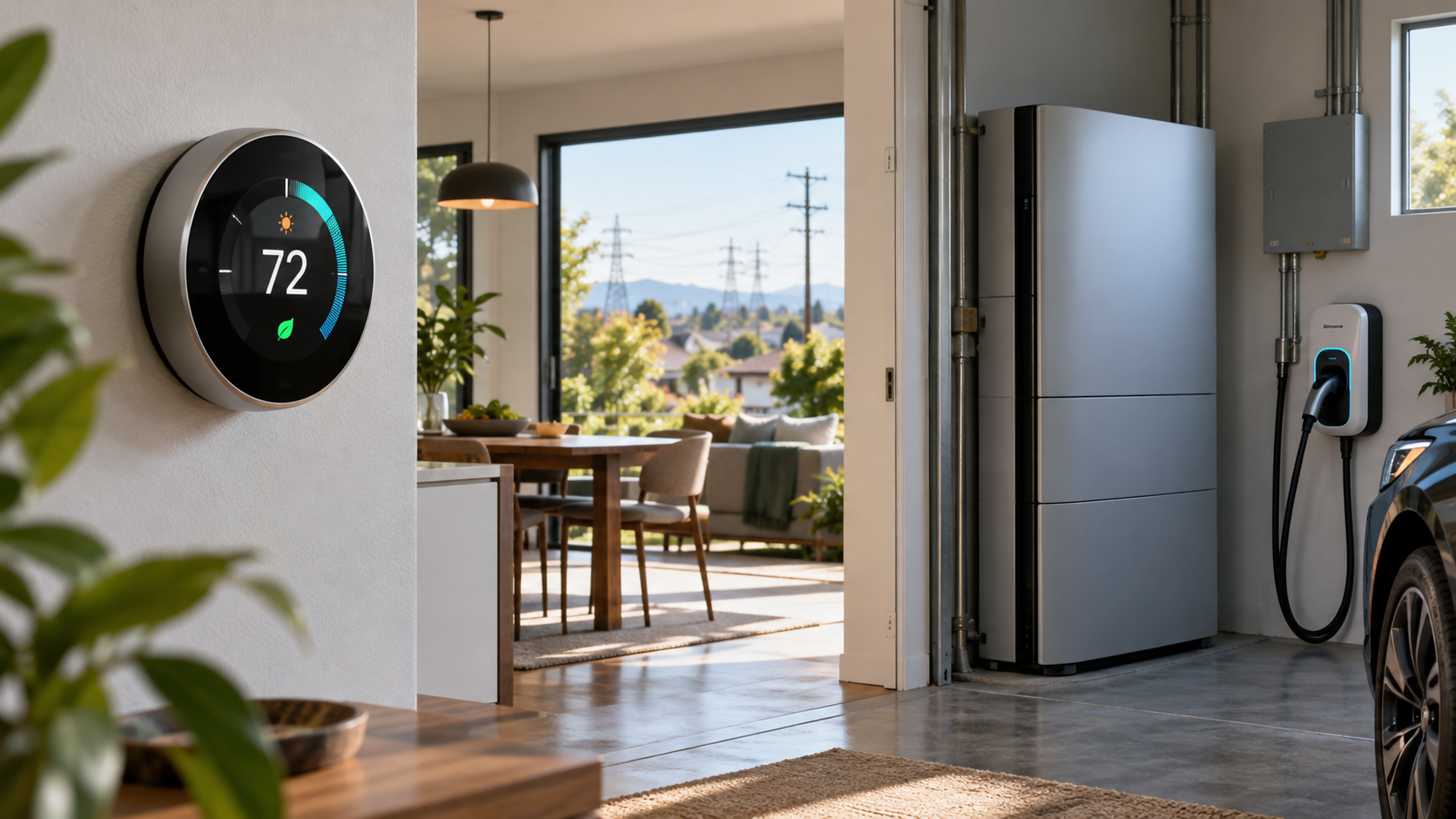
A virtual power plant is software-coordinated capacity rather than a single physical site. PJM describes VPPs as connected groups of distributed energy resources that respond together to provide load flexibility or generation. The individual devices remain spread across homes, offices, warehouses and industrial sites.
- Enrollment: A household or business joins an eligible demand-response or distributed-energy program and connects a qualifying device or controllable load.
- Forecasting: The operator monitors grid conditions, market signals and the availability of enrolled resources.
- Event: During a peak period, the operator sends a signal that can slightly adjust thermostats, pause flexible equipment, shift EV charging or discharge batteries.
- Measurement and payment: The program measures the verified response under its rules and sends the promised bill credit, incentive or direct payment.
No single thermostat is powering a neighborhood. The value comes from coordinating many small actions at the same time. A two-degree thermostat adjustment or delayed charging session may be minor in one home, but thousands of synchronized changes can reduce the amount of generation the grid must call on during its most expensive and stressed hours.
What this could mean for homes and small businesses
The announcement does not automatically enroll everyone in PJM territory, and owning a smart thermostat or battery does not guarantee eligibility. Participation depends on the local utility, device, aggregator, service address and the rules of a specific program. Google and Voltus have not published one universal residential sign-up page, payment schedule or device list for the full expansion.
Potential benefits
- Cash payments or utility bill credits for verified participation.
- Lower energy use during costly peak periods, which may add savings beyond the program incentive.
- Better use of existing thermostats, batteries, solar-plus-storage systems, EV chargers and other flexible equipment.
- A larger pool of flexible capacity that can reduce grid stress during extreme weather or other supply constraints.
Important tradeoffs
- Comfort can change temporarily if a thermostat is adjusted during an event.
- Payments may depend on measured performance, enrollment dates, event participation and device connectivity.
- An internet outage, dead battery, changed Wi-Fi password or disconnected account can make a device unavailable.
- The operator, utility or device partner may receive energy-use, device-status and event-response data.
- Program terms may allow opt-outs but reduce or eliminate incentives after repeated nonparticipation.
A good program should state the temperature limits, event length, expected number of events, opt-out method, payment formula and data-sharing terms before enrollment. Save those terms, because marketing summaries can omit conditions that decide the real value.
Where PJM operates—and why your address still matters
PJM coordinates wholesale electricity across all or parts of Delaware, Illinois, Indiana, Kentucky, Maryland, Michigan, New Jersey, North Carolina, Ohio, Pennsylvania, Tennessee, Virginia, West Virginia and Washington, D.C. Being in one of those jurisdictions is only the first filter. PJM’s footprint follows utility territories, not state borders.
A household should identify its electric utility and rate plan before assuming it can participate. For example, an earlier Voltus and Resideo program served eligible ComEd customers in Illinois and used Honeywell Home, ecobee or Google Nest thermostats. That history shows the type of consumer hardware that can join a VPP, but it does not prove those same devices or incentives will be available at every address in the new project.
Questions to answer before enrolling
- Is the offer from your utility, a recognized device partner or an aggregator authorized for your service territory?
- Which exact thermostat, battery, EV charger or equipment models qualify?
- What is the enrollment payment, ongoing payment and performance requirement?
- How many events may occur, how long can they last and what limits apply to temperature or battery discharge?
- Can you override an event immediately, and does overriding affect payment?
- What data is collected, who receives it, how long is it retained and can it be used for marketing?
- What happens if you move, replace the device, change utilities or leave the program?
Do not pay an unfamiliar company merely to join a grid program. Confirm the offer through the utility or program operator using contact information obtained independently, and be skeptical of urgent calls asking for account credentials or remote access to a thermostat.
A relevant smart-thermostat example
The Google Nest Thermostat, ASIN B08HRPDYTP, is a verified retail example of the device category used in residential demand-response programs. Readers can check the Google Nest Thermostat on Amazon for current availability and confirm HVAC compatibility before buying. The listing notes that some systems require a C wire or another compatible power accessory.
Buying the thermostat is not the same as enrolling in the Google–Voltus project. Check your utility’s current program list first; otherwise, treat the thermostat as an energy-management purchase rather than a guaranteed source of payments.
Affiliate disclosure: ReaderSpice may earn a commission from qualifying Amazon purchases made through the link above, at no additional cost to you.
Will the project lower everyone’s electric bill?
The announcements promise financial benefits for participating customers, not an automatic bill reduction for every PJM customer. VPPs can reduce the need to build or run expensive capacity for short peak periods, and Google and Voltus argue that better use of existing grid resources can improve affordability. The size and timing of system-wide savings depend on market rules, program performance and how costs are allocated.
For an individual household, the math is simpler: compare the promised annual incentive with any equipment cost, installation expense, comfort impact and data-sharing tradeoff. A free enrollment program using hardware you already own may be attractive. Buying a battery solely for a modest demand-response payment is a much larger decision that requires a payback calculation, warranty review and backup-power assessment.
Bottom line
The Google–Voltus agreement is notable because it treats connected homes and businesses as grid infrastructure rather than passive electricity customers. If Voltus can enroll and coordinate the promised scale, the project could show how data-center growth and customer-owned devices can share economic value instead of competing only for scarce capacity.
For consumers, the useful action is not to buy hardware immediately. Identify your utility, wait for a verified local offer, read the event and privacy terms, and calculate the net payment using equipment you already own. The project is real, but household eligibility and savings will be local, conditional and program-specific.
Sources
Google: 1-gigawatt virtual power plant announcement, October 22, 2026
Voltus: One Gigawatt Bring Your Own Capacity agreement details
Voltus: Original 100-megawatt Google agreement from June 2026
Voltus and Resideo: Residential thermostat VPP program example
PJM: Territory served across 13 states and Washington, D.C.
PJM: Advanced Technology Initiative virtual power plant explainer
Amazon: Google Nest Thermostat (ASIN B08HRPDYTP)