
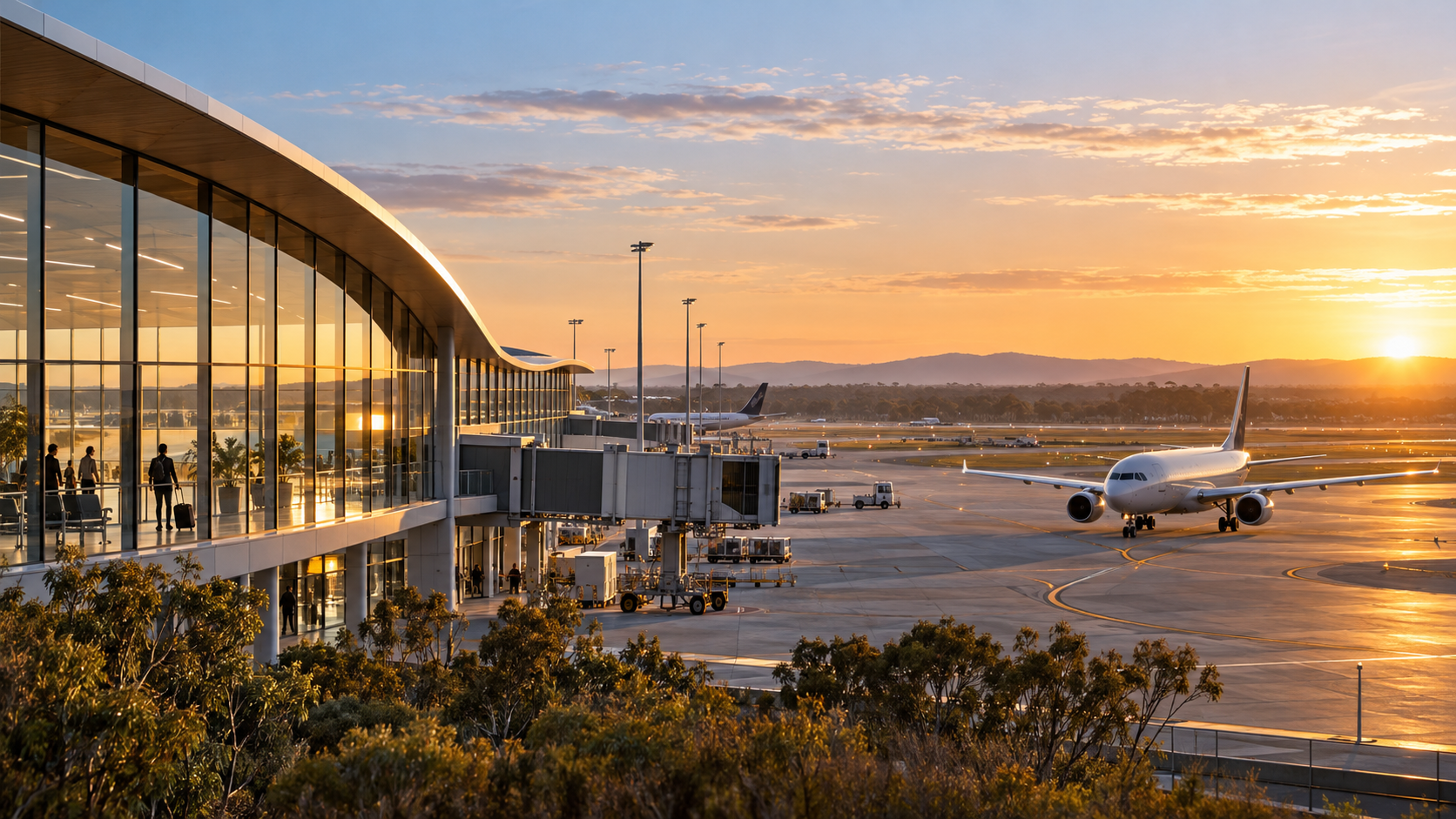
Western Sydney International (Nancy-Bird Walton) Airport opened to passenger traffic on Sunday, October 25, 2026, giving Australia its first major new airport in more than 50 years. The curfew-free airport at Badgerys Creek is designed to serve Western Sydney and eventually relieve pressure on Sydney Kingsford Smith Airport.
The opening matters, but travelers should not treat WSI as a drop-in replacement for SYD. The two airports are far apart, launch routes are limited, and the planned Metro connection is not operating at passenger opening. A cheaper airfare can still become inconvenient if the wrong airport, transfer time or ground-transport plan is overlooked.
This guide separates opening-day facts from future commitments and focuses on what a traveler can actually do now: identify the correct airport code, check the airline’s current schedule, plan the surface trip and allow enough time for a new terminal routine.
Western Sydney International at a glance
- Airport code: WSI, not SYD.
- Location: Badgerys Creek in Western Sydney, roughly 45 kilometers west of the Sydney CBD.
- Passenger opening: Sunday, October 25, 2026; cargo services began in July.
- Operating model: 24 hours a day without the overnight passenger-flight curfew that applies at Kingsford Smith.
- Initial capacity: up to 10 million passengers a year, with long-term expansion planned as demand grows.
- Rail at opening: no direct Metro service yet; bus, shuttle, taxi, rideshare, rental car and private vehicle are the practical options.
- First departure: Jetstar flight JQ362 to the Gold Coast.
What opened on October 25
Passenger operations followed 15 years of planning, seven years of construction and extensive testing, according to the Australian Government. The airport’s single terminal handles domestic and international services, while its runway and operating approvals allow airlines to schedule flights around the clock.
Jetstar operated the first commercial passenger departure, an Airbus A320 service to the Gold Coast. Reuters reported that the airport opened as a A$5.6 billion project and that cargo services had already started, giving the site an operational runway and logistics base before ordinary passengers arrived.
Opening day is not the finished network. WSI is built to scale, while airlines are phasing in routes over months and years. Travelers should therefore read an airline timetable as a date-specific commitment, not assume every announced carrier is already flying.
Launch routes and airline rollout
- Jetstar: up to 14 weekly services to Melbourne, four to the Gold Coast and three to Brisbane in the initial schedule.
- Air New Zealand: Auckland service scheduled to begin October 26, 2026.
- Singapore Airlines: daily Singapore service scheduled to begin November 23, 2026.
- VietJet: Ho Chi Minh City service scheduled for January 2027.
- Fiji Airways: Nadi service scheduled for March 2027.
- QantasLink: Brisbane and Melbourne services scheduled from March 28, 2027.
- Qatar Airways: Doha service is a later commitment, scheduled for December 2027.
Airline start dates, frequencies and aircraft can change. Confirm the airport code, local date and departure terminal on the airline’s own booking record before paying for lodging, parking or a separate connection.
Getting there before the Metro opens

The most important opening-period limitation is ground transport. The Sydney Metro–Western Sydney Airport line is not available for the first passenger services, so a rail itinerary cannot yet continue directly into the terminal. The interim plan combines existing rail with road transport.
Transport for NSW established a free interim bus link between St Marys station and the airport. WSI also lists scheduled airport shuttles, public buses, taxis, rideshare, car rentals and private-car access. Check live timetables because operating hours may not match a very early or late flight at a 24-hour airport.
The M12 Motorway provides direct road access to the airport precinct from the Sydney motorway network. Drivers should use the official airport route and booking confirmation, not simply search for ‘Sydney Airport,’ which can lead to Kingsford Smith.
The WSI Link fallback
For many travelers, the simplest public-transport plan is train to St Marys followed by the free WSI Link shuttle. Build in a buffer for the platform change, luggage handling, traffic and the possibility that a late-night arrival does not line up with a frequent suburban service.
The airport’s own shuttle service and other commercial coaches may suit the CBD, Parramatta or a transfer to SYD, but they are separate products with their own schedules and booking rules. Compare the total door-to-door time and cancellation terms, not only the headline fare.
Driving, parking, taxi and rideshare
WSI sells airport parking online and advises travelers to compare options and reserve ahead. A booking can reduce uncertainty during opening weeks, when first-time visitors are learning the terminal roads. Keep the confirmation accessible offline and confirm the correct entry lane before leaving home.
The airport has designated pickup and drop-off arrangements for taxis, rideshare and private vehicles. Do not ask a driver to stop on an approach road or in an unauthorized lane. If using rideshare, wait until baggage is collected and the pickup zone is confirmed before requesting a car.
A rental car can be practical for Western Sydney, the Blue Mountains or regional New South Wales, but it may be wasteful for a central-Sydney stay. Compare rental, parking, toll and fuel costs with the shuttle-plus-train option.
Do not book the wrong Sydney airport
WSI and SYD are different airports. WSI is Western Sydney International at Badgerys Creek. SYD is Sydney Kingsford Smith Airport near the city center. A confirmation that says ‘Sydney’ is not enough; the three-letter code should match every segment, transfer and car booking.
This distinction matters most for separate tickets. An inbound flight to SYD and an onward flight from WSI require a cross-city road transfer, baggage collection and a new check-in. The reverse is equally demanding. There is no protected airside connection between the airports.
If a search engine offers a low fare that changes airports, price the transfer and allow a conservative buffer. Consider traffic, immigration, customs, baggage delay and the missed-flight rules on the second ticket. An overnight stay may be safer than a tight same-day connection.
Check-in, baggage and security
WSI uses a modern terminal with digital check-in and bag-drop facilities, but the airport does not publish one universal arrival-time rule for every airline. Domestic and international cutoffs vary. Follow the operating airline’s current instructions and allow additional time during the opening period.
Check the flight-status page before leaving, then confirm check-in, baggage allowance, special-item handling and boarding requirements directly with the airline. A new airport cannot override a carrier’s cutoff, and an airport parking reservation does not guarantee enough time to reach the gate.
International arrivals should verify passport, visa, biosecurity and customs requirements. Travelers connecting onward on a separate ticket should assume they must collect bags and repeat check-in unless the airlines explicitly confirm through-checking.
Transferring between WSI and SYD
A transfer between Sydney’s two airports is a landside journey. There is no direct passenger rail link between them at opening, and travel time can change sharply with traffic. Treat any advertised shuttle time as an estimate, not a connection guarantee.
Before accepting a split-airport itinerary:
- Verify both airport codes on every flight segment.
- Check whether the tickets are protected on one booking or separate contracts.
- Add time for immigration, baggage collection and re-checking when applicable.
- Confirm the shuttle, taxi or rideshare operates at the required hour.
- Price tolls, luggage charges and an emergency hotel against a more direct itinerary.
- Avoid a short connection even if a booking site displays it as technically possible.
Accessibility and family travel
Travelers who need step-free transport, mobility assistance, accessible parking or help through the terminal should contact the airline and ground-transport provider before travel. An accessible terminal does not guarantee that every shuttle departure can accommodate an unannounced wheelchair or large mobility device.
Families should confirm stroller and car-seat rules with the airline, allow extra time at bag drop and identify the pickup zone before landing. Keep medication, documents, a change of clothes and essential child supplies in hand baggage in case the road transfer or checked baggage takes longer than expected.
A verified Australia plug adapter option
Australia uses Type I wall outlets and 230-volt, 50-hertz electricity. Most modern phone and laptop chargers accept 100–240 volts, but the charger’s input label is the deciding factor. A plug adapter changes the physical plug shape; it does not convert voltage.
Amazon lists the Ceptics Australia Plug Adapter three-pack (ASIN B01MR9D7VJ), which accepts common North American plugs and provides a Type I connection. Verify the exact seller, pack size, device voltage and current listing before purchase.
Do not use a simple adapter with a single-voltage hair dryer, styling tool or other high-wattage appliance unless the appliance is designed for Australia’s supply. The Amazon listing itself states that the product is not a voltage converter.
Disclosure: ReaderSpice may earn a commission from qualifying Amazon purchases made through the link above, at no additional cost to you.
Opening-week travel checklist
- Confirm WSI or SYD on every booking, calendar entry and ground-transfer reservation.
- Recheck the airline’s launch date and flight status before leaving.
- Choose and reserve parking, shuttle or rideshare arrangements before the travel day.
- If using public transport, confirm the St Marys connection and the latest WSI Link timetable.
- Allow extra time for unfamiliar roads, terminal wayfinding and opening-period queues.
- Download confirmations and maps in case mobile service or roaming is unreliable.
- Verify baggage, passport, visa, biosecurity and special-assistance requirements.
- For a WSI–SYD transfer, build a generous buffer or stay overnight.
The bottom line
Western Sydney International gives the region a long-awaited second passenger airport with 24-hour operations and room to grow. Its opening network is intentionally modest: Jetstar leads the domestic launch, Air New Zealand begins the first international service, and other airlines follow on different dates.
The travel advantage depends on where the trip begins and ends. WSI can be far more convenient for Western Sydney, but it can add time for a central-city stay or a connection at SYD. Check the code, plan the road leg, follow the airline’s deadline and treat future route announcements as future—not current—service.
Sources
Western Sydney International: Official transport options
Transport for NSW: Free interim WSI Link bus to St Marys station
Western Sydney International: Destinations and airline start dates
Western Sydney International: Departing passenger guidance
Western Sydney International: Arriving passenger guidance
Western Sydney International: Airport shuttle service announcement — September 30, 2026
Reuters: Western Sydney International opens to passengers — October 25, 2026
Amazon: Ceptics Australia Plug Adapter (ASIN B01MR9D7VJ)