FAA Ground Stop Recovery: How to Check Flights, Rebook and Use Your Refund Rights

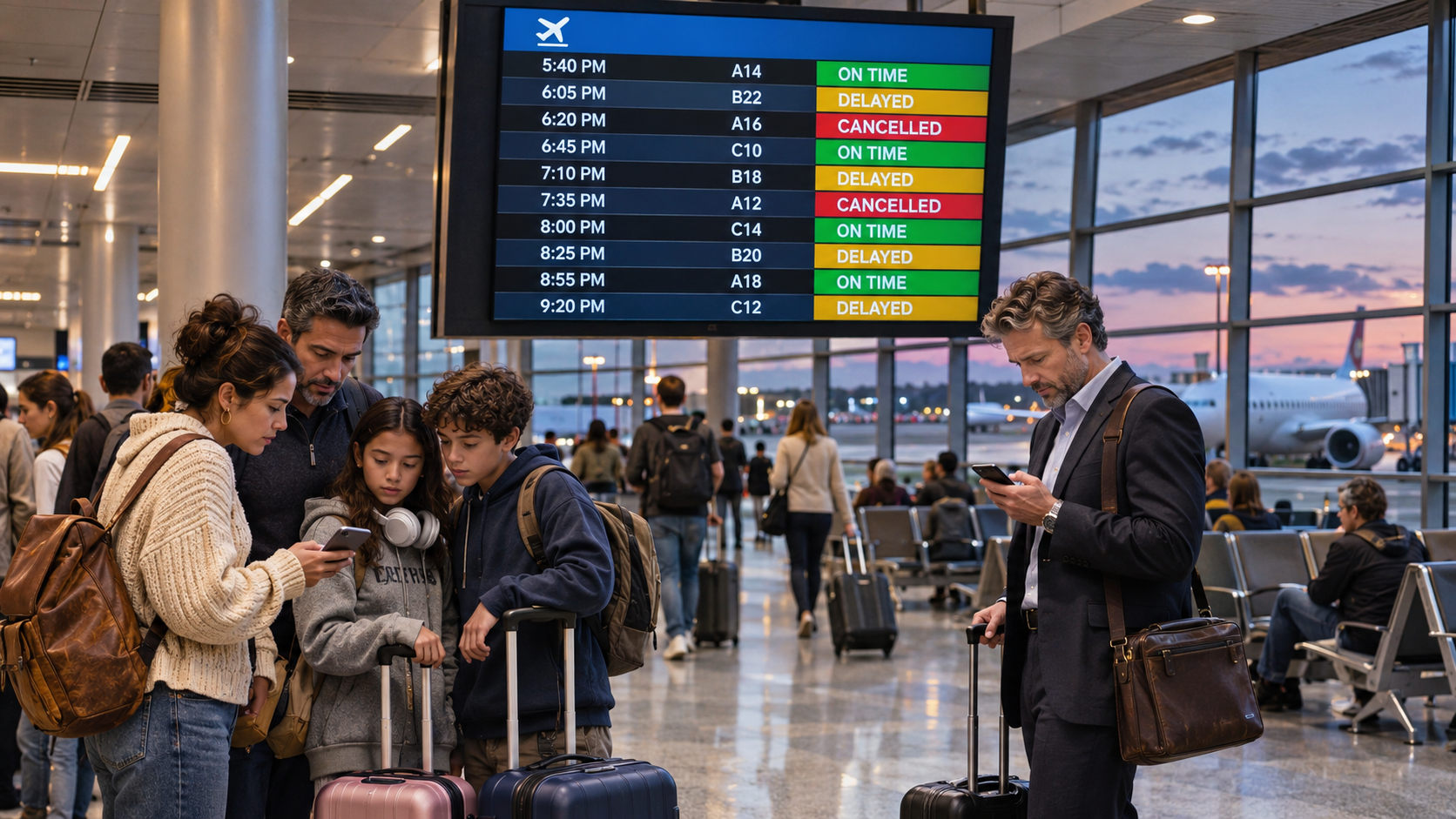
Travelers check phones beneath an airport departure board showing delayed, cancelled and on-time flights during recovery from a major disruption.

U.S. airspace reopened after the FAA’s November 13, 2026 nationwide ground stop, but recovery does not make every aircraft, crew and passenger immediately line up with the original schedule. The Department of Transportation said more than 3,500 flights were grounded and more than 8,000 flight operations resumed that night, while warning travelers to expect continuing delays and cancellations on November 14.

The ground stop followed telecommunications problems that affected the stability of communications and radar systems used by air traffic control. That cause matters when asking about meals or hotels, but it does not erase federal refund rights when an airline cancels a flight and the traveler decides not to continue.

This guide separates three questions that are easy to blur during a large disruption: Is the airport operating? Is your specific flight operating? And should you accept the airline’s replacement trip or take a refund? The right answer can be different for every itinerary.

FAA ground stop recovery at a glance

  • Incident: the FAA issued a nationwide ground stop on November 13 after communications problems affected multiple Air Route Traffic Control Centers.
  • Recovery: DOT said U.S. airspace was open on November 14 after more than 8,000 operations resumed the previous night.
  • Traveler impact: residual delays and cancellations can continue as aircraft and crews are repositioned.
  • Airport status: FAA status pages describe broad airport conditions and traffic-management programs, not the final status of an individual flight.
  • Specific flight status: the operating airline remains the authoritative source for departure time, gate, aircraft and rebooking options.
  • Refund rule: a cancelled flight is refundable if the passenger declines the replacement trip, credit, voucher or other compensation and chooses not to travel.
  • Amenities: meals, hotels and ground transport depend heavily on the cause and the airline’s commitments; benefits for airline-controlled disruptions do not automatically apply to an FAA system failure.

What recovery means after a nationwide ground stop

What recovery means after a nationwide ground stop

Air traffic and airport operations resume in sequence at sunrise while controllers and ground crews coordinate aircraft movements.

A ground stop pauses departures for affected destinations so the air traffic system does not receive more aircraft than it can safely manage. Lifting the restriction allows operations to restart, but it does not put every flight back in its original slot. An aircraft may still be at the wrong airport, a crew may reach its duty-time limit, a connecting passenger may be missing or a gate may be occupied by another delayed flight.

The FAA’s public airport-status tools are useful for understanding whether a major airport is under a ground delay, ground stop or other traffic-management initiative. The FAA explicitly says that this information is general rather than flight-specific. A green-looking national map therefore cannot guarantee that one flight will depart on time.

Check the full route, not only the first airport. A departure can be ready while the destination is restricted, and a connecting flight can fail even when the first segment operates. Travelers on separate tickets face extra risk because the second carrier may treat a missed connection differently from a protected connection on one ticket.

How to check your flight before leaving home

  • Open the operating airline’s app or website and confirm the flight number, date, origin, destination and current departure time. A codeshare flight should be checked with the carrier actually operating the aircraft.
  • Review every segment on the reservation. Look for a changed connection, different airport, aircraft swap or shortened connection time, not only the word ‘cancelled.’
  • Check the departure airport’s official website for terminal, gate, parking, ground-transport or security updates, then use the FAA airport-status page for broader system conditions.
  • Turn on airline push notifications, email and text alerts, but refresh the reservation directly before departing. A cached wallet pass or old screenshot may not show the newest gate or time.
  • If the flight is still scheduled, arrive according to the airline’s normal check-in and bag-drop deadlines unless the airline gives different instructions. A late aircraft does not always extend the passenger deadline.
  • Save the airline’s disruption notice and the original itinerary. Those records help when comparing the replacement trip, requesting a refund or documenting an insurance claim.

Choose between rebooking and a refund
Choose between rebooking and a refund

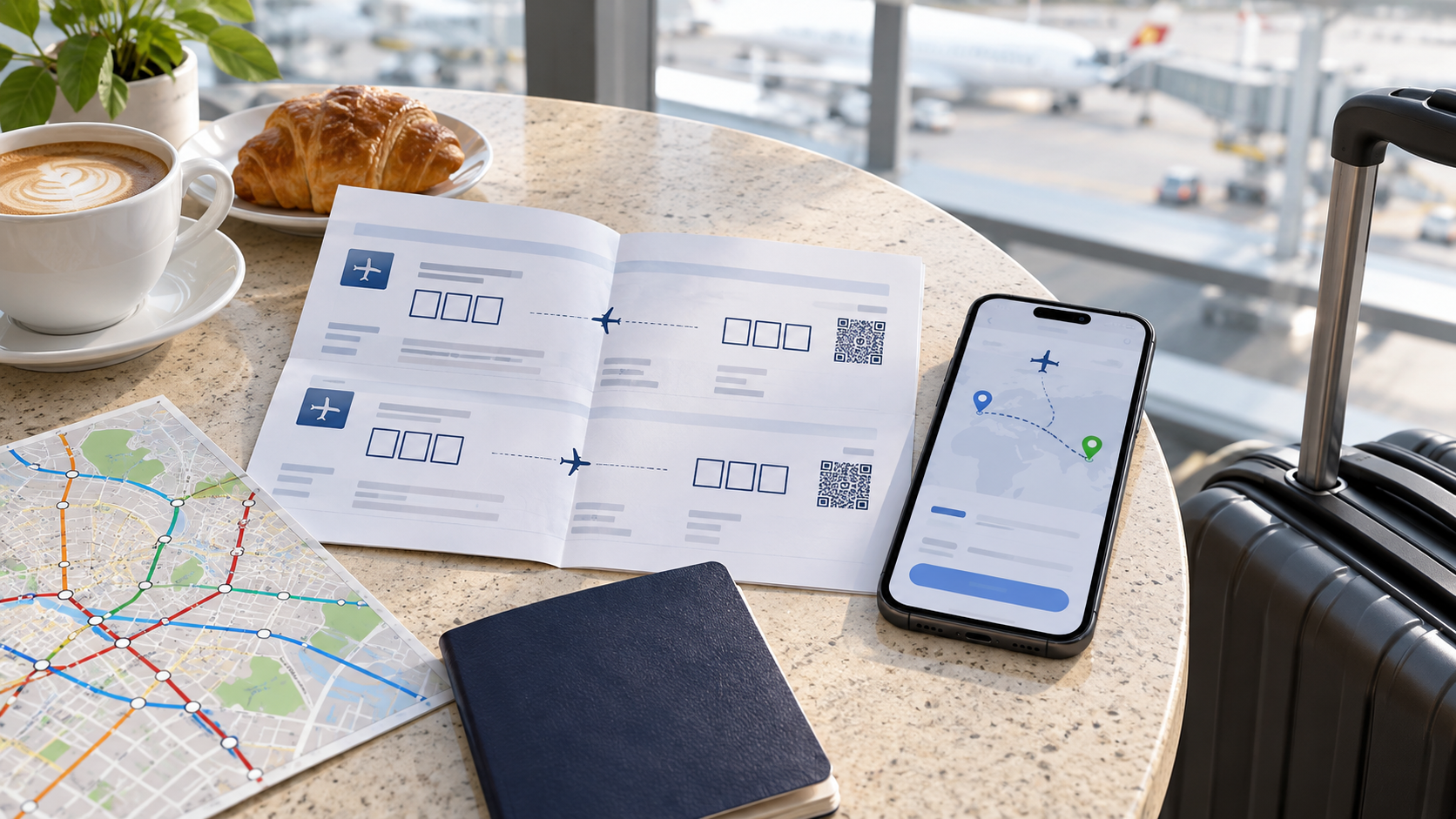
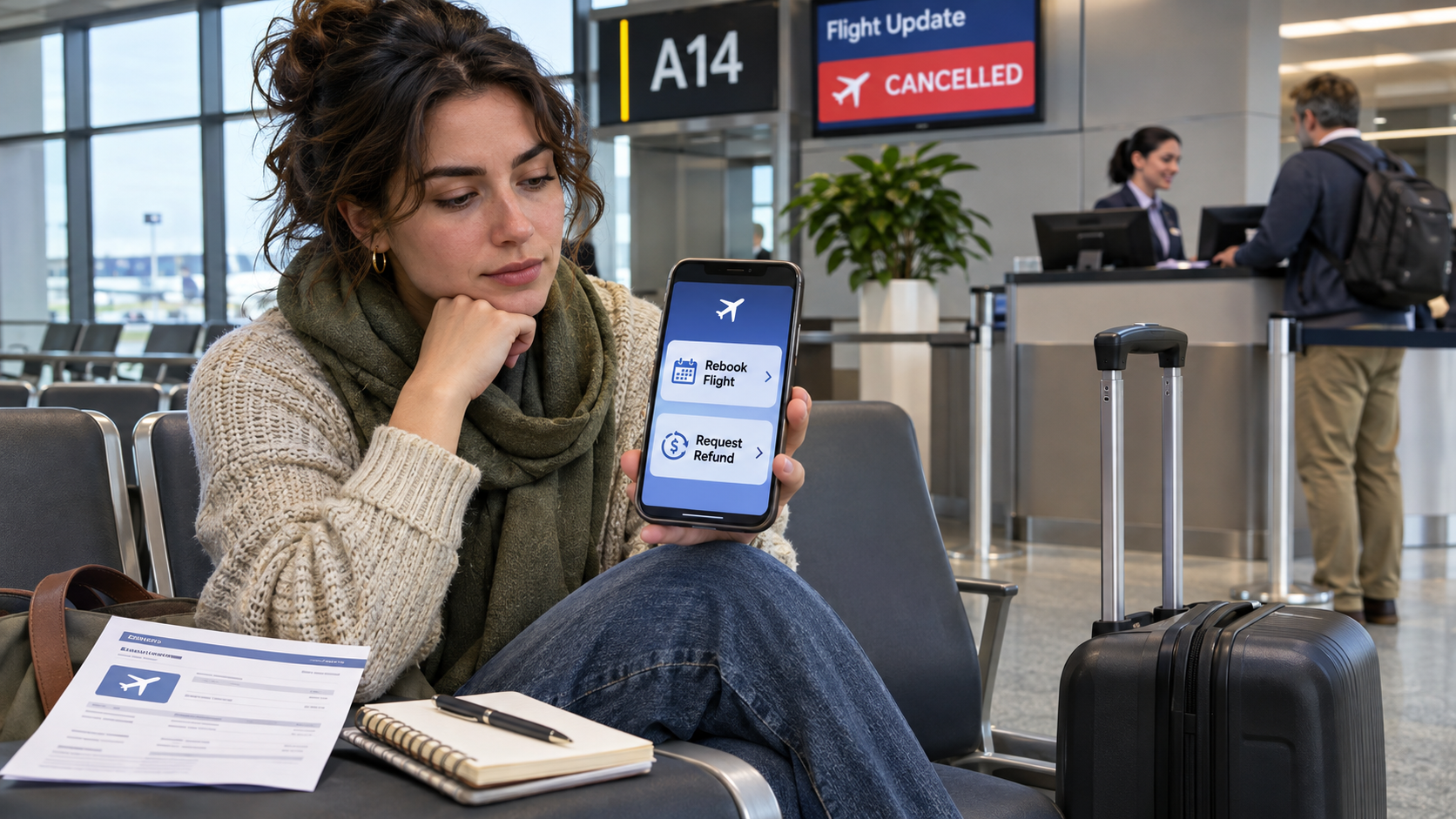
A traveler reviews generic rebooking and refund choices on a phone beside a carry-on after a flight cancellation.

Rebooking is usually the better choice when the replacement itinerary still meets the purpose of the trip. A refund can be better when the new timing defeats the trip, the destination event will be missed or another form of transportation is more practical. Do not accept a voucher automatically if cash back to the original form of payment is more useful and the trip qualifies for a refund.

Before accepting a new flight, compare the complete arrival time, airport, number of connections, cabin, accessibility and baggage plan. An earlier departure can also be a significant change. If the airline offers an itinerary that creates a different-airport transfer, overnight layover or impossible connection, ask whether another routing is available before accepting it.

When federal refund rights apply

DOT says a passenger is entitled to a refund when an airline cancels a flight for any reason and the passenger chooses not to travel or accept the airline’s alternatives. A refund is also due after a significant schedule change or delay if the passenger declines the changed or replacement trip.

  • Domestic itinerary: a scheduled departure at least three hours earlier or arrival at least three hours later can qualify as a significant change.
  • International itinerary: the corresponding threshold is at least six hours earlier departure or later arrival.
  • Other significant changes include a changed origin or destination airport, an increased number of connections, a downgrade to a lower cabin or certain less-accessible connections or aircraft changes for a traveler with a disability.
  • If the passenger takes the significantly changed flight or accepts alternative transportation, DOT says the passenger generally is not entitled to a ticket refund under this rule.
  • For tickets bought directly from an airline, an automatic refund is generally due within seven business days for credit-card purchases or 20 business days for cash purchases after the airline knows the passenger rejected the alternatives.

A refund is not the same as additional compensation. U.S. law does not create a universal cash-payment requirement for every delay. Travel insurance, credit-card protections and the airline’s contract may provide separate benefits, but each has definitions, exclusions and documentation requirements.

Meals, hotels and ground transportation

DOT’s Airline Customer Service Dashboard lists voluntary commitments carriers make for disruptions within the airline’s control. Major carriers generally commit to free rebooking on their own flights for controllable delays and cancellations, and many promise meals after a qualifying wait plus hotel and ground transportation for an overnight controllable disruption.

The November 13 event was attributed to telecommunications problems affecting air traffic control systems, not an airline operational failure. That means the dashboard’s controllable-disruption promises may not apply automatically. Ask the airline anyway, particularly when a later crew, maintenance or scheduling decision changes the cause of an individual flight. Keep a screenshot of the reason the airline displays, because a generic ‘operational issue’ can later be updated.

Protect a connection and checked baggage

If the trip has a connection, compare the live inbound arrival with the next flight’s boarding time rather than its departure time. Contact the operating airline before the first departure when the connection is already unrealistic. Rebooking the whole ticket early can be easier than reaching the hub after the last practical onward flight has left.

For checked bags, confirm whether the bag is tagged to the final destination or only to an intermediate airport. Keep the baggage receipt and take a quick photo of the suitcase before check-in. If the bag fails to arrive, file a mishandled-baggage report before leaving the airport and keep the claim number. A personal tracker can provide a clue, but it does not replace the airline’s baggage record or authorize entry into a restricted area.

How to document a baggage problem
How to document a baggage problem

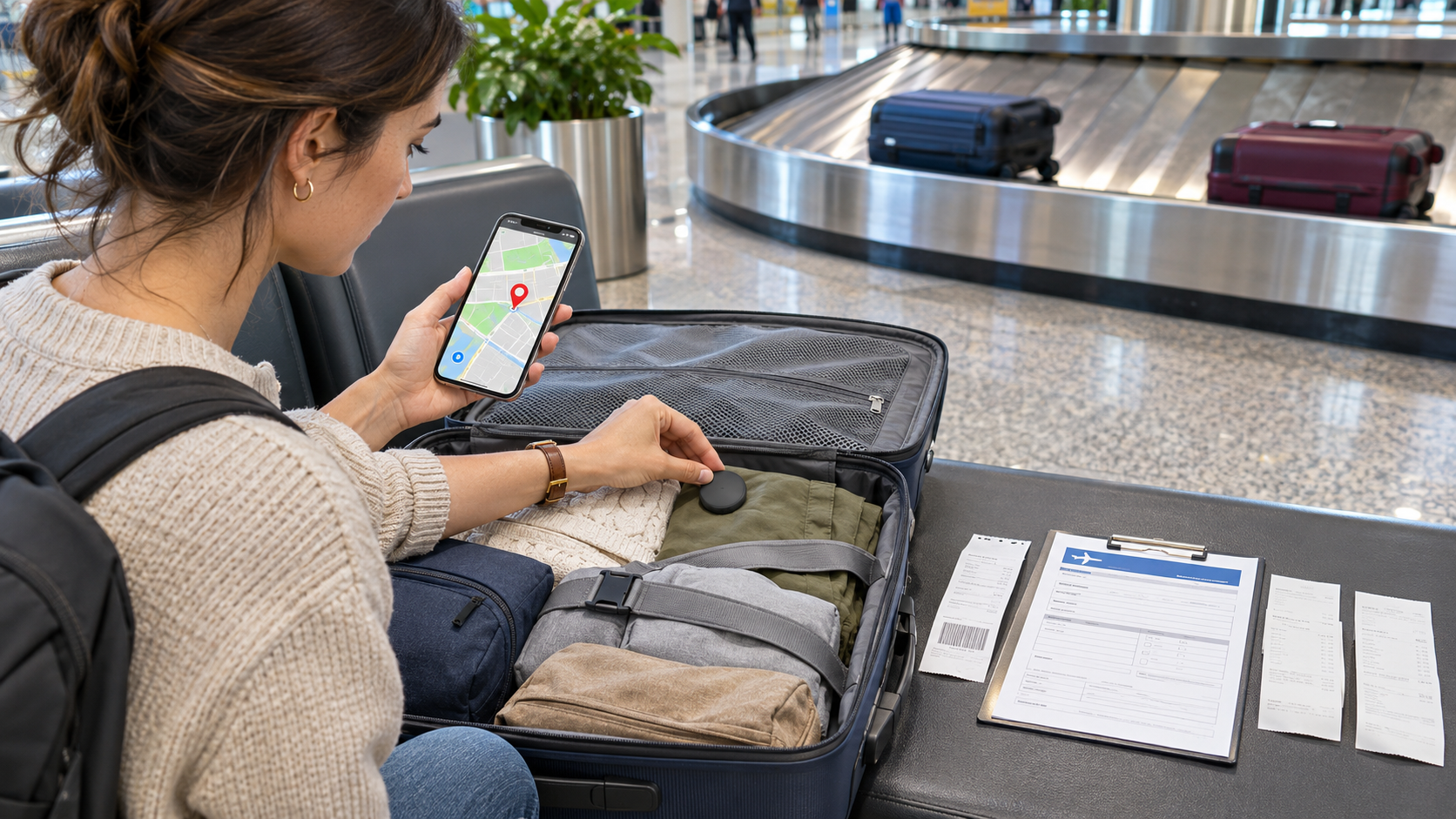
A traveler places a generic Bluetooth tracker in a suitcase while organizing a baggage receipt, claim form and expense receipts at baggage claim.


  • Photograph the bag, tag and receipt before surrendering the suitcase.
  • Report a missing or damaged bag to the airline immediately and save the property-irregularity or claim number.
  • Keep receipts for reasonable replacement items and review the airline’s reimbursement instructions before buying expensive substitutes.
  • Share a tracker location only through the airline’s supported process and disable the share link when the case is resolved.
  • Follow FAA battery rules and the operating airline’s restrictions. FAA guidance allows small Bluetooth baggage trackers in checked bags only when their battery is within the stated lithium-content or watt-hour limits.

A useful tracker for checked luggage

Apple’s current AirTag (2nd Generation) four-pack, ASIN B0GJTXVN9Z works with the Find My network and supports temporary Share Item Location links for participating airlines. That can help an airline locate a delayed bag, but it cannot prove that a suitcase is ready for pickup or override the airline’s tracing process. Verify device compatibility, the exact ASIN, seller, return policy and the airline’s tracker policy before purchasing or flying.

Affiliate disclosure: ReaderSpice may earn a commission from qualifying Amazon purchases made through this link, at no additional cost to you.

What to save for a complaint or insurance claim

  • Original confirmation, ticket number and itinerary.
  • Cancellation or delay notices and the reason shown by the airline.
  • Replacement itinerary, refund choice and any voucher terms.
  • Receipts for meals, hotel, ground transportation and necessary baggage replacements.
  • Names, times and reference numbers from airline chats or calls.
  • Baggage report, tag receipt and any temporary location-share record.

Ask the airline to resolve the issue first. If it does not provide a refund or honor a published customer-service commitment, DOT says passengers can file an aviation consumer complaint. A concise timeline with supporting documents is more useful than a long message without dates or reference numbers.

The bottom line

The FAA ground stop ended, but the schedule can take longer to recover than the airspace itself. Check the operating airline for the flight, the FAA for systemwide airport conditions and the destination or connecting airport for local changes. Treat each source as answering a different question.

If the airline cancels the flight or makes a qualifying significant change, decide whether the replacement trip still works before accepting it. Travelers who decline the alternative can be entitled to a refund even when the original disruption was outside the airline’s control; meals and hotels are a separate question and depend more heavily on cause and carrier commitments.

Sources

U.S. Department of Transportation – Airspace restoration update after the nationwide ground stop – November 14, 2026

Federal Aviation Administration – Statement on the nationwide ground stop – November 13, 2026

Federal Aviation Administration – Preparing to Fly and airport status guidance

Federal Aviation Administration – National Airport Status, text-only live page

U.S. Department of Transportation – Refunds for cancelled and significantly changed flights

U.S. Department of Transportation – Airline Customer Service Dashboard

Federal Aviation Administration – Airline passengers and battery-powered location trackers

Apple – AirTag features and participating-airline location sharing

Amazon – Apple AirTag second generation four-pack, ASIN B0GJTXVN9Z (affiliate link)

Inline image 1: Airport operations recovering after an FAA ground stop. Alt text: Air traffic and airport operations resume in sequence at sunrise while controllers and ground crews coordinate aircraft movements.

Inline image 2: Traveler comparing rebooking and refund options. Alt text: A traveler reviews generic rebooking and refund choices on a phone beside a carry-on after a flight cancellation.

Inline image 3: Traveler documenting a checked baggage problem. Alt text: A traveler places a generic Bluetooth tracker in a suitcase while organizing a baggage receipt, claim form and expense receipts at baggage claim.

Alaska Airlines Adds Five Seattle Nonstops for 2027 Dates Schedules and Destination Guide

Passenger jet departing above the Seattle skyline, Puget Sound and Mount Rainier at sunrise with five route arcs.

Alaska Airlines has put five new Seattle nonstops on sale for 2027: four daily, year-round domestic routes and one three-times-weekly seasonal route to Guadalajara. The additions are useful because they replace a connection for several city pairs that have never had nonstop Seattle service. The practical catch is that the start dates, operating windows and departure times differ, so travelers should compare the route they want rather than treating the announcement as one uniform launch.

The carrier announced the routes on November 12, 2026. Charlotte and Norfolk begin June 10, Jacksonville and Des Moines begin June 24, and Guadalajara begins March 18 for a season that runs through August 9. Alaska says the additions will take its Seattle network to 119 nonstop destinations. All schedules below use local times and remain subject to change, so verify the current itinerary before buying.

The five routes at a glance

How to read the last column: The first time is the Seattle departure; the second is the return departure from the destination. Alaska lists arrivals as 4:51 p.m. in Charlotte, 3:58 p.m. in Norfolk, 5:35 p.m. in Jacksonville, 2:42 p.m. in Des Moines and 5:11 a.m. the next day in Guadalajara. Return flights reach Seattle at 8:47 p.m., 8:11 p.m., 9:40 p.m., 5:36 p.m. and 5:03 p.m., respectively.

What these routes change for Seattle travelers

Three genuinely new nonstop city pairs. Alaska identifies Jacksonville, Norfolk and Des Moines as the first nonstop links between those cities and Seattle. The benefit is not simply a shorter itinerary: avoiding a connection removes one missed-connection point and makes short trips more realistic.

Four routes are built for repeat travel. Daily, year-round service is easier to use for business trips, family visits and long weekends because travelers are not confined to a short season or a few operating days each week.

Guadalajara is different. The Mexico route operates three times weekly only from March 18 through August 9, 2027. Travelers should compare both outbound and return operating days before reserving a hotel or separate positioning flight.

Charlotte North Carolina

Charlotte North Carolina

Route details. Daily year-round service starts June 10. The published outbound leaves Seattle at 8:30 a.m. and reaches Charlotte at 4:51 p.m.; the return leaves at 5:54 p.m. and reaches Seattle at 8:47 p.m. The eastbound schedule uses most of the day, while the westbound timing can preserve a final workday or sightseeing day in Charlotte.

Why go. Charlotte is a strong match for a compact urban break: the official visitor organization groups the city around attractions, arts and culture, shopping, outdoor activities, sports and food. Uptown puts museums, parks and major venues close together, while South End adds restaurants, breweries and the Rail Trail.

Planning angle. This route also matters for travelers connecting through Charlotte on American Airlines, Alaska’s oneworld partner. Compare a single through-ticket with separate tickets before assuming the new nonstop is the cheapest or most protected option. For a leisure weekend, pick one neighborhood base and reserve timed attractions early rather than spending the trip moving across the metro area.

Norfolk Virginia

Norfolk Virginia

Route details. Daily year-round service starts June 10. The Seattle departure is scheduled for 7:30 a.m., arriving Norfolk at 3:58 p.m. The return departs at 5:01 p.m. and arrives Seattle at 8:11 p.m. That early eastbound departure favors travelers who want to reach Hampton Roads before evening.

Why go. Norfolk’s official visitor site highlights a walkable downtown waterfront, Nauticus and the Battleship Wisconsin, the Chrysler Museum of Art, the Perry Glass Studio and the Norfolk Botanical Garden. It also works as a gateway to the wider Hampton Roads region, including Virginia Beach, but those places are not interchangeable: choose accommodations based on whether your priority is downtown culture, the naval waterfront or the oceanfront.

Planning angle. The nonstop is especially useful for military families, maritime travelers and anyone building a coastal Virginia itinerary. If Virginia Beach is the main goal, price the ground transfer and parking before booking; if Norfolk is the goal, the downtown core can support a more compact car-light stay.

Jacksonville Florida

Jacksonville Florida

Route details. Daily year-round service starts June 24. The flight leaves Seattle at 9:00 a.m. and arrives Jacksonville at 5:35 p.m. The return leaves at 6:38 p.m. and arrives Seattle at 9:40 p.m. The evening return can be convenient, but it also means a late arrival home.

Why go. Visit Jacksonville emphasizes the city’s 22 miles of beaches, parks, public art and waterways. The St. Johns River shapes the downtown experience through the Northbank and Southbank Riverwalks, while Atlantic Beach, Neptune Beach and Jacksonville Beach create a separate coastal trip. Northeast Florida can support either a downtown river weekend or a beach stay, but combining both is easier with a car.

Planning angle. Do not book a generic “Jacksonville” hotel before checking the map. The metro area is large, and a low nightly rate can be offset by long drives to the beach or riverfront. Summer travelers should also leave room for heat and thunderstorms by pairing outdoor plans with a museum, food hall or other indoor backup.

Des Moines Iowa

Des Moines Iowa

Route details. Daily year-round service starts June 24, marking Alaska’s first service to Iowa. The flight leaves Seattle at 9:00 a.m. and arrives Des Moines at 2:42 p.m. The return leaves at 3:27 p.m. and arrives Seattle at 5:36 p.m. This is the shortest published itinerary among the five additions and is well timed for a same-day arrival before dinner.

Why go. Catch Des Moines points visitors toward the Iowa State Capitol, Pappajohn Sculpture Park, the Greater Des Moines Botanical Garden, the Science Center of Iowa and the Downtown Farmers’ Market. The city is compact enough for a focused weekend, while the route also opens a simpler path to family visits, state business and regional events.

Planning angle. Check event calendars before choosing dates. The Iowa State Fair, major conventions and sports weekends can move hotel prices sharply. If the trip extends beyond the city, reserve a rental car early; if it stays downtown, compare the cost of a car with rideshare and parking rather than assuming one is essential.

Guadalajara Jalisco Mexico

Guadalajara Jalisco Mexico

Route details. Seasonal service starts March 18 and runs three times weekly through August 9. The overnight flight leaves Seattle at 11:15 p.m. and arrives Guadalajara at 5:11 a.m. the next day. The return leaves Guadalajara at 12:35 p.m. and arrives Seattle at 5:03 p.m. Alaska says the route will use Boeing 737 aircraft.

Why go. Jalisco’s official tourism site describes Guadalajara as a mix of historic plazas, markets, museums, architecture, gastronomy and contemporary culture. The historic center brings together the Metropolitan Cathedral, Teatro Degollado, Plaza de Armas, Plaza de la Liberacion and the Cabanas Museum. Nearby Tlaquepaque is known for galleries, workshops and ceramics, while Tequila, Ajijic and Cocula can extend the trip beyond the city.

Planning angle. The early arrival creates a practical first-day problem: a standard hotel room may not be ready at dawn. Ask about luggage storage or paid early check-in before departure. U.S. citizens need a valid passport for the Mexico route, and every traveler should review current entry, return and document rules that apply to their nationality before travel. Because the flight is not daily, build extra margin around cruises, tours, weddings or other fixed events.

How to compare the five routes before booking

  • Start with operating days, not just the launch date. Daily service gives more recovery options after a disruption. Guadalajara’s three-times-weekly pattern makes the return-day choice just as important as the outbound.
  • Price the complete trip. Add seat selection, checked bags, ground transportation, parking and any overnight connection avoided by the nonstop. A slightly higher fare may still be the better total value.
  • Check the arrival hour against your first commitment. Four eastbound domestic flights reach their destination in the afternoon or early evening. Guadalajara arrives before typical hotel check-in and may require a luggage plan.
  • Compare flexibility rules. For trips tied to weddings, cruises or major events, consider a fare that can be changed and avoid making the last scheduled flight before the event your only path.
  • Recheck after schedule changes. The published timetable is useful for planning, but airlines can adjust aircraft, days and times before a 2027 departure. Confirm the itinerary in the airline app and again before leaving for the airport.

A practical document organizer for Guadalajara

The Guadalajara route is the only international addition in this group, so it is the one itinerary where a passport organizer may be genuinely useful for families. The Travelon RFID Blocking Family Passport Wallet (ASIN B0BTJCZW6L) holds up to six passports and includes card slots, a pen loop and document pockets. It is not required for travel, and it is not necessary for the four domestic routes, but it can keep passports, boarding documents and currency together for a group.

Affiliate disclosure: ReaderSpice may earn a commission from qualifying purchases made through the Amazon link above, at no additional cost to you.

The bottom line

The biggest benefit is straightforward: Seattle gains five nonstop choices, including three first-ever city pairs and Alaska’s first Iowa service. Charlotte and Norfolk begin June 10, Jacksonville and Des Moines follow June 24, and Guadalajara operates March 18 through August 9. The domestic routes are flexible daily additions; Guadalajara is a more constrained seasonal service that rewards careful date and document planning. Treat Alaska’s published schedule as the starting point, then verify operating days, total trip cost and arrival logistics before booking.

Sources

  • Alaska Airlines newsroom – five new Seattle routes – Official announcement, launch dates, frequencies and published schedules.
  • Alaska Airlines booking site – Live fares, operating days and current itinerary details.
  • Charlotte’s got a lot – Official Charlotte visitor information and attraction categories.
  • VisitNorfolk – Official Norfolk visitor information and top attractions.
  • Visit Jacksonville – Official Jacksonville visitor information, beaches, parks and city experiences.
  • Visit Jacksonville – St. Johns River – Official riverfront, Riverwalk and water recreation overview.
  • Catch Des Moines – Official Des Moines visitor information and major attractions.
  • Visit Jalisco – Guadalajara – Official Guadalajara and metropolitan-area tourism guide.
  • Travelon product page – Manufacturer specifications for the family passport wallet.
  • Amazon – Travelon Family Passport Wallet – Verified ASIN B0BTJCZW6L with ReaderSpice affiliate tracking.
  • Charlotte inline image: Charlotte skyline and green park in spring sunshine. ReaderSpice original editorial image.
  • Norfolk inline image: Norfolk downtown waterfront promenade with harbor ship and sailboats. ReaderSpice original editorial image.
  • Jacksonville inline image: Jacksonville skyline and Main Street Bridge across the St. Johns River. ReaderSpice original editorial image.
  • Des Moines inline image: Des Moines skyline and the gold domes of the Iowa State Capitol at sunset. ReaderSpice original editorial image.
  • Guadalajara inline image: Guadalajara Metropolitan Cathedral and historic plaza under jacaranda trees. ReaderSpice original editorial image.

FAA’s First Digital Air Traffic Control Towers Are Live: How They Work and What Changes

Digital air traffic control center with panoramic airport displays and a camera mast beside a regional runway

The Federal Aviation Administration announced on November 6, 2026, that the first U.S. digital air traffic control towers are operational at Bartow Executive Airport in Florida and Kenai Municipal Airport in Alaska. Instead of relying only on a controller’s direct view through tower windows, the systems use camera arrays, sensors and dedicated displays to provide a continuous view of runways, taxiways and nearby airspace.

The word digital can make the change sound like automation replacing people. That is not what the FAA announced. Human controllers still issue instructions and manage traffic. The technology changes how they see the airport and how information reaches the control position. It may also give smaller airports another path to tower service without constructing or replacing a conventional high-rise tower.

For passengers, the immediate effect should be mostly invisible. The announcement does not add a check-in step, change Transportation Security Administration screening or guarantee fewer delays. Its significance is operational: two airports are now using an FAA-approved camera-and-display model that five more airports are expected to receive.

The rollout at a glance

  • Operational sites: Bartow Executive Airport in Florida and Kenai Municipal Airport in Alaska.
  • System supplier: Frequentis, selected by the FAA after testing and a formal design review.
  • Controller role: people still manage traffic and maintain aircraft separation; the system provides their visual picture.
  • Core technology: camera and sensor masts, closed network links, processing systems and panoramic displays in a digital tower center.
  • Next locations: Winter Haven, Venice, Montgomery County Airpark, Johnston Regional and Durango–La Plata County.
  • Passenger impact: no new traveler procedure was announced, and no individual completion dates were published for the next five airports.

Where the first two systems are operating

Bartow Executive Airport in Florida

Bartow became the first operational non-federal digital tower site in the FAA’s program in September 2026. The FAA also issued its first System Design Approval that month for the Frequentis smartVISION design within the approved operating scope. Bartow’s Digital Tower Operations Center combines the visual system with radio, telephony, recording and airport information tools.

The Bartow deployment is important because it moves the concept beyond demonstrations. It gives the FAA, the airport and the supplier a live site for evaluating procedures, maintenance and controller use over time. It does not mean every airport can buy the same configuration and begin operating immediately; each installation still has to fit the FAA’s approval, commissioning and airport-integration requirements.

Kenai Municipal Airport in Alaska

Kenai is a commercial-service airport with scheduled links to Anchorage as well as cargo, charter and general-aviation activity. The FAA’s November announcement identifies it as the second operational digital-tower site. That makes the deployment relevant beyond a purely experimental airfield because the airport supports regular passenger operations and works in Alaska’s demanding weather and seasonal-light conditions.

The City of Kenai still directs passengers to their airline for flight questions and baggage issues. That is a useful boundary: the new tower is part of airport traffic control, not a replacement for airline operations, reservations or passenger communications.

How a digital tower works

How a digital tower works

Concept illustration of a digital tower center using panoramic airport displays.

A digital tower starts with cameras and other sensors installed around the airport. Their feeds are processed and presented on dedicated displays in a Digital Tower Center. The controller uses the display wall as the primary visual view of the airport, while radios, weather information, lighting controls and flight data remain part of the working position.

The FAA says the system can be located on or off airport property, although federally funded installations may face specific property requirements. The agency is also changing its terminology from remote tower to digital tower because the control room does not have to be geographically remote. Older documents may still use both names.

The connection is not an ordinary internet video stream. FAA guidance says the camera mast and control center currently require a closed, physically point-to-point network with an independent fiber-optic feed; Wi-Fi is not allowed for that data path. That design reduces exposure to shared wireless networks and supports predictable performance, but it also means an airport must plan fiber routes, power, redundancy, maintenance access and recovery procedures.

What controllers gain and what stays human

A panoramic display can give controllers one continuous view instead of forcing them to turn between windows or work around a blocked line of sight. Camera systems can also support zoomed views and integrated information that a conventional window cannot provide by itself. Frequentis describes its platform as combining visualization, communications, weather, lighting and flight data, although individual airport configurations can differ.

Those tools do not authorize autonomous control. Controllers remain responsible for issuing clearances and instructions under FAA procedures. A camera may improve the visual picture, but it still depends on lens condition, lighting, weather, network performance, display quality and correct interpretation. The FAA’s approval process therefore evaluates the complete system and its safety case rather than treating cameras as a drop-in consumer product.

The FAA approval is narrower than a nationwide replacement plan

The first Frequentis System Design Approval covers a defined use case for sponsor-owned contract-tower airports, including the approved runway and airspace configuration. The FAA says a new design review typically takes about 24 to 36 months, depending on product maturity and supporting engineering evidence. Individual airport installations also require commissioning, operational coordination and updates to airport plans and publications.

The FAA states that more work is required before digital systems can replace federally owned brick-and-mortar towers. In other words, the Bartow and Kenai milestone establishes an operational path, not a blanket decision to convert every tower in the National Airspace System. Expansion will depend on approved system designs, airport suitability, funding and site-specific safety work.

Five additional airports are next

The FAA named five non-towered airports that are expected to receive digital systems:

  • Winter Haven Regional Airport in Florida
  • Venice Municipal Airport in Florida
  • Montgomery County Airpark in Maryland
  • Johnston Regional Airport in North Carolina
  • Durango–La Plata County Airport in Colorado

The announcement does not provide a go-live date for each location. It also does not say that all five airports will begin tower service at the same time. Funding, design, construction, fiber installation, testing, staffing and FAA commissioning can create different schedules. Travelers and local pilots should use the airport and FAA’s current notices rather than treating the list as a completed deployment.

What passengers should expect

A passenger should not need a special app or document because an airport uses a digital tower. Airline check-in, identification, security screening, boarding and baggage processes remain separate. The FAA’s announcement also does not promise an immediate schedule expansion, lower fares or shorter delay times.

The more realistic benefit is indirect. Better controller visibility and a modern control facility can support safe airport operations and future service planning, especially at regional airports where a conventional tower may be expensive to build or replace. Whether that eventually changes flight frequency or reliability depends on airlines, weather, runway capacity, staffing and many other constraints beyond the tower technology.

What pilots should verify before using a digital-tower airport

The basic operating discipline does not change: use current charts and airport information, obtain weather and notices, monitor the published frequency and follow controller instructions. The FAA says airport diagrams can mark the camera-and-signal-light location with a square labeled D-TWR, while the chart supplement can note that the signal light gun is co-located with the digital tower.

Pilots should not infer camera coverage, zoom capability or backup arrangements from a promotional description. Check the current Chart Supplement, airport diagram, NOTAMs and local guidance for the exact site. The presence of cameras does not remove see-and-avoid obligations, radio procedures or the need to report an unsafe or unclear situation to air traffic control.

A useful FAA handbook for airport operations

The FAA publishes the Pilot’s Handbook of Aeronautical Knowledge online at no cost. Readers who prefer a printed reference can find the 2023 color-print edition of FAA-H-8083-25C on Amazon (ASIN B0CKV58CW9). Chapter 14 covers airport operations, signs, markings, lighting and traffic patterns. The handbook is background material rather than a site-specific guide to the new digital-tower systems, so pilots should still use current FAA publications and local airport information.

Affiliate disclosure: ReaderSpice may earn a commission from qualifying Amazon purchases made through the link above, at no additional cost to you. Verify the edition, publisher, seller and current listing before ordering.

The bottom line

Bartow and Kenai mark a real change in U.S. air traffic control infrastructure: controllers at two airports are now using approved camera-and-display systems as their operational view of the airfield. The technology expands what a controller can see and changes where a control facility can be located, while keeping a human controller in charge.

The rollout is still limited. The approved path is not yet a universal replacement for federal towers, the next five sites do not have individual public completion dates, and passengers should not expect a new airport procedure. The important development is that digital towers have moved from testing into live U.S. operations, creating a practical model the FAA can evaluate before broader deployment.

Sources

Federal Aviation Administration: FAA deploys first digital air traffic control towers in Florida and Alaska — November 6, 2026

Federal Aviation Administration: Digital Towers program timeline and System Design Approval process

Federal Aviation Administration: Digital Airport Traffic Control Tower Systems overview and frequently asked questions

Federal Aviation Administration: Digital Tower systems process and reference documents

Frequentis: Bartow digital tower X10 implementation — March 10, 2026

City of Kenai: Kenai Municipal Airport traveler information

Federal Aviation Administration: Pilot’s Handbook of Aeronautical Knowledge FAA-H-8083-25C

Amazon: Pilot’s Handbook of Aeronautical Knowledge FAA-H-8083-25C color print (ASIN B0CKV58CW9)

New U.S. Flight Attestation Starts November 3: Who Must Sign and DRC Travel Rules

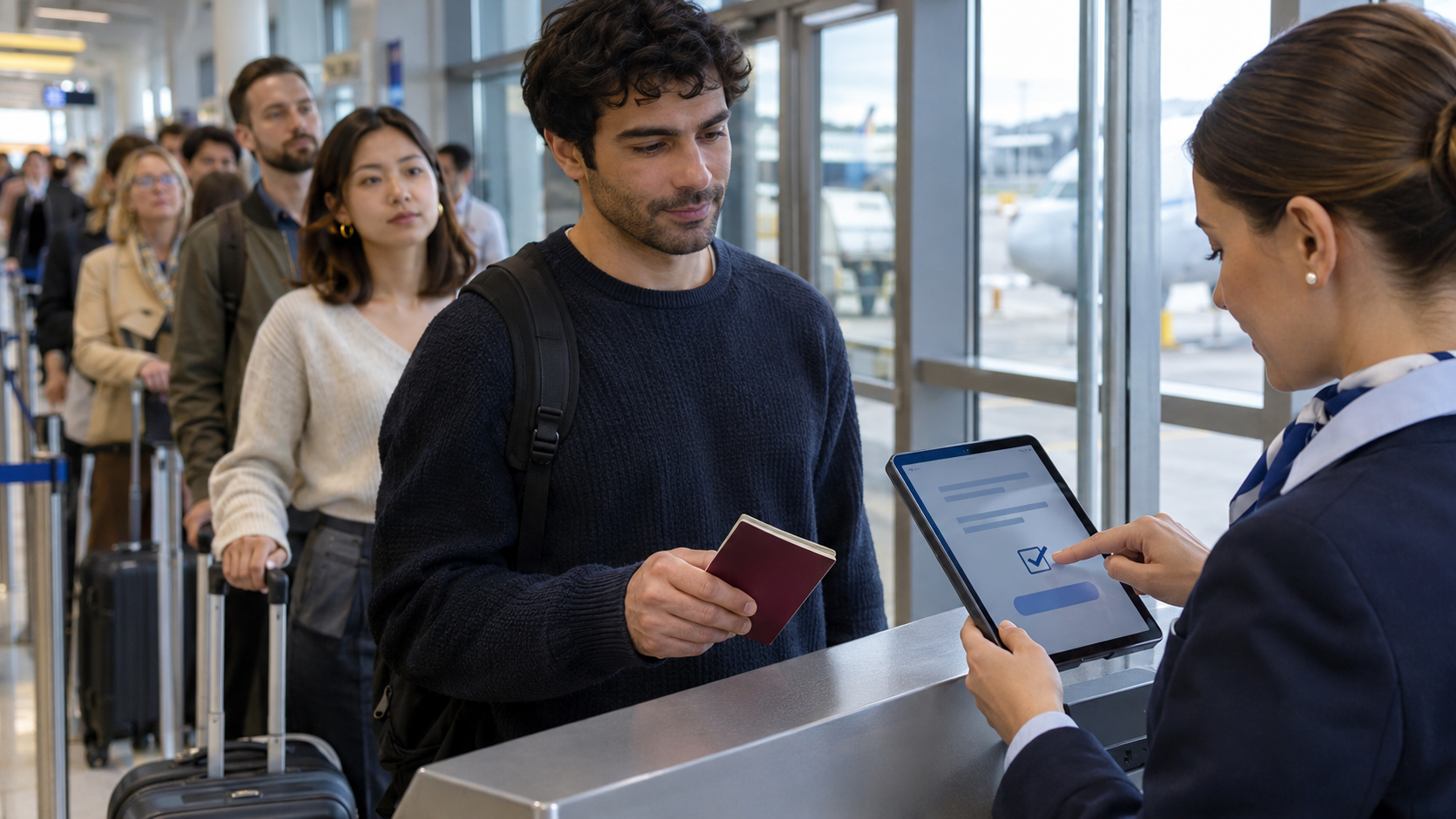
International travelers present passports and phones while an airline agent reviews a digital declaration at an airport counter

A new boarding requirement now applies to people flying to or connecting through the United States from another country. Beginning at 11:59 p.m. Eastern Standard Time on November 3, 2026, travelers must attest that they have not been present in the Democratic Republic of the Congo during the 21 days before boarding.

The requirement applies even to people who have never visited the DRC. It is a universal screening step for international flights bound for the United States, not a form limited to travelers departing Africa. Airlines must confirm completion shortly before boarding and must refuse boarding when the attestation is missing, unless the U.S. government has issued a rare exemption.

The rule responds to an Ebola outbreak, but the CDC says the overall risk to the American public and travelers remains low. The practical issue for most passengers is simple: expect an extra declaration in the airline check-in or gate process, answer it truthfully and do not wait until the boarding door is about to close.

The new rule at a glance

  • Effective time: 11:59 p.m. EST on November 3, 2026 — 10:59 p.m. Central Standard Time.
  • Covered travel: flights departing a foreign country for the United States, including itineraries that only connect through a U.S. airport.
  • Required statement: the traveler has not been present in the DRC during the 21 days before boarding.
  • DRC airport connections count as presence even when the traveler stayed on the aircraft or did not leave the airport.
  • Accepted formats: paper, authenticated digital signature, an airline electronic checkbox or another compliant process.
  • Boarding consequence: an airline must not board a person who fails to complete the attestation unless a U.S. government exemption applies.

The trigger is the departure time from the foreign country, not the scheduled arrival time in the United States. Domestic U.S. flights are not the target of this order, although a traveler may encounter the form before the international segment that reaches the United States.

Who must complete the attestation

Who must complete the attestation

The CDC order applies to all people intending to board a flight from any foreign country to the United States. Nationality and immigration status do not remove the requirement. U.S. citizens, U.S. nationals, lawful permanent residents, visitors and passengers connecting through the United States are all within the boarding process.

The amended order also covers people traveling on commercial, private, general-aviation and cargo aircraft. Crew members are included, including employees repositioning on a flight rather than operating it. Flights that merely pass over U.S. territory without landing are outside the order.

A parent or another authorized person may complete the attestation for someone under 18. An authorized representative may also act for a person who cannot complete it because of age or a physical or mental impairment. Airlines may create one electronic workflow for a representative to attest separately for each person in a traveling party.

What the attestation asks

The key statement is that the traveler was not present in the DRC during the 21 days before boarding a flight to the United States. Airlines must present the required language and the associated disclosure and privacy information. They may reformat the material for an app, website, kiosk or other electronic system, but they cannot replace the substance with a looser question.

A traveler may encounter the declaration during online check-in, at an airport counter, at a kiosk or at the gate. The airline can collect a physical signature, authenticated digital signature or an electronic confirmation. CDC guidance also allows a verbal attestation when the traveler or representative has reviewed the language and an airline agent records the response in a unique electronic record.

Willfully giving false or misleading information can lead to federal criminal penalties. A traveler who cannot truthfully make the statement should not check the box or sign the form simply to preserve an itinerary. Contact the airline and appropriate U.S. authorities before traveling.

What counts as being present in the DRC

Presence is broader than a hotel stay or a visit outside an airport. CDC says it includes transit through a DRC airport, even when a passenger did not disembark or remained inside the terminal. A short connection can therefore affect eligibility for a U.S.-bound flight during the following 21 days.

Review every segment in the relevant period, including separate tickets, positioning flights and connections that may not appear on the current reservation. If an employer or travel agency arranged the trip, confirm the actual airport history instead of relying only on the city listed on a calendar.

What happens after recent DRC travel

Travelers who have been in the DRC within the previous 21 days cannot truthfully complete the standard attestation and generally will not be allowed to board a flight with a U.S. destination. This restriction includes U.S. citizens and U.S. nationals. CDC advises affected travelers to remain outside the DRC for at least 21 days after leaving before boarding for the United States.

Exemptions are rare. CDC describes possible humanitarian or important government considerations and says that, when an exemption is issued, the agency coordinates with the airline and federal partners. A traveler should not assume that an urgent ticket, U.S. passport, permanent-resident card or family emergency automatically creates an exemption.

People who were in an outbreak-affected DRC province may face additional local departure requirements. U.S. citizens who need consular help can use the State Department’s published assistance channels. Travelers should work with the airline and government contacts before going to the airport because airport agents cannot create a federal exemption at the counter.

South Sudan and Uganda follow separate rules

The DRC attestation is only one part of the current public-health travel framework. CDC separately says that non-U.S. citizens and non-U.S. nationals — including lawful permanent residents — who were in South Sudan or Uganda within the previous 21 days are not allowed to enter the United States and should remain outside those countries for 21 days before travel.

U.S. citizens and U.S. nationals who were in South Sudan or Uganda, but not the DRC, may be routed through designated U.S. airports for public-health entry screening. These are distinct restrictions. Completing the DRC attestation does not cancel another rule that may apply because of travel in South Sudan or Uganda.

Because status, routing and outbreak conditions can change, check the CDC traveler page and the operating airline again before departure. A booking confirmation proves a seat was sold; it does not override a public-health boarding restriction.

How airlines will collect and retain the form

Airlines and other aircraft operators are responsible for collecting the attestation before boarding. They may use their own digital flow, a third-party system or the CDC fillable form, but the operator remains legally responsible for compliance. Staff may help with data entry without becoming the person making the statement.

The operator must retain each attestation for at least 42 days and produce it to the U.S. government if requested. CDC says the form should not be transmitted through the Advance Passenger Information System. The retained record can be connected with identifying flight information such as the traveler’s name, passenger record, carrier, flight number, airports and travel time.

Collection methods may therefore differ by airline. One carrier may place the question in online check-in, while another may confirm it at the gate. Follow the instructions from the carrier operating the U.S.-bound flight rather than assuming a form completed for an earlier codeshare segment covers the final boarding check.

How to avoid a last-minute boarding problem

  • Review the past 21 days of travel, including airport connections, before beginning check-in.
  • Open the operating airline’s app or website and complete any new health or travel declaration it presents.
  • If no electronic form appears, arrive with enough time for a counter or gate process and follow the airline’s instructions.
  • Keep the passport, itinerary and contact details for every traveler accessible, especially when an adult will attest for a child or dependent passenger.
  • Do not download an unofficial form from an unsolicited email or message; use the airline, CDC page or another verified government source.
  • If anyone in the party was in the DRC, South Sudan or Uganda during the relevant period, contact the airline before traveling to the airport.

Completing the declaration early does not eliminate ordinary document, visa, entry, check-in or transit requirements. It adds one public-health verification step to the existing international travel process.

A document organizer for international travel

The Travelon RFID Blocking Family Passport Wallet is a practical accessory for a family or group carrying multiple passports and paper confirmations. Travelon describes the zippered organizer as having space for travel documents, while retailer specifications list room for up to six passports, card slots, organizational pockets and a pen loop. The Amazon listing uses ASIN B0BTJCZW6L. Verify the exact color, model, seller and current listing before purchasing.

A wallet does not replace a secure digital backup or the airline’s electronic attestation record. Keep personal documents under direct control, remove unnecessary papers after the trip and avoid storing sensitive identification in checked baggage.

Affiliate disclosure: ReaderSpice may earn a commission from qualifying Amazon purchases made through the link above, at no additional cost to you.

The bottom line

The new U.S. flight attestation is broad: nearly everyone boarding an international flight that will land in or connect through the United States must confirm no DRC presence during the previous 21 days. For most travelers, it should be a short check-in step. For anyone with a recent DRC airport connection, it can determine whether boarding is permitted.

Answer truthfully, use the operating airline’s official process and allow extra time while carriers implement the rule. Travelers with recent DRC, South Sudan or Uganda history should review the separate restrictions and contact the airline or government authorities before arriving at the airport.

Sources

CDC: Requirement for Attestation by All Persons Traveling by Air to the United States — updated November 3, 2026

CDC: Information for Travelers Returning from Ebola-Affected Areas

CDC: Signed Attestation Order and Attachment A

U.S. Department of State: Additional Consular Information for Americans Regarding the Ebola Outbreak

Travelon: RFID Blocking Family Passport Zip Wallet

Amazon: Travelon RFID Blocking Family Passport Wallet (ASIN B0BTJCZW6L)

Navi Mumbai Airport Flight Shift: What IndiGo, Air India Express and Akasa Travelers Need to Know

Unbranded passenger aircraft taxis beside a modern airport terminal with runway lights and a coastal skyline at blue hour

Mumbai’s two-airport system is entering a more complicated phase. IndiGo, Air India Express and Akasa Air have now outlined separate plans to move selected flights from Chhatrapati Shivaji Maharaj International Airport to Navi Mumbai International Airport, with changes beginning in December 2026 and continuing through 2027.

The shift can create more capacity for the Mumbai region, but it also creates a simple travel risk: a ticket described as “Mumbai” may use either BOM or NMI. Those are different airports in different parts of the metropolitan region. Travelers who assume the wrong terminal—or the wrong airport—could face an expensive road transfer and a missed flight.

This guide separates the announced phases from routes that are still subject to approval or schedule changes. The operating airline’s current booking record remains the final authority for the airport, date, terminal and check-in deadline.

Mumbai’s two-airport transition at a glance

  • Navi Mumbai International Airport uses the IATA code NMI.
  • Chhatrapati Shivaji Maharaj International Airport uses BOM.
  • Air India Express plans four daily domestic departures from NMI beginning in December 2026, followed by a phased international expansion.
  • Akasa Air says its Mumbai–Jeddah operation will move to NMI in December 2026.
  • IndiGo plans to begin its new international phase at NMI in February 2027 and progressively transfer selected departures through the summer schedule.
  • Most Mumbai traffic will continue using BOM while Terminal 1 is redeveloped.
  • Airline, airport and regulatory approvals can change dates, frequencies and exact routes.

This is not a wholesale overnight closure of Mumbai’s established airport. It is a phased redistribution. A traveler should therefore check the airport code for every trip instead of relying on what the airline used last month or what a previous itinerary showed.

What IndiGo is moving and when

IndiGo and Adani Airports announced a phased expansion of international operations at Navi Mumbai on October 25. ETTravelWorld reports that IndiGo plans to begin the new phase in February 2027, progressively transferring 12 daily international departures from BOM while adding a daily Kathmandu service from NMI.

Reported destination plans include Bahrain, Riyadh, Jeddah, Kuwait, Muscat, Dhaka and Jakarta. The important word is progressively: not every route moves on the same day, and an announced city does not guarantee that every frequency to that city will use NMI.

IndiGo may also adjust domestic flights to support international connections at the new airport. That can make NMI more useful as a connecting point, but travelers should not assume that separate domestic and international bookings will connect automatically. Through-checked baggage and disruption protection depend on the ticket and airline rules.

For any IndiGo booking in the transition period, confirm the three-letter airport code in the itinerary and Manage Booking page. Recheck after a schedule-change email because the departure time may remain similar even when the airport changes.

What Air India Express plans

Air India Express is taking a different path. The published transition plan starts with four daily domestic flights from NMI in December 2026. International expansion is expected to follow, including Kuwait service from January 2027 and a progressive transfer of selected West Asian operations.

The airline’s current Navi Mumbai booking page already treats NMI as a distinct origin and lists domestic and international options. That page is useful for checking live availability, but it also warns that routes, fares and frequency can vary by season and demand.

Travelers should distinguish Air India Express from full-service Air India when reading an itinerary or news report. The carriers are part of the same group, but a flight number, fare bundle, baggage allowance and operating carrier still determine the actual rules. If a booking was sold by another airline, look for the “operated by” line as well as the marketing brand.

Akasa moves the Jeddah route in December

Akasa Air has announced one especially clear change: its Mumbai–Jeddah operation is scheduled to move from BOM to NMI in December 2026. The Indian Express reported the change on October 27, citing the airline and Adani Airport Holdings.

That does not mean every Akasa flight serving the Mumbai region is moving. It means passengers on the affected Jeddah service should verify the airport on their specific date. A round trip can also use different airports if the change occurs between the outbound and return journeys.

Anyone with a hotel transfer, family pickup, religious-tour package or separate domestic connection should update the ground plan as soon as the airline confirms NMI. A transfer arranged for BOM will not automatically redirect to Navi Mumbai.

Why flights are shifting from BOM

The airline moves support the redevelopment of Terminal 1 at Chhatrapati Shivaji Maharaj International Airport. Financial Express reports that the project is intended to raise Terminal 1’s annual passenger capacity from 15 million to 20 million while modernizing safety, passenger and operational facilities.

The current plan does not remove most traffic from BOM. Reporting on the redevelopment says roughly 9% of CSMIA’s annual passenger volume is expected to relocate during the first phase, leaving about 91% at the existing airport. Those percentages explain why airport-code checking matters: both airports will remain active, and the same airline may operate from both.

Navi Mumbai’s first terminal is designed for 20 million passengers a year, with long-term expansion planned. The broader goal is a dual-airport market that can add capacity without forcing every traveler through one congested site.

How to check whether your ticket uses NMI or BOM

How to check whether your ticket uses NMI or BOM

Do not rely on a city name alone. Use the itinerary, airline account and airport’s live flight-status page together.

  • Open the airline’s official app or website and retrieve the booking with the PNR.
  • Find the airport code beside every departure and arrival: NMI means Navi Mumbai; BOM means Chhatrapati Shivaji Maharaj International.
  • Check the operating carrier and flight number, especially on a codeshare.
  • Confirm the travel date, local departure time and terminal.
  • Review every segment separately; one connection can use BOM while another uses NMI.
  • Open the official airport flight-status page close to departure and compare the flight number.
  • Save the corrected itinerary offline and update whoever is providing transport.
  • Recheck after any airline schedule-change message.

If an email says only that the schedule changed, compare the old and new airport codes before accepting the revision. A small time adjustment can hide a much larger ground-transport change.

Changing airports can break a connection

NMI and BOM are not two terminals in one complex. A traveler changing between them must leave one airport, collect any checked baggage that is not through-tagged, travel by road and complete check-in and security again.

Traffic can make a cross-airport journey unpredictable. Immigration, customs, delayed baggage and road congestion can consume a large buffer before the second airline’s cutoff. A booking engine may display separate tickets next to each other without protecting the passenger if the first flight is late.

Before accepting a split-airport itinerary:

  • Confirm whether all flights are on one protected ticket.
  • Ask whether baggage is checked to the final destination.
  • Price the road transfer, tolls and possible overnight stay.
  • Check the second airline’s missed-flight policy.
  • Avoid a tight same-day connection, especially after an international arrival.
  • Keep essential medicine, documents and one change of clothes in hand baggage.

If the airlines will not guarantee the connection, treat it as two separate journeys. A cheaper fare is not necessarily cheaper after a transfer, hotel or replacement ticket.

Ground transport and arrival planning

Navi Mumbai International Airport is in the Ulwe area, while BOM serves the established airport complex closer to central Mumbai. The practical choice depends on the traveler’s origin, destination, time of day and road conditions.

Use the official NMI website for the current airport address, passenger services and flight status. Do not ask a driver simply for “Mumbai airport.” Send the airport code and terminal from the booking. If a pickup is being arranged by family, a hotel or a tour company, share a screenshot of the confirmed itinerary.

Allow more time during the transition period. Drivers, hotel desks and even repeat travelers may default to BOM from habit. Confirm the destination before the vehicle leaves, and keep the airline’s contact details available in case a late airport change appears.

Baggage and check-in deadlines still come from the airline

Moving to a new airport does not create one universal check-in rule. Domestic and international deadlines, baggage allowances, document requirements and boarding-gate closure times remain airline- and fare-specific.

Air India Express advises travelers to select NMI explicitly when booking and to verify the live timetable. Its published guidance recommends arriving earlier for international travel than for domestic travel, but passengers should use the deadline shown for their own flight and fare.

Check baggage allowance before packing because a route move can coincide with an aircraft, schedule or fare change. If the airline reissues the ticket, verify that paid seats, meals, extra baggage and assistance requests remain attached to the booking.

A small luggage scale can prevent check-in surprises

Airport changes are stressful enough without discovering an overweight suitcase at the counter. Amazon lists the Etekcity Digital Luggage Scale, ASIN B00NW62PCA, as a compact handheld scale with a claimed capacity of up to 110 pounds or 50 kilograms.

Travelers can compare the Etekcity luggage scale on Amazon before departure. Confirm the exact seller, current model, battery inclusion and return terms. A home scale is a planning aid; the airline’s calibrated airport scale and the baggage allowance on the ticket determine the final result.

Disclosure: ReaderSpice may earn a commission from qualifying Amazon purchases made through the link above, at no additional cost to you.

Practical checklist before departure

  • Confirm NMI or BOM on every flight segment.
  • Recheck the airport after schedule-change emails.
  • Verify the operating carrier and flight number.
  • Update taxi, hotel, family pickup and tour arrangements.
  • Download the itinerary and airport address for offline access.
  • Confirm baggage, passport, visa and check-in rules with the airline.
  • Add a large buffer for any NMI–BOM ground transfer.
  • Use the official airport flight-status page on the travel day.
  • Keep documents, medicine, chargers and essentials in hand baggage.

The bottom line

The Navi Mumbai transition is becoming real, but it is deliberately gradual. Air India Express begins a new domestic phase in December 2026, Akasa moves its Jeddah service in December, and IndiGo’s expanded international phase is scheduled from February 2027. Exact routes and frequencies can still change.

For passengers, the most important habit is simple: read the airport code, not just the city. NMI and BOM are separate airports. Confirm the code at booking, after every schedule update and again before leaving for the terminal.

Sources

IndiGo: IndiGo and Adani Airports announce phased expansion of international flight operations at Navi Mumbai Airport — October 25, 2026

ETTravelWorld: IndiGo and Air India Express transition plans for Navi Mumbai Airport — October 27, 2026

The Indian Express: Akasa Air to move Mumbai–Jeddah flights to Navi Mumbai Airport — October 27, 2026

Financial Express: Mumbai Terminal 1 redevelopment and passenger-capacity plan — October 26, 2026

Navi Mumbai International Airport: Official flight-status page

Navi Mumbai International Airport: Official traveler information

Air India Express: Flights from Navi Mumbai (NMI)

Amazon: Etekcity Digital Luggage Scale (ASIN B00NW62PCA)

Western Sydney International Airport Is Open: Flights, Transport and What Travelers Should Know

Passenger aircraft taxis beside a modern airport terminal at sunrise in an editorial illustration of Western Sydney International Airport

Western Sydney International (Nancy-Bird Walton) Airport opened to passenger traffic on Sunday, October 25, 2026, giving Australia its first major new airport in more than 50 years. The curfew-free airport at Badgerys Creek is designed to serve Western Sydney and eventually relieve pressure on Sydney Kingsford Smith Airport.

The opening matters, but travelers should not treat WSI as a drop-in replacement for SYD. The two airports are far apart, launch routes are limited, and the planned Metro connection is not operating at passenger opening. A cheaper airfare can still become inconvenient if the wrong airport, transfer time or ground-transport plan is overlooked.

This guide separates opening-day facts from future commitments and focuses on what a traveler can actually do now: identify the correct airport code, check the airline’s current schedule, plan the surface trip and allow enough time for a new terminal routine.

Western Sydney International at a glance

  • Airport code: WSI, not SYD.
  • Location: Badgerys Creek in Western Sydney, roughly 45 kilometers west of the Sydney CBD.
  • Passenger opening: Sunday, October 25, 2026; cargo services began in July.
  • Operating model: 24 hours a day without the overnight passenger-flight curfew that applies at Kingsford Smith.
  • Initial capacity: up to 10 million passengers a year, with long-term expansion planned as demand grows.
  • Rail at opening: no direct Metro service yet; bus, shuttle, taxi, rideshare, rental car and private vehicle are the practical options.
  • First departure: Jetstar flight JQ362 to the Gold Coast.

What opened on October 25

Passenger operations followed 15 years of planning, seven years of construction and extensive testing, according to the Australian Government. The airport’s single terminal handles domestic and international services, while its runway and operating approvals allow airlines to schedule flights around the clock.

Jetstar operated the first commercial passenger departure, an Airbus A320 service to the Gold Coast. Reuters reported that the airport opened as a A$5.6 billion project and that cargo services had already started, giving the site an operational runway and logistics base before ordinary passengers arrived.

Opening day is not the finished network. WSI is built to scale, while airlines are phasing in routes over months and years. Travelers should therefore read an airline timetable as a date-specific commitment, not assume every announced carrier is already flying.

Launch routes and airline rollout

  • Jetstar: up to 14 weekly services to Melbourne, four to the Gold Coast and three to Brisbane in the initial schedule.
  • Air New Zealand: Auckland service scheduled to begin October 26, 2026.
  • Singapore Airlines: daily Singapore service scheduled to begin November 23, 2026.
  • VietJet: Ho Chi Minh City service scheduled for January 2027.
  • Fiji Airways: Nadi service scheduled for March 2027.
  • QantasLink: Brisbane and Melbourne services scheduled from March 28, 2027.
  • Qatar Airways: Doha service is a later commitment, scheduled for December 2027.

Airline start dates, frequencies and aircraft can change. Confirm the airport code, local date and departure terminal on the airline’s own booking record before paying for lodging, parking or a separate connection.

Getting there before the Metro opens

Getting there before the Metro opens

The most important opening-period limitation is ground transport. The Sydney Metro–Western Sydney Airport line is not available for the first passenger services, so a rail itinerary cannot yet continue directly into the terminal. The interim plan combines existing rail with road transport.

Transport for NSW established a free interim bus link between St Marys station and the airport. WSI also lists scheduled airport shuttles, public buses, taxis, rideshare, car rentals and private-car access. Check live timetables because operating hours may not match a very early or late flight at a 24-hour airport.

The M12 Motorway provides direct road access to the airport precinct from the Sydney motorway network. Drivers should use the official airport route and booking confirmation, not simply search for ‘Sydney Airport,’ which can lead to Kingsford Smith.

The WSI Link fallback

For many travelers, the simplest public-transport plan is train to St Marys followed by the free WSI Link shuttle. Build in a buffer for the platform change, luggage handling, traffic and the possibility that a late-night arrival does not line up with a frequent suburban service.

The airport’s own shuttle service and other commercial coaches may suit the CBD, Parramatta or a transfer to SYD, but they are separate products with their own schedules and booking rules. Compare the total door-to-door time and cancellation terms, not only the headline fare.

Driving, parking, taxi and rideshare

WSI sells airport parking online and advises travelers to compare options and reserve ahead. A booking can reduce uncertainty during opening weeks, when first-time visitors are learning the terminal roads. Keep the confirmation accessible offline and confirm the correct entry lane before leaving home.

The airport has designated pickup and drop-off arrangements for taxis, rideshare and private vehicles. Do not ask a driver to stop on an approach road or in an unauthorized lane. If using rideshare, wait until baggage is collected and the pickup zone is confirmed before requesting a car.

A rental car can be practical for Western Sydney, the Blue Mountains or regional New South Wales, but it may be wasteful for a central-Sydney stay. Compare rental, parking, toll and fuel costs with the shuttle-plus-train option.

Do not book the wrong Sydney airport

WSI and SYD are different airports. WSI is Western Sydney International at Badgerys Creek. SYD is Sydney Kingsford Smith Airport near the city center. A confirmation that says ‘Sydney’ is not enough; the three-letter code should match every segment, transfer and car booking.

This distinction matters most for separate tickets. An inbound flight to SYD and an onward flight from WSI require a cross-city road transfer, baggage collection and a new check-in. The reverse is equally demanding. There is no protected airside connection between the airports.

If a search engine offers a low fare that changes airports, price the transfer and allow a conservative buffer. Consider traffic, immigration, customs, baggage delay and the missed-flight rules on the second ticket. An overnight stay may be safer than a tight same-day connection.

Check-in, baggage and security

WSI uses a modern terminal with digital check-in and bag-drop facilities, but the airport does not publish one universal arrival-time rule for every airline. Domestic and international cutoffs vary. Follow the operating airline’s current instructions and allow additional time during the opening period.

Check the flight-status page before leaving, then confirm check-in, baggage allowance, special-item handling and boarding requirements directly with the airline. A new airport cannot override a carrier’s cutoff, and an airport parking reservation does not guarantee enough time to reach the gate.

International arrivals should verify passport, visa, biosecurity and customs requirements. Travelers connecting onward on a separate ticket should assume they must collect bags and repeat check-in unless the airlines explicitly confirm through-checking.

Transferring between WSI and SYD

A transfer between Sydney’s two airports is a landside journey. There is no direct passenger rail link between them at opening, and travel time can change sharply with traffic. Treat any advertised shuttle time as an estimate, not a connection guarantee.

Before accepting a split-airport itinerary:

  • Verify both airport codes on every flight segment.
  • Check whether the tickets are protected on one booking or separate contracts.
  • Add time for immigration, baggage collection and re-checking when applicable.
  • Confirm the shuttle, taxi or rideshare operates at the required hour.
  • Price tolls, luggage charges and an emergency hotel against a more direct itinerary.
  • Avoid a short connection even if a booking site displays it as technically possible.

Accessibility and family travel

Travelers who need step-free transport, mobility assistance, accessible parking or help through the terminal should contact the airline and ground-transport provider before travel. An accessible terminal does not guarantee that every shuttle departure can accommodate an unannounced wheelchair or large mobility device.

Families should confirm stroller and car-seat rules with the airline, allow extra time at bag drop and identify the pickup zone before landing. Keep medication, documents, a change of clothes and essential child supplies in hand baggage in case the road transfer or checked baggage takes longer than expected.

A verified Australia plug adapter option

Australia uses Type I wall outlets and 230-volt, 50-hertz electricity. Most modern phone and laptop chargers accept 100–240 volts, but the charger’s input label is the deciding factor. A plug adapter changes the physical plug shape; it does not convert voltage.

Amazon lists the Ceptics Australia Plug Adapter three-pack (ASIN B01MR9D7VJ), which accepts common North American plugs and provides a Type I connection. Verify the exact seller, pack size, device voltage and current listing before purchase.

Do not use a simple adapter with a single-voltage hair dryer, styling tool or other high-wattage appliance unless the appliance is designed for Australia’s supply. The Amazon listing itself states that the product is not a voltage converter.

Disclosure: ReaderSpice may earn a commission from qualifying Amazon purchases made through the link above, at no additional cost to you.

Opening-week travel checklist

  • Confirm WSI or SYD on every booking, calendar entry and ground-transfer reservation.
  • Recheck the airline’s launch date and flight status before leaving.
  • Choose and reserve parking, shuttle or rideshare arrangements before the travel day.
  • If using public transport, confirm the St Marys connection and the latest WSI Link timetable.
  • Allow extra time for unfamiliar roads, terminal wayfinding and opening-period queues.
  • Download confirmations and maps in case mobile service or roaming is unreliable.
  • Verify baggage, passport, visa, biosecurity and special-assistance requirements.
  • For a WSI–SYD transfer, build a generous buffer or stay overnight.

The bottom line

Western Sydney International gives the region a long-awaited second passenger airport with 24-hour operations and room to grow. Its opening network is intentionally modest: Jetstar leads the domestic launch, Air New Zealand begins the first international service, and other airlines follow on different dates.

The travel advantage depends on where the trip begins and ends. WSI can be far more convenient for Western Sydney, but it can add time for a central-city stay or a connection at SYD. Check the code, plan the road leg, follow the airline’s deadline and treat future route announcements as future—not current—service.

Sources

Australian Government: Official passenger opening date, initial capacity and launch airline schedule — June 10, 2026

Western Sydney International: Official transport options

Transport for NSW: Free interim WSI Link bus to St Marys station

Western Sydney International: Destinations and airline start dates

Western Sydney International: Departing passenger guidance

Western Sydney International: Arriving passenger guidance

Western Sydney International: Airport shuttle service announcement — September 30, 2026

Reuters: Western Sydney International opens to passengers — October 25, 2026

Amazon: Ceptics Australia Plug Adapter (ASIN B01MR9D7VJ)

Big Bend Border Project May Shrink: What Visitors Should Know

Rio Grande and desert mountains in Big Bend National Park at sunset

A federal border-security project inside Big Bend National Park may be reduced before work resumes, according to court filings described by the Associated Press. The government says it is considering changes that would narrow the plan and avoid or minimize impacts after consulting the National Park Service and other stakeholders.

For travelers, the key point is simple: no final scope has been announced. The National Park Service is still posting project-related closures around Old Maverick Road and part of the Santa Elena Boat Launch area, so visitors should plan from current park alerts rather than assumptions about what the final project will include.

What is confirmed right now

The government expects to announce a final decision during the first week of October. It also told the court that several weeks would likely pass after that announcement before any new ground-disturbing work begins inside the park.

Earlier plans for a 30-foot bollard wall through the national park were dropped. Options still under consideration have included access-road work, lighting, vehicle barriers and surveillance technology. Officials have not yet published a final map or a complete list of features that will move forward.

The construction-related pause began in August after heavy equipment was seen clearing land. Customs and Border Protection has said the activity at that stage was design and planning work rather than full-scale construction. The newest filing says adjustments are being considered, but it does not guarantee that the project will be canceled.

Why the location matters to visitors

Big Bend is not a compact park where one detour affects every itinerary. It covers a vast, remote section of West Texas, and driving between major areas can take hours. A closure near the western river corridor can complicate a Santa Elena Canyon day without preventing a visit to Chisos Basin or Rio Grande Village.

That makes the exact work zone more important than broad headlines. The park’s current alerts list Old Maverick Road as closed until further notice and restrict public access near the eastern edge of the Santa Elena Boat Launch parking area and the adjacent riverbank. The stated purpose is to keep visitors away from construction equipment and road work.

The National Park Service alert does not describe a park-wide closure. Travelers should still check the live conditions page before departure because road, facility and river conditions can change independently of the border project.

Do not confuse two different projects

Reporting about the broader Big Bend region can be confusing because the federal government is also working on a separate stretch of mostly private land west of the national park. That project is described as more than 60 miles long and includes a 30-foot steel bollard wall, roads and surveillance technology where officials consider it appropriate.

The pending decision discussed here concerns work inside Big Bend National Park. A resumption of activity on private property elsewhere in West Texas does not automatically mean the same design will be used within park boundaries.

How to plan a Big Bend trip while the decision is pending

How to plan a Big Bend trip while the decision is pending

Start with the official NPS Alerts & Conditions page, then build a route that does not depend on a single primitive road. If Santa Elena Canyon is a priority, verify the current access plan shortly before leaving your lodging and ask a ranger about river and trail conditions when you arrive.

  • Download maps before entering the park; cell coverage is limited and distances are large.
  • Carry more water than you expect to need and keep your fuel tank well above empty.
  • Use paved roads unless your vehicle and experience match the park’s high-clearance and four-wheel-drive guidance.
  • Keep a backup half-day destination, such as the Chisos Basin scenic drive or a visitor-center stop, in case access changes.

For remote-area communication beyond normal phone coverage, a Garmin inReach Mini 2 satellite communicator can be a sensible addition to a desert travel kit. As an Amazon Associate, ReaderSpice earns from qualifying purchases.

What to watch next

The most useful next update will be the promised public announcement from Customs and Border Protection. Travelers should look for a final project scope, maps, a construction timeline and any revised National Park Service closure orders.

Until those details appear, claims that a wall is definitely returning inside the park—or that the project has been fully abandoned—go beyond the available evidence. The confirmed news is narrower: the agency is considering a smaller plan, expects a decision in early October and says ground-disturbing work would not begin immediately after that decision.

Sources

Associated Press report on the Big Bend project review

National Park Service Big Bend alerts and conditions

Houston Chronicle report on the pending federal decision