
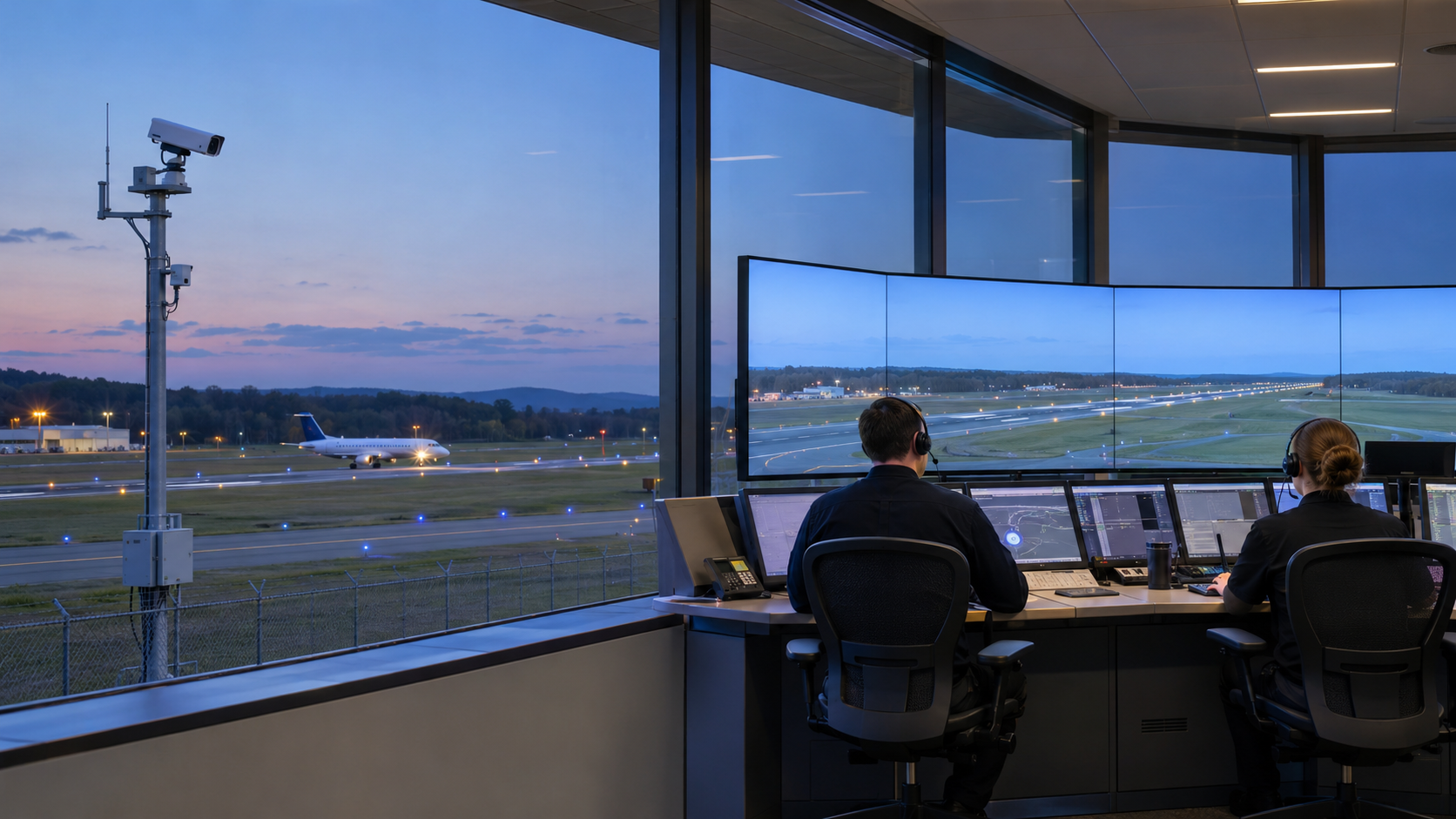
The Federal Aviation Administration announced on November 6, 2026, that the first U.S. digital air traffic control towers are operational at Bartow Executive Airport in Florida and Kenai Municipal Airport in Alaska. Instead of relying only on a controller’s direct view through tower windows, the systems use camera arrays, sensors and dedicated displays to provide a continuous view of runways, taxiways and nearby airspace.
The word digital can make the change sound like automation replacing people. That is not what the FAA announced. Human controllers still issue instructions and manage traffic. The technology changes how they see the airport and how information reaches the control position. It may also give smaller airports another path to tower service without constructing or replacing a conventional high-rise tower.
For passengers, the immediate effect should be mostly invisible. The announcement does not add a check-in step, change Transportation Security Administration screening or guarantee fewer delays. Its significance is operational: two airports are now using an FAA-approved camera-and-display model that five more airports are expected to receive.
The rollout at a glance
- Operational sites: Bartow Executive Airport in Florida and Kenai Municipal Airport in Alaska.
- System supplier: Frequentis, selected by the FAA after testing and a formal design review.
- Controller role: people still manage traffic and maintain aircraft separation; the system provides their visual picture.
- Core technology: camera and sensor masts, closed network links, processing systems and panoramic displays in a digital tower center.
- Next locations: Winter Haven, Venice, Montgomery County Airpark, Johnston Regional and Durango–La Plata County.
- Passenger impact: no new traveler procedure was announced, and no individual completion dates were published for the next five airports.
Where the first two systems are operating
Bartow Executive Airport in Florida
Bartow became the first operational non-federal digital tower site in the FAA’s program in September 2026. The FAA also issued its first System Design Approval that month for the Frequentis smartVISION design within the approved operating scope. Bartow’s Digital Tower Operations Center combines the visual system with radio, telephony, recording and airport information tools.
The Bartow deployment is important because it moves the concept beyond demonstrations. It gives the FAA, the airport and the supplier a live site for evaluating procedures, maintenance and controller use over time. It does not mean every airport can buy the same configuration and begin operating immediately; each installation still has to fit the FAA’s approval, commissioning and airport-integration requirements.
Kenai Municipal Airport in Alaska
Kenai is a commercial-service airport with scheduled links to Anchorage as well as cargo, charter and general-aviation activity. The FAA’s November announcement identifies it as the second operational digital-tower site. That makes the deployment relevant beyond a purely experimental airfield because the airport supports regular passenger operations and works in Alaska’s demanding weather and seasonal-light conditions.
The City of Kenai still directs passengers to their airline for flight questions and baggage issues. That is a useful boundary: the new tower is part of airport traffic control, not a replacement for airline operations, reservations or passenger communications.
How a digital tower works
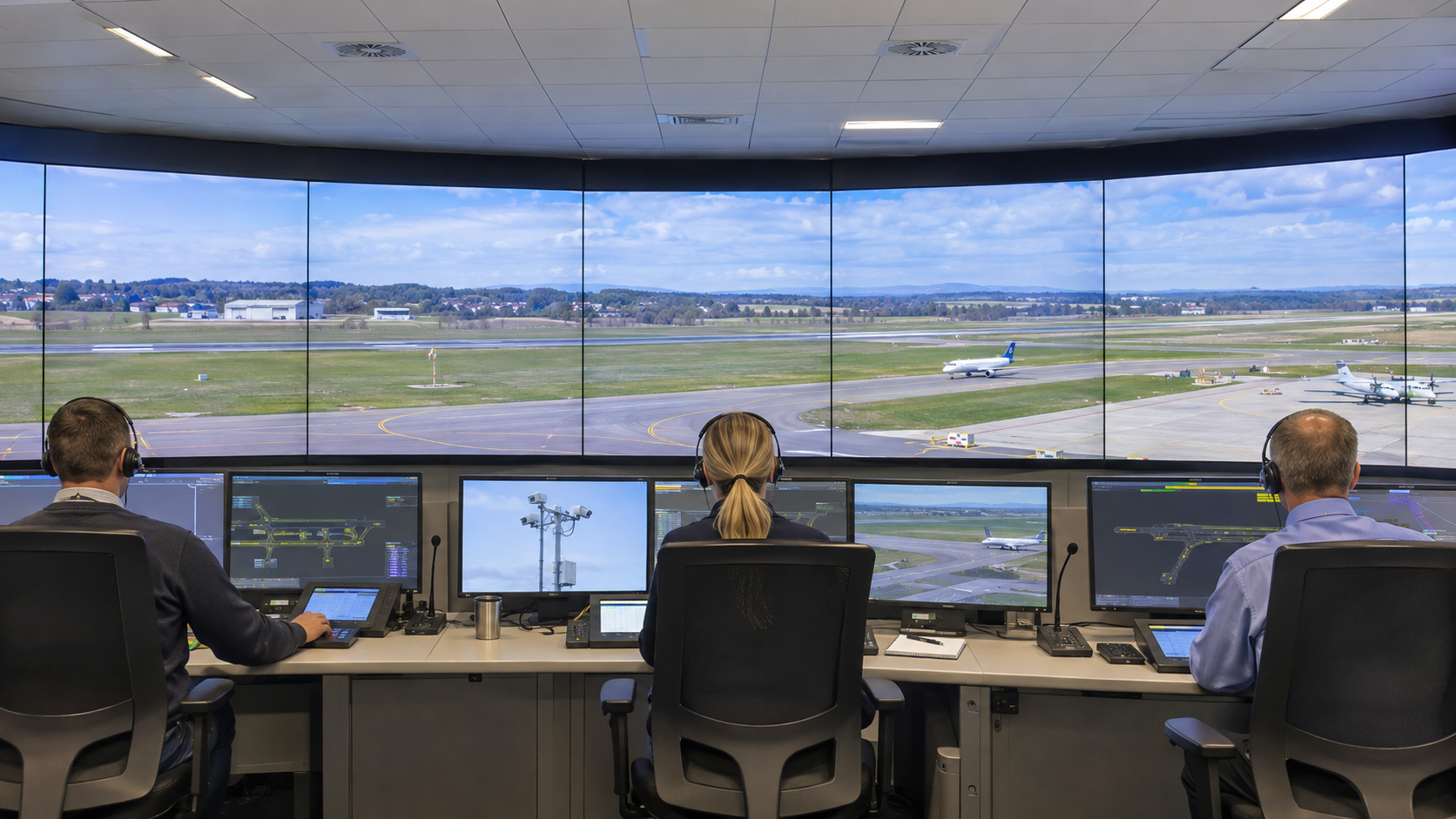
Concept illustration of a digital tower center using panoramic airport displays.
A digital tower starts with cameras and other sensors installed around the airport. Their feeds are processed and presented on dedicated displays in a Digital Tower Center. The controller uses the display wall as the primary visual view of the airport, while radios, weather information, lighting controls and flight data remain part of the working position.
The FAA says the system can be located on or off airport property, although federally funded installations may face specific property requirements. The agency is also changing its terminology from remote tower to digital tower because the control room does not have to be geographically remote. Older documents may still use both names.
The connection is not an ordinary internet video stream. FAA guidance says the camera mast and control center currently require a closed, physically point-to-point network with an independent fiber-optic feed; Wi-Fi is not allowed for that data path. That design reduces exposure to shared wireless networks and supports predictable performance, but it also means an airport must plan fiber routes, power, redundancy, maintenance access and recovery procedures.
What controllers gain and what stays human
A panoramic display can give controllers one continuous view instead of forcing them to turn between windows or work around a blocked line of sight. Camera systems can also support zoomed views and integrated information that a conventional window cannot provide by itself. Frequentis describes its platform as combining visualization, communications, weather, lighting and flight data, although individual airport configurations can differ.
Those tools do not authorize autonomous control. Controllers remain responsible for issuing clearances and instructions under FAA procedures. A camera may improve the visual picture, but it still depends on lens condition, lighting, weather, network performance, display quality and correct interpretation. The FAA’s approval process therefore evaluates the complete system and its safety case rather than treating cameras as a drop-in consumer product.
The FAA approval is narrower than a nationwide replacement plan
The first Frequentis System Design Approval covers a defined use case for sponsor-owned contract-tower airports, including the approved runway and airspace configuration. The FAA says a new design review typically takes about 24 to 36 months, depending on product maturity and supporting engineering evidence. Individual airport installations also require commissioning, operational coordination and updates to airport plans and publications.
The FAA states that more work is required before digital systems can replace federally owned brick-and-mortar towers. In other words, the Bartow and Kenai milestone establishes an operational path, not a blanket decision to convert every tower in the National Airspace System. Expansion will depend on approved system designs, airport suitability, funding and site-specific safety work.
Five additional airports are next
The FAA named five non-towered airports that are expected to receive digital systems:
- Winter Haven Regional Airport in Florida
- Venice Municipal Airport in Florida
- Montgomery County Airpark in Maryland
- Johnston Regional Airport in North Carolina
- Durango–La Plata County Airport in Colorado
The announcement does not provide a go-live date for each location. It also does not say that all five airports will begin tower service at the same time. Funding, design, construction, fiber installation, testing, staffing and FAA commissioning can create different schedules. Travelers and local pilots should use the airport and FAA’s current notices rather than treating the list as a completed deployment.
What passengers should expect
A passenger should not need a special app or document because an airport uses a digital tower. Airline check-in, identification, security screening, boarding and baggage processes remain separate. The FAA’s announcement also does not promise an immediate schedule expansion, lower fares or shorter delay times.
The more realistic benefit is indirect. Better controller visibility and a modern control facility can support safe airport operations and future service planning, especially at regional airports where a conventional tower may be expensive to build or replace. Whether that eventually changes flight frequency or reliability depends on airlines, weather, runway capacity, staffing and many other constraints beyond the tower technology.
What pilots should verify before using a digital-tower airport
The basic operating discipline does not change: use current charts and airport information, obtain weather and notices, monitor the published frequency and follow controller instructions. The FAA says airport diagrams can mark the camera-and-signal-light location with a square labeled D-TWR, while the chart supplement can note that the signal light gun is co-located with the digital tower.
Pilots should not infer camera coverage, zoom capability or backup arrangements from a promotional description. Check the current Chart Supplement, airport diagram, NOTAMs and local guidance for the exact site. The presence of cameras does not remove see-and-avoid obligations, radio procedures or the need to report an unsafe or unclear situation to air traffic control.
A useful FAA handbook for airport operations
The FAA publishes the Pilot’s Handbook of Aeronautical Knowledge online at no cost. Readers who prefer a printed reference can find the 2023 color-print edition of FAA-H-8083-25C on Amazon (ASIN B0CKV58CW9). Chapter 14 covers airport operations, signs, markings, lighting and traffic patterns. The handbook is background material rather than a site-specific guide to the new digital-tower systems, so pilots should still use current FAA publications and local airport information.
Affiliate disclosure: ReaderSpice may earn a commission from qualifying Amazon purchases made through the link above, at no additional cost to you. Verify the edition, publisher, seller and current listing before ordering.
The bottom line
Bartow and Kenai mark a real change in U.S. air traffic control infrastructure: controllers at two airports are now using approved camera-and-display systems as their operational view of the airfield. The technology expands what a controller can see and changes where a control facility can be located, while keeping a human controller in charge.
The rollout is still limited. The approved path is not yet a universal replacement for federal towers, the next five sites do not have individual public completion dates, and passengers should not expect a new airport procedure. The important development is that digital towers have moved from testing into live U.S. operations, creating a practical model the FAA can evaluate before broader deployment.
Sources
Federal Aviation Administration: Digital Towers program timeline and System Design Approval process
Federal Aviation Administration: Digital Tower systems process and reference documents
Frequentis: Bartow digital tower X10 implementation — March 10, 2026
City of Kenai: Kenai Municipal Airport traveler information
Federal Aviation Administration: Pilot’s Handbook of Aeronautical Knowledge FAA-H-8083-25C
Amazon: Pilot’s Handbook of Aeronautical Knowledge FAA-H-8083-25C color print (ASIN B0CKV58CW9)