
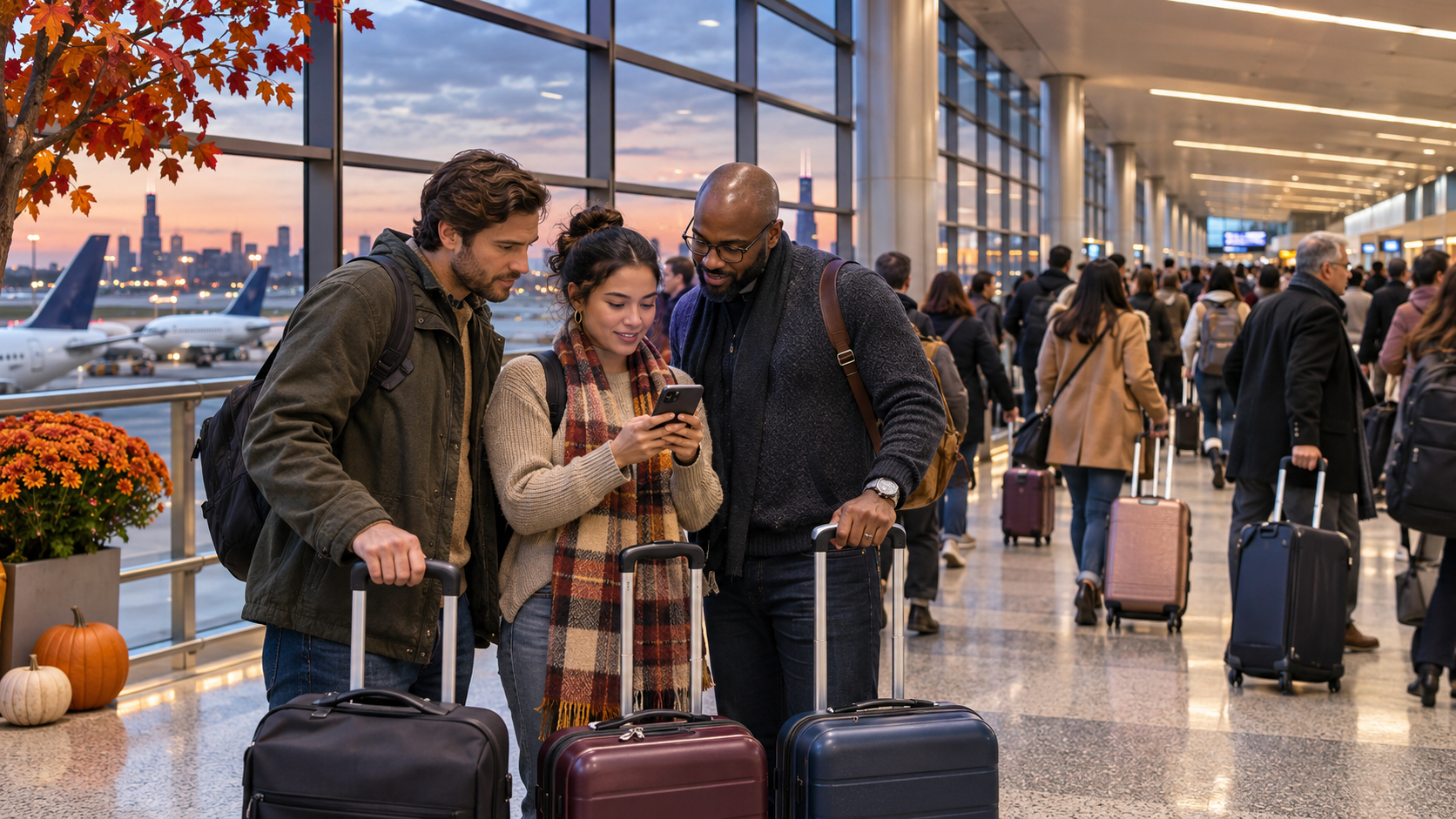
Chicago’s Thanksgiving return rush reaches its hardest point on Sunday, November 29. The Chicago Department of Aviation expects more than 297,000 passengers at O’Hare that day, the airport’s peak of a record seven-day holiday period. The useful plan is not simply to ‘leave early’: travelers need to decide whether they are parking, being dropped off, using the Blue Line, or meeting an arriving passenger before they enter the airport road system.
This guide focuses on O’Hare from Friday night through Monday morning. It combines the city’s November 24 passenger forecast with current airport parking and pickup instructions, CTA’s planned Sunday-night Blue Line work, and Illinois Tollway construction guidance. Conditions can change quickly, so verify the operating airline, terminal, parking status, CTA alert and road conditions again before departure.
O’Hare return travel at a glance
- Holiday period: Tuesday, November 24 through Monday, November 30, 2026.
- O’Hare forecast: nearly 1.67 million passengers, 7.2% more than 2025 and a Thanksgiving-week record.
- Peak day: Sunday, November 29, with more than 297,000 projected passengers.
- Parking: check the live FlyChicago parking module before driving in; economy lots can reach temporary capacity.
- Pickup rule: curbside waiting is prohibited. Use the free cell phone lot at 560 N. Bessie Coleman Drive until the traveler has baggage and is ready at the curb.
- Blue Line: trains run 24 hours, but planned single-track work between Harlem and Jefferson Park begins Sunday at 10 p.m. and runs until 4 a.m. Monday.
- Road plan: most temporary Tollway lane closures are suspended through 9 a.m. Monday, but permanent work-zone shifts and ramp closures remain.
Sunday will be O’Hare’s peak return day
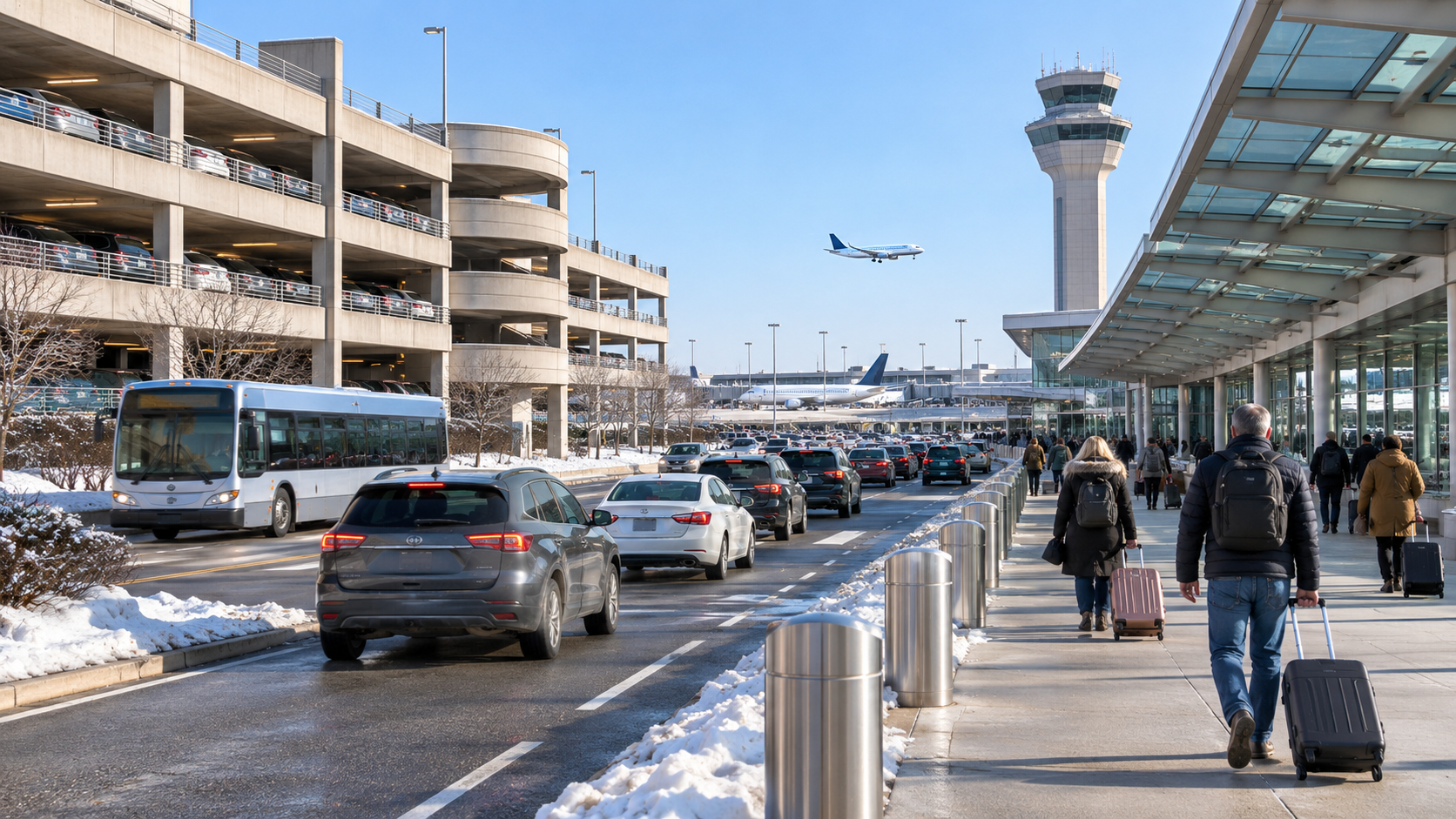
Sunday, November 29 is O’Hare’s projected peak day, so the curb and garages can become the trip’s first bottleneck.
CDA projects nearly 1.67 million O’Hare passengers across the November 24–30 period, with Sunday’s volume exceeding 297,000. That number includes arriving, departing and connecting travelers; it is not a security-line forecast. Still, the same surge pressures terminal roads, bag-drop counters, parking shuttles, rental-car facilities and airline rebooking capacity.
A practical departure plan works backward from the airline’s cutoff, not the scheduled takeoff alone. Complete online check-in when available, confirm the terminal with the operating carrier, and leave margin for parking or a Blue Line delay. A delayed flight should not be treated as permission to arrive late because bag-drop, check-in and boarding cutoffs may remain unchanged.
- Confirm the operating carrier and terminal before leaving home; codeshare itineraries can display a marketing airline first.
- Keep identification, medications, keys, essential chargers and one change of clothing in the cabin bag.
- Check TSA’s accepted-ID list if a license is not REAL ID compliant; a photo of an ID is not a substitute.
- Keep power banks and spare lithium batteries in carry-on baggage, not checked luggage.
- Save the airline’s app, confirmation number and rebooking contact before the terminal becomes crowded.
Choose parking, pickup or Kiss ’n’ Fly before entering I-190
O’Hare’s main garage and surface lots sit closest to the domestic terminals, while Terminal 5 has its own garage and Lot D. Economy F is at the Multi-Modal Facility and connects to the terminals by the Airport Transit System. Economy G and H use shuttle service. The live FlyChicago module is the authoritative source for open and temporarily full lots; a reservation or a familiar lot name is not a guarantee that the same route will be available when the car arrives.
The general parking page currently lists the main daily garage and Terminal 5 parking at $43 per day, Economy F at $30, and Economy G and H at $16. Rates and availability can change, so travelers should verify the live page rather than relying on a screenshot or an old search result. A cheap lot that is full is not a plan; identify a second acceptable lot and its terminal connection before driving.
Meeting an arriving traveler
Curbside waiting is prohibited. Drivers should wait free in the cell phone lot at 560 N. Bessie Coleman Drive until the traveler has deplaned, collected bags and reached the designated outer arrivals curb. The arriving traveler should send the terminal and door number only when actually ready; circling early adds traffic and can make the pickup slower for everyone.
Using Kiss ’n’ Fly and the Multi-Modal Facility
For departures, the Kiss ’n’ Fly point at the Multi-Modal Facility can avoid the terminal frontage. Passengers enter the Airport Transit System, which runs every few minutes at peak times and links Terminals 1, 2, 3 and 5 with the rental-car center and Economy F. Add time for the transfer and do not use this option if mobility needs or oversized baggage make the extra connection impractical.
Blue Line and Tollway plans can avoid curb traffic
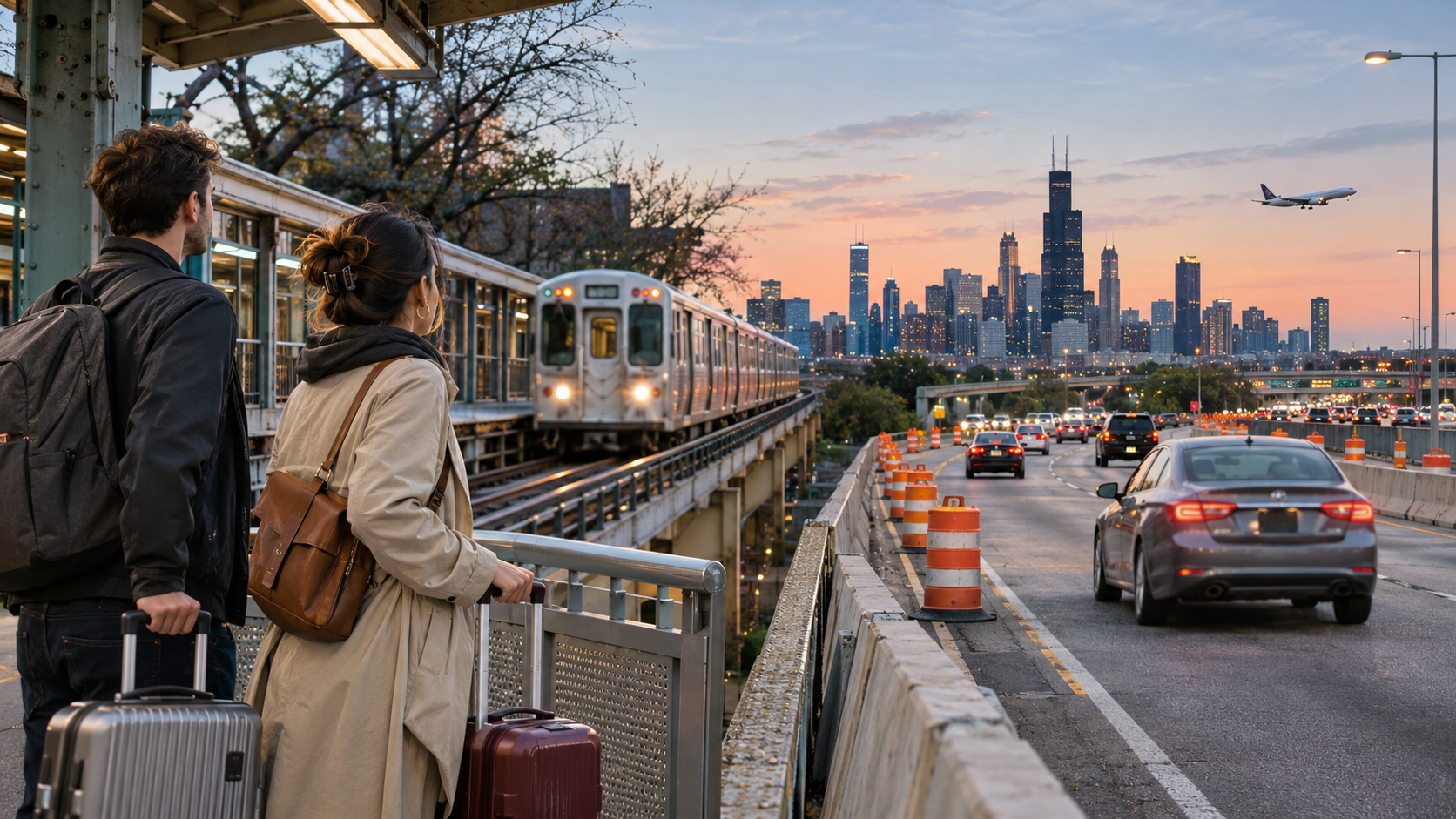
The Blue Line avoids airport parking, while drivers still need to account for I-294 work-zone shifts and closed ramps.
The CTA Blue Line runs between O’Hare and downtown 24 hours a day. It is often the more predictable choice when terminal roads and garages are crowded, but it still requires a transfer plan at the Chicago end and enough time for luggage, station access and platform waits.
CTA’s current alert page schedules single-track work between Harlem on the O’Hare branch and Jefferson Park from 10 p.m. Sunday, November 29 until 4 a.m. Monday. Trains will continue, but the agency warns of minor delays. Travelers on late Sunday flights should check the live alert again after landing; a construction window can shift, extend or be canceled.
Drivers get partial relief from the Illinois Tollway’s holiday construction suspension, which runs through 9 a.m. Monday. Existing work zones remain. On I-294, traffic is shifted between Cermak Road and the Lake Street Interchange, the ramps from westbound I-290 to northbound and southbound I-294 are closed, and the northbound Halsted Street ramp to southbound I-294 remains closed. A route that looked normal last year may now require a detour.
Build a disruption plan before leaving
A record passenger forecast increases the cost of improvising. If a flight is canceled or significantly changed, decide in advance whether the trip still has value on a later itinerary. U.S. Department of Transportation rules generally require a refund when an airline cancels or significantly changes a flight and the passenger rejects the alternative, but accepting a replacement flight or credit can change the remedy.
- Screenshot the operating carrier’s itinerary and terminal after the final confirmation.
- Know the latest acceptable arrival time at the destination before choosing a rebooking.
- Keep hotel, rental-car and event cancellation terms available offline.
- If driving, check both the Tollway map and the last few miles into O’Hare; local incidents can outweigh a clear interstate.
- If the car breaks down on the Illinois Tollway, stay belted inside when safe, turn on hazard lights and dial *999 for roadway assistance.
A relevant compact carry-on on Amazon
For travelers trying to avoid a checked-bag queue, the Amazon Essentials 21-inch hardside carry-on (ASIN B0711DPSXT) is a verified U.S. listing worth comparing with the operating airline’s exact size and weight limits. A product name that includes ‘carry-on’ does not guarantee acceptance on every airline or fare type, and expandable shells should be measured in the configuration used for travel.
Amazon sellers, colors, prices and return terms can change. Confirm the ASIN, seller, dimensions and delivery date before ordering. Affiliate disclosure: ReaderSpice may earn a commission from qualifying purchases through this link at no additional cost to you.
O’Hare return-trip checklist
- Reconfirm the operating airline, terminal and departure time on the travel day.
- Choose parking, drop-off, Blue Line or Kiss ’n’ Fly before entering the airport road system.
- Check live parking status; keep a second lot and its terminal connection ready.
- For pickups, wait in the free cell phone lot until the passenger has bags and a door number.
- For late Sunday Blue Line trips, account for the 10 p.m.–4 a.m. single-track work window.
- Keep identification, medications, batteries and essential electronics in the cabin bag.
- Review I-294 work-zone shifts and ramp closures, especially when approaching from I-290.
- Decide what refund or rebooking outcome is acceptable before disruption starts.
The bottom line
Sunday, November 29 is not a normal O’Hare day: more than 297,000 passengers are projected during the airport’s busiest Thanksgiving week on record. The most useful defense is a complete ground plan. Parking users need a live lot check and backup. Pickup drivers should use the cell phone lot. Late-night Blue Line riders need the planned single-track window. Tollway drivers need current work-zone routing, not last year’s memory.
Build margin around the step you control least, whether that is a garage shuttle, bag-drop line, train transfer or I-294 detour. Confirm the live status close to departure and keep essential documents and batteries with you. A specific plan will save more time than simply leaving ‘a little early.’
Sources
- Chicago Department of Aviation — Thanksgiving 2026 passenger forecast and Sunday peak
- Chicago O’Hare — Live parking status, locations and rates
- Chicago O’Hare — Pickup, cell phone lot and Kiss ’n’ Fly instructions
- Chicago O’Hare — Airport Transit System and Multi-Modal Facility connections
- CTA — Blue Line hours and current/planned service alerts
- Illinois Tollway — Thanksgiving traffic forecast, construction suspension and active work zones
- TSA — Acceptable identification and REAL ID guidance
- FAA — Airline passenger battery rules
- U.S. Department of Transportation — Airline cancellation and refund rights
- Amazon — Amazon Essentials 21-inch hardside carry-on, ASIN B0711DPSXT
Inline image 1: O’Hare curb and parking pressure. Alt text: Travelers with rolling luggage approach a busy airport terminal beside a parking garage, shuttle bus and curb traffic.
Inline image 2: Blue Line and Tollway planning. Alt text: Travelers with luggage compare a Chicago commuter train and a busy expressway work zone at sunset.