The Dark World

Love, this word now doesn’t exist
Hate, now have overcame Love
Honesty, took another name brutality
By seeing all this I/m feeling anxious

World is seem to be dark
Hater overrated thy feelings
In such case, I’m only searching for
love, in this cruel world.

Now, there is no any path
where the light of love shines again
There is no any way
where I can go in search of optimism.

People killed their desire of peace
Thinking that they will be rich
But, where can they find the calm
War have exodus optimism
I’m feeling rit-et-raf
God I am calling you to pick me up
I don’t want to live in this world
where brutality still exist….

-Shailesh Sapkota

Nike’s CSR Challenge | Case Study

One of the popular known brands Nike, who manufacture sports and clothing, has more than 50,000 workers produces shoes through subcontractors. Most of their factories are located in Asian countries because of large non-employed population and low cost workers.


In 2005 Nike started disclosing their CSR activities after a couple of years of silence due to legal concerns. After several audits Nike reported that a large percentage of their overseas factories have their employees working in terrible environments for low pay and in unsanitary health conditions. This is the first time that a major corporation has revealed such problems to the public so honestly. Nike is now taking a new strategy and approach in an attempt to correct these problems. They are attempting to take responsibility to effect positive systematic changes in working conditions with several branches of their industry.
Nike plans to reshape the way customers, supplies, investors, and regulators see the company. They are changing it from a closed system and making the company more open so that suppliers and customers can relate to Nike. One of Nike’s problems is changing the way its leadership and management style that is “leaders beyond borders” meaning leaders reach out to more than just their professional role and engage people on shared goals. Nike needs to reach out to wider issues of trade flows, governance, and media otherwise all their changes may not make a difference as they optimistically hope.
Case Questions:

  1. Discuss the challenges regarding corporate social responsibility that companies in the apparel industry face in their supply chains around the world.
  • The apparel industry is possibly for the most part at risk to issues of social responsibility. The industry is still somewhat labor intensive and operates in a low wage environment. For example, in developing countries, apparel and sports manufacturers lack trained personal, information on CSR implementation and benefits and insufficient infrastructures for initiating CSR, but 25% to 50% of the factories in the South Asian region restrict access to toilets and drinking water during the working day. The industry has a lot of contract manufacturing in which a foreign firm is contracted to do all the production for the firm owning the brand.

Extra working hours are also required to meet demands, which result in overtime and poor working conditions in developing countries, but the same percentage of factories in Asia denies workers at least one day off in seven. More than 60 hours per week and 25% of workers punished for refusing overtime work. All of this can lead to the problems we can see in this case.

  1. Discuss the meaning and implications of the statement by a Nike representative that “consumers are not rewarding us for investments in improved social performance in supply chains.”

– This statement suggests that those companies who invest their sources on “above-standard compliance” will be outperformed by those companied who are less concerned about compliance. Therefore, companies who concerns about compliance have to either reduce their profit margin or lose in market share if they charge extra for improved social performance. Nevertheless, it is not a good excuse for not doing the right thing. Although competitors may be engaging in unethical practices, and consumers may not care about the working conditions of foreign employees, it is still not a justification situation to engage in socially irresponsible actions. In the case of Nike, the company is not competing with the low end of the market, and one would assume that the premium pricing of the brand could allow for improvements in wages and working conditions. It should be pointed out that consumer perceptions and concerns can change and a firm can find it dealing with a successful PR campaign directed toward its practices. Consumer “rewarding” can change and make such companies vulnerable due to their foreign employment practices.

  1. What does it mean to have an industry open-systems approach to social responsibility? What parties are involved? Who are stakeholders?
  • Open-system approach refers to the organization views its actions in terms of the effect it has on larger social system that’s not only concerning with internal part of companies such as employees, manager, material, equipment and production, and labors, but also all elements, which includes environment-such as competitor, suppliers, distributors and governmental regulator, as well as citizenship and its internal elements. Basically everyone is involved in this case, ranging from government, to company and even customers/buyers. Stakeholders are person with an interest or concern in business. In addition to being socially responsive to internal stakeholders such as domestic employees, the organization also views its impact on suppliers, investors, regulators and communities, regardless of their location.
  1. What is meant by “Leadership beyond borders”?

– Leadership beyond borders means that leadership moves beyond borders or barriers created by others. For example, leaders in the apparel industry would attempt to extend their influence beyond the company borders in order to deal with the CSR issues. Real life example could be Gandhi, who has given hopes, whose life and personality was enhanced in the process. This kind of leader is only little in existence.
Transcendent leadership offers us a metaphor to help Nike move more closely to a world where human talents and energies will be maximized for the betterment of al – personally, organizationally, and globally (Gardiner, 2006).

  1. Is it possible to have “a compatibility of profits with people and planet”? Whose responsibility is it to achieve that state?

– Yes, it is possible to have “a compatibility of profits with people and planet”, but this is an idea of socialism and in some point it does not work. It’s everyone responsibility to care for each other and everything. It is a based of culture on corporation not competition with not just humans, but also everything that lives on the planet including other animals and resources. This is a social ideal ecosystem. Some people work hard toward the needs of others and the planet, while others will exploit. So it must be mixed with areas of competition in order to maintain a balance of cooperation with competition.

  1. Research Nike’s CSR actions since the time frame and why it has earned the reputation as one of the world’s foremost organizations in sustainability.

– When Nike adopted open-system approach, they had believed that the future of the company will be dependent on every element – internal and external. They believe that good society will bring good profitability and thus it would contribute to sustainability, Nike managed to create a green life cycle, were Nike has managed to eliminate waste in production and harmful substances, and ensure that all their products are recyclable and re-usable.
Despite Nike’s efforts to take the lead in the apparel industry to form a Global Alliance to improve labor conditions, not only in its own factories and sub-contractors, but also among its competitors on the footwear and other apparel industries, incidents such as:

  • Collapse in April 2013 of Rana building in Bangladesh, which housed a number of garment units, who were sub contractors to leading MNCs (Multinational corporations) collapsed, killing over a 1,000 people – mostly women and injuring seriously a few hundreds, keep happening.
  • Early this year (2014) in the state of Tamilnadu in India, 7 workers died when they were cleaning a tank in a textile dyeing unit, KPR textiles, Perundurai, Erode district. They were exposed to toxic gases from chemicals used in dyeing.

Nike also took the lead in forming the Fair Labor Association (FLA). The awareness and the initiative taken by Nike has been acknowledged and appreciated by all the stakeholders in the industry, including customers. The operation council of the Global Alliance after detailed audit, has commended Nike for the processes introduced, not only in its own operations and among its subcontractors, but also in the rest of the industry.

References:
Adidas Group. Sustainability History. Retrieved from:
http://www.adidas-group.com/en/sustainability/managing-sustainability/sustainability-history/
International Institute for Sustainable Development (2013). Nike. From:
http://www.iisd.org/business/viewcasestudy.aspx?id=81
Megha, G. (2012). Corporate Social Responsibility in the Global Apparel Industry: An Exploration of Indian Manufacturers’ Perceptions. Recovered from:
http://libres.uncg.edu/ir/uncg/f/Gupta_uncg_0154D_11000.pdf
The Bangladesh Factory Collapse: Why CSR is more important than ever
http://www.theguardian.com/sustainable-business/blog/bangladesh-factory-collapse-csr-important
CM condoles death of 7 workers in textile dyeing unit. From:
http://www.business-standard.com/article/pti-stories/cm-condoles-death-of-7-workers-in-textile-dyeing-unit-114031900421_1.html
Trapped in Textile. Retrieved from:
http://newjurist.com/trapped-in-textile.html

-Bishal Aryal

High Blood Pressure a Silent Killer

Almost one billion people worldwide have high blood pressure, and over half a billion more will harbor this silent killer by 2025. (AP News). Nowadays, high blood pressure is becoming common. This is a disease and can cause to anyone in the world. It is a major risk factor all around the globe. “Even in the U.S., the majority of people with high blood pressure are not treated reasonably,” says Dr. Sidney Smith of the University of North Carolina at Chapel Hill, who advises the World Heart Federation. This disease will not show or patients notice the symptoms until organs already have been damaged.
Continue reading “High Blood Pressure a Silent Killer”

Man Goes from One Women to Another

“Man goes from one woman to another, goes on changing. People think he is a great lover; he is not a lover at all. He is avoiding, he is trying to avoid any deep involvement because with deep involvement problems have to be faced, and much pain has to be gone through. So one simply plays safe; one makes it a point never to go too deeply into somebody.
If you go too deep you may not be able to come back easily. And if you go deeply into somebody, somebody else will go deeply into you also; it is always proportionate. If I go very deep in you the only way is to allow you also to go that deep in me. It is a give and take, it is a sharing. Then one may get entangled too much, and it will be difficult to escape and the pain may be much. So people learn how to play safe: just let surfaces meet — hit-and-run love affairs. Before you are caught, run.

This is what is happening in the modern world. People have become so juvenile, so childish; they are losing all maturity.

Maturity comes only when you are ready to face the pain of your being; maturity comes only when you are ready to take the challenge. And there is no greater challenge than love.”

~ Osho

Brushing Up on Colgate-Palmolive

This article is about Colgate Palmolive which produces essential personal products, such as toothpaste, detergents.  The word product is defined as anything that is offered to the market that will satisfy need or want.  As stated in the article Colgate had spent its huge amount of money in research and development for the product in the development stage. Due to the troubles in 2004 the company has increase its market share and profits through the use of cost cutting and advertising.

Decrease in profit lead to high reconstruction and stock options expense that affected the profits for the past several years. Colgate is a big producer of consumer products. Consumer product is defined as a product which is bought by consumers to satisfy their individual needs and wants. This leads to a very long-term stable firm because its products are always going to be needed in the future. Colgate and rival Proctor & Gamble are very brand oriented; their brand is very distinguished from others. A brand is a collection of images and ideas representing an economic producer. It refers to the concrete symbols such as a name, logo, slogan, and design scheme. A Colgate brand serves to create associations and expectations among products made by a producer and also it gives the company the opportunity to increase prices without causing a change in the demand.
The global brand builders are also intensely creative in getting their message outside its home country at least 20 percent. Many of the biggest and most established brands like Colgate, Coca-Cola, Marlboro, achieved their global market. There brand as well their products are very well known. Colgate discovered new ways to captivate and attract new consumers and it is trying improving its marketing strategy by increasing production line. Product lining is the marketing strategy of offering for sale several related product by a single company. Therefore, Product lining will help to satisfy similar needs for different target audience. The more the product the more audience the companies are able to attract.

-Pravesh Khanal

Finding Happiness | Cartoon of the Week

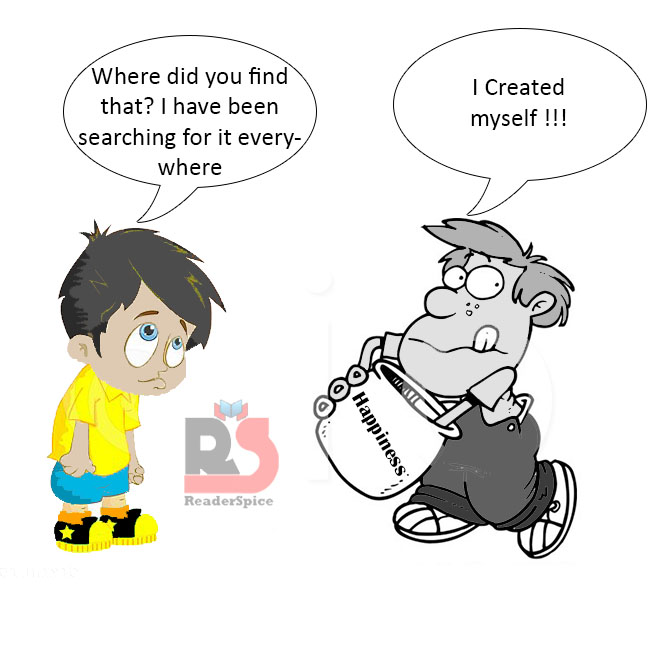
When I created this cartoon, I was thinking the same what the picture is trying to portray. The above picture speak itself. However, this image is really trying to give a very good lesson to everyone. People cannot be happy during their lifetime, they have many ups and downs in their entire life.

However, creating happy environment is the main key point to be a successful. The guy on the left is colorful, he looks like he has everything. He looks richer and brighter, but he is still missing something that is making him sad. He is trying to find a precious moments that will make him happy. His facial expression shows that he is lonely and looking to make himself happy.
The picture portray that the Yellow guy is looking for the happiness. He tried to look for it, however he failed to find it. All the sudden he saw another guy holding happiness and finally he ask him that, “Where did you find that? I have been searching for it everywhere.” Yellow guy think that the other guy is holding his happiness.
All the sudden it came out that the black and white guy, who looks poor, but he is happy. He said that, “I created myself” That means he made himself happy.
The moral of this picture is that, “Happiness has to be created by yourself, not by others.” Be happy, try to forget or don’t remember difficult stages of your life. Just move on and be happy.

-Bishal

Top 10 Principles for Positive Business Ethics

This morning, I read about a company using on-line auctions to defraud customers. Last week, I consulted on an ethics complaint where a business coach betrayed a client’s confidentiality. And, recently a Physician was convicted of insider trading based on information from a patient, a violation of both business ethics and her professional ethics.


Business ethics are the key to profits. If clients and customers don’t trust you, and your business ethics, they will not do business with you. Would you buy from a company you didn’t trust? Of course not!

Business ethics have become a hot-button topic. There are often ethical conflicts between making money, and doing what is right. There can be dilemmas about doing what is best for your employer, what’s best for your own career, and what’s best for the customer. Business ethics is about negotiating these mine-fields. Here are my Top 10 Principles for Positive Business Ethics:

1. Business Ethics are built on Personal Ethics. There is no real separation between doing what is right in business, and playing fair, telling the truth and being ethical in your personal life.

2. Business Ethics are based on Fairness. Would a dis-interested observer agree that both sides are being treated fairly? Are both sides negotiating in good faith? Does each transaction take place on a “level playing field”? If so, the basic principles of ethics are being met.

3. Business Ethics require Integrity. Integrity refers to whole-ness, reliability and consistency. Ethical businesses treat people with respect, honesty and integrity. They back up their promises, and they keep their commitments.

4. Business Ethics require Truth-telling. The days when a business could sell a defective product and hide behind the “buyer beware” defense are long gone. You can sell products or services that have limitations, defects or are out-dated, but not as first-class, new merchandise. Truth in advertising is not only the law, business ethics require it.

5. Business Ethics require Dependability. If your company is new, unstable, about to be sold, or going out of business, ethics requires that you let clients and customers know this. Ethical businesses can be relied upon to be available to solve problems, answer questions and provide support.

6. Business Ethics require a Business Plan. A company’s ethics are built on its image of itself and its vision of the future and its role in the community. Business ethics do not happen in a vacuum. The clearer the company’s plan for growth, stability, profits and service, the stronger its commitment to ethical business practices.

7. Business Ethics apply Internally and Externally. Ethical businesses treat both customers and employees with respect and fairness. Ethics is about respect in the conference room, negotiating in good faith, keeping promises and meeting obligations to staff, employers, vendors and customers. The scope is universal.

8. Business Ethics require a Profit. Ethical businesses are well-run, well-managed, have effective internal controls, and clear expectations of growth. Ethics is about how we live in the present to prepare for the future, and a business without profits (or a plan to create them) is not meeting its ethical obligations to prepare for the future well-being of the company, its employees and customers.

9. Business Ethics are values-based. The law, and professional organizations, must produce written standards that are inflexible and universal. While they may talk about “ethics”, these documents are usually prescriptive and refer to minimal standards. Ethics are about values, ideals and aspirations. Ethical businesses may not always live up to their ideals, but they are clear about their intent.

10. Business Ethics come from the Boss. Leadership sets the tone, in every area of a business. Ethics are either central to the way a company functions, or they are not. The executives and managers either lead the way, or they communicate that cutting corners, deception and dis-respect are acceptable. Line staff will always rise, or sink, to the level of performance they see modeled above them. Business ethics starts at the top.

Ethics is about the quality of our lives, the quality of our service, and ultimately, about the bottom line. An unhappy customer complains to an average of 16 people. Treating employees, customers, vendors and the public in an ethical, fair and open way is not only the right thing, in the long run, it’s the only way to stay in business.

© Copyright 2003 by Philip E. Humbert. All Rights Reserved. This article may be copied and used in your own newsletter or on your website as long as you include the following information: “Written by Dr. Philip E. Humbert, writer, speaker and success coach. Dr. Humbert has over 300 free articles, tools and resources for your success, including a great newsletter! It’s all on his website at: http://www.philiphumbert.com

Article Source: http://EzineArticles.com/expert/Philip_E._Humbert/36018

Second Big Festival in Nepal

There is a second big festival going on in Nepal at the moment called “Dipawali” or “Tihar”. This festival will last for couple of days, 5 days to be exact. First three days are the animals. Especially, the second day of the festival is solely for dog.

“Kukur” (DOG) Tihar in Nepali or Worship of the dogs is the name for this day. Each year during this festival Nepalese people worship dogs. Mostly people offer garlands, “tika” (crimson color on their forehead) and delicious food to dogs.
Old believe of this festival is Dogs are the messengers of the Lord Yamarag (God of Death) and they guards the Heaven. So by pleasing dog worshipers are going to meet at Heaven’s door, and allow to be enter in Heaven.
Nowadays, people celebrate this festival to cherished relationship between humans and dogs. Their loyalty, love and friendship with human make worship-able as well.

Watch Below Video

Video has been uploaded on Image Channel Television on YouTube

-Bipin Aryal