
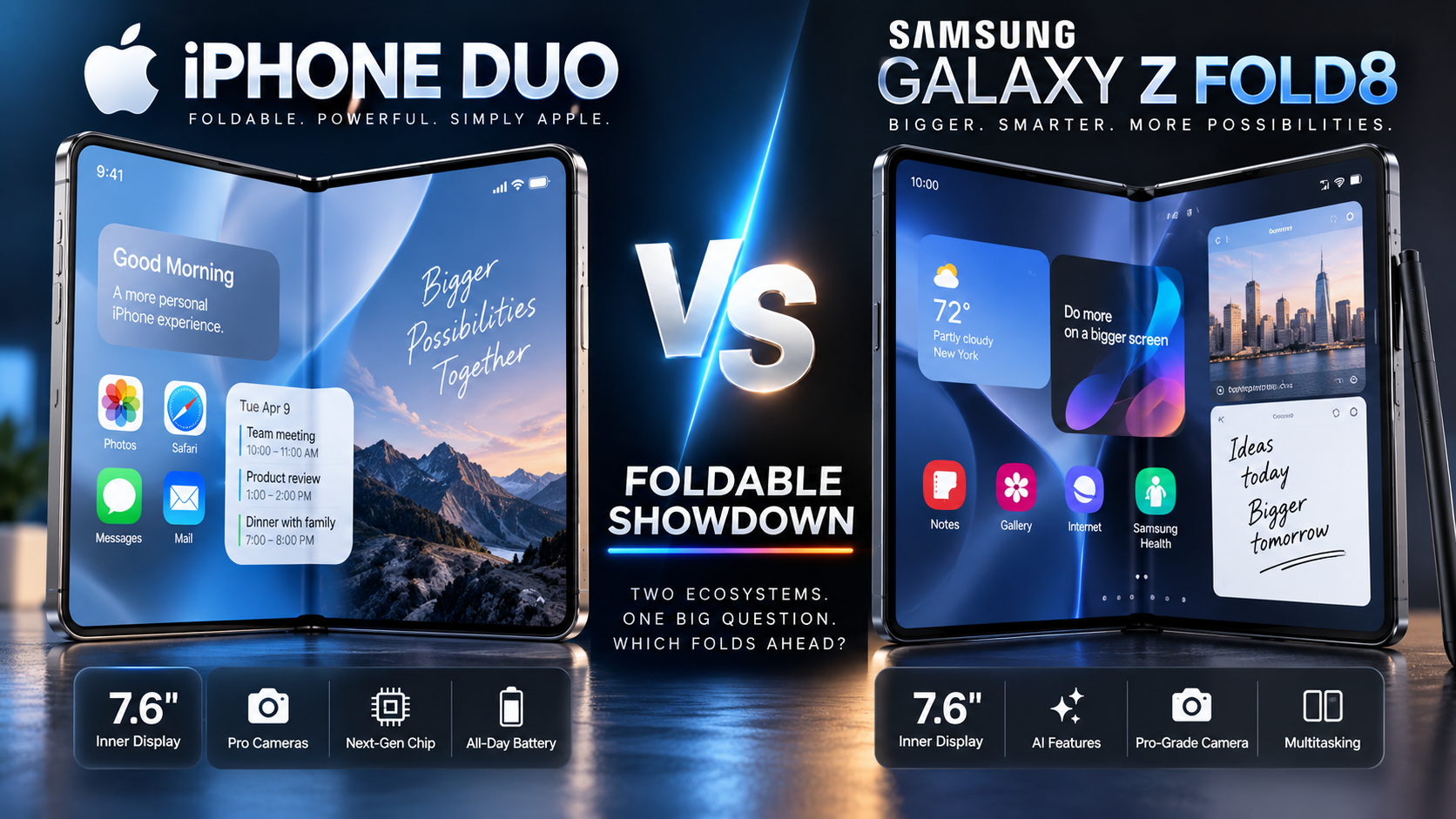
Apple has officially entered the foldable-phone market with the iPhone Duo, putting its first folding iPhone directly against Samsung’s Galaxy Z Fold8. Both use a passport-style book design, both open to a 7.6-inch display, and both target buyers willing to spend flagship-level money for a phone that can become a small tablet.
But these two foldables take noticeably different approaches. Apple emphasizes iOS integration, its A20 Pro chip, Apple Intelligence, Apple Pencil support and continuity between the two displays. Samsung’s Fold8 is dramatically lighter, thinner when unfolded, built around Galaxy AI and Android multitasking, and comes from a company with years of foldable-phone experience.
Here is how the iPhone Duo and Galaxy Z Fold8 compare based on their official specifications and announced features.
Design: Similar Idea, Very Different Weight
The biggest surprise is how similar the basic form factors are. Apple’s iPhone Duo has a 5.4-inch outer display and a 7.6-inch inner folding display. Samsung gives the Galaxy Z Fold8 a 5.5-inch cover display and the same 7.6-inch main-screen size.
The difference becomes much more obvious when you pick up the spec sheet. Samsung says the Galaxy Z Fold8 weighs just 201 grams and measures 4.5 mm thick when unfolded. Apple lists the iPhone Duo at 254 grams and 5.2 mm unfolded.
That makes the Fold8 53 grams lighter. For a device designed to be carried every day, that difference could be meaningful. Apple counters with a grade 5 titanium construction and a precision hinge, while Samsung uses Armor Aluminum, Gorilla Glass, an Armor FlexHinge and its Flex Titanium display reinforcement.
Displays: Both Give You a 7.6-Inch Canvas
Both phones open to a 7.6-inch OLED display with adaptive refresh rates up to 120Hz. Apple’s inner Super Retina XDR panel has a 2670-by-1878 resolution at 430 ppi, while Samsung’s Fold8 uses a 7.6-inch main display designed around a wider 4:3 aspect ratio.
Apple also applies a nano-texture finish to the inner screen to reduce glare. The iPhone Duo supports Apple Pencil (USB-C), which gives Apple an interesting productivity angle for handwritten notes, markup and creative work.
Samsung focuses heavily on side-by-side productivity. Its wide main screen supports Multi Window, and Samsung has spent several generations refining Android apps, drag-and-drop workflows and multitasking for Galaxy Fold devices.
iOS 27 vs Android and Galaxy AI
Software may be the biggest reason to choose one device over the other.
The iPhone Duo ships with iOS 27.1, with Apple redesigning parts of iOS specifically for the foldable form factor. When opened, the Duo can show two Home Screen pages, and Apple has adapted the Dock, navigation controls, Dynamic Island and Live Activities for the larger folding canvas. Content can react as the phone folds, rotates or switches displays.
The Duo also combines Apple Intelligence and Siri AI with the foldable interface. For people already using Macs, iPads, Apple Watches and AirPods, the broader Apple ecosystem may be one of its strongest advantages.
Samsung approaches productivity from the Android side. Galaxy Z Fold8 combines Galaxy AI with Google’s Gemini experiences and Samsung’s mature Multi Window system. Samsung specifically highlights side-by-side productivity and AI workflows on the Fold8’s larger display.
Performance: A20 Pro vs Snapdragon 8 Elite Gen 5 for Galaxy
Apple powers the iPhone Duo with its A20 Pro chip, along with a custom vapor chamber and dual-battery architecture. Samsung uses the Snapdragon 8 Elite Gen 5 for Galaxy, a customized Qualcomm platform with upgraded CPU, GPU and NPU performance.
Raw benchmark numbers will matter once the devices can be tested side by side, but both are positioned as premium flagship processors. In day-to-day use, the larger difference may come from how iOS and Android use the folding display rather than from processor speed alone.
Cameras: Two Different Takes on Foldable Photography
The iPhone Duo includes a 48MP Fusion Main camera and a 48MP Ultra Wide camera, with 2x optical-quality zoom. Apple also uses the folding design for new shooting options, including ways to use the outer display while taking photos and video.
Samsung’s Galaxy Z Fold8 has a 50MP Wide camera and a 50MP Ultra Wide camera, with up to 10x digital zoom. Samsung describes it as a camera system aimed at social-media creators and also takes advantage of the foldable body for flexible shooting positions.
Neither phone should automatically be judged by megapixel count alone. Image processing, video quality, low-light performance and consistency will require real-world testing.
Battery and Charging
Samsung lists a 4,800 mAh typical battery for the Galaxy Z Fold8 and rates it for up to 26 hours of video playback under its test conditions.
Apple does not market the iPhone Duo around a conventional mAh figure on its main product page. Instead, Apple uses a dual-battery architecture and describes the device as delivering all-day battery life. Real-world comparisons will be especially important because foldable battery life can vary significantly depending on how often the large inner screen is used.
Price and Availability
Apple’s iPhone Duo starts at $1,999 in the United States with 256GB of storage. Apple says pre-orders begin October 16, 2026, with availability beginning October 23.
Samsung launched the Galaxy Z Fold8 earlier, with general U.S. availability beginning August 7, 2026. Retail pricing and promotions can change, so buyers should compare current offers rather than relying only on launch pricing.
Amazon Shopping Links
ReaderSpice may earn a commission from qualifying purchases made through affiliate links, at no additional cost to you.
Shop Samsung Galaxy Z Fold8 on Amazon
Shop Apple iPhone models on Amazon
These are standard Amazon links for now and can be replaced with ReaderSpice affiliate links.
Where the iPhone Duo Stands Out
The iPhone Duo is particularly notable for bringing Apple’s ecosystem to a foldable for the first time. It combines the A20 Pro, iOS 27.1, Apple Intelligence, Apple Pencil support, a nano-texture 7.6-inch display and Apple’s familiar app ecosystem in a completely new iPhone form factor.
It is also Apple’s first generation of foldable hardware, which makes independent durability and long-term hinge testing worth watching once the phone reaches customers.
Where the Galaxy Z Fold8 Stands Out
Samsung’s Fold8 has a substantial portability advantage on paper. At 201 grams and 4.5 mm unfolded, it is considerably lighter and thinner than the iPhone Duo. Samsung also brings years of experience developing foldable software, Multi Window workflows and hinge designs.
For users who frequently run multiple apps at once or already use Galaxy and Google services, the Fold8’s Android-based multitasking environment offers a different experience from Apple’s approach.
Which One Fits Your Needs?
The specifications point to two distinct priorities rather than a universal winner. The iPhone Duo brings foldable hardware into Apple’s ecosystem, with iOS 27.1, Apple Intelligence, Apple Pencil support and tight integration with other Apple products. The Galaxy Z Fold8 emphasizes lower weight, a thinner unfolded design, established foldable multitasking and Galaxy AI.
People already invested in either ecosystem may find that software, apps, accessories and connected devices matter more than small differences in specifications. Buyers who are flexible between iOS and Android should also consider portability, multitasking style, cameras, durability and current pricing before deciding.
Sources
Apple Newsroom — Apple unveils iPhone Duo
Apple — iPhone Duo Technical Specifications
Samsung — Galaxy Z Fold8 Features
Samsung Newsroom — Making the Most of Your New Galaxy Z Fold8
9to5Mac — iPhone Duo vs Galaxy Z Fold8 specification comparison