
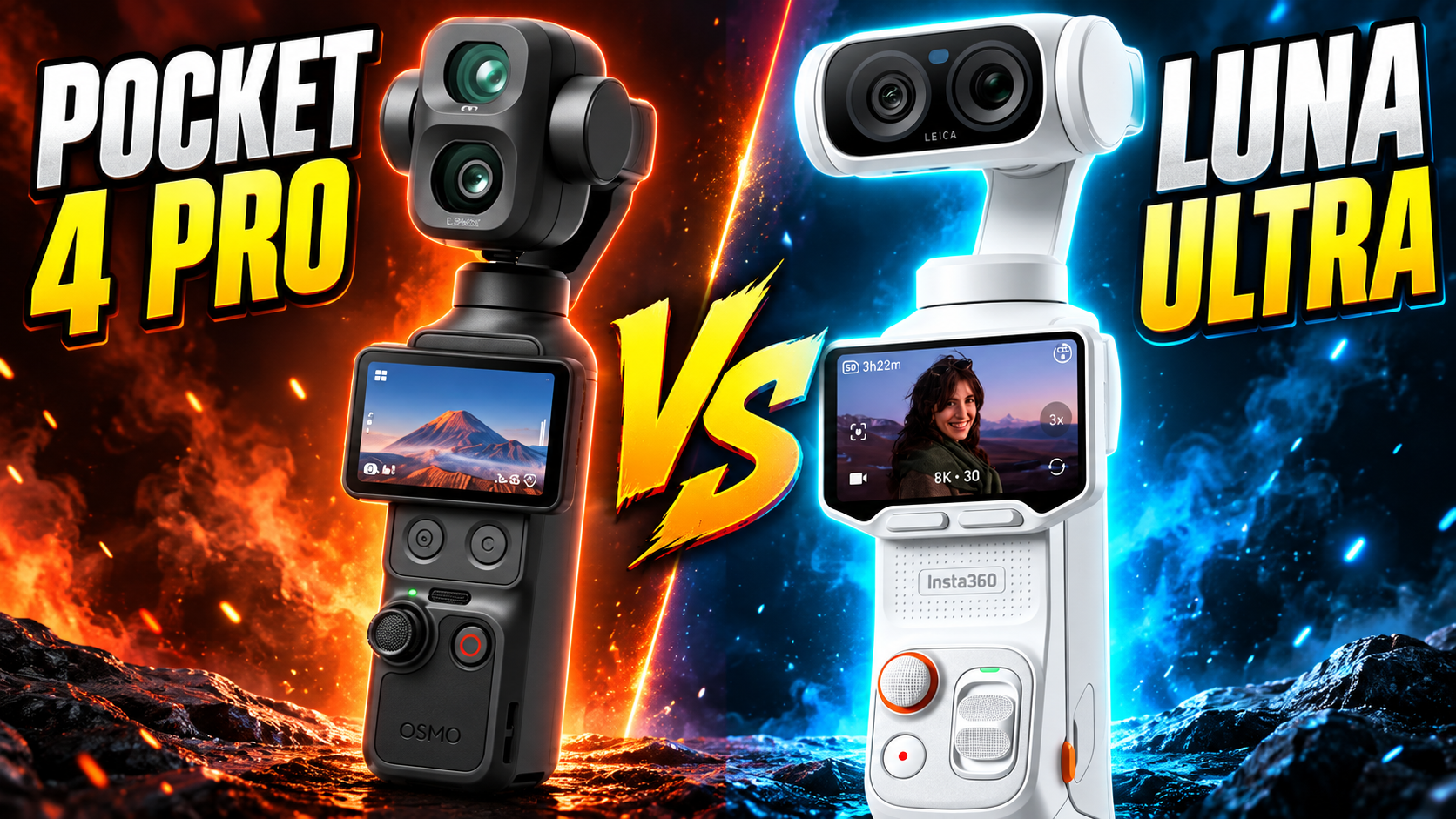
DJI and Insta360 are now fighting for the same creator with two of the most ambitious pocket gimbal cameras yet. The DJI Osmo Pocket 4P doubles down on cinematic 4K, extreme dynamic range, fast slow motion and DJI’s tracking ecosystem, while the Insta360 Luna Ultra pushes the category toward 8K, Leica optics, a detachable monitoring screen and a more flexible remote-shooting workflow.
Both cameras use a 1-inch main sensor, both add a dedicated 60mm-class telephoto camera, both have three-axis mechanical stabilization, and both are built for creators who want more than a phone without carrying a mirrorless camera and separate gimbal.
The similarities stop there. DJI and Insta360 made very different choices around resolution, color workflow, storage, screen design and creator features. Here is how the Osmo Pocket 4P and Luna Ultra compare based on current official specifications and announced features.
Quick Comparison: Two Dual-Lens Cameras, Two Different Priorities
DJI Osmo Pocket 4P: 1-inch wide camera, 1/1.28-inch 60mm med-tele camera, up to 17 stops of dynamic range in supported D-Log 2 shooting, 4K up to 240fps on the wide camera, ActiveTrack 8.0, 103GB built-in storage and up to 210 minutes of rated operating time.
Insta360 Luna Ultra: 1-inch 8K main camera, 1/1.3-inch 60mm telephoto camera, Leica Summicron optics, 8K30, 4K120, 10-bit I-Log, detachable 2-inch OLED monitoring screen, 47GB internal storage plus microSD expansion up to 2TB, and up to 240 minutes of rated battery life under Insta360’s laboratory conditions.
Camera Hardware: Surprisingly Similar on Paper
Image: DJI Osmo Pocket 4P official Cannes preview image. Source: DJI.
The basic camera layouts are remarkably close. DJI uses an all-new 1-inch CMOS wide-angle camera with a 20mm-equivalent f/2.0 lens and pairs it with a 1/1.28-inch 60mm-equivalent med-tele camera with an f/1.8 aperture. DJI says the wide camera can deliver up to 17 stops of dynamic range in its supported D-Log 2 workflow.
Luna Ultra also uses a 1-inch main camera, but its main Leica Summicron lens is slightly faster at f/1.8. Its secondary 60mm-equivalent telephoto camera uses a 1/1.3-inch sensor and an f/2.0 aperture. The difference in telephoto sensor size is small on paper, so real-world image processing, autofocus, highlight handling and low-light performance will matter more than the fractionally different sensor dimensions.
Both systems give creators a true wide-to-telephoto jump without swapping lenses. That is a major change for pocket gimbal cameras, which historically relied heavily on digital cropping once users wanted a tighter frame.
Resolution and Slow Motion: 8K vs Extreme 4K Frame Rates
This is one of the clearest differences. Luna Ultra can record 8K 16:9 video at up to 30fps and 4K at up to 120fps. It also supports 10-bit I-Log and Dolby Vision, giving creators both high-resolution capture and a professional grading option.
DJI takes a different route. The Osmo Pocket 4P tops out at 4K rather than 8K, but the wide camera can record 4K slow motion up to 240fps, while the med-tele camera can reach 4K up to 200fps in supported modes. For creators who film sports, action, product sequences or cinematic slow-motion inserts, those frame rates are a major advantage.
So the tradeoff is straightforward: Luna Ultra gives you more resolution for reframing and cropping, while Pocket 4P puts more emphasis on high-frame-rate 4K capture.
Dynamic Range and Color: DJI D-Log 2 vs Insta360 I-Log
DJI is heavily promoting the Osmo Pocket 4P’s new D-Log 2 workflow. DJI says the wide camera can reach up to 17 stops of dynamic range under its stated test conditions, which is unusually ambitious for a camera this small. The goal is to preserve more highlight and shadow information for color grading, especially in high-contrast scenes.
Insta360 counters with 10-bit I-Log on Luna Ultra, along with Dolby Vision and Leica color options. Insta360 lists a maximum video bitrate of 150Mbps and supports 10-bit video across its professional modes. Luna Ultra’s Leica partnership also gives it a distinctive color-science story that may appeal to creators who want attractive footage without always doing a heavy grade.
The important detail is that spec-sheet dynamic range and real usable dynamic range are not always the same thing. Independent side-by-side testing will still matter for skin tones, highlight roll-off, shadow noise and matching the wide and telephoto cameras.
Zoom and Telephoto: Both Reach 12x, but Differ in Approach
Both cameras are built around a 20mm wide view and a 60mm telephoto view, giving a natural 1x-to-3x optical jump. DJI advertises up to 12x zoom and ActiveTrack support at high zoom levels. The dedicated 60mm f/1.8 camera is particularly aimed at portraits and compressed-background shots.
Luna Ultra also reaches up to 12x in supported 4K modes and offers up to 6x Clarity Zoom. Its 8K mode supports zoom from 1x to 6x, and the second camera is central to Insta360’s five-focal-length shooting concept.
For creators who regularly film people, stages, street scenes or distant travel details, both cameras are far more flexible than a traditional single-lens pocket gimbal.
Screen and Solo-Creator Workflow: Luna Ultra Has the More Radical Design
Image: Insta360 Luna Ultra product configuration. Source: Metapod product listing (manufacturer product image).
DJI keeps a conventional integrated 2-inch OLED display on the Pocket 4P. That should feel familiar to anyone coming from the Pocket 3 or Pocket 4, and it keeps the camera simple and self-contained.
Luna Ultra does something much more unusual: its 2-inch OLED touchscreen can detach from the camera and operate as a remote monitor and controller. The detachable screen also has its own microphone. For a one-person production setup, that can be extremely useful when the camera is across the room, on a tripod, attached to a rig or positioned somewhere that makes a fixed screen hard to see.
For travel vlogging and handheld shooting, DJI’s simpler integrated design may be more straightforward. For solo creators who frequently film themselves from a distance, Insta360’s detachable screen can fundamentally change the workflow.
Tracking and Stabilization
Both cameras use three-axis mechanical gimbals, so neither relies only on electronic stabilization. DJI combines its gimbal with ActiveTrack 8.0 and specifically promotes subject tracking even at longer zoom settings.
Insta360 also provides intelligent tracking and framing features on Luna Ultra, including multi-person tracking and remote monitoring through the detachable display. Both are clearly designed for creators who work without a second camera operator.
Storage: DJI Gives More Built In, Insta360 Gives More Expansion
Osmo Pocket 4P includes 103GB of built-in storage according to DJI’s current product comparison information. That is a major convenience when you want to start recording immediately without relying on a memory card.
Luna Ultra includes 47GB of internal storage, but it also supports microSD cards up to 2TB. That makes Luna Ultra considerably more expandable for long trips, extended shoots and large 8K projects.
The better approach depends on your workflow: DJI gives you more usable space inside the camera from day one, while Insta360 gives you far more potential capacity through removable media.
Battery and Charging
DJI rates the Osmo Pocket 4P for up to 210 minutes of operation when recording 1080p/24fps under its specified laboratory conditions. DJI also states that the camera can reach 80% charge in about 18 minutes and 100% in about 32 minutes with a compatible PD charger.
Insta360 rates Luna Ultra for up to 240 minutes at 1080p/24fps with the screen and Wi-Fi off under laboratory conditions. It lists about 23 minutes to reach 80% and around 38 minutes for a full charge using a compatible 45W USB-C setup.
These battery numbers are not directly representative of demanding 4K120, 4K240 or 8K recording, so creators should expect shorter real-world endurance in high-resolution, high-frame-rate modes.
Size and Weight
DJI lists the Osmo Pocket 4P at about 230 grams. Insta360 lists Luna Ultra at approximately 233 grams in Cosmic Black and 235 grams in Stellar White. In practical terms, they are in the same weight class.
That makes this comparison especially interesting: both companies have managed to fit two cameras, a mechanical gimbal and a touchscreen into a device that still weighs well under a typical mirrorless camera body before adding a lens.
Price and Availability
Pricing varies by region. DJI’s regional stores currently list the Osmo Pocket 4P from roughly USD $609 in some markets, while availability and pricing differ by country. Insta360 lists Luna Ultra in the United States at $769.99.
That gives DJI a lower entry price in markets where both are officially sold, but regional availability is important and buyers should check the current local store before comparing purely on price.
Shop Insta360 Luna Ultra on Amazon
ReaderSpice may earn a commission from qualifying purchases made through this affiliate link, at no additional cost to you.
Which One Fits Your Workflow?
The Osmo Pocket 4P makes the strongest case for creators who prioritize high-frame-rate 4K, maximum dynamic-range potential, DJI’s tracking ecosystem, substantial built-in storage and a more conventional pocket-camera workflow.
Luna Ultra stands out for creators who want 8K capture, Leica optics, a detachable monitoring screen, expandable storage and a remote-shooting design built around solo production. Its 8K resolution also gives more room for reframing in post, while the detachable screen is genuinely different from DJI’s approach.
Neither camera is simply a copy of the other. DJI is leaning toward compact cinematic performance and speed; Insta360 is leaning toward resolution, flexible monitoring and creator-oriented hardware experimentation. That makes this one of the most interesting pocket-camera matchups of 2026.
Sources
DJI — Osmo Pocket 4P Product Page
DJI — Osmo Pocket 4P Official Cannes Announcement
DJI — Osmo Pocket 4P / Pocket Series Comparison
DJI Support — Osmo Pocket 4P Charging and Battery Information
Insta360 — Luna Ultra Hardware Specifications
Insta360 — Luna Ultra Photo & Video Specifications
Insta360 — Luna Ultra Official Announcement
Digital Camera World — DJI Osmo Pocket 4P vs Insta360 Luna Ultra Comparison