

NVIDIA has launched Minerva, an AIOps platform designed to connect infrastructure and workload telemetry across very large AI data centers. The goal is straightforward: identify a failing component before it wastes an expensive training run, then give operators enough context to act without digging through separate dashboards.
The October 22, 2026 announcement matters because an AI cluster can look healthy at the server level while a network interface, storage device or scheduler bottleneck quietly slows a job. Minerva builds a live map of hardware and workloads, applies machine learning to spot abnormal behavior and groups related symptoms into a smaller number of incidents. NVIDIA says the system can run on premises or as software as a service, but it has not published public list pricing.
Minerva at a glance
- Product: NVIDIA Minerva, an AI-native AIOps and observability platform
- Main job: correlate compute, network, storage, scheduler and workload telemetry
- Core methods: dynamic knowledge graph, supervised and unsupervised machine learning, anomaly prediction and event correlation
- Operator interface: dashboards plus the Sherlock natural-language assistant
- Deployment: on premises or SaaS, from data collection to a turnkey platform
- Integrations: OpenTelemetry, gNMI, syslog, DCGM, Slurm, JSON, Grafana, Slack, Microsoft Teams, PagerDuty, ServiceNow and Ansible
- Scale claim: designed to reach clusters with hundreds of thousands of GPUs
- Public pricing: not announced
What problem NVIDIA Minerva is trying to solve
AI training and inference depend on more than GPUs. A job may cross network switches, SuperNICs, DPUs, NVLink fabric, storage systems, schedulers and software libraries before it produces useful work. A degraded cable or an NVMe drive losing performance can surface as a slow training job rather than an obvious hardware failure.
Traditional monitoring often separates those layers. A networking team sees switch counters, an infrastructure team sees server health and a machine-learning team sees job throughput. Minerva is meant to connect those views so an operator can see which physical or software component is affecting a specific workload.
NVIDIA frames the outcome as higher “AI factory yield.” That is not a conventional manufacturing yield percentage. Here it refers to useful output measured through factors such as effective GPU hours, goodput, cluster uptime and token production. The relevant question for a buyer is whether Minerva improves those metrics enough to justify deployment and operational cost.
How Minerva traces a slow job to hardware
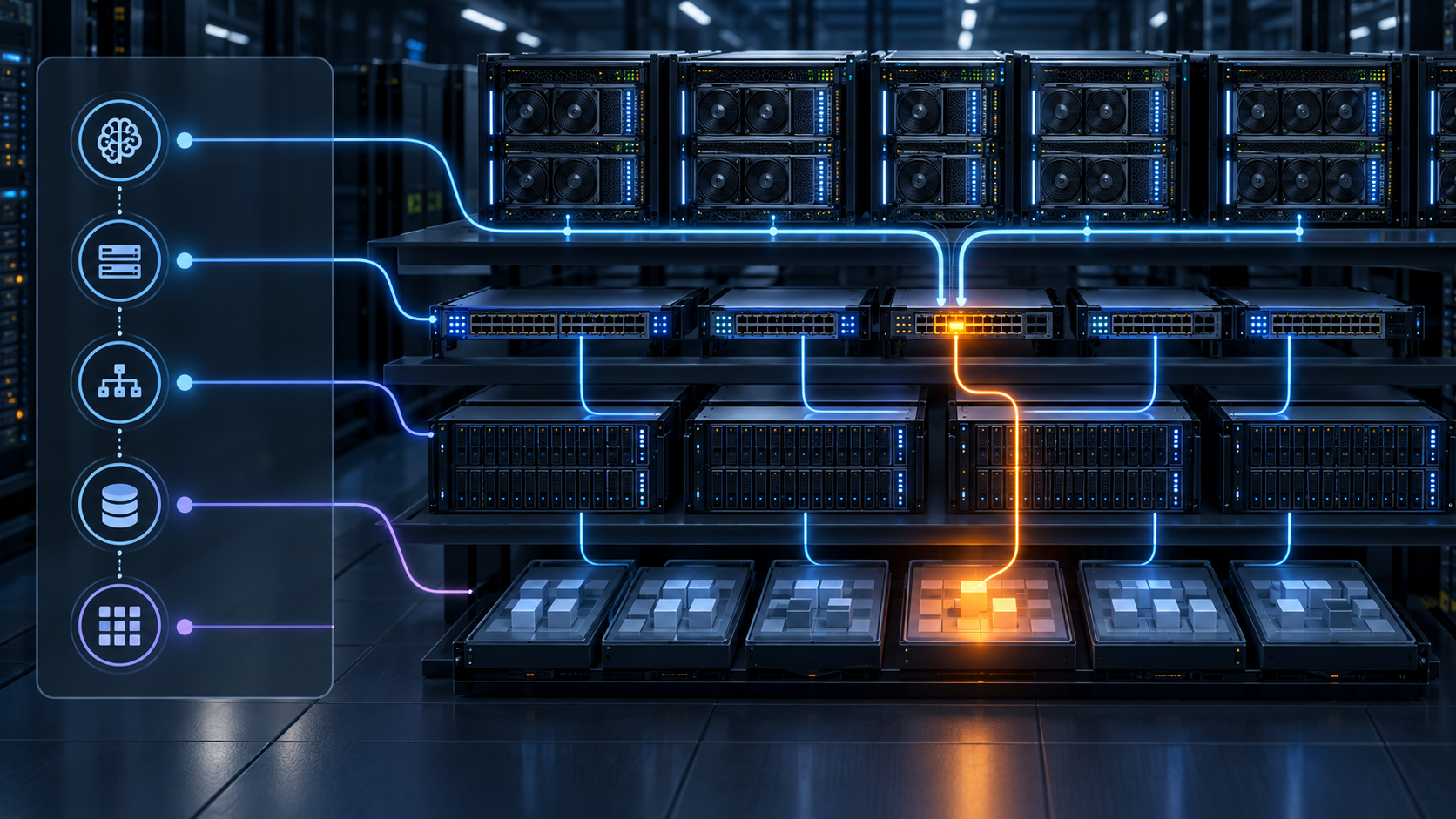
Minerva ingests telemetry from NVIDIA GPUs, networking, storage, NCCL communications, schedulers and active AI workloads. It turns those relationships into a dynamic knowledge graph: a continuously updated map of components, topology and the jobs using them.
If a training run slows down, the platform can connect the symptom to an abnormal interface, switch, GPU or storage device along the path. NVIDIA says its purpose-built models analyze billions of data points per hour, learn normal behavior, detect previously unseen anomalies and predict emerging failures. Topology-aware correlation can also collapse a flood of secondary alerts into one prioritized incident with a likely root cause.
The practical advantage is context. A temperature increase on one GPU may not matter by itself, but it becomes important when it lines up with lower job throughput and errors on the same path. Minerva’s value depends on the quality and coverage of the telemetry it receives; it cannot explain signals that are missing, inaccurate or outside the integrated stack.
Sherlock adds a natural-language operations layer
NVIDIA calls Minerva’s built-in multi-agent assistant Sherlock. Operators can ask questions about cluster health in natural language, receive answers grounded in current telemetry and get recommended remediation. An MCP server also lets customers connect external agentic tools.
That interface can reduce the time needed to move from an alert to an investigation, but it should not be treated as permission for autonomous repair by default. A wrong diagnosis or aggressive automated action could interrupt healthy workloads. Teams can keep a person in the loop, limit which systems an agent can change and connect automation only through approved infrastructure APIs.
Before enabling closed-loop remediation, operators should define:
- Which actions require human approval
- Which jobs, tenants or facilities an automation can affect
- How proposed changes are logged and rolled back
- What evidence is required before a component is quarantined
- How access is separated between investigation and execution
Deployment options and integrations
Minerva is not presented as one fixed appliance. NVIDIA lists on-premises and SaaS deployment, open APIs, modular capabilities and Grafana integration. Customers can use Minerva primarily as a collector that feeds an existing observability stack, add its anomaly detection and correlation to outside tools, or adopt the full turnkey interface and assistant.
The platform accepts telemetry through standards and interfaces including OpenTelemetry, gNMI, syslog, DCGM, Slurm and JSON. NVIDIA also lists integrations with Slack, Microsoft Teams, PagerDuty, ServiceNow, Grafana, Ansible and infrastructure APIs. Those connections should make it easier to fit Minerva into incident-response workflows, but every integration expands the permissions and data flows that security teams must review.
Minerva is also tied closely to NVIDIA’s infrastructure roadmap. The company positions it as part of the Vera Rubin platform and the primary network-observability layer for NVIDIA AI factories. Minerva Collector is integrated with DSX OS, and NVIDIA says key collector capabilities will be open sourced in DSX OS. Organizations using mixed vendors should verify exactly which third-party components expose equivalent depth before assuming “full stack” means every device in the building.
Early adopters and the evidence gap
IREN is already using Minerva, while Aolani, Bitdeer AI, IBM, Jio, Lambda, Quake AI and Tesla plan deployments, according to NVIDIA. Dell Technologies, Lenovo and Supermicro are expected to offer it through their AI-factory operations portfolios.
Bitdeer says its deployment will use Minerva across training and inference infrastructure. The partner also cites NVIDIA internal tests in which an NVMe power fault was reduced from a multi-day outage to six hours and 81 noisy events were consolidated into a single alert. Those examples are useful, but they are vendor and partner claims rather than independent benchmarks.
NVIDIA has not disclosed broad customer pricing, a universal return-on-investment figure or a public comparison against general-purpose observability platforms. Results will vary with cluster design, telemetry coverage, incident history and staff workflow. Buyers should ask for a proof of value on their own jobs and failure modes instead of extrapolating from a showcase deployment.
What teams should verify before adopting Minerva
- Telemetry coverage: confirm every critical GPU, switch, storage path, scheduler and workload emits supported signals.
- Data location: document whether telemetry and incident context remain on premises or enter a SaaS environment.
- Permissions: separate read-only investigation from actions that can drain nodes, restart services or change network configuration.
- False positives: measure how often anomaly alerts lead to useful action instead of more noise.
- Vendor mix: test visibility across non-NVIDIA storage, networking and management components.
- Operational impact: compare mean time to detect, mean time to repair, interrupted GPU hours and job goodput before and after the pilot.
- Exit plan: confirm that raw telemetry and incident history remain usable if the organization changes tools.
Who Minerva is for — and who can ignore it
Minerva is aimed at cloud providers, research labs and large enterprises operating dense NVIDIA GPU clusters. Its strongest case appears when separate teams manage compute, networking, storage and machine-learning workloads, and when a few hours of lost cluster time carry substantial cost.
It is not a consumer utility, a desktop GPU monitor or a small-business dashboard. Most organizations running a handful of accelerators will be better served by existing monitoring and scheduler tools. Readers who want hands-on experience with NVIDIA AI hardware at a much smaller scale can compare the NVIDIA Jetson Orin Nano Super Developer Kit on Amazon, but that board is not a Minerva deployment target or a substitute for an AI factory.
ReaderSpice may earn a commission from qualifying purchases made through affiliate links, at no additional cost to you.
Bottom line
NVIDIA Minerva is an attempt to turn fragmented AI-infrastructure telemetry into a connected operational model. The combination of a topology-aware knowledge graph, anomaly detection, alert correlation and a telemetry-grounded assistant could make large GPU clusters easier to diagnose and maintain.
The promise is credible enough for a serious pilot, not an automatic purchase. Minerva’s real value will depend on integration depth, data governance, false-positive rates and measured reductions in interrupted GPU hours. Until independent results and public pricing emerge, treat the launch as the beginning of validation rather than proof that every AI factory should standardize on it.
Sources
NVIDIA Blog: Minerva launch announcement and early deployment plans
NVIDIA: Minerva product capabilities, integrations and deployment models
Bitdeer AI: Minerva support, use cases and cited internal test examples
SiliconReport: Independent launch summary and deployment context