
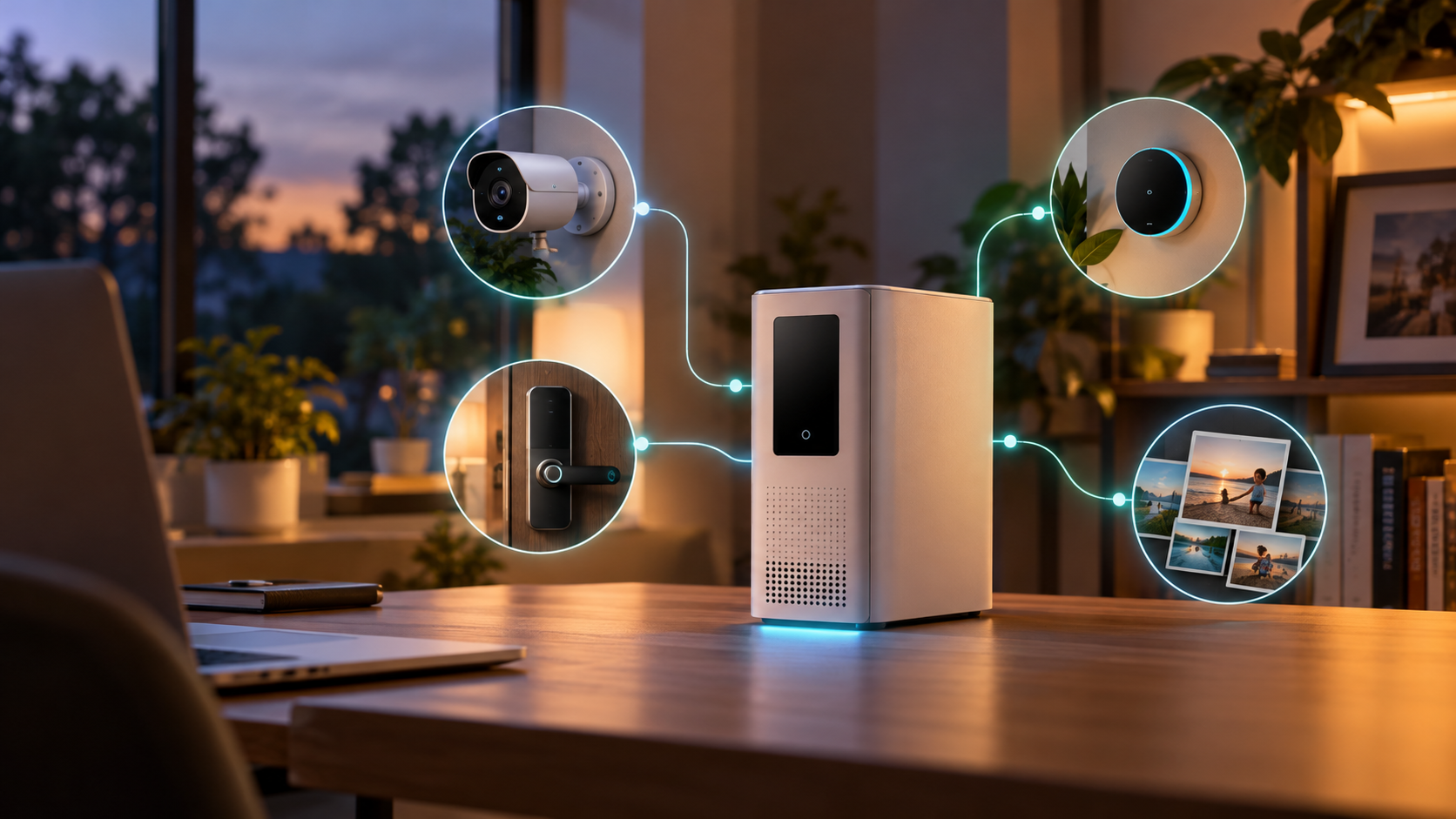
UGREEN’s HomeAgent HA100 is an unusual pre-retail product: part network-attached storage system, part local AI computer, part surveillance recorder and part smart-home hub. Reservations are open ahead of a Kickstarter campaign scheduled for November 17, 2026, with a promoted $799 offer against a stated $1,599 MSRP.
That price sounds aggressive for a device with 26 TOPS of local AI performance, 16GB of memory and storage expansion. The tradeoff is that HomeAgent is not simply a discounted conventional NAS. Its drive layout, networking, supported devices and still-developing software make it a more specialized—and riskier—purchase.
This preview separates UGREEN’s current claims from independent hands-on findings so buyers can decide whether to reserve early or wait for retail hardware and finished software.
The quick take
- UGREEN lists the HA100 at $799 for reservation customers, with a $50 deposit required to secure the promoted offer.
- The Kickstarter campaign is scheduled to begin November 17, 2026; hands-on reporting points to February 2027 shipping, not immediate delivery.
- Its advertised 26 TOPS combines the Rockchip platform and a removable T20 AI accelerator.
- The box combines two NAS data-drive bays, a dedicated surveillance-drive bay, an M.2 slot, a four-port PoE switch and smart-home radios.
- Local AI can analyze camera activity, search events and control supported devices without making cloud processing the default.
- The biggest cautions are beta software, limited present-day compatibility, non-expandable memory and no simple upgrade path to the faster HomeAgent models.
What the $799 reservation actually buys
UGREEN’s current campaign page lists the HomeAgent HA100 at $799, reduced from a stated $1,599 MSRP. A $50 reservation is required. The company also shows a $2,699 HA100 Pro and a $9,999 MasterAgent MA100 at promoted prices, making the entry model the only one likely to interest a mainstream enthusiast.
A reservation is not the same as buying a finished retail product. Kickstarter timelines, specifications and software can change, and the balance is still a large commitment after the deposit. Buyers should save screenshots of the exact package, refund terms, shipping estimate and included accessories shown when they reserve.
TechRadar’s October 19 hands-on says the HA100 and HA100 Pro reservation package includes a SynCare ID500 Pro camera, but UGREEN’s official campaign page also says some camera accessories are not sold separately and are unlocked only with a HomeAgent purchase. Confirm the bundle in the final pledge tier rather than assuming every early promotion will remain available.
HA100 hardware at a glance
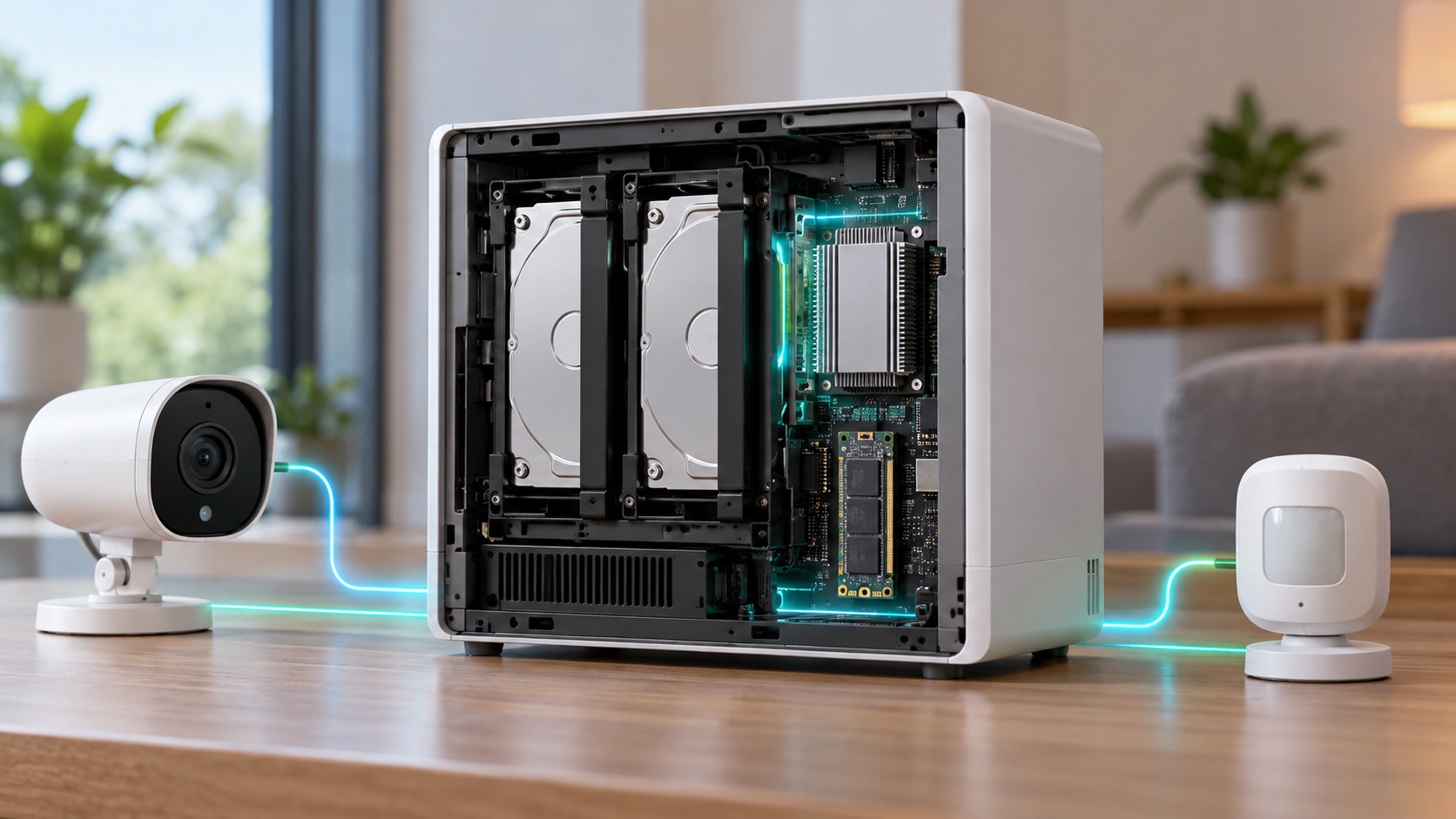
The entry HomeAgent is built around a Rockchip RK3588 processor, 16GB of non-expandable LPDDR5 memory and a T20 accelerator. UGREEN markets 26 TOPS of total local-AI performance—20 TOPS from the accelerator plus 6 TOPS from the platform.
- Rockchip RK3588 with four Cortex-A76 and four Cortex-A55 CPU cores.
- 16GB LPDDR5 memory that is not user-expandable.
- Two SATA bays for ordinary NAS storage plus one SATA bay allocated to surveillance storage.
- One M.2 NVMe PCIe Gen 3 x1 slot for storage, cache or AI models.
- One 2.5GbE network port for the main LAN connection.
- Four integrated 10/100Mbps PoE ports with up to 65W total power for compatible cameras.
- USB-C, two USB-A ports, HDMI and a front SD card slot.
- Thread 1.4, Zigbee 3.0 and Bluetooth radios for smart-home connectivity.
- A four-microphone array, dual 5W speakers and a touch-sensitive front display.
- UGOS Pro with EXT4 and Btrfs support; the two general-purpose bays support Basic, JBOD, RAID 0 and RAID 1.
The capacity number needs clarification before backing
UGREEN’s campaign page currently advertises “up to 96TB storage.” TechRadar’s hands-on specification table instead describes 68TB as two 30TB SATA drives plus one 8TB M.2 drive, while separately identifying the third SATA bay as surveillance storage. Those figures may be counting different pools or updated drive qualifications.
Because the HA100 does not present three ordinary data bays, buyers should not assume they can build a conventional three-disk RAID 5 array. The hands-on unit supports RAID 0 or RAID 1 across its two main storage bays, while surveillance footage is assigned to a separate drive.
Ask UGREEN to confirm the maximum qualified drive size, whether the surveillance bay can ever join the primary pool, how camera retention is calculated and whether the M.2 slot can be used simultaneously for AI models and general storage. Capacity marketing is not a substitute for a usable-volume plan.
What local AI and Uliya are supposed to do
HomeAgent’s central idea is to keep supported recognition and automation work inside the home. UGREEN says local AI can identify people, vehicles, pets and packages, create event summaries, search footage by keyword and generate alerts without making a cloud subscription the default.
The system’s Uliya assistant can receive spoken questions through the hub, compatible cameras or UGREEN’s smart speaker. In the hands-on software, a locally running Qwen 3.5 4B model handled the basic assistant layer while modular recognition components watched for selected people, pets or parcels.
Local processing can reduce the amount of sensitive camera footage and household activity sent to remote servers, but “local” should not be treated as an absolute privacy guarantee. Remote access, optional cloud AI connections, mobile notifications and third-party integrations can still move data outside the box depending on settings.
Owners should review every connected account, disable cloud-model API keys they do not need, use unique credentials and keep backups separate from the HomeAgent. A locally stored copy is still vulnerable to theft, drive failure, accidental deletion and ransomware.
Matter support and the camera ecosystem
UGREEN says HomeAgent works with its own SynCare cameras and compatible Matter devices. Thread and Zigbee radios are built in, but protocol hardware alone does not guarantee that every device or feature will pair correctly.
TechRadar found the pre-release Smart Home app limited mainly to UGREEN peripherals and Matter accessories. Older devices without Matter pairing codes were not easy to bring into the system, which matters for households already invested in Philips Hue, Tapo, Smart Life, Google Home or Amazon Alexa hardware.
The integrated PoE switch is convenient for cameras because a single Ethernet cable can provide power and data. Its ports are only 10/100Mbps, though. That is adequate for many compressed camera streams, but it is not a substitute for the main 2.5GbE connection and could become a constraint with multiple high-bitrate cameras.
UGREEN’s camera lineup includes the indoor ID500 Pro, the wired outdoor OD600 Pro and a battery-and-solar OD800 Pro. Confirm which cameras can record continuously, which AI functions require HomeAgent, whether ONVIF or third-party cameras are supported and whether a camera can operate after the campaign bundle ends.
What still looks unfinished
The HA100 hardware shown to reviewers appears close to production, but the software is still beta. TechRadar reported a special mobile application for the hands-on unit, limited assistant behavior and a smart-home catalog that needs broader compatibility.
The current local model is designed for focused household tasks, not broad conversational intelligence. That may be a sensible privacy and performance choice, but buyers should not expect a private equivalent of a large cloud chatbot from 16GB of shared memory and a 26-TOPS appliance.
There is also no simple upgrade path from the HA100 to the HA100 Pro or MA100. The models use different processors, accelerators and expansion interfaces. If the entry model feels slow later, the path appears to be replacing the entire hub rather than swapping in a Pro-class module.
Before launch, UGREEN still needs to prove:
- Reliable everyday operation after power failures, network interruptions and app updates.
- Clear backup and restore procedures for the hub, camera database and AI configuration.
- Broader compatibility beyond UGREEN accessories and basic Matter onboarding.
- Predictable support periods for UGOS Pro, security patches and AI models.
- Useful local voice responses without sending routine requests to a cloud model.
Reservation risk and the real total cost
The $799 hub price excludes the storage drives needed for a practical NAS and surveillance system. Add two NAS-rated data drives, a surveillance-rated drive, optional NVMe storage, cameras, network cabling and a backup destination before comparing HomeAgent with a standard NAS or cloud subscription.
A sensible budget should also account for:
- Sales tax, shipping and any import charges shown during the final pledge.
- At least two matching NAS drives if RAID 1 protection is required.
- A separate backup drive or second NAS; RAID is not a backup.
- A UPS or supported battery backup for clean shutdowns during outages.
- Replacement-camera flexibility if proprietary accessories are discontinued.
Kickstarter campaigns can deliver late or change specifications. Treat the reservation as early-adopter hardware funding, not as a risk-free retail preorder. Use a payment method with appropriate consumer protections and read the campaign’s refund language before the final charge.
How it differs from a conventional NAS
A conventional four-bay NAS usually prioritizes flexible storage pools, mature backup tools, containers and third-party apps. HomeAgent prioritizes local event recognition, dedicated surveillance storage, voice control and first-party smart-home accessories. Neither approach is automatically better; they solve different problems.
Readers who mainly need centralized storage, Docker, media serving and broader drive configurations can compare the UGREEN DXP4800 Plus (ASIN B0D22JRHZB) on Amazon. It is a current four-bay, diskless NAS rather than a HomeAgent substitute, but it shows what buyers give up when they choose a specialized two-data-bay smart-home appliance.
Affiliate disclosure: ReaderSpice may earn a commission from qualifying purchases made through the Amazon link above, at no additional cost to you.
Choose HomeAgent if local camera intelligence and voice-controlled automations are the main goal. Choose a conventional NAS if storage flexibility, app maturity, media workflows or an existing Home Assistant setup matter more.
Who should reserve—and who should wait?
Reserve early if:
- You are comfortable testing first-generation hardware and beta software.
- Your smart home already uses Matter devices or you plan to buy UGREEN’s cameras.
- Local video analysis and reduced cloud dependence matter more than maximum NAS flexibility.
- You can absorb delays and still maintain separate backups and security coverage.
Wait for retail if:
- You need proven compatibility with an existing mix of non-Matter devices.
- You require RAID 5, four general-purpose drive bays, 10GbE or expandable memory.
- You want independent long-term tests of recognition accuracy, noise, thermals and power use.
- You need a guaranteed delivery date, simple returns and mature support documentation.
Checklist before paying the deposit
- Verify that the November 17 campaign date and your regional shipping window are still current.
- Save the exact pledge-tier description, included camera and early-bird price.
- Confirm supported drive models, maximum capacity and the role of the surveillance bay.
- List every existing smart-home device and check Matter compatibility one by one.
- Ask whether third-party ONVIF cameras, Home Assistant bridges and cloud assistants are supported.
- Price two data drives, a surveillance drive, backup storage and power protection.
- Review privacy controls for remote access, camera recognition, stored faces and optional cloud AI.
- Wait for final campaign specifications if any essential answer is missing.
The bottom line
UGREEN HomeAgent HA100 is one of the most ambitious home-storage products of 2026 because it tries to combine a NAS, NVR, local AI server and smart-home controller in one appliance. The $799 reservation price makes that experiment tempting, especially with a camera bundle.
The same integration creates its biggest risks. Two ordinary data bays limit storage options, compatibility is narrow in the beta software, memory is fixed and faster HomeAgent models require a new machine. For households that already use Matter and want local camera intelligence, the HA100 could become a useful private hub. Everyone else should wait for the Kickstarter specification, retail software and independent tests before treating it as a replacement for a mature NAS or smart-home platform.
Sources
UGREEN: HomeAgent crowdfunding page — pricing, memory, storage and local-AI claims
UGREEN: Smart Living launch event — HomeAgent lineup and accessories — September 9, 2026
UGREEN: Smart home hub with local storage — September 14, 2026
TechRadar: UGREEN HomeAgent HA100 hands-on — October 19, 2026
Kickstarter: UGREEN HomeAgent campaign page
Amazon: UGREEN DXP4800 Plus four-bay NAS (ASIN B0D22JRHZB)