
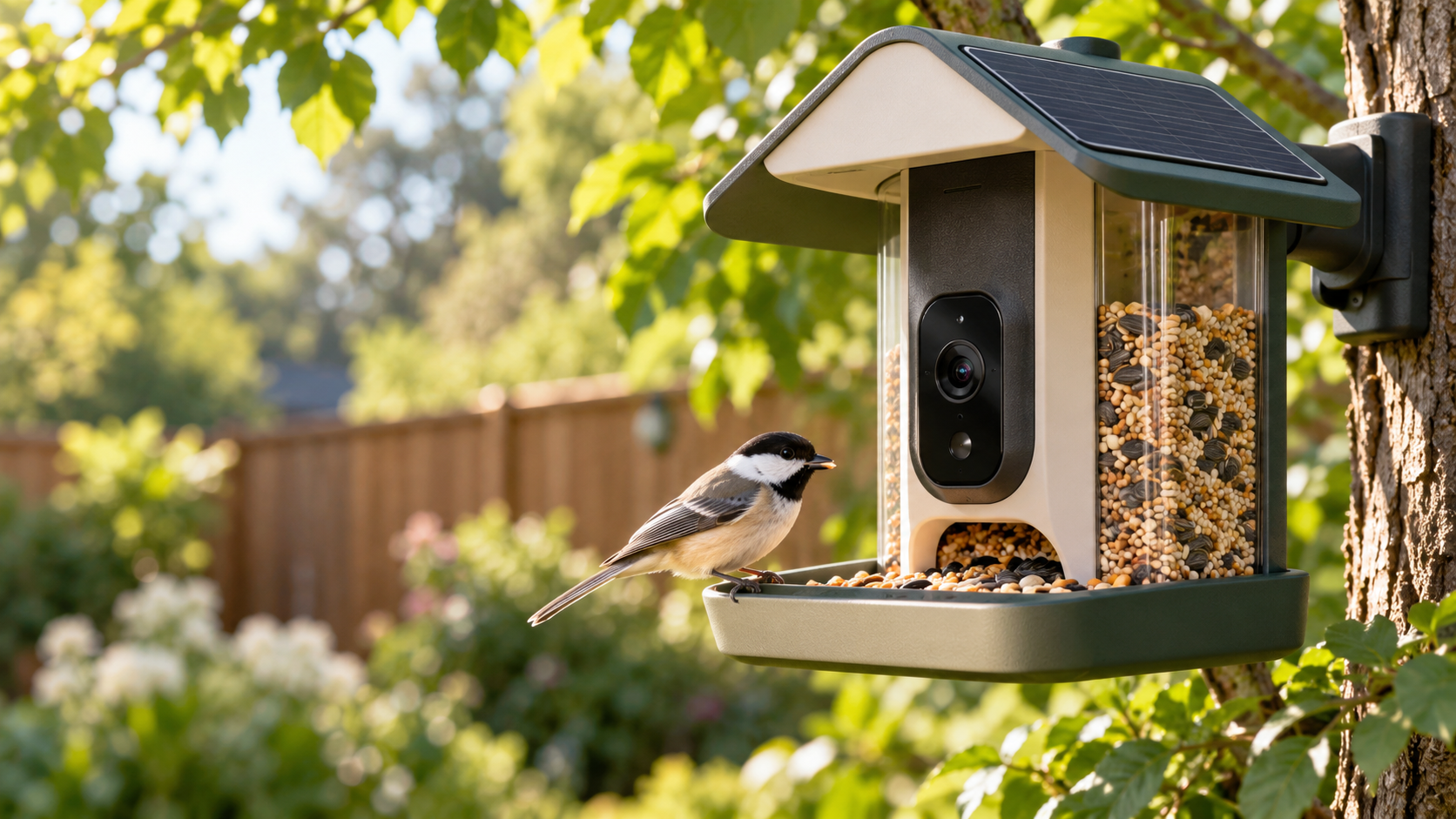
Birdbuddy expanded its smart-feeder lineup on October 22, 2026, with two products built around the same new 2K HDR camera: the $99 Nook and the $219 Home. That shared camera makes the cheaper model unusually compelling. Most buyers are paying the extra $120 for a larger seed reservoir, integrated solar charging, tougher weather protection and a few convenience upgrades—not a better core bird-identification experience.
After comparing the specifications with early hands-on coverage and a long-term Home test, the value case is straightforward: buy Nook if you want Birdbuddy’s current camera and app at the lowest price; buy Home if minimizing refills and charging matters more than the upfront cost.
Quick verdict
- Best value: Nook at $99. It gets the 2K HDR camera, 135-degree field of view, fast wake-up and Birdbuddy’s AI-assisted species recognition.
- Best for lower maintenance: Home at $219. Its six-cup reservoir, dual integrated solar panels and longer perch are designed for less frequent attention.
- Best middle ground: Nook Solar at $159, although the $60 solar premium narrows the gap to Home.
- Existing Pro owners: do not assume either new model is an automatic image-quality upgrade. Independent hands-on testing found tradeoffs as well as speed improvements.
Price and configurations
Nook starts at $99 with a 3.8-cup seed reservoir and no built-in solar charging. Nook Solar costs $159 and adds the matching solar roof. Home costs $219 and includes a six-cup reservoir, dual integrated solar panels, a perch extender, dual-band Wi-Fi and an IP67 rating.
Those prices position Nook as the entry point, but it is not a stripped-down camera. Birdbuddy says both new feeders use the same 2K HDR imaging system, 135-degree view, instant wake-up and continuous capture. Both can record in portrait or landscape orientation, and both work with the same Birdbuddy app.
What both feeders share
The common camera is the most important detail in this comparison. It can capture higher-resolution clips than the previous generation, while the wider framing gives a bird more room to move without immediately leaving the shot. Birdbuddy’s app turns visits into notifications and uses computer vision to suggest the species it sees.
The hardware is also modular. The camera can be removed from the feeder body, which helps with charging, cleaning and future accessories. Neither model requires a paid plan just to receive visits, but some advanced identification and cloud features sit behind Birdbuddy’s membership tiers.
Nook vs Home: the hardware differences
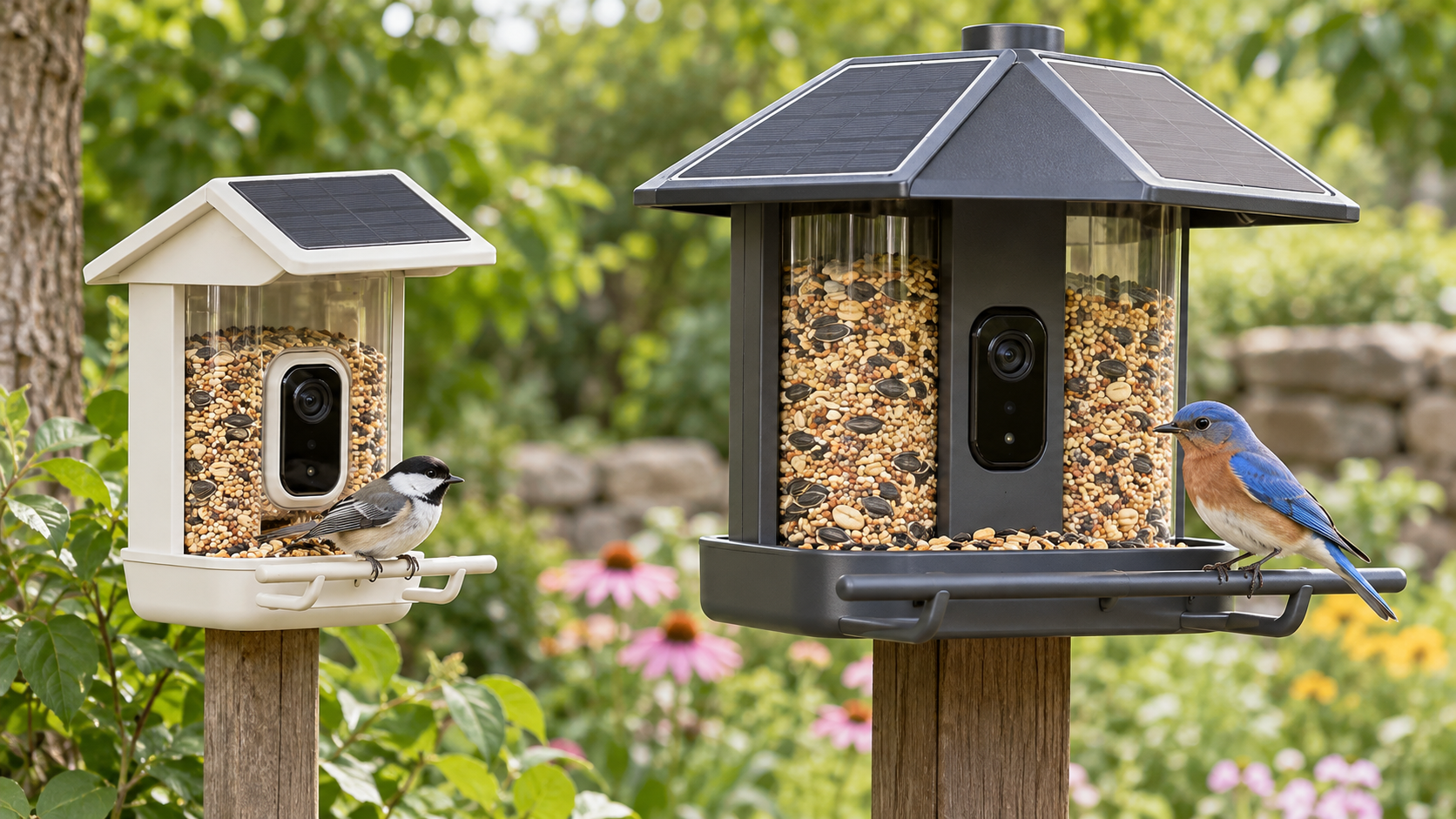
Nook keeps the essentials small
Nook is the simpler design. Its 3.8-cup reservoir should be sufficient for a modest backyard setup, and the smaller body is easier to place where a bulky feeder would look intrusive. The base $99 package relies on periodic wired charging. If the location receives dependable sun, the $159 Nook Solar package can reduce that chore.
The key compromise is capacity. Active feeders can empty quickly, particularly in colder weather or where several species visit. Nook owners should expect to refill more often than Home owners. That may be an acceptable exchange for a lower price and a smaller visual footprint.
Home is built around fewer interventions
Home’s six-cup reservoir holds roughly 58 percent more seed than Nook’s 3.8 cups. Its dual solar panels are integrated rather than optional, and its perch extender offers more room for larger birds. Dual-band Wi-Fi adds 5GHz support alongside 2.4GHz, which can be useful close to a modern router, while the IP67 rating gives Home the clearest on-paper weather-resistance advantage.
Home therefore makes the most sense when the feeder will be inconvenient to reach, when bird traffic is heavy, or when the owner simply values fewer refills and charging sessions. The camera experience alone does not justify the price difference; the maintenance savings might.
Why Nook is the better value for most yards
At $99, Nook costs less than half as much as Home while preserving the features that make a smart feeder interesting: a capable camera, fast capture, visit notifications and species suggestions. For a first-time buyer who does not yet know how much use a backyard feeder will get, the lower entry price reduces the risk.
The Verge’s hands-on testing also found that a Nook livestream opened in under eight seconds, compared with roughly 30 seconds for the older Bird Buddy Pro. That is a practical improvement: a slow live view often means the bird has already flown away when the video appears.
Nook Solar is a less obvious bargain. Its $159 price is still $60 below Home, but buyers who already know they want solar power should decide whether another $60 is worth the larger reservoir, integrated dual-panel roof, longer perch, IP67 rating and dual-band Wi-Fi. In a busy yard, Home can earn back that difference in convenience.
When Home is worth $219
Choose Home when access is awkward or bird traffic is consistently high. A six-cup reservoir can materially extend the interval between refills, and built-in solar charging avoids the decision of whether to add an accessory later. Home is also the safer specification choice for exposed locations because Birdbuddy lists an IP67 rating.
The premium is harder to defend for a feeder mounted near a door or window, where refilling and charging are easy. In that setting, Home’s main benefits become comfort rather than necessity. Nook delivers the same generation of camera for substantially less.
Real-world issues the spec sheet does not solve
Squirrels remain the first adversary
Tom’s Guide used an early Home unit for about 10 months and found that squirrels still required active countermeasures. A smart camera does not make a feeder squirrel-proof. Placement, pole guards and seed choice can matter as much as the feeder body, so budget for a baffle if squirrels are common.
Weather resistance and lens moisture deserve attention
The same long-term test reported moisture inside the removable lens cover after rain. The reviewer noted that the issue may have been specific to an early unit, but it is worth inspecting the camera after storms. Home’s IP67 specification is reassuring, yet no outdoor camera should be treated as maintenance-free.
The new camera is faster, not unambiguously better
The Verge praised the speed of the new platform but found the image more distorted near the edges than on the outgoing Pro, with a viewpoint that can feel more like looking down on the bird. That does not erase the value of 2K HDR capture, but existing Pro owners should compare real samples before replacing a working feeder.
What the Birdbuddy membership costs
Birdbuddy’s current membership page lists Premium at $69.99 per year. The Verge also reports a $7.99 monthly option. Paid features include automatic species identification and additional cloud or app capabilities; availability can change by plan and region.
Treat that fee as part of the total cost if automatic identification is a must-have. Over two years, a $99 Nook plus two annual Premium renewals reaches about $239 before tax—already more than the Home hardware by itself. Buyers who are comfortable reviewing visits without every premium feature can keep the ownership cost lower.
A relevant Amazon alternative for existing inventory
Birdbuddy says the outgoing Pro is being removed from its own store, with remaining inventory expected to continue through Amazon through the end of 2026. That makes the Birdbuddy Pro Solar a relevant price-check for shoppers who prefer the older camera perspective or find it discounted.
Check the current Birdbuddy Pro Solar price on Amazon. This is an affiliate link; ReaderSpice may earn a commission from qualifying purchases at no extra cost to you. Prices and availability can change.
Bottom line
Nook is the smarter default. It preserves the new 2K HDR camera and app experience at $99, leaving enough room in the budget for seed, a squirrel baffle or a membership. Home is the better tool for a specific buyer: someone with a busy feeder, an exposed installation or a strong preference for fewer refills and charging sessions.
The most important buying question is not which feeder takes better pictures—they share the same camera. It is how often you are willing to service the feeder. If the answer is “whenever needed,” choose Nook. If the answer is “as little as possible,” Home’s larger, solar-equipped body can justify the premium.
Sources
- Birdbuddy launch announcement — Nook and next-generation Home
- The Verge — Birdbuddy Home and Nook hands-on comparison
- The Verge — launch specifications and pricing
- Tom’s Guide — long-term Birdbuddy Home test
- Birdbuddy — current membership pricing
- Birdbuddy — official shop
- Amazon — Birdbuddy Pro Solar product listing
Inline image: Side-by-side comparison of a compact smart bird feeder and a larger solar smart bird feeder
Inline alt text: Compact smart bird feeder beside a larger model with dual solar panels, a bigger seed reservoir and a longer perch