

Ring is turning two familiar security-camera ideas into moving robots. Announced on November 10, 2026, the $249.99 Ring Drone Cam is a compact indoor flying camera for homes, while the $999.99 Ring Rover Cam is a wheeled patrol robot aimed at businesses. Both use a new AI Pilot system to map spaces, suggest patrol points and navigate without a person steering them.
These are launch previews, not ReaderSpice reviews. The Rover Cam is scheduled to ship in the United States on December 16, 2026. The Drone Cam is scheduled for January 27, 2027, but Ring says it has not yet received required Federal Communications Commission authorization and cannot be offered or sold until that happens. The practical questions are therefore less about image quality today and more about coverage, cloud dependence, subscriptions and who is comfortable placing an autonomous camera in a home or workplace.
Ring Drone Cam and Rover Cam at a glance
- Ring Drone Cam: $249.99; 2K video; 148-degree field of view; full 360-degree rotation; scheduled for U.S. shipping on January 27, 2027, subject to FCC authorization.
- Ring Rover Cam: $999.99; video up to 4K while moving; 360-degree scanning; periscope-style camera mast, siren, light tower and two-way audio; scheduled for U.S. shipping on December 16, 2026.
- AI Pilot: maps a home or business, suggests patrol points, plans routes and avoids obstacles with cameras, vision models, on-device sensors and cloud processing.
- Control: owners choose routes and destinations, but Ring does not provide manual piloting or driving controls.
- Security: both products use Ring TAKE encryption; optional end-to-end encryption remains a separate setting with reduced sharing and cloud-feature support.
- Subscription: scheduled patrol and recording features require a compatible Ring Protect plan; buyers should confirm the current plan and feature matrix before ordering.
Ring Drone Cam: a $249.99 flying indoor camera
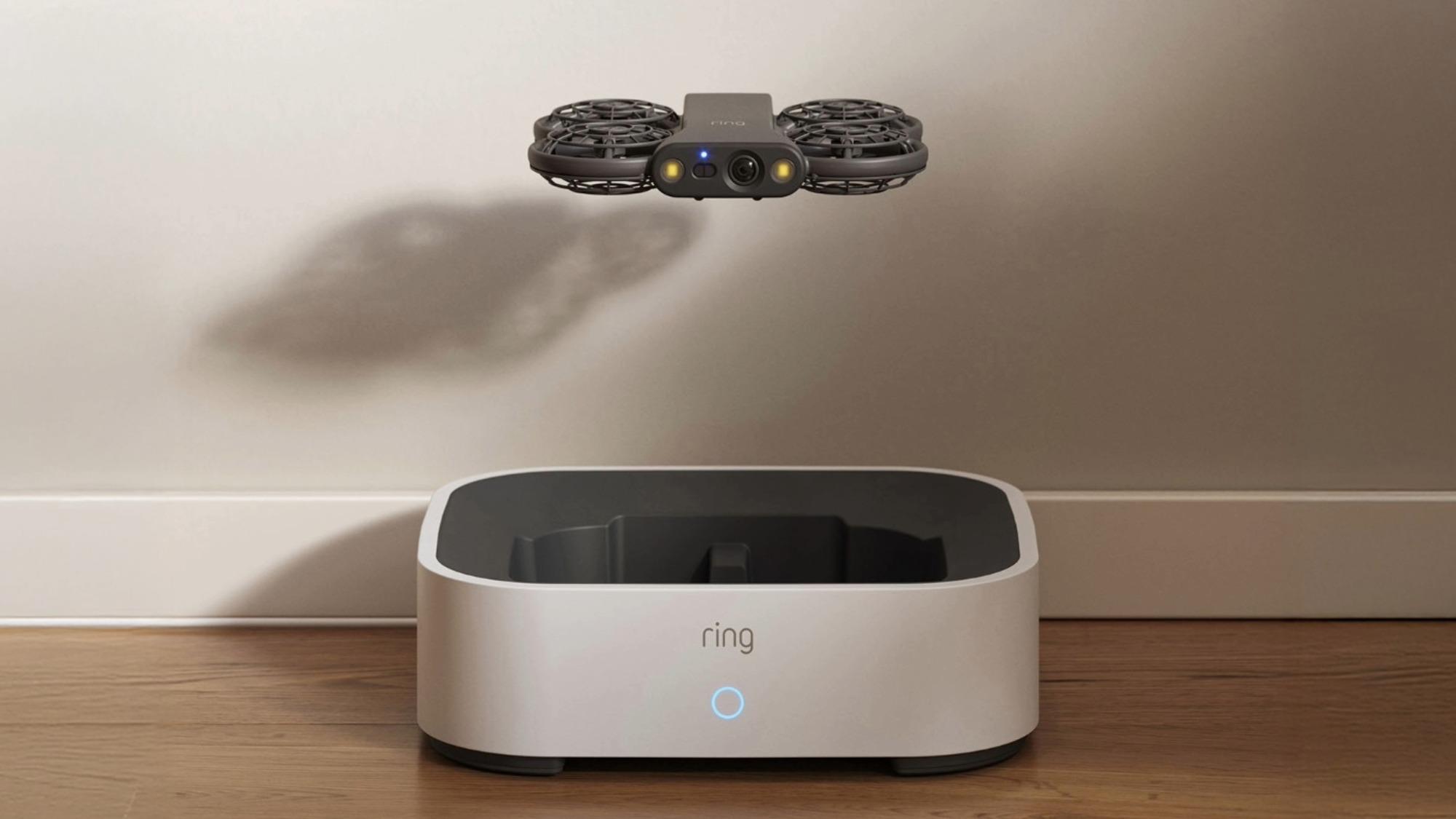
Ring Drone Cam is designed for indoor, autonomous patrols rather than manual flight. Product image: Ring/Amazon.
Drone Cam resembles a small shrouded quadcopter. It records in 2K with a 148-degree field of view, rotates through 360 degrees and carries two LEDs for low-light patrols. Owners can define routes and schedules, launch an on-demand patrol or have the camera respond to activity from compatible Ring sensors, cameras or alarm devices. Alexa Home Map can also become part of the setup.
The camera and motors are powered down while the drone is docked, so it cannot record from its base. When it flies, the aircraft is intentionally audible and visible rather than a silent observation device. Ring says its protected propellers and obstacle-avoidance system are designed for indoor spaces, but this remains a flying object that needs an uncluttered route and should not be treated as a toy.
Battery life is the clearest constraint. Ring support lists up to eight minutes of flight in controlled testing, while hands-on reports place typical flights between five and eight minutes. The Verge reports roughly eight minutes of charging for each minute of flight. The drone also depends on Wi-Fi and cloud processing; Wired reports that it lands if it loses its internet connection. It cannot be manually flown, used outdoors or sent where its mapped route cannot safely reach.
Ring lists a January 27, 2027 U.S. ship date, but its launch notice explicitly says Drone Cam has not been authorized under FCC rules. Until authorization is granted, the company cannot offer it for sale. Ring is collecting email sign-ups rather than taking orders, so readers should not treat the date as unconditional.
Ring Rover Cam: a $999.99 patrol robot for businesses

Ring Rover Cam combines a wheeled base with a raised camera mast, siren, light tower and two-way audio. Product image: Ring/Amazon.
Rover Cam is the larger and more capable robot, but Ring is positioning it for commercial sites rather than ordinary living rooms. It can make a 360-degree scan, raise its camera on a periscope-style mast, stream and record at up to 4K while moving, play a siren, activate a light tower and support two-way audio. When docked, it continues person-motion detection instead of becoming completely inactive.
The robot can run scheduled patrols, respond to Ring alarms and visit mapped locations on demand. Wired reports coverage of spaces up to about 5,000 square feet and around 30 minutes of operation, though actual runtime and navigation will vary with the route, Wi-Fi coverage and activity. A facilities team should test dead zones, stairs, glass, reflective surfaces, moving carts and closed doors before treating it as a substitute for fixed-camera coverage.
Rover Cam is scheduled to ship in the United States on December 16, 2026. Amazon is accepting preorders for ASIN B0HDVQ32Q7. A preorder does not establish long-term software support, local suitability or whether the robot can meet a business’s retention, labor and privacy obligations.
How AI Pilot changes setup and control
AI Pilot is the navigation layer shared by both robots. During setup, it builds a map, suggests locations worth visiting and plans paths around obstacles. Ring says the system combines cameras, vision models, on-device sensors and cloud processing. Users select patrol points or schedules; the robot decides how to reach them.
That division makes the products simpler to operate but also creates failure modes that fixed cameras do not have. A changed room layout, weak network, new obstruction or closed door can prevent coverage. Neither product should be the only camera watching a critical entrance, safe, server room or emergency route. Keep fixed cameras for continuous views and use patrol robots as supplemental coverage.
The cloud component matters for resilience and latency. Buyers should ask what happens during a broadband outage, how maps are stored, which features work locally, how long recordings are retained and whether administrators can export an audit trail showing who launched a patrol or watched a live feed.
Privacy, encryption and the limits of TAKE
Ring says Drone Cam and Rover Cam use TAKE encryption, its system of unique rotating encryption keys. According to Amazon, a temporary copy of the key can be held in a secure cloud enclave while an enabled smart feature is active and is deleted afterward; the customer retains the keys. That is a useful safeguard, but it is not the same thing as permanent end-to-end encryption for every automated feature.
Ring also offers optional end-to-end encryption for compatible camera recordings. Its own documentation says that enabling it removes Shared Users and cloud-dependent features, while keeping core functions such as Live View, playback and sharing available to the enrolled device. Buyers must therefore choose between the broadest automation and sharing features or the tighter access model; the launch announcement does not make that trade-off disappear.
A moving camera creates social questions beyond cryptography. Households should agree on no-fly rooms and schedules, avoid bedrooms and bathrooms, and tell visitors when patrols may run. Businesses should disclose monitoring, consult local employment and recording rules, define retention and access policies, and avoid routes where confidential screens or conversations are likely. Audible motors and visible status lights help, but they do not replace consent and governance.
Subscriptions, release dates and what buyers should verify
Ring’s footnotes tie scheduled patrols and recorded video to a compatible Ring Protect subscription. Plan names, pricing and included features can change, so the hardware price is not the complete cost. Confirm the exact plan required for schedules, trigger-based responses, cloud storage, person detection and business management before the return window closes.
- Drone Cam: wait for explicit FCC authorization and a live order page; January 27, 2027 is a scheduled ship date, not a guarantee.
- Rover Cam: December 16, 2026 scheduled U.S. shipping; preorder availability and delivery estimates may change.
- Network: test Wi-Fi and internet reliability along every intended route, not only at the charging dock.
- Coverage: keep fixed cameras on critical areas because patrol robots only see where they are currently positioned.
- Privacy: document no-go zones, access permissions, retention periods and visitor or employee notice before enabling schedules.
- Support: check warranty, return terms, replacement parts and the promised software-support period before relying on a moving platform.
Amazon preorder and affiliate disclosure
Readers who want the business model can review the Ring Rover Cam on Amazon (Amazon ASIN B0HDVQ32Q7). Verify the product name, seller, scheduled delivery date, required subscription, return policy and regional availability before placing a preorder. The Drone Cam does not yet have an authorized U.S. sales listing.
Affiliate disclosure: ReaderSpice may earn a commission from qualifying Amazon purchases made through the link above, at no additional cost to you.
Who should wait
Most households should wait for independent reviews. A fixed indoor camera is cheaper, quieter and available continuously; a patrol drone makes the strongest case for people who need occasional views of multiple rooms but cannot install several fixed cameras. Renters, small homes, pet-heavy spaces and anyone uncomfortable with cloud-assisted mapping have especially good reasons to pause.
Rover Cam is more plausible for a warehouse, showroom or office that already uses Ring and wants a visible mobile deterrent. Even there, first-generation hardware brings support risk. Amazon previously ended its Astro for Business program, and Rover Cam inherits parts of that robotics lineage. Businesses should treat the robot as an addition to existing controls, not the single layer guarding a facility.
Bottom line
Ring Drone Cam and Rover Cam are more ambitious than conventional smart cameras. The $249.99 drone can inspect multiple rooms without permanent wall-mounted cameras, while the $999.99 rover adds 4K mobile video and business-oriented alarms. AI Pilot removes manual driving, but it also makes network quality, maps and cloud service part of the security chain.
The sensible approach is to wait for shipping hardware, independent battery and navigation tests, confirmed subscription costs and a clear answer on Drone Cam’s FCC authorization. Ring’s rotating-key TAKE system is meaningful, but buyers still need to decide which cloud features they will enable, who may access the footage and where an autonomous camera should never go.
Sources
Ring and Amazon: Ring Robotics launches Drone Cam and Rover Cam, November 10, 2026
Ring Support: Ring Drone Cam specifications and product help
Ring and Amazon: How TAKE encryption works
Amazon: Ring Rover Cam (ASIN B0HDVQ32Q7)
Wired: Ring Drone Cam and Rover Cam hands-on report
The Verge: Ring Drone Cam hands-on, price and release date
Reuters: Amazon Ring launches flying camera and autonomous security robot
Inline image 1: Ring Drone Cam flying inside a home. Source and credit: Ring/Amazon official launch media. Alt text: Small Ring Drone Cam flying through a bright living room while its charging dock sits nearby.
Inline image 2: Ring Rover Cam patrolling a business. Source and credit: Ring/Amazon official launch media. Alt text: Ring Rover Cam security robot moving through a modern office with its camera mast raised.