
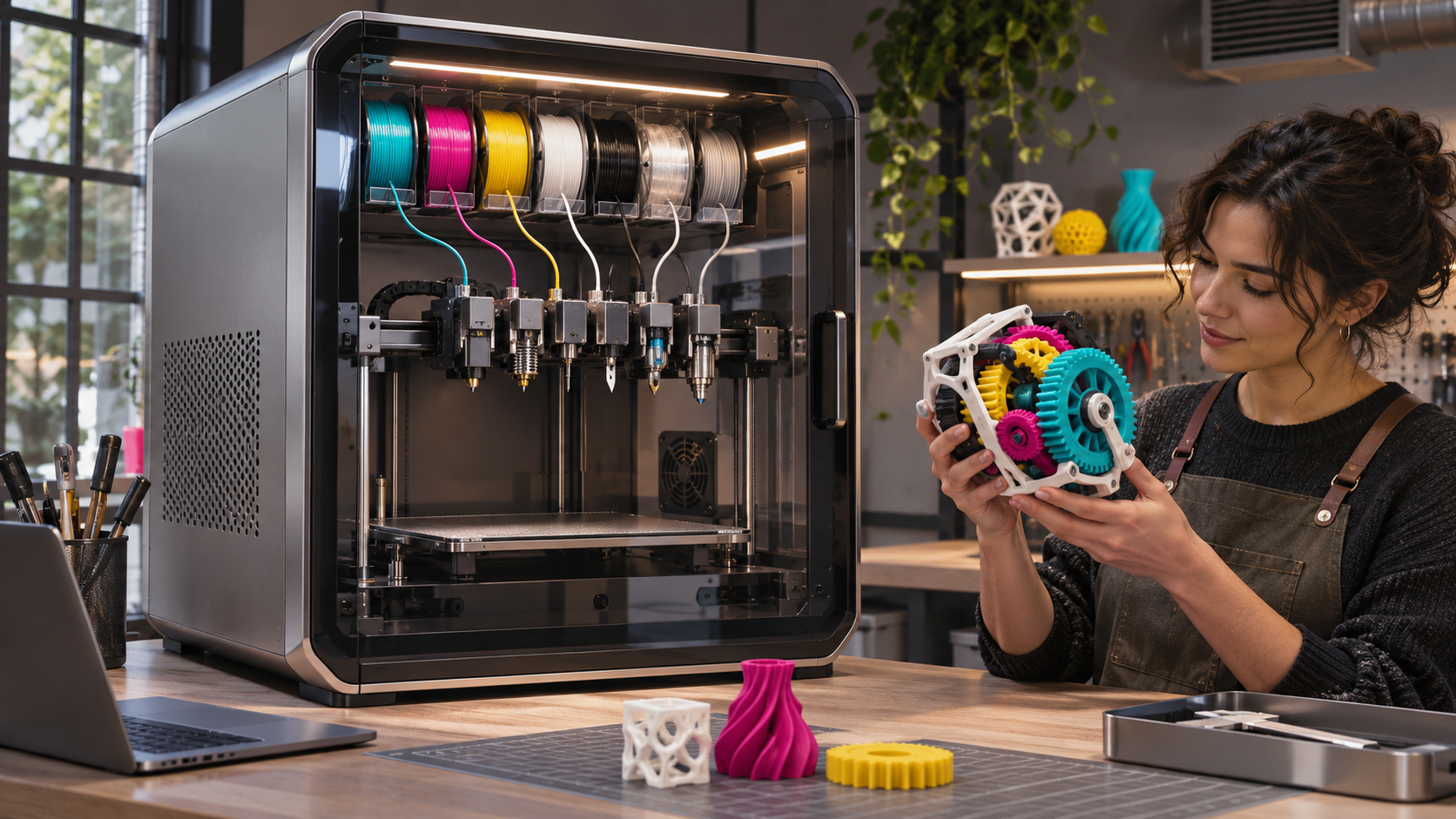
Bambu Lab launched the P3C worldwide on November 24, 2026, positioning a seven-slot tool-changing platform below its H3-series machines. The headline price is $1,149 before tax in the United States with free shipping, but the base P3C Combo does not arrive with seven fully populated tools: it includes five standard 0.4 mm PrintTools and leaves two slots open.
That distinction matters. The P3C is built around the Swaptek rack and an integrated AMS 3P, so it can stage more colors and material paths while reducing purge waste. Yet buyers still need to choose the right extra tools, filament format, dryer and workspace for their jobs. The printer and AMS 3P also ship as separate packages that may arrive on different days.
This is a launch analysis based on Bambu Lab’s official announcement, forum documentation and published specifications—not a hands-on review. ReaderSpice has not independently confirmed the tool-change timing, print quality, noise, long-run reliability or AI failure detection.
Bambu Lab P3C at a glance
- US starting price: $1,149 before tax for the P3C Combo; Bambu Lab lists free shipping.
- Included system: P3C printer, integrated seven-slot AMS 3P and five 1.75 mm PrintTools with 0.4 mm nozzles.
- Tool-changing claim: a 3.4-second physical swap and a return to printing within six seconds using active preheating.
- Build volume: 256 × 256 × 260 mm; maximum nozzle temperature: 300°C; maximum bed temperature: 110°C.
- Printer size and weight: 413 × 538 × 540 mm and 26.5 kg including the AMS 3P, according to the launch specifications.
- Material options: 1.75 mm through the main system, plus 2.85 mm through a dedicated bypass tool; the printer also supports mixed nozzle sizes.
- Shipping detail: the printer and AMS 3P are separate parcels and may not be delivered together.
What the $1,149 P3C Combo actually includes
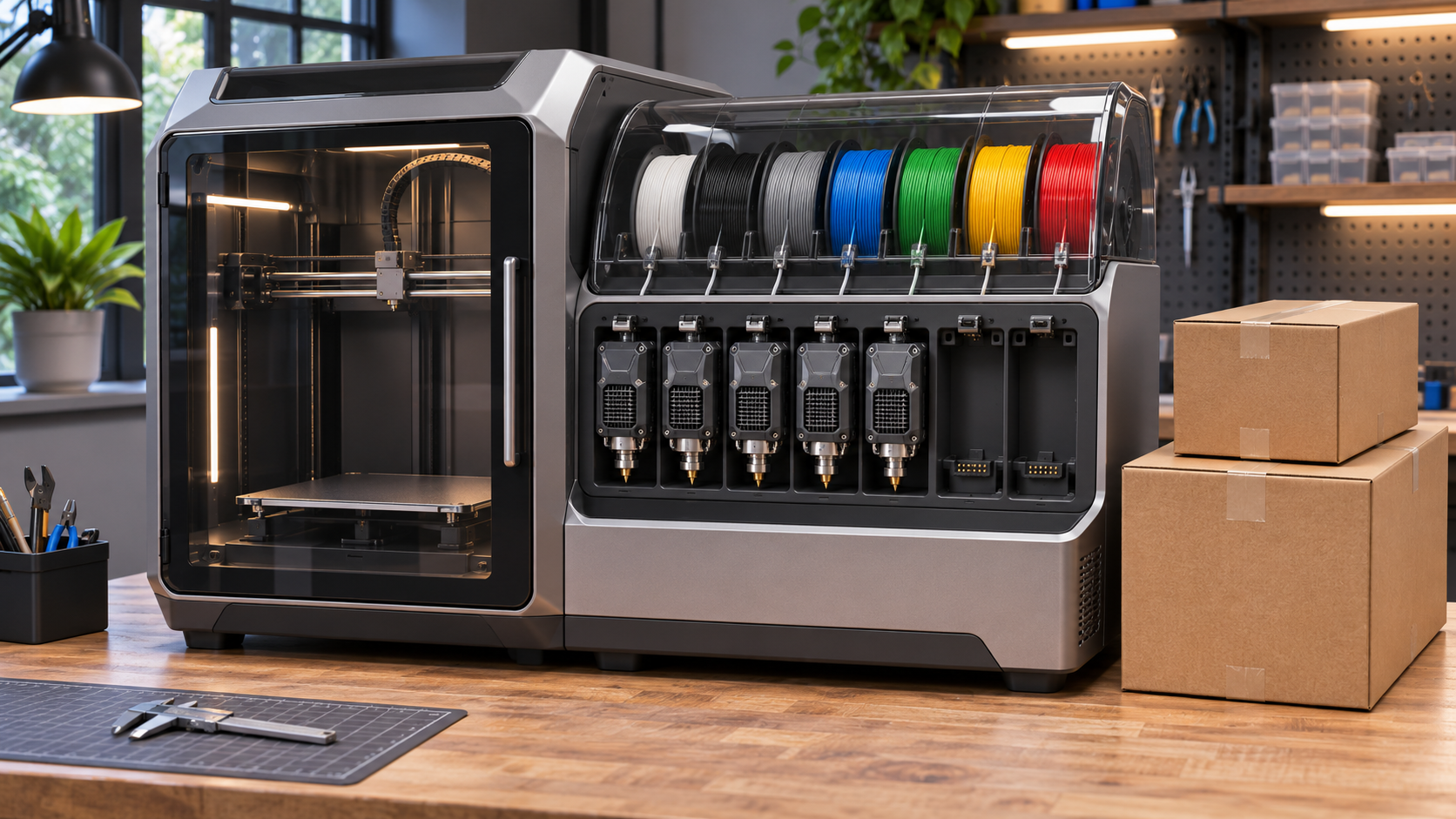
The base bundle combines the printer and seven-slot material station with five standard tools—not seven populated tool bays. Original ReaderSpice illustration.
Bambu Lab’s P3C Combo includes five standard PrintTools for 1.75 mm filament, all with 0.4 mm nozzles. Two spaces remain available for optional tools. That setup is enough to start multi-color work, but a project that needs seven simultaneously prepared tool paths requires additional PrintTools.
The integrated AMS 3P supplies seven sealed filament slots, while the tool rack stores the heating and extrusion hardware. Those are related but separate counts: seven spool positions do not mean the base package includes seven fully equipped printheads. Buyers should price the exact nozzle and material mix they need instead of relying on the seven-slot headline alone.
Seven-slot Swaptek changes the multi-material workflow
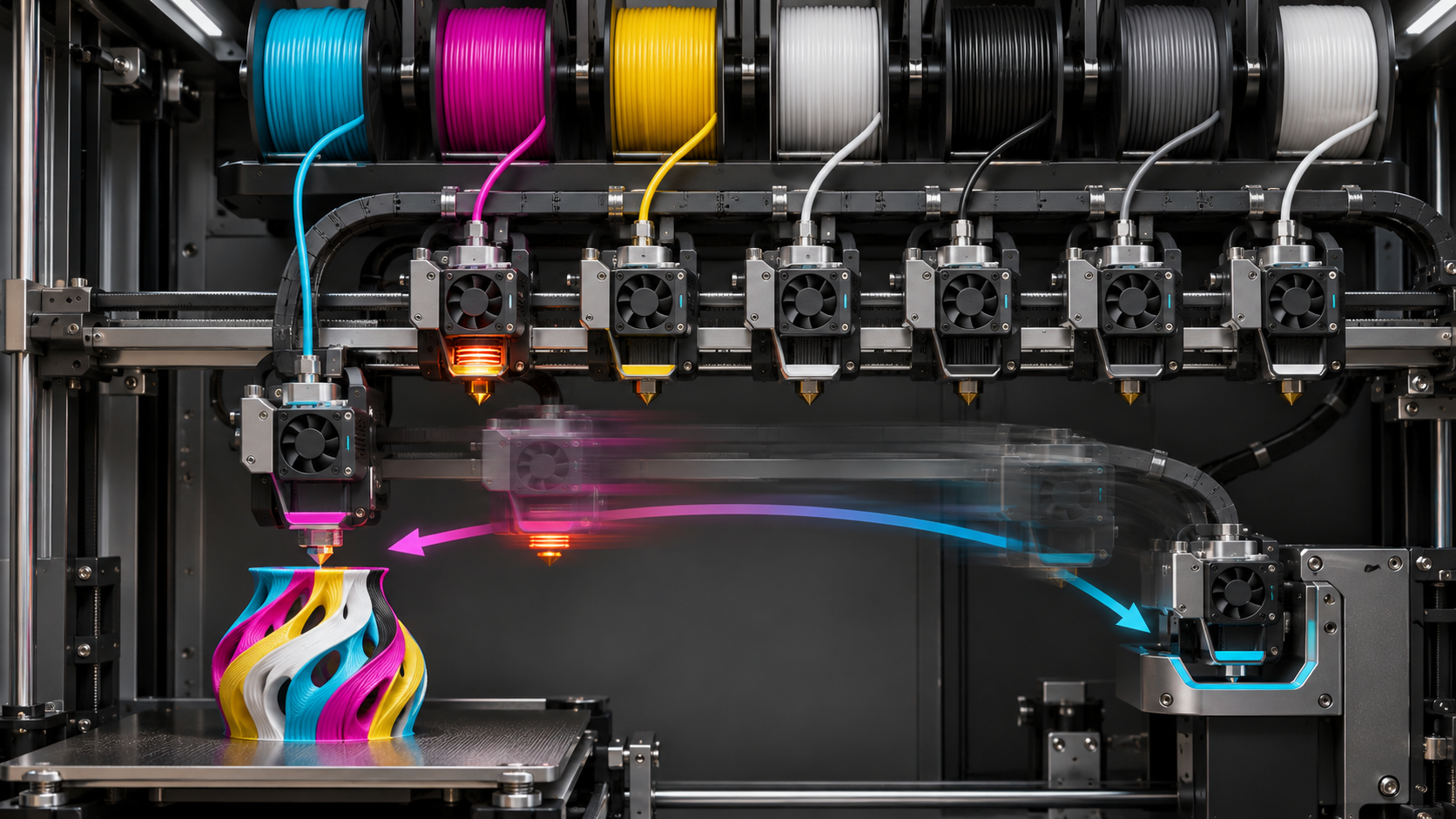
Bambu Lab says active preheating lets the printer resume within six seconds of a tool swap. That is a manufacturer claim awaiting independent testing. Original ReaderSpice illustration.
Conventional single-nozzle color changes can consume time and filament because one material must be unloaded, purged and replaced. Swaptek parks complete tools instead. Bambu Lab says the physical exchange takes 3.4 seconds and the printer can resume within six seconds because the next tool preheats before it is needed.
The approach should reduce—but not automatically eliminate—purge waste. Transitions can still require a wipe, prime or color-clearing step depending on the model, materials and slicer settings. The real benefit will vary with toolpath order, calibration and how often a print changes materials.
Mixed nozzle sizes and soft TPU need the right tools
Each PrintTool has its own filament path, extruder, heater and nozzle. Bambu Lab lists optional 0.2, 0.6 and 0.8 mm nozzle sizes, with hardened-steel components rated HRC 55 or higher. That lets a single job combine fine-detail and high-flow tools, subject to slicer support and careful calibration.
The FlexFeed system supports both 1.75 mm and 2.85 mm filament, but 2.85 mm material uses a bypass feed rather than the AMS 3P. Bambu Lab’s multi-material bundle includes a dedicated 2.85 mm TPU tool for soft TPU 75A. Do not assume every included standard tool is suitable for every abrasive, oversized or flexible filament.
AMS 3P storage, drying and 22-color expansion
The AMS 3P provides seven sealed bays and five bypass ports. Its optional dual-slot dryer can reach 75°C, allowing two spools to be dried while the system remains loaded. A dryer can help moisture-sensitive filament, but the correct temperature and time depend on the polymer and manufacturer guidance.
Bambu Lab says as many as four external AMS units can connect through PrintTool 1, expanding the system to as many as 22 colors or spools. That figure describes available material feeds, not 22 hotends installed in the printer. Complex jobs still depend on tool availability, slicer planning and practical purge or prime requirements.
Desk space, ventilation and material planning
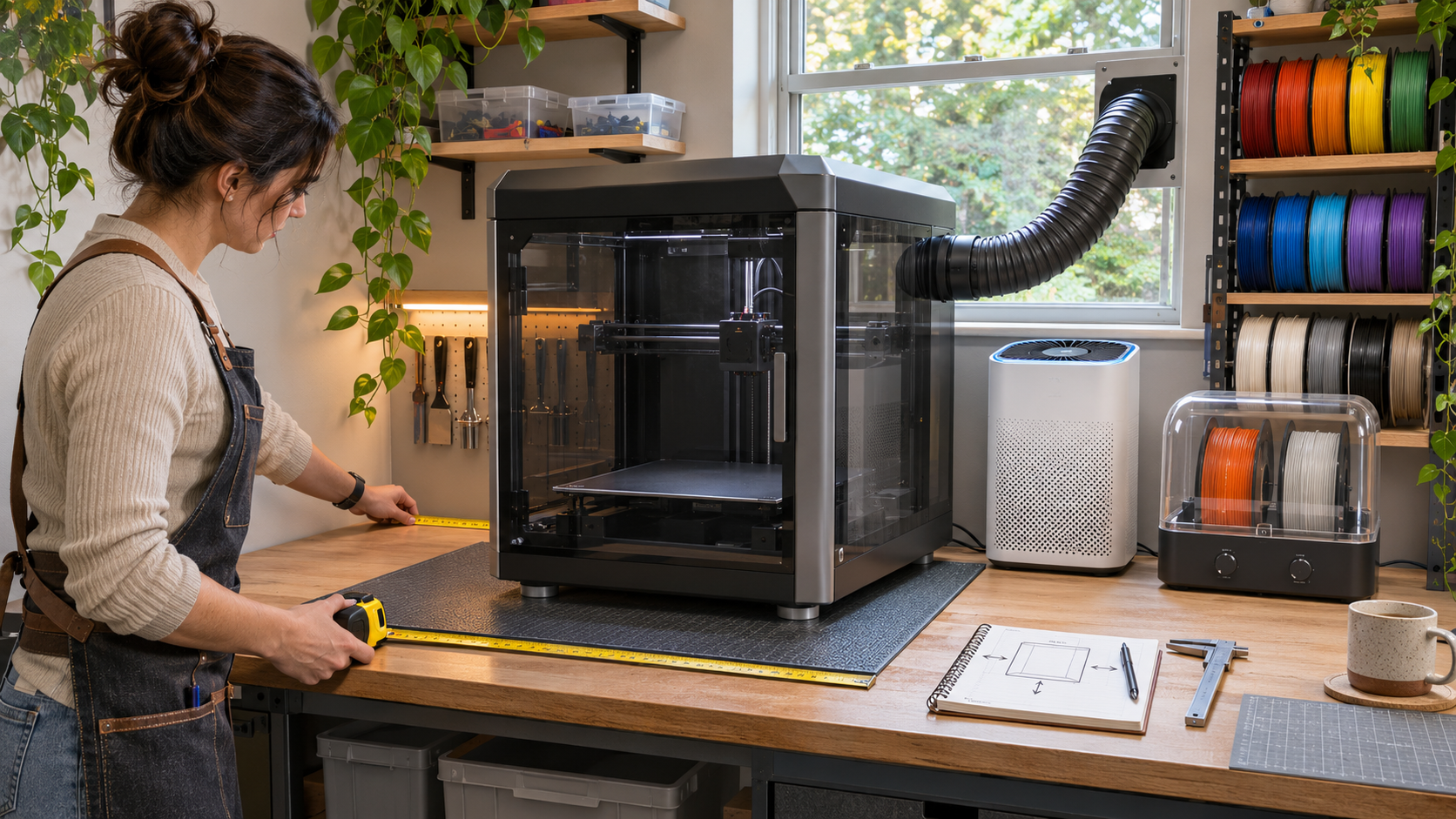
Allow service access, filament clearance and a stable bench; filtration does not replace safe material handling or appropriate ventilation. Original ReaderSpice illustration.
The listed 413 × 538 × 540 mm machine footprint and 26.5 kg weight call for a rigid, level bench with extra room for the AMS lid, rear connections, doors and tool access. Leave clearance for separate parcels during setup and avoid planning a shelf that matches only the bare chassis dimensions.
The P3C includes H11 HEPA filtration, but an internal filter is not a universal substitute for room ventilation, source capture or material-specific safety controls. Follow the filament maker’s safety data and Bambu Lab’s guidance, especially for high-temperature polymers, long prints or occupied rooms.
P3C bundle prices and the December 3 deadline
Bambu Lab’s US launch page lists the following prices before tax. Availability, stock and regional pricing can change; verify the current store page before ordering.
- P3C Combo: $1,149, with the printer, AMS 3P and five standard 0.4 mm PrintTools.
- Multi-Colorist Bundle: $1,269 before December 3, then $1,299; adds two standard PrintTools.
- Colorist Bundle: $1,289 before December 3, then $1,319; adds two standard PrintTools and two PLA spools.
- Multi-Material Bundle: $1,299 before December 3, then $1,319; adds a 1.75 mm PrintTool, a 2.85 mm TPU PrintTool and TPU 75A filament.
- Complete Experience Bundle: $1,699; Bambu Lab’s broadest launch configuration.
The deadline applies to the promotional prices Bambu Lab published for the listed bundles, not to an across-the-board price increase for every P3C configuration. Compare the extras with your actual nozzle, material and drying needs before paying for a larger bundle.
A practical setup checklist
- Measure the bench, shelf height, door swing and service clearance; account for the AMS 3P and rear connections.
- Decide how many PrintTools you need and which nozzle sizes or material paths each one will serve.
- Confirm whether your flexible or specialty filament is 1.75 mm or 2.85 mm and whether it needs a bypass tool.
- Plan drying and sealed storage around the polymers you actually use instead of treating every spool the same.
- Set up ventilation and filtration appropriate to the material, room and print duration.
- Expect two delivery parcels and inspect both before starting assembly or calibration.
- Update the printer and slicer, run the full automatic calibration and test a small multi-tool model before a long production job.
Bambu Lab PLA Basic on Amazon
A relevant starter option is the Bambu Lab PLA Basic 1.75 mm, 1 kg spool (ASIN B0C4GB3GG5). The indexed listing is for a blue spool with a reusable spool, while Bambu Lab specifies 1.75 mm diameter with ±0.03 mm tolerance for PLA Basic. Confirm the current color, seller, included spool, price and delivery terms on Amazon because listings can change.
PLA Basic is appropriate for ordinary setup prints and color work, but it is not a substitute for choosing the correct engineering material. The P3C launch bundles differ, so check whether filament is included in the exact package you select.
Affiliate disclosure: ReaderSpice may earn a commission from qualifying purchases made through the Amazon link above, at no additional cost to you.
Who should consider the P3C
- Creators who regularly combine several colors or materials and want dedicated tool paths instead of repeated single-nozzle unloading.
- Small studios that need mixed nozzle sizes in one workflow and can justify extra tools and material management.
- Experienced Bambu Lab users willing to adopt a new tool-changing platform and validate it with staged test prints.
Who should wait or buy something else
- Single-color PLA users who would not benefit from multiple prepared tools or a seven-slot material system.
- Buyers who need independent reliability, acoustic, energy-use or maintenance data before committing to first-generation hardware.
- Workspaces that cannot provide the bench area, service clearance, ventilation or filament storage the system needs.
- Anyone who assumes the $1,149 bundle includes seven populated tools, a dryer or every specialty nozzle.
What ReaderSpice has not verified
ReaderSpice has not used a production P3C. The six-second resume time, 3.4-second physical swap, AI detection of spaghetti failures, purge-bin jams and clogs, full automatic calibration, dimensional accuracy, print quality, noise, energy use, tool alignment and long-term reliability are manufacturer claims or specifications. Real-world results may differ by firmware, slicer profile, material, model and maintenance.
Stock, shipping times, local taxes, bundle contents and regional prices can change after publication. Readers should compare the live store page, warranty terms and official safety documentation before purchasing.
The bottom line
At $1,149, the P3C makes Bambu Lab’s seven-slot Swaptek architecture substantially more accessible than its higher-end tool-changing machines. The important buying detail is that the base combo includes five standard tools, not seven. Its value depends on whether faster swaps, mixed nozzles, AMS 3P storage and specialty-material paths solve a real workflow problem—and whether the buyer budgets for the additional tools, drying, space and safety controls that workflow requires.
Sources
- Bambu Lab official launch announcement: “P3C brings H3C technology at half the price”
- Bambu Lab official forum announcement: “P3C is here — tool changer now standard”
- Bambu Lab company press release: worldwide P3C launch and pricing
- Bambu Lab official P3C documentation
- Bambu Lab official PLA Basic filament specifications
- Amazon listing: Bambu Lab PLA Basic 1.75 mm, 1 kg (ASIN B0C4GB3GG5)