
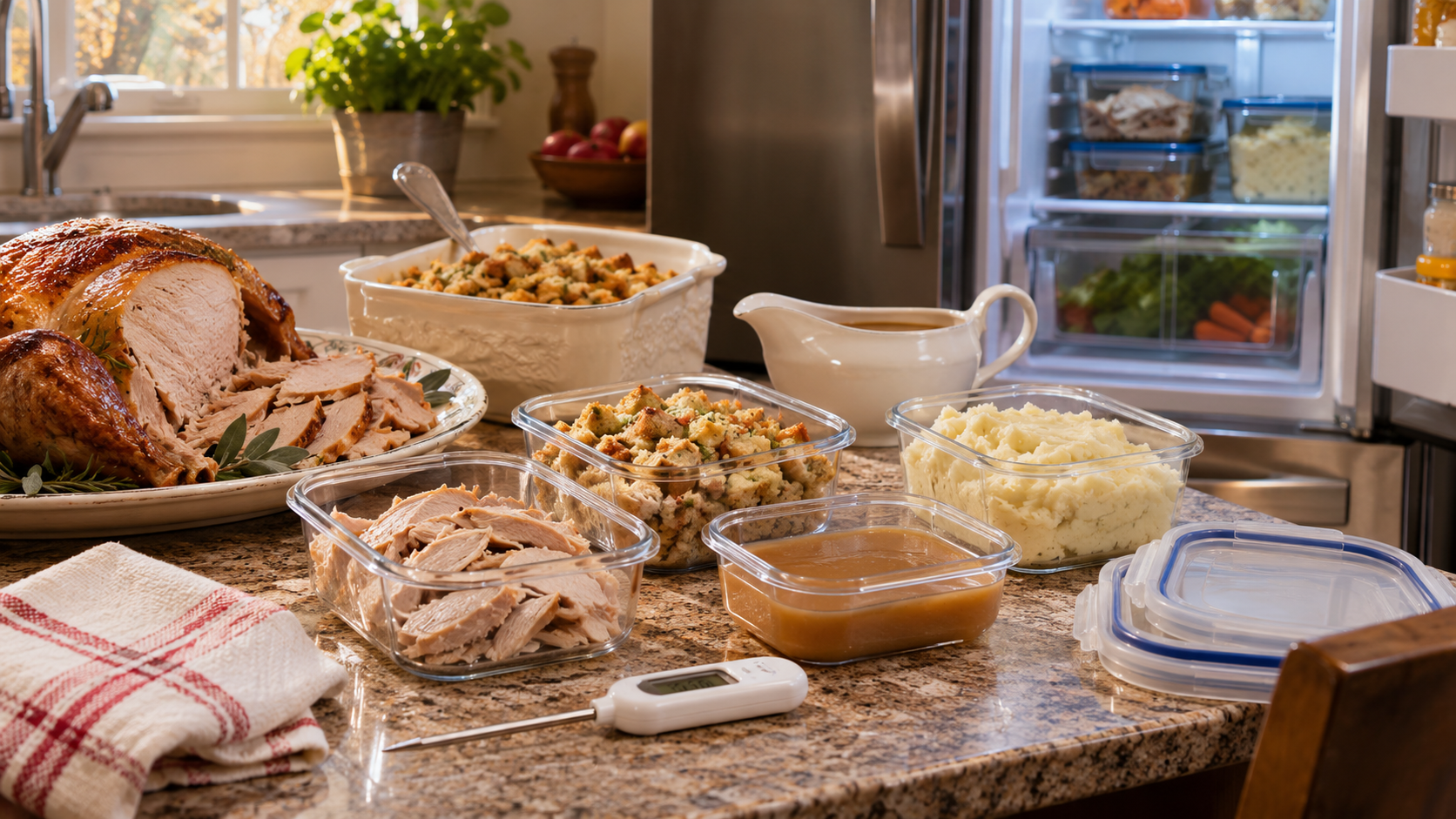
Thanksgiving was Thursday, November 26, 2026. For food refrigerated within two hours of serving, the practical USDA deadline is Monday, November 30: eat it or freeze it by then. That four-day window is short enough that a Friday refrigerator cleanout can prevent a risky Monday-night guess.
The safest decision depends on time and temperature, not a smell test. Disease-causing bacteria may grow without changing a food’s odor, appearance or taste. If the storage history is unknown—or the turkey, stuffing or gravy sat out too long—reheating does not make the earlier handling safe.
This guide translates current FoodSafety.gov, USDA and FDA guidance into a post-Thanksgiving checklist. It is general food-safety information, not medical advice; people with symptoms or individual health concerns should contact a qualified health professional.
Thanksgiving leftovers safety at a glance
- Refrigerate or freeze perishable food within two hours; the limit drops to one hour when the air temperature is above 90°F.
- Keep the refrigerator at 40°F or below and the freezer at 0°F.
- Leftovers refrigerated on Thanksgiving should be eaten or frozen by Monday, November 30.
- Use small, shallow, covered containers so food cools quickly; portion turkey instead of storing the bird whole.
- Reheat leftovers to 165°F and check several places with a food thermometer.
- Bring soups, sauces and gravy to a rolling boil when reheating.
- Frozen leftovers remain safe while continuously held at 0°F, but cooked meat and poultry are best quality within two to six months.
Use or freeze Thanksgiving leftovers by Monday, November 30
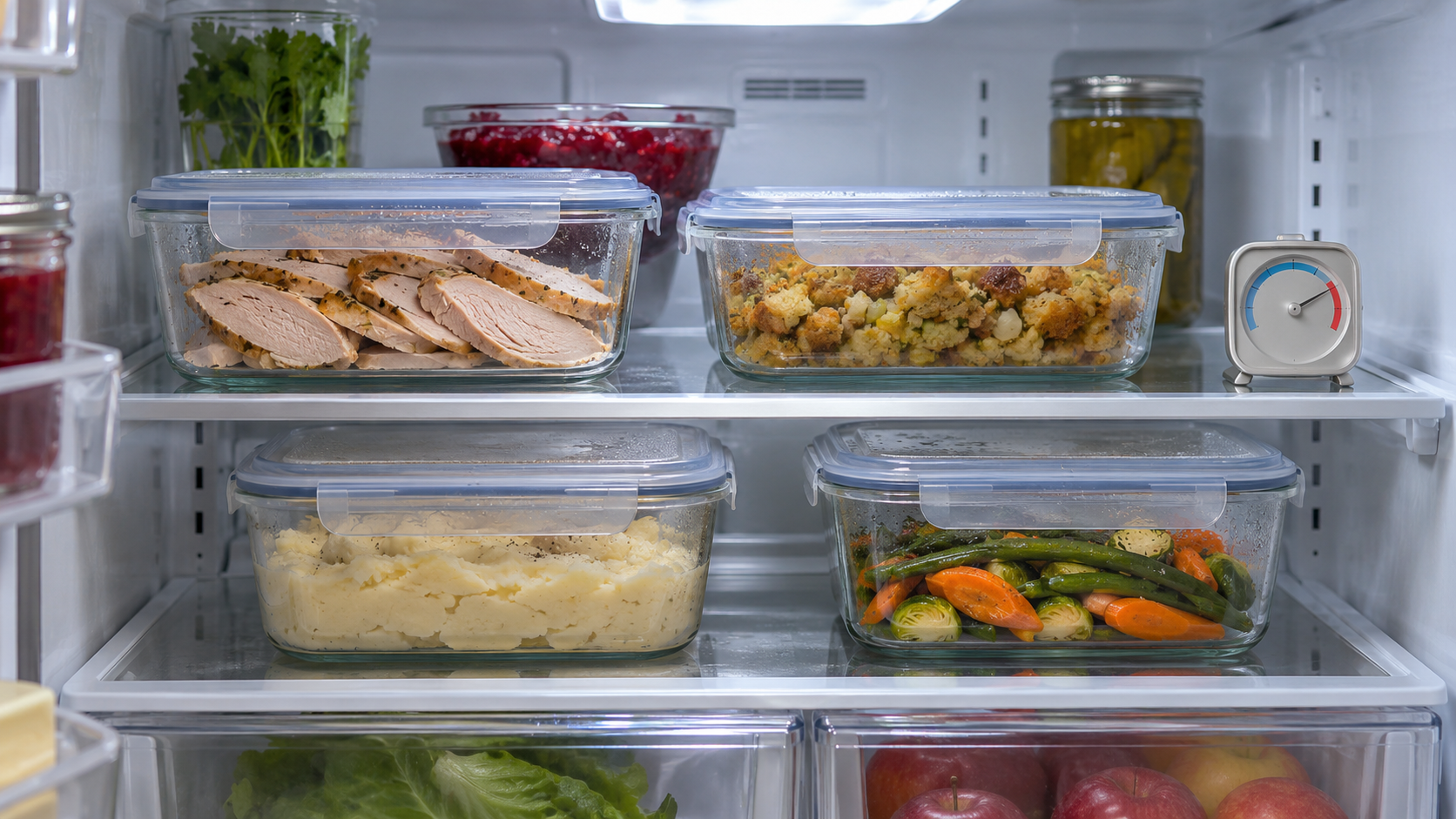
Shallow containers and a refrigerator at 40°F or below help leftovers cool quickly and stay within the safe storage window.
FoodSafety.gov says Thanksgiving leftovers can be kept in the refrigerator for three to four days and should be eaten or frozen by the Monday after Thanksgiving. For food stored on Thursday, November 26, Monday, November 30 is day four. Freezing by Monday pauses quality loss and bacterial growth; it does not repair food that was mishandled before freezing.
The deadline assumes the food went into a refrigerator at 40°F or below within two hours. If a dish stayed on the table longer, spent hours in a warm car, or has an uncertain timeline, discard it rather than resetting the clock. Reheating later does not remove every toxin that some bacteria can produce.
The two-hour rule starts when food leaves safe temperature control
Count the total time perishable food is out of refrigeration or other safe temperature control. A platter that sat through dinner, went back into the refrigerator, and returned for late-night grazing does not receive a fresh two-hour allowance. The time is cumulative.
When the surrounding temperature exceeds 90°F—such as at an outdoor gathering or inside a hot vehicle—the limit is one hour. Food held properly hot at 140°F or above is under temperature control, but once it cools into the danger zone the clock matters.
Hot food can go directly into the refrigerator. The safer approach is to divide large amounts into small, shallow containers rather than leaving a stockpot or whole turkey on the counter to cool. Leave enough space for cold air to circulate and avoid overloading the refrigerator with tightly packed warm containers.
How to cool turkey, stuffing, gravy and casseroles safely
Turkey and stuffing
Remove meat from the carcass, cut large pieces into smaller portions and refrigerate them in shallow containers. Store stuffing separately from the turkey. A deep container or an intact bird holds heat in the center, so the outside can feel cool while the interior remains warm.
Gravy, soups and casseroles
Split large batches among small, shallow containers before refrigerating. For a very large pot, USDA also recommends rapid-cooling methods such as dividing the food or using an ice- or cold-water bath before refrigeration. Do not leave the pot at room temperature waiting for it to feel completely cool.
Vegetables, cranberry sauce and desserts
Refrigerate cooked vegetables, creamy sides and other perishable dishes within the same two-hour limit. Pumpkin, custard and cream pies also require refrigeration. A high sugar content or a holiday label does not automatically make a dish shelf-stable; follow the product label or recipe’s storage guidance when it is more specific.
Reheat every leftover to 165°F
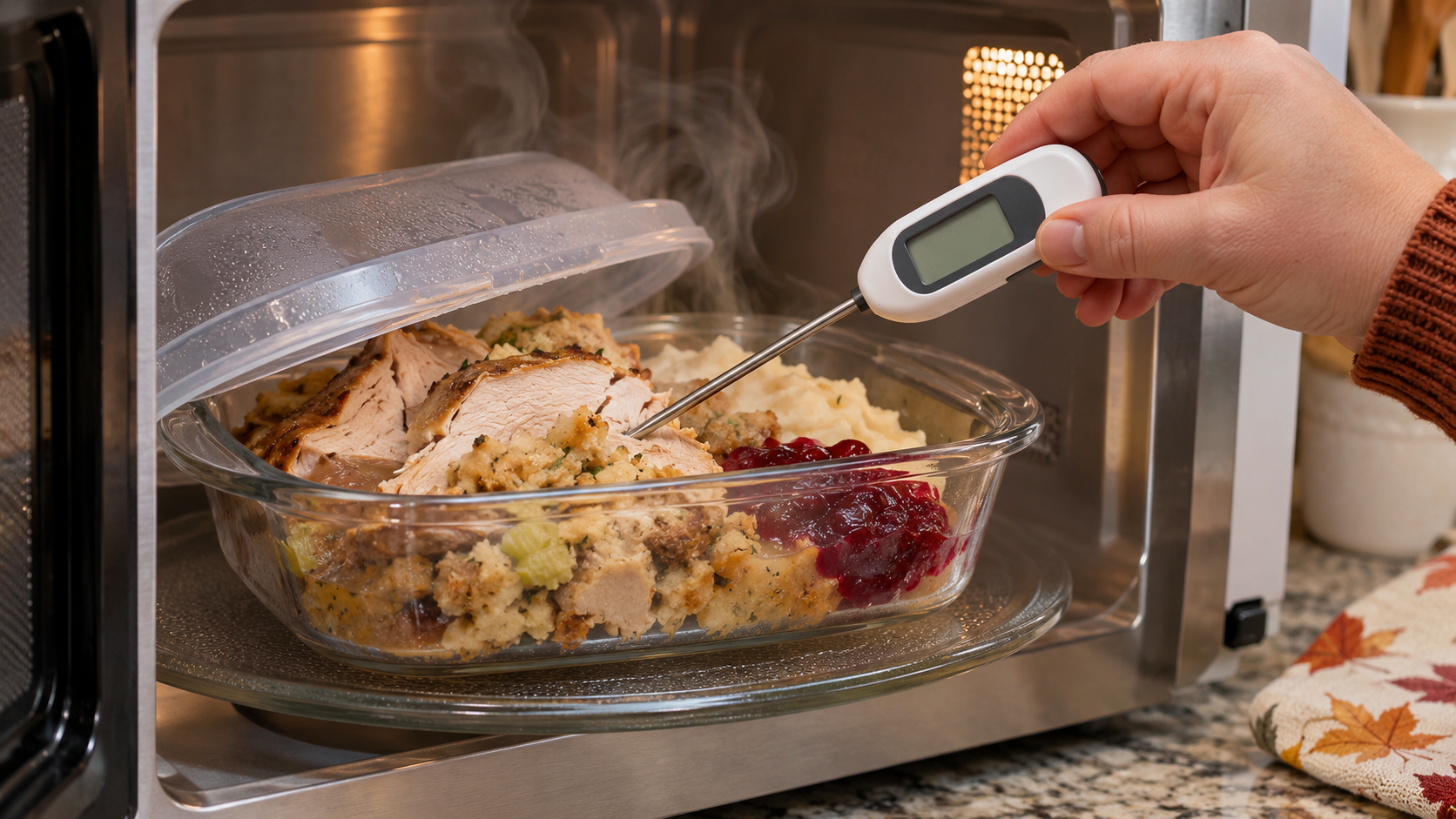
Measure several thick or dense spots because turkey, stuffing and microwave-heated dishes can warm unevenly.
USDA recommends reheating leftovers to an internal temperature of 165°F. Insert a food thermometer into the thickest or densest parts and check more than one spot. For mixed dishes, test the center as well as areas near the edge. Bring soups, sauces and gravy to a rolling boil.
Covering food while it reheats helps retain moisture and distribute heat. In a microwave, rotate or stir the food midway, rearrange large pieces, and allow the standing time called for by the recipe or appliance. Then measure again before eating.
Microwave cold spots can fool you
- Arrange food in an even layer and place thicker pieces toward the outside of the dish.
- Add a small amount of liquid when appropriate, then cover the dish with a microwave-safe lid or vented wrap.
- Pause to stir, rotate and rearrange food so the same area is not always at the edge of the turntable.
- Let the food stand after heating so temperatures can equalize.
- Check several places with a clean food thermometer; continue heating until every tested area reaches 165°F.
When to discard instead of taste-test
- Perishable food sat out for more than two hours, or more than one hour above 90°F.
- The refrigerator was above 40°F for more than two hours and the food’s temperature history cannot be verified.
- Nobody can establish when the food was cooked, served or refrigerated.
- The food is moldy, slimy, leaking or otherwise spoiled—while remembering that normal appearance does not prove safety.
- A container was contaminated by raw meat juices, dirty utensils or repeated handling.
Do not taste food to decide whether it is safe. When the evidence is incomplete, the cost of discarding a serving is lower than the health risk of gambling on it.
How freezing changes the deadline
Freeze leftovers by Monday in meal-size portions, remove excess air, and label each package with its contents and date. A freezer maintained at 0°F keeps food safe indefinitely, although texture and flavor decline. FoodSafety.gov lists two to six months as the best-quality range for frozen cooked meat or poultry.
Thaw frozen leftovers in the refrigerator, in cold water, or in the microwave—not on the counter. Food thawed in cold water or the microwave should be reheated promptly. USDA says frozen leftovers can also be reheated without thawing; allow extra time and verify 165°F in several spots.
A useful food thermometer for leftovers
A fast thermometer is more reliable than judging steam or touching a container. One relevant option is the ThermoPro TP19H instant-read food thermometer on Amazon (ASIN B07XXSYLL8). The tracked listing was verified for the TP19H model, but price, seller and availability can change. Confirm the model, current specifications, seller and return terms on the live listing before ordering.
Affiliate disclosure: ReaderSpice may earn a commission from qualifying Amazon purchases made through the link above, at no additional cost to you.
The bottom line
For Thanksgiving 2026 leftovers stored safely on Thursday, Monday, November 30 is the practical refrigerator deadline. Freeze what you will not eat by then, keep the refrigerator at 40°F or below, and reheat every portion to 165°F.
The two-hour rule is the gatekeeper. If a dish exceeded that limit, had an unknown timeline or warmed above 40°F for too long, do not rely on smell, taste or a second round of cooking. Discard it and keep the next batch on a documented time-and-temperature schedule.
Sources
FoodSafety.gov: Thanksgiving leftovers—safe keeping after weekend grazing
USDA FSIS: How to handle leftovers safely
FoodSafety.gov: Cold food storage chart
FoodSafety.gov: Safe minimum internal temperatures
FDA: Refrigerator thermometers and safe cold storage
USDA FSIS: Can hot food go in the refrigerator?
USDA FSIS: How to reheat leftovers safely
Amazon: ThermoPro TP19H instant-read thermometer (ASIN B07XXSYLL8)