DJI Neo Hits Record-Low $139 on Amazon as New U.S. Drone Tariffs Take Effect

If you’ve been waiting for a cheap way to get into DJI drones, this could be one of the best buying opportunities we’ve seen. The DJI Neo has dropped to just $139 on Amazon, down from its regular $199 price — a 30% discount and a record-low price.

The timing of this deal is especially interesting because new U.S. tariffs on imported drones have just taken effect, potentially putting upward pressure on drone prices as retailers replenish their inventories.

DJI Neo Drops to Just $139

Amazon is currently offering the controller-free DJI Neo Mini Drone with 4K UHD Camera for $139.


Amazon deal:

“Check the DJI Neo $139 deal on Amazon” https://amzn.to/4qWsV9j

Price and availability can change at any time.

At $139, the Neo is $60 below its $199 regular price, representing a 30% discount. Recent deal tracking and reporting identify this as the lowest price seen for the drone.

The sale isn’t limited to the basic configuration either. Amazon deal listings have recently shown:

– DJI Neo — $139

– DJI Neo Three-Battery Combo — $199

– DJI Neo Fly More Combo with RC-N3 — $239

– DJI Neo Motion Fly More Combo with Goggles N3 — $369

For buyers who want to fly with a traditional controller, the $239 Fly More Combo may offer the strongest overall value because it includes the RC-N3 controller, three Intelligent Flight Batteries and a two-way charging hub.

Why the $139 DJI Neo Is Such a Good Deal

Despite its low price, the DJI Neo isn’t simply a toy drone.

It weighs only about 135 grams and can record stabilized 4K/30fps video. It’s designed particularly well for beginners, travelers, vloggers and creators who want aerial footage without carrying a larger drone.

Some of its biggest features include palm takeoff and landing, AI subject tracking, QuickShots, full propeller guards and multiple control options.

You don’t even need a conventional remote controller to start using the basic Neo. It can work with DJI’s mobile app and automated flight modes, making it especially convenient as a compact flying camera.

Why the Timing Matters: New U.S. Drone Tariffs

There’s another reason this particular sale deserves attention.

New U.S. Section 232 tariffs covering unmanned aircraft systems went into effect for covered imports beginning September 3, 2026.

Under the presidential proclamation, covered drones with a maximum takeoff weight of 25 kilograms or less can face an additional 25% ad valorem duty, subject to the classifications and exceptions established by the proclamation.

Certain larger drones, thermal-imaging UAS, docking stations and specified critical components can face duties as high as 100%.

The U.S. Customs and Border Protection implementation guidance confirms that the new UAS duties became effective September 3. An additional 25% duty covering certain other UAS components is scheduled to become effective February 9, 2027.

Does That Mean the DJI Neo Will Become 25% More Expensive?

Not necessarily.

A 25% import tariff doesn’t mean Amazon simply takes today’s $139 price and adds another 25% at checkout.

The tariff applies at the import level to covered products. Retail prices depend on several factors, including import value, existing inventory, distributor costs, retailer margins and how much of the additional cost manufacturers or sellers decide to absorb.

There’s also an important inventory consideration.

Drones that were already imported before the new tariff took effect aren’t suddenly charged the new tariff simply because they’re sitting on a retailer’s shelf.

That means some of the DJI drones currently being sold in the United States could effectively represent pre-tariff inventory.

The bigger question is what happens when retailers need to replace that inventory with newly imported units subject to the new duty structure.

There is no guarantee that DJI Neo prices will increase, but the additional import costs create a legitimate risk of higher retail pricing once inventory turns over.

Is the DJI Neo Worth Buying at $139?

At $139, the DJI Neo becomes extremely compelling for someone buying their first DJI drone or a creator looking for an inexpensive secondary drone.

Its combination of 4K recording, subject tracking, palm launch, compact size and DJI’s stabilization technology is difficult to match at this price.

For casual users, the $139 base model makes sense.

For someone planning to fly regularly, however, the $239 Fly More Combo deserves serious consideration because the additional batteries, charging hub and RC-N3 controller significantly expand what you can do with the Neo.

Should You Buy Before Drone Prices Rise?

Nobody can guarantee that the DJI Neo will become more expensive after the current inventory sells out.

What we do know is that the Neo has reached a record-low $139 price at the same time new U.S. drone import tariffs are beginning to affect incoming products.

That’s an unusual combination.

If you’ve already been planning to buy a DJI Neo, waiting specifically for a substantially lower price may therefore carry more risk than usual.


Check the current Amazon price here:


“DJI Neo on Amazon”

https://amzn.to/4qWsV9j

Disclosure: If you use an affiliate link on your website, Prices and availability are subject to change.

Galaxy S27 Ultra Snapdragon leak: Samsung is already testing Qualcomm’s next flagship chip in the U.S., Korea and Asia-Pacific

Galaxy S27 Ultra Snapdragon leak and Qualcomm flagship chip testing

A meaningful new Samsung Galaxy S27-series processor leak surfaced on September 5, and it adds an important twist to the recent Exynos 2700 story.

According to a leaked Qualcomm project-portal screenshot obtained by Notebookcheck, Samsung Electronics is already validating Galaxy S27 hardware using Qualcomm’s unreleased SM8975 flagship processor across at least three regional builds: Asia-Pacific, South Korea and Verizon in the United States.

Snapdragon testing is further along than we knew

The leaked project entries are reportedly:

SS_SM8975_GS27_AP — Asia-Pacific
SS_SM8975_GS27_KOR — South Korea
SS_SM8975_GS27_VZW — Verizon/U.S.

All three reportedly use Qualcomm’s internal “Snapdragon_Premium_High_2026” software distribution. The existence of a Verizon-specific build is particularly interesting because it suggests Samsung is already doing carrier-specific RF/software validation for the upcoming Galaxy generation.

The SM8975 is expected to become Qualcomm’s highest-end next-generation Snapdragon chip, currently reported under the Snapdragon 8 Elite Extreme Gen 6 name. Qualcomm is expected to formally introduce its next Snapdragon flagship family at Snapdragon Summit, scheduled for September 22–24, 2026.

What does this mean for the Exynos 2700 S27 Ultra leak?

This is where today’s leak becomes particularly important.

Earlier reports said Samsung had begun preparing an Exynos 2700 Galaxy S27 Ultra motherboard for South Korea, potentially bringing Exynos back to an Ultra phone after a five-year absence. Those reports do not necessarily conflict with today’s information.

The new evidence shows that Samsung is simultaneously testing an SM8975 Snapdragon Galaxy S27 build for Korea.

That suggests Samsung may currently be evaluating multiple chipset configurations rather than having finalized which processor every S27 Ultra market will receive.

So claims that the South Korean S27 Ultra is definitely getting Exynos 2700 are premature.

What we can say with higher confidence

The strongest new evidence is that real Galaxy S27 development builds using SM8975 now appear to exist for the U.S./Verizon, Korea and Asia-Pacific regions. That’s more substantial than a generic rumor saying Samsung “plans to use Snapdragon,” although the leaked portal screenshot is still unofficial information.

It also strengthens the likelihood that the U.S. Galaxy S27 Ultra will continue using Qualcomm silicon, particularly given the presence of a dedicated Verizon project.

What it does not establish is whether every Galaxy S27 model represented by those projects uses SM8975, whether Samsung will ultimately ship both Snapdragon and Exynos S27 Ultras, or which regions would receive each processor.

Where the rest of the S27 Ultra leaks stand

There is no comparably strong new development today concerning the S27 Ultra’s cameras, battery, S Pen, Qi2 magnets, display or pricing.

Recent reporting still points toward the dramatic camera-plateau redesign, an integrated S Pen, potential native Qi2 magnets, a possible larger battery, and a reduced three-camera configuration. Those remain leaks rather than confirmed specifications.

Likewise, the experimental 50MP 4x telephoto with a roughly 1/1.9-inch sensor remains something Samsung is reportedly evaluating rather than a finalized retail camera configuration.

Current expectations still place the Galaxy S27 family in early 2027, but Samsung has not announced an Unpacked date or retail launch date.

Confirmed vs. leaked

Confirmed: Samsung has not officially announced the Galaxy S27 Ultra, its processor, specifications, price, cameras, battery capacity or release date.

Leaked: Qualcomm project information reportedly shows Samsung testing SM8975-powered Galaxy S27 hardware in Asia-Pacific, Korea and on Verizon.

Still uncertain: whether the S27 Ultra will ship with Snapdragon everywhere, return to a Snapdragon/Exynos regional split, or whether Samsung is simply evaluating both platforms before making its final decision.

For now, the most interesting takeaway is that Samsung appears to have both Snapdragon and Exynos options in development—and Snapdragon testing is already occurring even in Korea.

Read the September 5 Notebookcheck report

Apple’s iPhone Roadmap Leaks Through 2028: Foldable iPhone Above $2,000, iPhone Air 2 Upgrades and Major 2027 Redesign

iPhone 18 rumors and Apple iPhone roadmap concept

Apple appears to be preparing its biggest iPhone lineup shake-up in years. A new report attributed to Bloomberg’s Mark Gurman lays out Apple’s iPhone roadmap through 2028, including new details about the first foldable iPhone, the iPhone Air 2, the delayed standard iPhone 18, and an even more ambitious redesign planned for 2027.

The most important takeaway is that Apple’s first foldable iPhone is increasingly looking like a permanent new branch of the iPhone family rather than a one-off experiment.

Foldable “iPhone Ultra” Could Cost More Than $2,000

Gurman’s latest reporting says Apple’s first foldable iPhone will be roughly the size of a passport when folded and is expected to cost more than $2,000. The device is said to use an advanced hinge and Touch ID rather than Face ID, with both light and dark finishes reportedly planned.

Earlier reporting has pointed to roughly a 5.5-inch external display and 7.8-inch internal display, along with the A20 Pro chip, two rear cameras and MagSafe support.

The final product name remains unconfirmed. “iPhone Ultra” is increasingly being used in reports, but Apple has not publicly announced the name.

Apple May Release a New Foldable Every Year

One of today’s most significant new revelations is that Apple reportedly already has a second-generation foldable iPhone well into testing for 2027.

That model is expected to receive a newer chip, while a third-generation foldable planned for 2028 could increase both the exterior and interior display sizes.

If this roadmap holds, Apple would effectively establish an annual foldable upgrade cycle alongside its conventional iPhones.

iPhone Air 2 Gets Three Important Upgrades

Gurman’s roadmap also provides fresh information about the second-generation iPhone Air.

The iPhone Air 2 is now expected to gain:

  • an Ultra Wide camera
  • a faster processor
  • longer battery life

The Air 2 is reportedly part of Apple’s spring 2027 iPhone wave rather than the September 2026 Pro launch.

That could address two of the biggest compromises associated with ultra-thin phone designs: camera flexibility and battery endurance.

Standard iPhone 18 Moves to Spring 2027

Today’s report further reinforces Apple’s unusual split-launch strategy.

The expected fall 2026 lineup is centered on the iPhone 18 Pro, iPhone 18 Pro Max and foldable iPhone, while the regular iPhone 18 and iPhone 18e are reportedly scheduled for spring 2027.

Importantly, the latest credible roadmap does not identify an iPhone 18 Plus. Older rumors or concept images that include an iPhone 18 Plus should therefore be treated cautiously.

iPhone 18 Pro and Pro Max Still Expected Next Week

The iPhone 18 Pro and Pro Max remain expected to headline Apple’s September launch alongside the foldable.

Current credible rumors include:

A20 Pro chip: Apple is expected to move its Pro models to a 2nm-generation processor.

Smaller Dynamic Island: Apple reportedly plans to reduce the front display cutout.

Improved vapor-chamber cooling: Both Pro phones could receive better thermal management.

Larger battery: The Pro Max in particular is expected to become slightly thicker to accommodate additional battery capacity.

Variable aperture: The Pro Max may receive a mechanically adjustable main-camera aperture, although reports still disagree on whether the feature will also appear on the smaller Pro.

The Bigger Story Could Arrive in 2027

Perhaps the most interesting part of Gurman’s roadmap concerns Apple’s 20th-anniversary iPhone generation.

The 2027 Pro models are reportedly being developed with curved glass around the corners and edges, significantly thinner bezels and a substantially redesigned appearance.

Gurman describes it as Apple’s biggest Pro-line redesign since the iPhone X era.

That means the iPhone 18 Pro generation may serve as an evolutionary step before Apple makes a much larger visual change one year later.

Credibility Check

Higher confidence: The split iPhone launch schedule, fall 2026 Pro models, spring 2027 standard iPhone 18, development of a foldable iPhone, and continued work on iPhone Air are now supported by repeated reporting from established Apple sources.

Credible but still unofficial: The $2,000+ foldable price, Touch ID, yearly foldable refreshes, Air 2 Ultra Wide camera and specific 2027 redesign details come from reporting attributed to Gurman but remain unconfirmed by Apple.

Still speculative: Exact foldable naming, final retail pricing, exact screen dimensions, launch-day availability and some camera configurations could still change.

Final Thoughts

Apple’s rumored strategy is becoming much clearer.

Instead of launching every iPhone together each September, the company appears ready to divide its lineup into premium fall releases and mainstream spring releases. Meanwhile, the foldable iPhone could become a yearly product family of its own, while the Air line evolves into a more capable ultra-thin alternative.

The most significant new detail today is therefore not a single iPhone 18 specification—it is the emerging roadmap for three consecutive generations of foldable iPhones, combined with a substantially upgraded Air 2 and a major 20th-anniversary redesign in 2027.

SEO Title: Apple iPhone Roadmap Leaks: $2,000+ Foldable, iPhone Air 2 Upgrades & 2027 Redesign

Meta Description: New Apple leaks reveal a $2,000+ foldable iPhone, yearly foldable upgrades through 2028, iPhone Air 2 camera and battery improvements, a spring 2027 iPhone 18 launch and a major Pro redesign.

Sources include Bloomberg reporting as summarized by 9to5Mac and other current Apple coverage.

Galaxy S27 Ultra could bring Exynos back to the Ultra — a major strategy shift

Galaxy S27 Ultra Exynos leak and Samsung chipset strategy

A meaningful new Samsung Electronics Galaxy S27 Ultra leak has emerged from South Korea. According to a September 1 report from MoneyToday, Samsung has started preparing an Exynos 2700 version of the Galaxy S27 Ultra for selected markets, including South Korea. More significantly, the report says Samsung has already placed an initial order for S27 Ultra motherboards designed around the Exynos 2700.

Exynos could return to the Ultra after five years

This would be a substantial change in Samsung’s flagship strategy. The Galaxy S22 Ultra was the last Ultra generation offered with an Exynos processor. Galaxy S Ultra models from 2023 through 2026 have instead relied exclusively on Snapdragon silicon.

The report claims Samsung originally intended to use Qualcomm’s next-generation Snapdragon platform across the S27 Ultra lineup. Development of that Snapdragon model is reportedly already well advanced, but Samsung’s MX and System LSI divisions are now coordinating development of an additional Exynos 2700 motherboard.

That means the S27 Ultra could once again become a region-dependent phone:

United States: Snapdragon is still expected.
South Korea: Exynos 2700 is now reportedly being prepared.
Other regions: not yet firmly established for the Ultra.

Samsung has not confirmed this regional configuration, so reports claiming that Europe will definitely receive an Exynos S27 Ultra are currently getting ahead of the strongest source.

Exynos 2700 itself just received another interesting leak

A newly reported Exynos 2700 die shot provides additional clues about what Samsung may be developing. The analysis points toward Samsung’s second-generation 2nm SF2P process, a 10-core CPU arrangement with two high-performance tiers, a large NPU, 24MB system-level cache, Xclipse 970 graphics and LPDDR6 support.

The leaked architecture could be especially important for sustained performance and efficiency. However, these are engineering-stage processor details, not confirmed Galaxy S27 Ultra specifications. Support for technologies such as LPDDR6 does not automatically mean the retail S27 Ultra will actually use LPDDR6 memory.

What Ice Universe is saying

There isn’t a new Ice Universe specification leak today that overrides the previous camera, design, battery or S Pen reporting. A September 2 post attributed to Ice Universe instead criticized the S27 series as feeling “tired, bored, exhausted”, suggesting disappointment with the direction of the lineup rather than revealing another hardware specification.

Current S27 Ultra leak picture

The Exynos 2700 Ultra variant is the meaningful new development. The other major reports remain largely where they were: a dramatically redesigned rear camera area, three-camera direction, integrated S Pen, potential native Qi2 magnets, and a larger battery remain under discussion. The recently reported experimental 4x telephoto configuration also remains just that—something reportedly being evaluated rather than a finalized retail camera specification.

Pricing also remains unknown. Reports estimating a price based on the current Ultra should not be treated as an actual S27 Ultra price leak. Current launch expectations remain around early 2027, but Samsung has not announced the Galaxy S27 Ultra, its launch date, pricing, processors or specifications.

The strongest evidence behind today’s development is the Korean supply-chain report about Samsung ordering Exynos 2700 S27 Ultra motherboards. That makes this considerably more interesting than a generic specification rumor, while still stopping short of proving that Exynos-powered retail S27 Ultras will actually ship.

Meaningful new Galaxy S27 Ultra camera leak

Samsung Galaxy S27 Ultra camera leak and rumored rear camera redesign

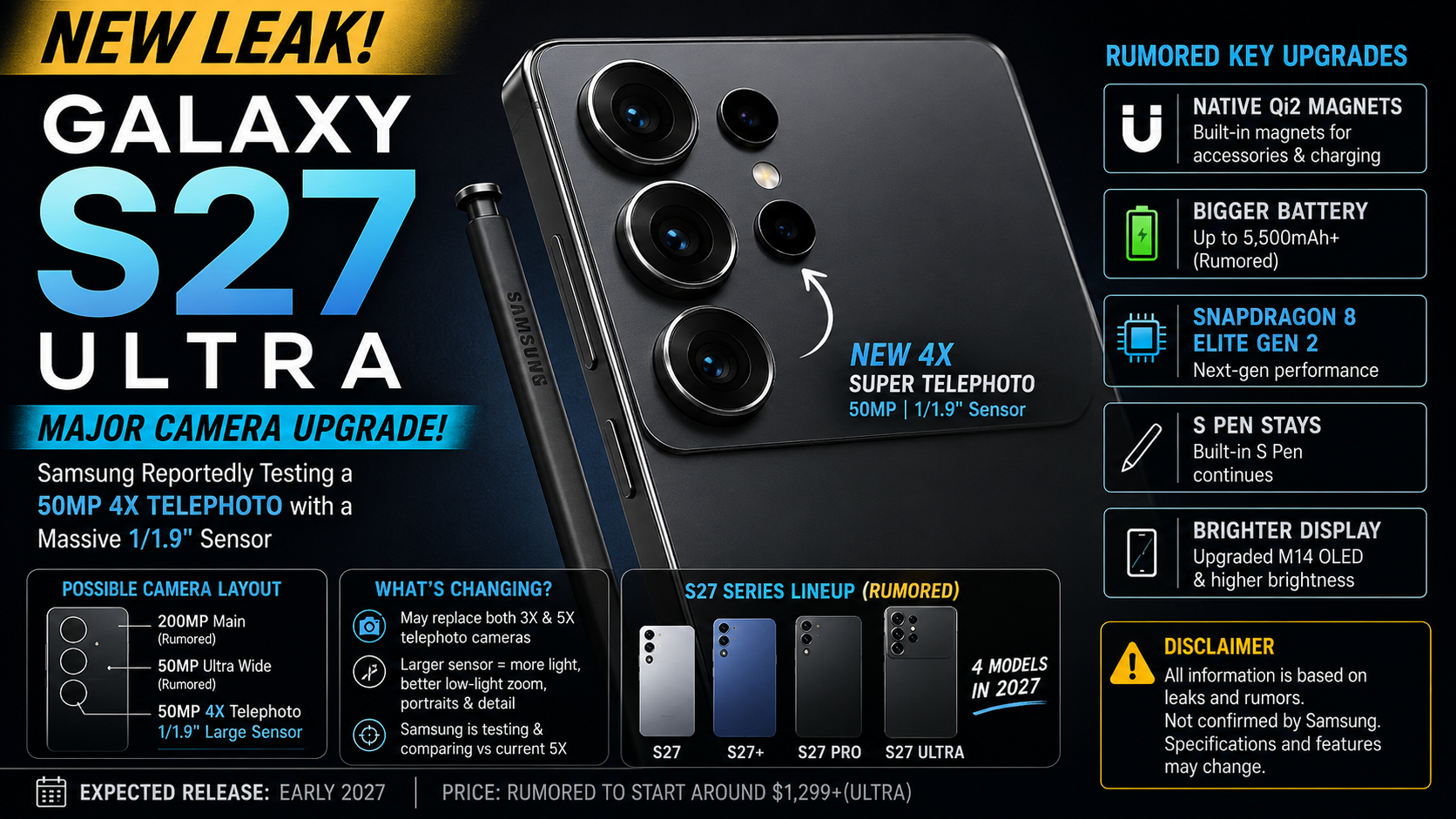
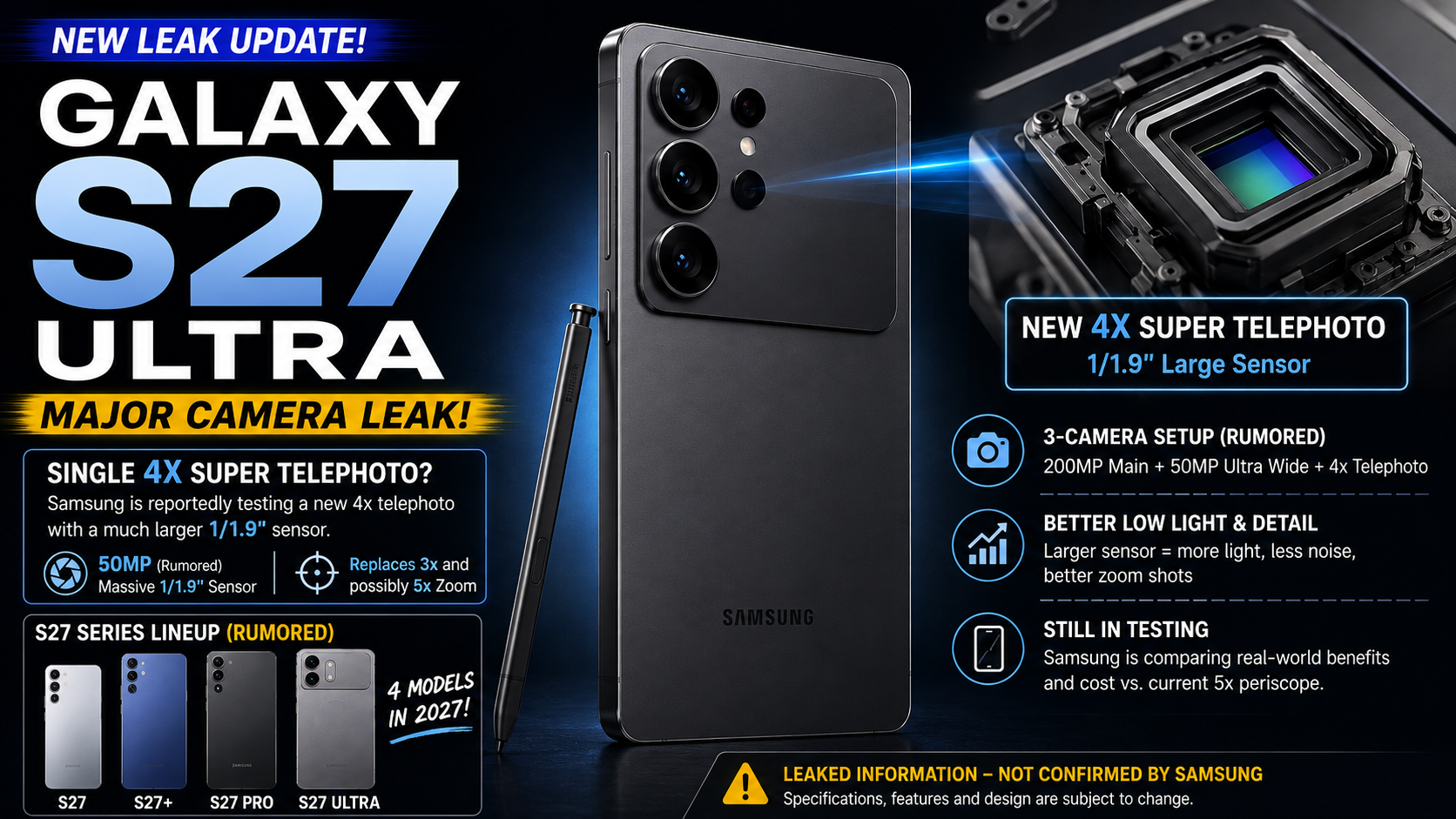
Samsung is reportedly testing a major change to the S27 Ultra zoom system: a single 4x “super telephoto” camera with a much larger 1/1.9-inch sensor. This could replace not only the rumored-to-be-removed 3x telephoto, but potentially the existing 5x periscope as well.

The new 4x sensor is reportedly 50MP in some reports and substantially larger than the current 5x telephoto’s roughly 1/2.52-inch sensor. The idea would be fewer dedicated zoom cameras but a significantly larger sensor capable of gathering more light, potentially improving low-light zoom, portraits, detail and noise.

This also fits the recently leaked CAD design surprisingly well: those renders appear to provide space for three rear cameras total, supporting the possibility of a 200MP main + ultrawide + single high-quality telephoto architecture.

Important: this configuration is not finalized. The originating leak says Samsung is testing the 4x solution and comparing its real-world benefit and cost against retaining the existing 5x design. Reports claim multiple S27 Ultra prototypes are still being evaluated.

There is no new official confirmation from Samsung, and I found no meaningful new Ice Universe disclosure today that supersedes his recent design/battery information. So I would currently label the 4x super-telephoto as a notable new leak, but medium confidence rather than a near-final specification.

A meaningful new Galaxy S27 Ultra battery/S Pen leak surfaced

Samsung Galaxy S27 Ultra battery and S Pen leak

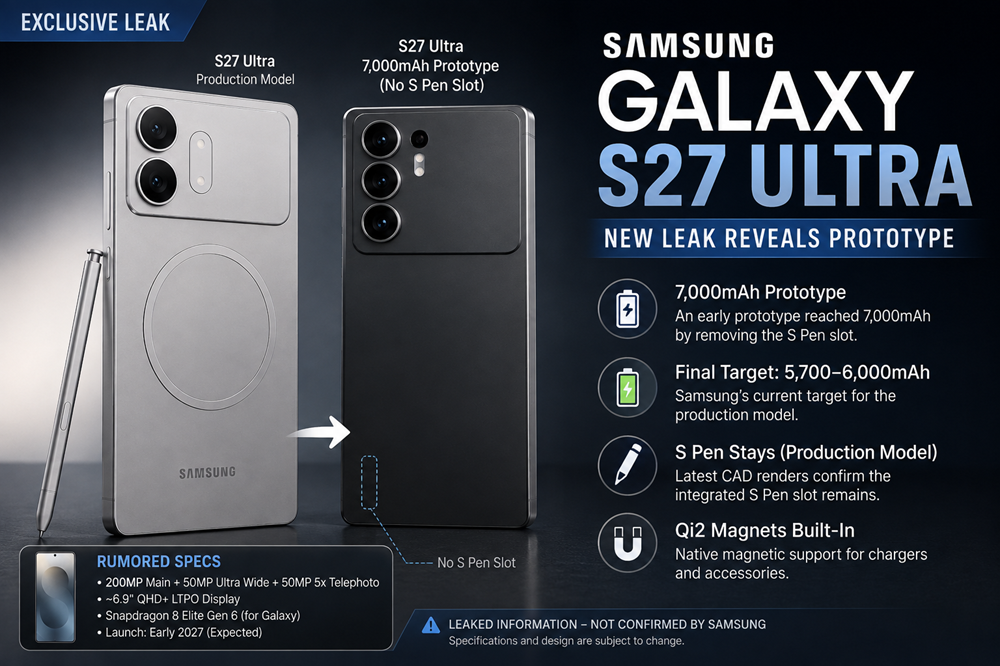
Samsung reportedly tested several S27 Ultra prototypes, including an extreme version with a 7,000mAh battery that removed the built-in S Pen slot to create additional internal space. More importantly for the likely production phone, the same leak says Samsung’s current battery target has settled around 5,700–6,000mAh, potentially using silicon-carbon technology. Android Authority

This does not mean Samsung is removing the S Pen. In fact, the latest CAD renders still show an integrated S Pen slot, suggesting the 7,000mAh/S-Pen-less configuration was an experimental prototype that Samsung decided against.

There is also newer CAD information putting the S27 Ultra at roughly 163.76 × 78.25 × 7.97 mm, with the substantial new camera plateau reaching approximately 12.53 mm thick at its highest point. That means the main body could remain around 8mm despite the rumored battery increase, but the camera bump would become noticeably thicker.

The other major leaks remain consistent with the previous update: a three-camera arrangement potentially consisting of 200MP main + 50MP ultrawide + 50MP 5x telephoto, removal of the dedicated 3x camera, native Qi2 magnetic support, approximately 6.9-inch display, and an early-2027 launch.

Confirmed by Samsung: none of these S27 Ultra specifications yet. The 7,000mAh prototype in particular should be treated as an interesting development-history leak—not the expected retail specification.

Samsung Galaxy S27 Ultra Leaks: Everything We Know So Far

Samsung Galaxy S27 Ultra leaks and rumored flagship design

Samsung’s Galaxy S27 Ultra is still months away from its expected official debut, but leaks surrounding Samsung’s next flagship are already starting to paint an interesting picture. If the latest information is accurate, the Galaxy S27 Ultra could bring one of the biggest design changes to Samsung’s Ultra lineup in years.

The most attention-grabbing leak is the phone’s completely redesigned rear camera layout. But rumors also point toward built-in Qi2 magnets, a larger battery, next-generation Snapdragon hardware, camera upgrades and other internal improvements.

It is important to remember that Samsung has not officially announced the Galaxy S27 Ultra, so everything discussed below should be considered leaked or rumored information rather than confirmed specifications.

A Completely New Galaxy S27 Ultra Design?

The biggest recent development comes from well-known Samsung leaker Ice Universe.

A sketch shared online appears to show Samsung abandoning the familiar individually arranged camera rings found on recent Galaxy Ultra phones. Instead, the Galaxy S27 Ultra may feature a large horizontal camera plateau extending across much of the upper portion of the phone.

The leaked concept shows two large circular cameras positioned vertically on the left side of the camera area, with another pill-shaped section next to them.

Recent reporting based on the leak says Samsung may be considering this significantly different camera arrangement for its next Ultra flagship.

Additional alleged CAD-style renders have since appeared online and seem to support the idea that Samsung is experimenting with a substantially redesigned camera housing.

If accurate, this would represent a major departure from Samsung’s recent minimalist camera-ring design.

Could There Be Two Galaxy S27 Ultra Sizes?

An even more surprising rumor emerged shortly after the first design leak.

Tipster Sonny Dickson reportedly shared imagery suggesting Samsung could be considering two Galaxy S27 Ultra variants or sizes.
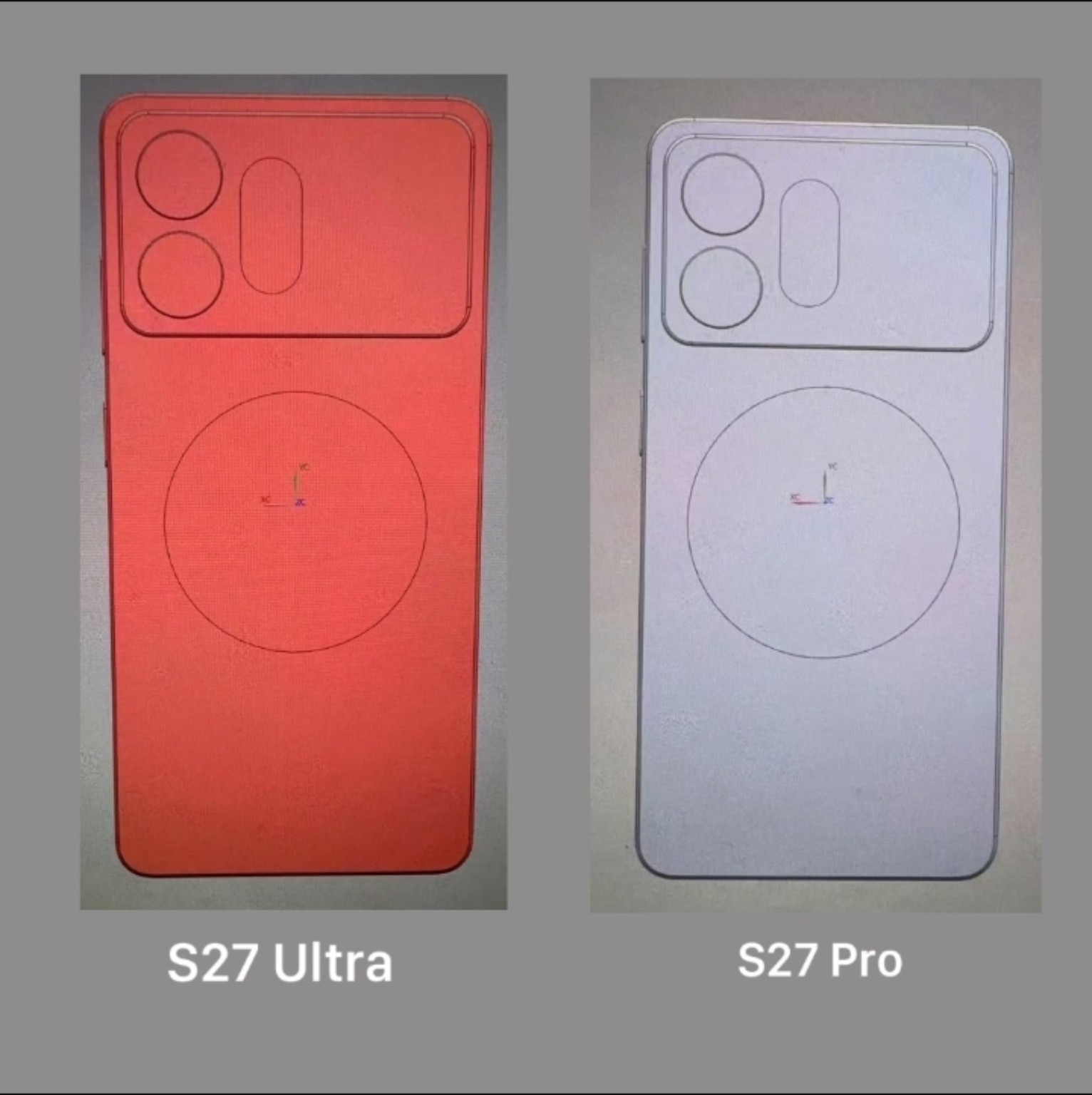
The information is still extremely preliminary, and it isn’t clear whether both versions represent products Samsung actually intends to release. They could potentially represent prototypes or different stages of development.

For now, a second Ultra size should therefore be treated as one of the less certain S27 Ultra rumors.

Built-In Qi2 Magnets Could Finally Arrive

Another major detail visible in some alleged S27 Ultra renders is a large circular structure on the rear of the phone.

That has fueled reports that Samsung may finally integrate Qi2 magnets directly into the Galaxy S27 Ultra.

Instead of requiring a magnetic case, integrated magnets could allow compatible magnetic wireless chargers, stands, wallets and other accessories to attach directly to the phone.

The possibility of native magnetic charging has appeared in multiple reports surrounding the S27 Ultra.

If Samsung implements it properly, this could be one of the most useful everyday upgrades to the Galaxy Ultra series.

What Happens to the S Pen?

Adding strong magnets creates an interesting engineering challenge because magnetic fields can potentially interfere with digitizer technology used by styluses.

However, the latest leaked CAD information suggests Samsung may still retain the integrated S Pen slot on the S27 Ultra.

SamMobile reports that the alleged CAD renders show the S27 Ultra retaining a layout similar to the S26 Ultra around the bottom of the device, including its S Pen slot and left-side speaker positioning.

That would be important news for longtime Galaxy Note and Ultra users.

If Samsung can combine an internal S Pen with fully integrated Qi2 magnets, the S27 Ultra could offer both features without forcing buyers to choose between them.

Galaxy S27 Ultra Camera Rumors

Camera specifications are currently one of the most contradictory parts of the leaks.

One recent rumor suggested an ambitious four-camera system consisting of:

  • 200MP main camera
  • 50MP ultrawide camera
  • 50MP telephoto camera
  • 50MP 5x telephoto camera
  • 16MP front-facing camera

That report also specifically mentioned a Sony IMX855 sensor for the 50MP ultrawide camera.

Another leak concerning Galaxy S27 series codenames and cameras similarly pointed toward a 50MP Sony IMX855 ultrawide sensor on higher-end S27 models and a 16MP autofocus selfie camera.

But there is an important contradiction.

The much newer design leak appears to suggest the S27 Ultra could instead have only three rear cameras.

SamMobile interprets the latest leaked design as potentially containing a 200MP primary camera, 50MP ultrawide and 50MP 5x telephoto camera.

That means Samsung may potentially eliminate one of the current telephoto cameras.

At this stage, the number of rear cameras is not settled.

Thinner Camera Hardware

Samsung may also be working on making the camera assembly physically thinner.

A report originating from South Korea claims Samsung plans to expand the use of specialized inkjet lens-printing technology across three rear camera modules on the Galaxy S27 Ultra.

The technology could help reduce unwanted light reflections while also allowing Samsung to reduce the physical thickness of camera components.

Interestingly, the reference to three camera modules could potentially support the newer three-camera rumor, although it isn’t enough by itself to confirm that configuration.

Bigger Silicon-Carbon Battery

Battery capacity could finally receive a meaningful upgrade.

One widely circulated leak claims the Galaxy S27 Ultra will use a 5,700mAh silicon-carbon battery.

Silicon-carbon battery technology can provide greater energy density, allowing manufacturers to fit more battery capacity into a similar physical space.

Another leak has gone even further, suggesting the S27 Ultra could exceed 6,000mAh.

Because those numbers conflict, the safest conclusion right now is that Samsung appears to be investigating a larger battery, while its final capacity remains uncertain.

A 5,700mAh battery currently appears in several of the more detailed specification leaks.

Snapdragon 8 Elite Gen 6

Samsung’s next Ultra should naturally receive Qualcomm’s next-generation flagship processor.

Early reports referred to the chip as the Snapdragon 8 Elite Gen 6 Pro for Galaxy.

More recent reporting, however, suggests Qualcomm may use different branding. The higher-performance processor destined for the Galaxy S27 Ultra and S27 Pro could potentially be called the Snapdragon 8 Elite Extreme Gen 6.

Qualcomm itself has now teased two upcoming Snapdragon 8 Elite-class chips ahead of Snapdragon Summit 2026, lending additional credibility to reports of multiple flagship Snapdragon variants.

The processors are widely expected to move to an advanced 2nm manufacturing process, although final specifications have not yet been announced.

12GB or 16GB RAM

Leaks currently suggest Samsung could offer the Galaxy S27 Ultra with:

12GB or 16GB RAM

One detailed specification leak claims both capacities are being considered.

There have also been rumors surrounding LPDDR6 memory, although reports disagree about whether Samsung will actually use it in the S27 Ultra. Some leaks instead suggest Samsung may continue using older memory technology.

Until production hardware begins appearing in benchmarks, RAM technology remains uncertain.

6.9-Inch QHD+ Display

Samsung does not appear to be dramatically changing the overall display size.

Multiple rumors point toward another approximately 6.9-inch QHD+ display.

One report claims Samsung could introduce a newer M16 LTPO OLED panel, potentially improving efficiency and display performance.

The S27 Ultra is also expected to continue Samsung’s privacy-display technology, with one leak specifically describing it as a 6.9-inch QHD+ Privacy Display.

Expect extremely thin bezels and a centered hole-punch selfie camera if Samsung follows its current design direction.

Improved Cooling

Another interesting rumor involves thermal management.

One report claims Samsung could introduce a more advanced liquid-based cooling solution in the Galaxy S27 Ultra.

A more powerful processor combined with increasingly demanding on-device AI workloads makes cooling particularly important.

Whether this turns into an entirely new cooling architecture or simply a substantially improved vapor chamber remains unclear.

Galaxy S27 Ultra Software

Assuming Samsung follows its normal schedule, the S27 Ultra should arrive with the newest version of Samsung’s One UI available at launch and a version of Android appropriate for early 2027.

Current specification listings expect Android 17, although software details this far before launch should not be considered final.

Galaxy AI will almost certainly continue to play a major role, especially as Samsung and Qualcomm push more AI processing directly onto the device.

Possible Galaxy S27 Family Expansion

Another unusual rumor concerns the entire Galaxy S27 lineup.

Leaked internal codenames reportedly run from NM1 through NM4, which could indicate four primary S27-series devices rather than the traditional three.

Recent CAD leaks have similarly suggested a lineup potentially consisting of:

Galaxy S27
Galaxy S27+
Galaxy S27 Pro
Galaxy S27 Ultra

The rumored S27 Pro appears to receive some of the more substantial camera and design upgrades as well.

This remains unconfirmed, but it could represent a significant restructuring of Samsung’s flagship lineup.

Expected Galaxy S27 Ultra Release Date

Samsung has not announced a launch date.

Based on Samsung’s established Galaxy S release schedule, however, the Galaxy S27 family is widely expected in early 2027.

Current industry estimates point toward approximately January or February 2027, with some listings specifically expecting availability around February.

Galaxy S27 Ultra — Rumored Specifications

Based on the leaks currently circulating, the overall picture looks something like this:

Display: Approximately 6.9-inch QHD+ LTPO OLED
Processor: Snapdragon 8 Elite Gen 6-class flagship chip
RAM: 12GB / 16GB rumored
Main camera: 200MP rumored
Ultrawide: 50MP rumored
Telephoto: 50MP 5x rumored
Additional telephoto: Possibly another 50MP sensor, but disputed
Selfie camera: 16MP rumored
Battery: Approximately 5,700mAh rumored, with some reports claiming 6,000mAh+
Charging: Qi2 wireless charging rumored
Magnets: Integrated Qi2 magnetic system strongly rumored
S Pen: Latest CAD leaks suggest the built-in S Pen remains
Software: Android 17 expected
Design: Major new horizontal camera plateau
Launch: Expected early 2027

How Much of This Should We Believe?

Not all Galaxy S27 Ultra leaks deserve equal weight.

The new camera design deserves attention because multiple sources have now circulated imagery pointing toward a redesigned camera plateau.

Built-in Qi2 magnets are also becoming increasingly plausible because they appear visually in alleged renders and have been discussed in separate reports.

The processor upgrade is highly likely simply because it follows Samsung’s normal flagship upgrade cycle, although the final Snapdragon branding remains unclear.

A larger battery looks increasingly possible, but whether Samsung chooses 5,700mAh, more than 6,000mAh or something else remains unresolved.

The camera configuration is currently the biggest question mark. Earlier rumors describe four rear cameras, while newer design leaks appear to show only three.

And the possibility of two different S27 Ultra sizes should currently be treated as an early rumor rather than an established feature.

Final Thoughts

If even most of these leaks turn out to be accurate, the Galaxy S27 Ultra may be a much more significant upgrade than a typical year-over-year Galaxy Ultra refresh.

The potential combination of a completely redesigned camera system, integrated Qi2 magnets, larger silicon-carbon battery, next-generation 2nm Snapdragon processor, improved cooling and upgraded cameras could make the S27 Ultra one of Samsung’s biggest flagship changes in years.

But the most controversial change may also be the simplest: its appearance.

Samsung spent several generations developing a recognizable minimalist Galaxy Ultra camera design. The leaked S27 Ultra appears ready to abandon that look for a large camera plateau.

Whether Samsung fans see that as a much-needed redesign—or simply think Samsung is following its competitors—could become one of the biggest discussions surrounding the Galaxy S27 Ultra.

For now, the Galaxy S27 Ultra remains unannounced, and these specifications should be treated as rumors until Samsung makes them official.


Top 5 Best Smartphones in 2026 (Ultimate Buyer’s Guide)

Looking for the best smartphone in 2026? Whether you’re a gamer, content creator, photographer, or just want the fastest flagship, these are the top five smartphones worth considering this year.

1. Samsung Galaxy S26 Ultra ⭐ Best Overall

The Samsung Galaxy S26 Ultra continues to dominate the Android market with its premium design, industry-leading display, AI-powered features, and outstanding camera system.

Pros

  • Excellent camera performance
  • Beautiful AMOLED display
  • Long battery life
  • S Pen support
  • Powerful Snapdragon processor
  • 7 years of software updates

Best For

  • Professionals
  • Content creators
  • Mobile photographers

👉 Check Price:
https://amzn.to/4w2lkI4

2. Apple iPhone 17 Pro Max ⭐ Best iPhone

Apple’s latest flagship delivers incredible performance thanks to its newest A-series chip, improved cameras, longer battery life, and seamless integration with the Apple ecosystem.

Pros

  • Best video recording
  • Extremely fast performance
  • Excellent battery life
  • Premium build quality

Best For

  • Apple users
  • Video creators
  • Everyday premium users

👉 Check Price:
https://amzn.to/4vqXnJ

3. Google Pixel 10 Pro ⭐ Best Camera Phone

Google continues to impress with AI-powered photography and one of the cleanest Android experiences available.

Pros

  • Outstanding computational photography
  • AI editing tools
  • Clean Android software
  • Regular software updates for 7 years

Best For

  • Photography lovers
  • Android enthusiasts
  1. 👉 Check Price:
    https://amzn.to/4w1maVy

4. Samsung Galaxy Z Fold 7 – Best Foldable Phone

The Galaxy Z Fold 7 combines a smartphone and tablet into one premium device, making it ideal for multitasking, productivity, and entertainment.

Best For

  • Business users
  • Multitasking
  • Foldable enthusiasts

👉 Check Price:

https://amzn.to/4pjUloM

Nothing Phone (3) – Best Value Flagship

The Nothing Phone (3) offers flagship-level performance, a unique transparent design, a clean Android interface, and excellent value for the price.
Best For

  • Budget flagship buyers
  • Android enthusiasts
  • Everyday users

👉 Check Price:

https://amzn.to/44YWCMJ


Final Verdict

If you want the best overall smartphone in 2026, the Samsung Galaxy S26 Ultra is our top recommendation thanks to its excellent balance of performance, cameras, battery life, and productivity features.

Apple users should choose the iPhone 17 Pro Max, while photographers will love the Google Pixel 10 Pro. If you’re looking for flagship performance without spending as much, the Nothing 3 remains one of the best value options.


Disclosure: As an Amazon Associate, I earn from qualifying purchases at no extra cost to you.

DJI Osmo Nano: A Wearable 4K Action Camera – Specs and Review

DJI Osmo Nano: A Wearable 4K Action Camera

DJI Osmo Nano: A Wearable 4K Action CameraThe DJI Osmo Nano is an ultra-compact wearable action camera designed for hands-free shooting[1][2]. Weighing only 52 g and measuring 57×29×28 mm[2], it’s DJI’s smallest action camera. The Nano features a dual-sided magnetic design, so it can attach to hats, helmets, straps or even pet collars for new shooting angles[2]. It’s waterproof to 10 meters without a case, making it suitable for water sports and outdoor adventures[2]. According to DJI, the Nano delivers “crisp, vivid footage” of your daily activities – from cycling and running to epic adventures[1]. It comes in 64GB or 128GB versions and includes a magnetic Vision Dock (with touchscreen) for charging, live preview and remote control.

Key Specifications

  • Weight & Size: 52 g; 57×29×28 mm[2]. (Extremely lightweight and pocket-sized.)
  • Sensor & Video: 1/1.3″ CMOS sensor (13.5 stops dynamic range); up to 4K (3840×2160) at 60 fps[3]. Supports slow-motion at 4K/120fps and 2.7K/240fps for ultra-smooth footage. 143° ultra-wide field of view[3].
  • Color & Photo: 10-bit D-Log M color profile and 72% wider color gamut for rich colors[3]. Captures roughly 35 MP still images.
  • Stabilization: DJI RockSteady 3.0 electronic image stabilization and HorizonBalancing (±30°) ensure steady, level video[3].
  • Battery Life: 530 mAh internal Li-ion battery; ~90 minutes continuous recording at 1080p/24fps[4]. Extended with dock: up to ~200 minutes of 1080p video when attached to the Vision Dock[4]. Fast charging: 80% in ~20 minutes via dock[5]. New “Endurance Mode” allows up to 60 min at 4K/30fps (16:9) on a full charge[5].
  • Mounting: Dual-sided magnetic design (magnets on two faces) lets you mount anywhere (hats, helmet, strap, etc.)[2]. Also included: magnetic pendant and ball-joint adapter for flexible mounting.
  • Vision Dock:0″ OLED touchscreen on dock for live preview and menu control. Dock acts as a remote trigger, charger and USB-C hub. Includes a built-in microSD slot and PD port for high-speed transfer (up to 600 MB/s)[5].
  • Audio: Built-in stereo microphones. Supports DJI wireless mic transmitters (OsmoAudio™) for up to two external mics without a receiver[6].
  • Additional: Time-lapse, intervals, gesture control (start with head nod/tap), pre-record buffer, ND filter support. DJI accessories include magnetic headband, quick-release mounts, ND filters, lens covers, etc.[7].

Design and Mounting

The Osmo Nano’s ultra-compact design and dual magnets make it extremely versatile for mounting. One side of the camera can attach magnetically to its Vision Dock, and both front/back surfaces can stick to metal mounts or included magnetic accessories[2]. Weighing just 52 g and about the size of a lighter, it can be clipped onto a shirt, mounted on a helmet or even a pet collar. Despite its size, the Nano is highly durable: the bare camera (with lens cover tightened) is waterproof to 10 m for short periods, allowing use in rain or water sports without an extra case[2]. Its slim form factor lets it be worn unobtrusively, unlocking creative hands-free angles that traditional cameras can’t easily achieve[1]. DJI highlights that this design means you can “own the moment” in various activities – from cycling to running or climbing – without holding the camera[1][2].

Camera and Video Capabilities

At its core, the Osmo Nano packs a powerful imaging engine. It uses a 1/1.3″ CMOS sensor (the same size used in larger drones) that captures up to 13.5 stops of dynamic range for rich detail in highlights and shadows[3]. The Nano records video up to 4K (3840×2160) at 60 frames per second (16:9 aspect)[3]. It also supports 4K video at 120 fps (for 4× slow-motion) as well as 2.7K and 1080p up to 240 fps for slow-motion effects. For color, the Nano offers 10-bit D-Log M recording, enabling post-production color grading with a much wider color gamut[3]. Its lens provides a 143° ultra-wide field of view, capturing a broad scene.

For stabilization, DJI’s latest RockSteady 3.0 electronic image stabilization keeps footage smooth and level. In addition, HorizonBalancing can correct tilts up to ±30° in a shot, virtually leveling the horizon for a drone-like steady look[3]. Low-light performance is aided by a “SuperNight” mode (8-bit, 30fps) which uses noise reduction algorithms. Still photos can be captured at up to ~35 megapixels in JPEG or RAW. In all modes, video is saved in HEVC format (H.265) with up to 120 Mbps bitrate, ensuring high image quality.

Battery Life & Charging

The Osmo Nano’s small body houses a 530 mAh Li-ion battery. In real-world use, DJI specifies about 90 minutes of continuous recording at 1080p/24fps on a single charge[4]. This means you can easily film most activities on one charge, though using high frame rates, Wi-Fi, or the screen will reduce runtime. The real game-changer is the included Vision Dock: when the Nano is docked and fully charged, DJI states up to 200 minutes of 1080p/24fps recording[4]. The dock also charges the camera very rapidly – up to 80% in only 20 minutes[5] – thanks to its high-power USB-C port. DJI introduced an Endurance Mode, which lets you continuously record about 60 minutes of 4K/30fps video on a full charge[5]. For practical use, this means occasional bursts of action won’t drain your battery, and a power bank or AC adapter can top up the Vision Dock for extended sessions. (Note: actual battery life will vary with settings and conditions.)

Vision Dock and Accessories

The Vision Dock (included with the Nano) greatly expands its capabilities[8]. This multifunctional dock features a 1.96″ OLED touchscreen, letting you preview and control the camera remotely. As RedShark News notes, the dock “acts as a display screen, a remote photo trigger, a charging station, and a high-speed file transfer station”[8]. You simply snap the Nano onto it magnetically in either orientation – portrait (selfie) or landscape – depending on whether you want to face the lens toward you or outward. The dock can fast-charge the Nano’s battery (80% in ~20 min) and offers a USB-C PD port for connecting a charger or computer. It even includes a built-in microSD card slot and supports transfer speeds up to 600 MB/s[5].

Beyond the dock, DJI offers accessories to complement the Nano. These include a magnetic headband and quick-release mounts for head or chest attachment, a glass lens cover for protection, a set of ND filters for exposure control, and a dual-direction magnetic ball-joint adapter to angle the camera[7]. All magnetic parts make mounting quick and secure. Together, the dock and accessories let you use the Nano almost anywhere – from selfie vlogging to fixed POV setups.

Audio and Connectivity

The Osmo Nano features dual built-in microphones for stereo audio recording. Notably, DJI’s OsmoAudio™ system lets you connect wireless microphone transmitters directly to the Nano. You can pair up to two DJI wireless mic transmitters (sold separately) simultaneously, without needing a separate receiver[6]. This is ideal for vlogging or interviews, as you can capture high-quality audio from a distance. The Nano also has Wi-Fi 6 (2.4/5.8 GHz) and Bluetooth LE for control and file transfer via the DJI Mimo smartphone app. This allows for remote live view and adjusting settings on your phone. (There’s no standard headphone jack, but the wireless mic support covers most use cases.)

Shooting Modes and Controls

In everyday use, the Osmo Nano offers a variety of creative shooting modes[7]. It supports both vertical and horizontal orientation recording (great for social media vs. traditional video). You can capture time-lapse or interval-lapse sequences at 4K/2.7K/1080p with customizable intervals. The Nano can also start recording via gesture control: a simple head nod or hand tap can trigger the shutter, which is handy when the camera is mounted out of reach[7]. A pre-record buffer (up to 60 seconds) ensures you never miss a moment – it continuously records in a short loop, so when you hit record, it saves what just happened. The included OLED dock screen (or DJI app) provides an intuitive menu for mode selection.

Accessories enhance versatility: a magnetic lanyard and headband mount let you quickly switch between angles. For example, you can go from chest-mounted action shots to a wrist-mounted selfie. DJI also sells a Magnetic Ball-Joint Adapter for 180° rotation, and a small tripod mount if needed. All these shooting modes and accessories make the Osmo Nano a flexible tool for vlogging, POV action, and creative filming.

Pricing, Availability, and Where to Buy

The DJI Osmo Nano was announced in September 2025. At launch, it comes in 64GB and 128GB storage versions. In the UK market, DJI listed prices of £239 for 64GB and £259 for 128GB[9] (roughly $300/$330 USD). US pricing was expected around $299 for 64GB. The Nano is sold through DJI’s official channels and authorized retailers. It is also available online – for example, you can purchase the DJI Osmo Nano on Amazon. (Affiliate link: DJI Osmo Nano on Amazon). This affiliate link can be used to check current prices and buy the product (it typically includes both camera and Vision Dock).

With its tiny form factor and powerful specs, the DJI Osmo Nano offers creative videographers a unique wearable camera option. Its long recording times with the dock, high-quality 4K imaging, and wide range of mounts make it suitable for travel, sports, pets, and everyday vlogging. For hands-free 4K capture in virtually any situation, the Osmo Nano is DJI’s answer – and it’s now available for purchase at retailers such as Amazon[9].

Tags: DJI Osmo Nano, wearable camera, action camera, 4K camera, vlogging, Osmo Nano features, Osmo Nano specs, camera accessories, battery life

[1] Osmo Nano – Own the Moment – DJI

https://www.dji.com/nano

[2] [3] [5] [6] [7] [8] [9] DJI Osmo Nano: A Super Compact Wearable Camera

https://www.redsharknews.com/dji-osmo-nano-a-super-compact-wearable-camera

[4] Osmo Nano – 仕様 – DJI

https://www.dji.com/jp/nano/specs

Eufy Clean X9 Pro: Revolutionizing Home Cleaning with Smart Technology

Eufy Clean X9 Pro robot vacuum and mop review

Are you tired of spending your precious time cleaning your floors? Look no further! Introducing the eufy Clean X9 Pro, the advanced CleanerBot equipped with innovative features to make your cleaning routine effortless.

Powerful Cleaning Technology

The eufy Clean X9 Pro is designed to deliver exceptional cleaning performance. With its adaptive pressure cleaning and 2 rotating mops, it effectively removes dirt, grime, and stains from a variety of surfaces. Whether you have hardwood floors, carpets, or tiles, this CleanerBot can handle it all.

Advanced Features:

Carpet Detection with Auto-Lifting Mops

The eufy Clean X9 Pro has a built-in carpet detection feature that automatically lifts the mops by 12 mm when it detects carpeted areas. This ensures thorough and efficient cleaning, without damaging your carpets.

Auto-Clean Station

Say goodbye to the hassle of manually emptying the dustbin. The eufy Clean X9 Pro comes with an auto-clean station that automatically collects and disposes of the dirt and debris. This means you can enjoy a cleaner home without the mess.

AI Obstacle Avoidance

Thanks to its AI obstacle avoidance technology, the eufy Clean X9 Pro can navigate effortlessly around your home without getting stuck on furniture or tripping hazards. It intelligently detects and avoids obstacles, ensuring a smooth and uninterrupted cleaning experience.

Why Choose the eufy Clean X9 Pro?

Here are some reasons why the eufy Clean X9 Pro stands out from the competition:

  • Powerful Suction: With a suction power of 5,500 Pa, the eufy Clean X9 Pro ensures every bit of dirt and debris is effectively picked up, leaving your floors spotless.
  • Easy to Use and Maintain: The eufy Clean X9 Pro is designed with user convenience in mind. It’s easy to set up and operate, and the mop heads can be easily removed for cleaning or replacement.
  • Brand Reliability: eufy is a trusted brand known for its quality and innovative products. Rest assured that the eufy Clean X9 Pro is built to last and deliver exceptional performance.!
    Eufy Clean X9 Pro

Check Price on Amazon

Pros:

  • Efficient Cleaning: Robotic vacuums with mopping capabilities can vacuum and mop your floors in a single pass, saving time and effort.
  • Scheduling: You can schedule cleaning sessions at specific times, ensuring your home is consistently clean.
  • Hands-Free Operation: These devices work autonomously, reducing the need for manual cleaning.
  • Smart Navigation: Many models use smart mapping technology to navigate and clean efficiently.
  • Low Profile: Designed to fit under furniture and into tight spaces, where manual cleaning can be difficult.
  • HEPA Filtration: Some models come with HEPA filters that can trap allergens and improve indoor air quality.
  • Remote Control/App Integration: Control and monitor the vacuum through a smartphone app, which is convenient for remote operation.
  • Obstacle Detection: Sensors help the robot detect and avoid obstacles and stairs, reducing the risk of accidents.
  • Self-Charging: The robot can return to its docking station to recharge automatically.
  • Customization: Some models allow you to set cleaning preferences and customize cleaning zones.
  • Mopping Capabilities: In addition to vacuuming, the device can mop hard floors, providing a more thorough cleaning.

Cons:

  • Initial Cost: Robotic vacuums with mopping capabilities tend to be more expensive than traditional vacuums.
  • Maintenance: Regular maintenance is required, including emptying the dustbin, cleaning brushes, and replacing mop pads.
  • Limited Deep Cleaning: They may not provide as deep a clean as traditional vacuums and mops, especially on heavily soiled surfaces.
  • Noise: Some models can be noisy, which may be disruptive in smaller spaces.
  • Stuck or Confused: The robot may occasionally get stuck or confused, requiring manual intervention.
  • Pets and Long Hair: Some models may struggle with pet hair or long hair, necessitating frequent maintenance.
  • Limited Battery Life: Battery life may limit cleaning time, especially for larger spaces.
  • Initial Setup Complexity: Setting up the device, mapping your space, and configuring preferences can be complex for some users.
  • Privacy Concerns: Smart robotic vacuums may raise privacy concerns due to their connectivity and data collection capabilities.

Check Price on Amazon

Let’s check unboxing and testing Video of this Robot Mop Vacuum