

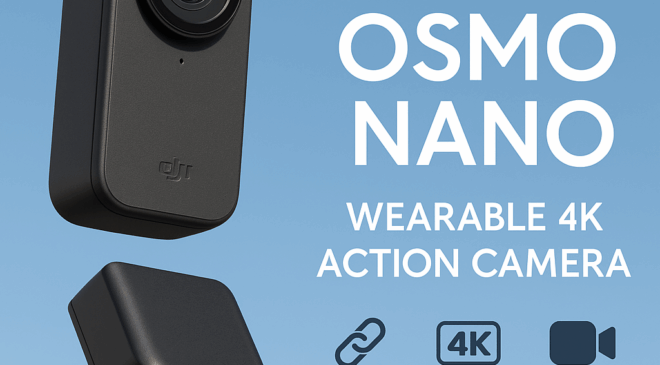
 The DJI Osmo Nano is an ultra-compact wearable action camera designed for hands-free shooting[1][2]. Weighing only 52 g and measuring 57×29×28 mm[2], it’s DJI’s smallest action camera. The Nano features a dual-sided magnetic design, so it can attach to hats, helmets, straps or even pet collars for new shooting angles[2]. It’s waterproof to 10 meters without a case, making it suitable for water sports and outdoor adventures[2]. According to DJI, the Nano delivers “crisp, vivid footage” of your daily activities – from cycling and running to epic adventures[1]. It comes in 64GB or 128GB versions and includes a magnetic Vision Dock (with touchscreen) for charging, live preview and remote control.
Key Specifications
- Weight & Size: 52 g; 57×29×28 mm[2]. (Extremely lightweight and pocket-sized.)
- Sensor & Video: 1/1.3″ CMOS sensor (13.5 stops dynamic range); up to 4K (3840×2160) at 60 fps[3]. Supports slow-motion at 4K/120fps and 2.7K/240fps for ultra-smooth footage. 143° ultra-wide field of view[3].
- Color & Photo: 10-bit D-Log M color profile and 72% wider color gamut for rich colors[3]. Captures roughly 35 MP still images.
- Stabilization: DJI RockSteady 3.0 electronic image stabilization and HorizonBalancing (±30°) ensure steady, level video[3].
- Battery Life: 530 mAh internal Li-ion battery; ~90 minutes continuous recording at 1080p/24fps[4]. Extended with dock: up to ~200 minutes of 1080p video when attached to the Vision Dock[4]. Fast charging: 80% in ~20 minutes via dock[5]. New “Endurance Mode” allows up to 60 min at 4K/30fps (16:9) on a full charge[5].
- Mounting: Dual-sided magnetic design (magnets on two faces) lets you mount anywhere (hats, helmet, strap, etc.)[2]. Also included: magnetic pendant and ball-joint adapter for flexible mounting.
- Vision Dock:0″ OLED touchscreen on dock for live preview and menu control. Dock acts as a remote trigger, charger and USB-C hub. Includes a built-in microSD slot and PD port for high-speed transfer (up to 600 MB/s)[5].
- Audio: Built-in stereo microphones. Supports DJI wireless mic transmitters (OsmoAudio™) for up to two external mics without a receiver[6].
- Additional: Time-lapse, intervals, gesture control (start with head nod/tap), pre-record buffer, ND filter support. DJI accessories include magnetic headband, quick-release mounts, ND filters, lens covers, etc.[7].
Design and Mounting
The Osmo Nano’s ultra-compact design and dual magnets make it extremely versatile for mounting. One side of the camera can attach magnetically to its Vision Dock, and both front/back surfaces can stick to metal mounts or included magnetic accessories[2]. Weighing just 52 g and about the size of a lighter, it can be clipped onto a shirt, mounted on a helmet or even a pet collar. Despite its size, the Nano is highly durable: the bare camera (with lens cover tightened) is waterproof to 10 m for short periods, allowing use in rain or water sports without an extra case[2]. Its slim form factor lets it be worn unobtrusively, unlocking creative hands-free angles that traditional cameras can’t easily achieve[1]. DJI highlights that this design means you can “own the moment” in various activities – from cycling to running or climbing – without holding the camera[1][2].
Camera and Video Capabilities
At its core, the Osmo Nano packs a powerful imaging engine. It uses a 1/1.3″ CMOS sensor (the same size used in larger drones) that captures up to 13.5 stops of dynamic range for rich detail in highlights and shadows[3]. The Nano records video up to 4K (3840×2160) at 60 frames per second (16:9 aspect)[3]. It also supports 4K video at 120 fps (for 4× slow-motion) as well as 2.7K and 1080p up to 240 fps for slow-motion effects. For color, the Nano offers 10-bit D-Log M recording, enabling post-production color grading with a much wider color gamut[3]. Its lens provides a 143° ultra-wide field of view, capturing a broad scene.
For stabilization, DJI’s latest RockSteady 3.0 electronic image stabilization keeps footage smooth and level. In addition, HorizonBalancing can correct tilts up to ±30° in a shot, virtually leveling the horizon for a drone-like steady look[3]. Low-light performance is aided by a “SuperNight” mode (8-bit, 30fps) which uses noise reduction algorithms. Still photos can be captured at up to ~35 megapixels in JPEG or RAW. In all modes, video is saved in HEVC format (H.265) with up to 120 Mbps bitrate, ensuring high image quality.
Battery Life & Charging
The Osmo Nano’s small body houses a 530 mAh Li-ion battery. In real-world use, DJI specifies about 90 minutes of continuous recording at 1080p/24fps on a single charge[4]. This means you can easily film most activities on one charge, though using high frame rates, Wi-Fi, or the screen will reduce runtime. The real game-changer is the included Vision Dock: when the Nano is docked and fully charged, DJI states up to 200 minutes of 1080p/24fps recording[4]. The dock also charges the camera very rapidly – up to 80% in only 20 minutes[5] – thanks to its high-power USB-C port. DJI introduced an Endurance Mode, which lets you continuously record about 60 minutes of 4K/30fps video on a full charge[5]. For practical use, this means occasional bursts of action won’t drain your battery, and a power bank or AC adapter can top up the Vision Dock for extended sessions. (Note: actual battery life will vary with settings and conditions.)
Vision Dock and Accessories
The Vision Dock (included with the Nano) greatly expands its capabilities[8]. This multifunctional dock features a 1.96″ OLED touchscreen, letting you preview and control the camera remotely. As RedShark News notes, the dock “acts as a display screen, a remote photo trigger, a charging station, and a high-speed file transfer station”[8]. You simply snap the Nano onto it magnetically in either orientation – portrait (selfie) or landscape – depending on whether you want to face the lens toward you or outward. The dock can fast-charge the Nano’s battery (80% in ~20 min) and offers a USB-C PD port for connecting a charger or computer. It even includes a built-in microSD card slot and supports transfer speeds up to 600 MB/s[5].
Beyond the dock, DJI offers accessories to complement the Nano. These include a magnetic headband and quick-release mounts for head or chest attachment, a glass lens cover for protection, a set of ND filters for exposure control, and a dual-direction magnetic ball-joint adapter to angle the camera[7]. All magnetic parts make mounting quick and secure. Together, the dock and accessories let you use the Nano almost anywhere – from selfie vlogging to fixed POV setups.
Audio and Connectivity
The Osmo Nano features dual built-in microphones for stereo audio recording. Notably, DJI’s OsmoAudio™ system lets you connect wireless microphone transmitters directly to the Nano. You can pair up to two DJI wireless mic transmitters (sold separately) simultaneously, without needing a separate receiver[6]. This is ideal for vlogging or interviews, as you can capture high-quality audio from a distance. The Nano also has Wi-Fi 6 (2.4/5.8 GHz) and Bluetooth LE for control and file transfer via the DJI Mimo smartphone app. This allows for remote live view and adjusting settings on your phone. (There’s no standard headphone jack, but the wireless mic support covers most use cases.)
Shooting Modes and Controls
In everyday use, the Osmo Nano offers a variety of creative shooting modes[7]. It supports both vertical and horizontal orientation recording (great for social media vs. traditional video). You can capture time-lapse or interval-lapse sequences at 4K/2.7K/1080p with customizable intervals. The Nano can also start recording via gesture control: a simple head nod or hand tap can trigger the shutter, which is handy when the camera is mounted out of reach[7]. A pre-record buffer (up to 60 seconds) ensures you never miss a moment – it continuously records in a short loop, so when you hit record, it saves what just happened. The included OLED dock screen (or DJI app) provides an intuitive menu for mode selection.
Accessories enhance versatility: a magnetic lanyard and headband mount let you quickly switch between angles. For example, you can go from chest-mounted action shots to a wrist-mounted selfie. DJI also sells a Magnetic Ball-Joint Adapter for 180° rotation, and a small tripod mount if needed. All these shooting modes and accessories make the Osmo Nano a flexible tool for vlogging, POV action, and creative filming.
Pricing, Availability, and Where to Buy
The DJI Osmo Nano was announced in September 2025. At launch, it comes in 64GB and 128GB storage versions. In the UK market, DJI listed prices of £239 for 64GB and £259 for 128GB[9] (roughly $300/$330 USD). US pricing was expected around $299 for 64GB. The Nano is sold through DJI’s official channels and authorized retailers. It is also available online – for example, you can purchase the DJI Osmo Nano on Amazon. (Affiliate link: DJI Osmo Nano on Amazon). This affiliate link can be used to check current prices and buy the product (it typically includes both camera and Vision Dock).
With its tiny form factor and powerful specs, the DJI Osmo Nano offers creative videographers a unique wearable camera option. Its long recording times with the dock, high-quality 4K imaging, and wide range of mounts make it suitable for travel, sports, pets, and everyday vlogging. For hands-free 4K capture in virtually any situation, the Osmo Nano is DJI’s answer – and it’s now available for purchase at retailers such as Amazon[9].
Tags: DJI Osmo Nano, wearable camera, action camera, 4K camera, vlogging, Osmo Nano features, Osmo Nano specs, camera accessories, battery life
[1] Osmo Nano – Own the Moment – DJI
[2] [3] [5] [6] [7] [8] [9] DJI Osmo Nano: A Super Compact Wearable Camera
https://www.redsharknews.com/dji-osmo-nano-a-super-compact-wearable-camera
[4] Osmo Nano – 仕様 – DJI
https://www.dji.com/jp/nano/specs