
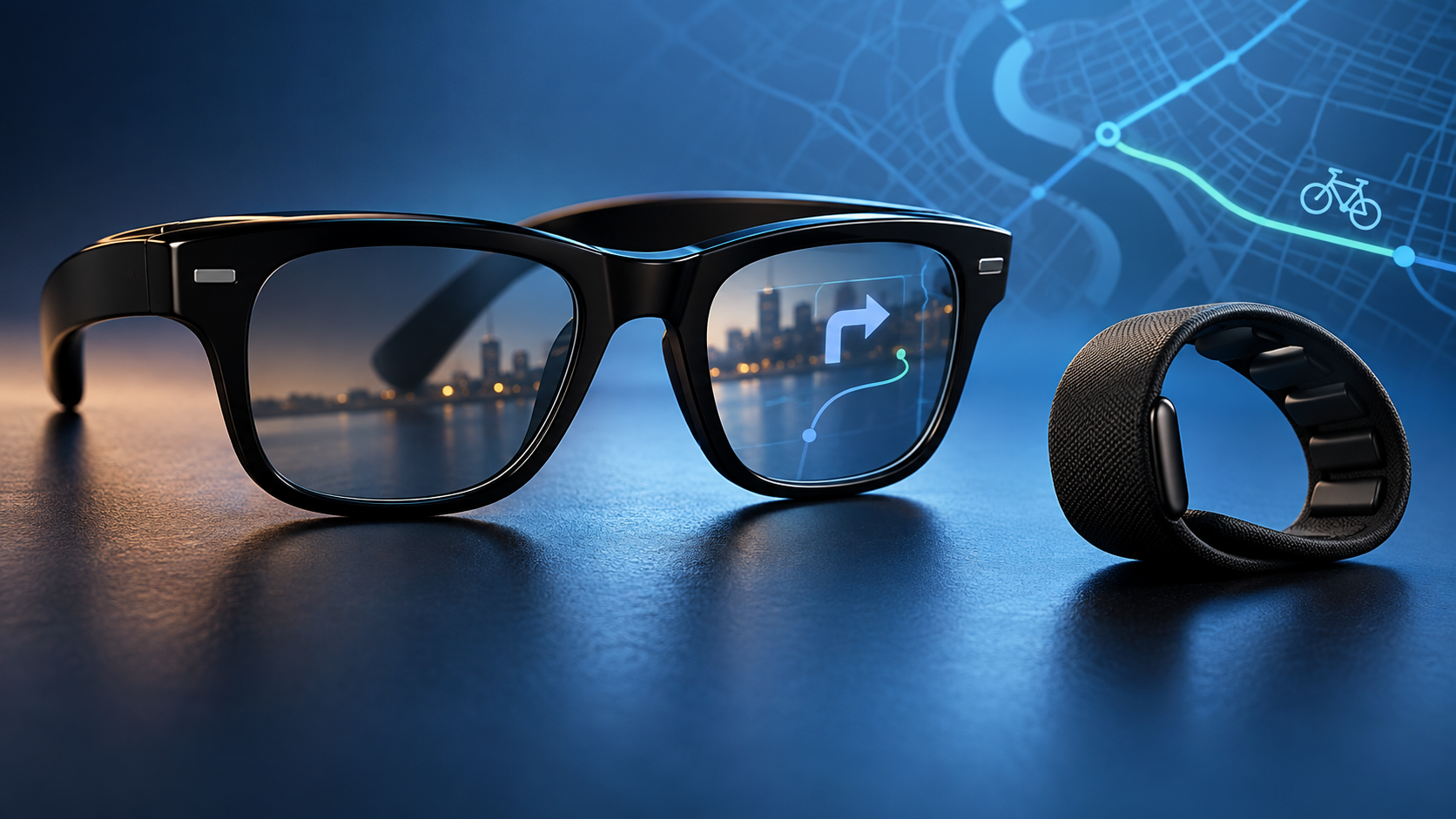
Meta is turning its $799 Meta Ray-Ban Display glasses into a more capable everyday display. The newest software roadmap adds turn-by-turn directions for cycling and public transit, richer walking cues, better calendar controls, mirrored phone notifications and a forthcoming WhatsApp calling feature that creates a photorealistic digital version of the wearer.
The update matters because it pushes the glasses beyond quick AI answers and camera previews. Some additions are scheduled for later this month, while others remain early-access or “coming soon” features. That distinction is important for anyone deciding whether to buy now.
What Meta is adding now
The headline changes are:
- Cycling and public-transit directions in the United States and Canada.
- Walking directions that can reference visible landmarks, such as a distinctive house.
- A Hologram calling mode for WhatsApp that animates a generated likeness of the wearer.
- Expanded calendar actions, mirrored phone notifications and Threads Community feeds.
- Dolby Atmos capture for videos and a new Explore app for discovering experiences.
Cycling and transit navigation arrive

Meta says cycling and public-transit turn-by-turn directions are coming to Meta Ray-Ban Display in the United States and Canada. Walking navigation is also becoming more conversational: instead of relying only on street names and distances, the glasses can point to a visual landmark and tell you to turn there.
That approach could make directions easier to follow without staring at a phone, especially in unfamiliar neighborhoods or at transit transfers. It does not mean riders should treat the lens as a full map. The small display is best used for short prompts, and cyclists still need to keep their attention on traffic, signals and road conditions.
The navigation expansion builds on the product’s existing walking directions. Meta Ray-Ban Display has a full-color display in the right lens and comes with the Meta Neural Band, which interprets small wrist and finger movements. The bundle starts at $799.
Hologram calls: a generated face, not a live camera feed
Meta’s “Hologram” name sounds more futuristic than the actual experience. The feature creates a photorealistic digital likeness after the owner records a short selfie video. During a WhatsApp call, the glasses use the wearer’s voice to drive facial expressions in that generated image.
The practical benefit is that callers can appear on video while wearing the glasses, even though the front-facing camera cannot film the wearer’s own face. It is not a three-dimensional projection floating in the room, and it is not a conventional live selfie-camera feed. That distinction should keep expectations realistic.
Meta says Hologram will enter early access in the United States later this fall. Early access usually means availability may be limited and the experience can change before a broader rollout. Buyers should not treat it as a guaranteed, finished feature at purchase.
Notifications, calendars and Threads move onto the display
Meta is also filling in smaller gaps that determine whether wearable displays are useful day to day. Calendar support can show attendees and let the wearer accept, decline or join a meeting. The calendar additions are initially in English in the United States.
Mirrored notifications are coming soon, with controls for which phone alerts appear on the glasses. That could reduce phone checks, but it also creates a new reason to tune notification settings carefully; sending every alert into the lens would quickly become distracting.
Threads Community feeds are being added, while a new Explore app is intended to help owners find experiences built for the glasses. Video capture is gaining Dolby Atmos audio. None of these changes turns the device into a general-purpose augmented-reality headset, but together they make the display feel less like a demo and more like a compact companion screen.
Where Meta Ray-Ban Display is available
Meta now sells the glasses online in the United States. Sales are also open in Canada and the United Kingdom. France, Italy and Germany can preorder, with retail availability planned for October.
The package includes the glasses and Meta Neural Band. Meta’s launch information lists up to six hours of mixed use for the glasses and up to 30 hours total with the charging case. The Neural Band is rated for up to 18 hours and has IPX7 water resistance, while the glasses themselves should still be treated as everyday electronics rather than sports goggles.
Availability, supported apps and individual features vary by country and language. Shoppers outside the United States should confirm the exact feature list on Meta’s regional store before buying rather than assuming every announced function is active on day one.
Is this update useful enough to justify $799?
For existing owners, navigation is the most immediately valuable part of the update. Cycling and transit prompts expand the situations where the display can save a phone check. Calendar actions and selective notification mirroring could also help commuters and people who spend much of the day moving between meetings.
For new buyers, the answer depends on whether the in-lens display and wristband are worth the premium. The less expensive Ray-Ban Meta line already offers a camera, open-ear audio and Meta AI, but it does not provide the same visual display or neural-band controls.
ReaderSpice may earn a commission from qualifying purchases.
Readers who want the camera-and-audio experience without the in-lens display can compare the current Ray-Ban Meta Gen 2 Wayfarer on Amazon.
The $799 Display model makes the strongest case for people who will regularly use private visual prompts, navigation, live captions and message controls. Hologram calling is interesting, but it remains an early-access extra rather than a reason by itself to spend the money.
Before you buy
- Check the regional feature list, supported phone requirements and prescription-lens options.
- Expect announced features to arrive in stages; “coming soon” is not the same as available today.
- Review notification permissions so sensitive messages do not appear unexpectedly in the lens.
- Use the recording indicator responsibly and get consent where local rules or the situation require it.
If privacy around camera glasses is your main concern, read ReaderSpice’s guide to recognizing when smart glasses are recording.
The bottom line
This is a meaningful software expansion for Meta Ray-Ban Display. Navigation for bicycles and public transit gives the glasses a clearer practical role, while calendar actions and notification mirroring make the display more useful between trips. Hologram calls show where Meta wants wearable video communication to go, but the limited early-access rollout means buyers should judge the product primarily on features available in their region now.
Sources
Meta: New Features for Meta Ray-Ban Display
Meta: Introducing Meta Ray-Ban Display and the Meta Neural Band
Reuters: Meta launches smart glasses with a built-in display
Reuters: Privacy fears challenge smart glasses and AI wearables