
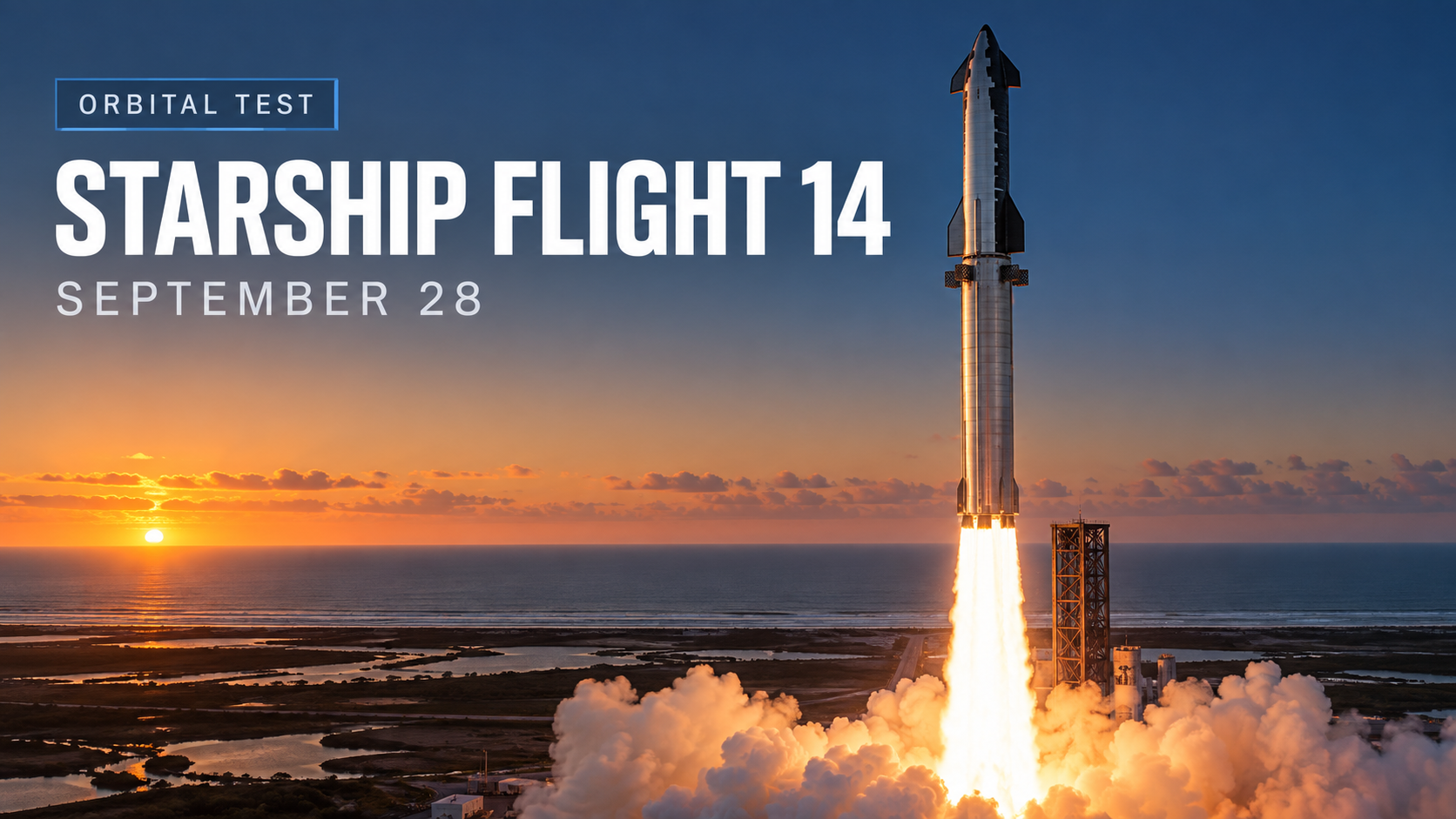
SpaceX is now targeting Monday, September 28, 2026, for Starship Flight 14, a mission designed to move the vehicle beyond its previous suborbital tests and into a sustained orbital flight. The nearly 10-hour mission is expected to circle Earth six times, deploy 26 Starlink V3 satellites and end with controlled ocean splashdowns for both stages.
The date has moved from an earlier September 22 target. SpaceX has not publicly identified a specific reason for the change, and the company continues to describe the schedule as a target rather than a guarantee. Vehicle readiness, weather, range coordination and regulatory clearance can all affect a launch attempt.
Starship Flight 14 launch date and time
SpaceX’s official mission page lists liftoff no earlier than September 28 from Starbase in South Texas. The 75-minute launch window is scheduled to open at 7:15 a.m. Central, or 8:15 a.m. Eastern.
That timing is unusually viewer-friendly for the United States, but anyone planning to watch should check the official mission page again shortly before the window opens. Starship test schedules can change with little notice, and a hold during the countdown can push the attempt deeper into the window or to another day.
How to watch Starship Flight 14
SpaceX is expected to provide live coverage through its official channels. The safest place to start is the Starship Flight 14 mission page, which should carry the latest countdown status and viewing link when coverage becomes available.
A livestream typically begins shortly before liftoff. Because the planned mission lasts close to 10 hours, SpaceX may provide updates during the coast phase before the Ship returns for its Pacific splashdown.
The mission plan at a glance
- Launch from Starbase, Texas, during a 75-minute window opening at 7:15 a.m. CT.
- Fly Starship on its first planned sustained orbital trajectory after 13 suborbital integrated flight tests.
- Complete six orbits at an altitude of roughly 275 kilometers, or 171 miles.
- Deploy 26 Starlink V3 satellites during the mission.
- Send Super Heavy to a controlled splashdown in the Gulf of Mexico rather than attempting a launch-tower catch.
- Return the Ship to a controlled Pacific Ocean splashdown west of Chile after nearly 10 hours.
Why reaching orbit changes the test
The first 13 integrated Starship flights followed suborbital trajectories. Flight 14 is planned to keep the Ship in orbit long enough to complete six laps around Earth, making thermal control, navigation, communications and long-duration vehicle operations more important than on the earlier tests.
The longer profile also gives SpaceX more time to collect data on how Starship behaves in space. Reentry remains one of the program’s hardest challenges: the stainless-steel Ship must survive extreme heating while maintaining enough control to reach its designated splashdown zone.
Three of the Starlink satellites are expected to carry cameras aimed at the Ship’s heat shield, according to Space.com. Those views could give engineers another perspective on tile performance and any damage accumulated during launch, the orbital coast and reentry.
Flight 14 will carry 26 Starlink V3 satellites
SpaceX says Flight 14 will deploy 26 Starlink V3 satellites. The mission therefore combines a major Starship test with a practical payload demonstration, although it remains an experimental flight and the satellite deployment is part of the test plan.
Starlink V3 spacecraft are intended to add network capacity and support faster service. Carrying 26 at once would demonstrate why SpaceX sees Starship’s large payload volume and mass capacity as central to the next phase of the Starlink constellation.
The company’s Starship overview lists the full stack at 124 meters, or 407 feet, tall, with more than 100 metric tons of payload capacity to low Earth orbit in its reusable configuration. Super Heavy uses 33 Raptor engines, while the Ship has six.
What happens to Super Heavy and the Ship
Flight 14 is not scheduled to attempt a tower catch. After stage separation, Super Heavy is expected to perform its return sequence and make a controlled splashdown in the Gulf of Mexico. Skipping a catch keeps the focus on the new orbital mission profile while still testing booster guidance and landing-burn performance.
The Ship is expected to remain in orbit for nearly 10 hours before reentering and aiming for a controlled splashdown in the Pacific Ocean west of Chile. The plan does not include recovery of either stage; both ocean landings are test objectives.
What could delay the launch
September 28 remains a target. SpaceX still needs the vehicle, launch site and range to be ready, and regulatory requirements must be satisfied before liftoff. South Texas weather and upper-level winds can also affect the countdown.
Readers should treat the posted opening time as the beginning of a window, not a fixed appointment. If the flight slips, SpaceX’s mission page will be the most authoritative source for a replacement date and time.
A current Starlink option for travelers and remote work
Flight 14’s V3 payload is not the same hardware sold to consumers. Readers exploring currently available satellite-internet equipment can compare current Starlink Mini kits and accessories on Amazon. The compact Mini is intended for portable connectivity, while the V3 satellites aboard Flight 14 are part of the space-based network infrastructure.
As an Amazon Associate, ReaderSpice earns from qualifying purchases.
Why Flight 14 matters
A successful sustained orbital mission would be a meaningful step between Starship’s suborbital test campaign and the repeatable orbital operations SpaceX ultimately needs. The key milestones are not limited to liftoff: orbital endurance, satellite deployment, heat-shield performance, controlled reentry and accurate splashdowns all matter.
Even if every objective is not completed, Flight 14 should produce data that shapes the next vehicle and mission. For viewers, the practical takeaway is simple: the current target is September 28 at 7:15 a.m. CT, but check SpaceX’s official page before setting an alarm.
Sources
SpaceX: Starship Flight 14 mission page
SpaceX: Starship vehicle overview
Space.com: Flight 14 delay and orbital mission report
San Antonio Express-News: Flight 14 mission and satellite deployment details