
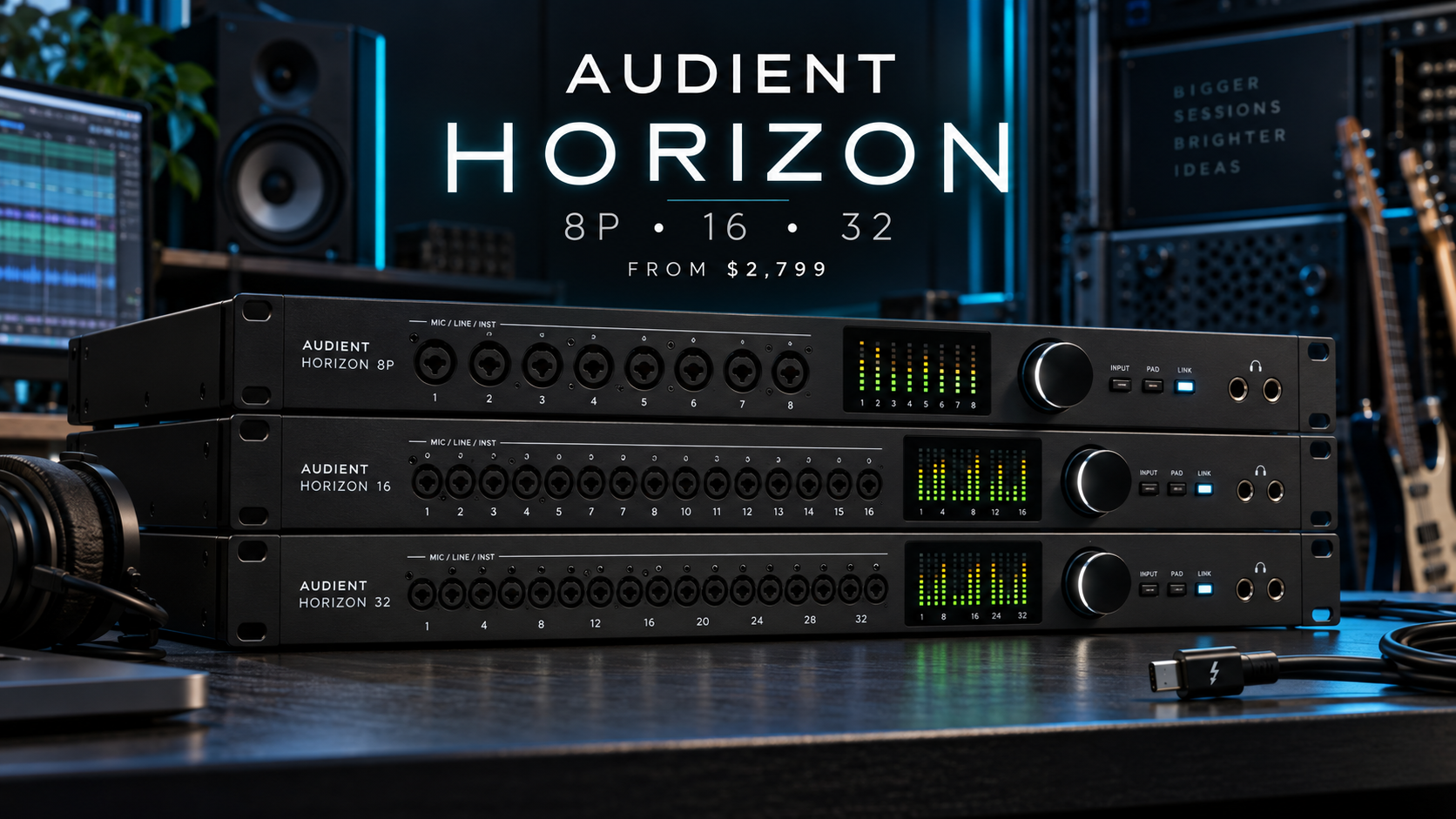
Audient is moving into higher-end commercial studio territory with Horizon, a three-model family of rackmount Thunderbolt 3 audio interfaces built around the same 32-bit conversion platform. The lineup includes the microphone-focused Horizon 8P and two line-level converters—the Horizon 16 and Horizon 32—designed for studios that already own preamps, consoles or outboard processors.
All three models are scheduled to become available on September 28, 2026. U.S. pricing starts at $2,799, placing Horizon well above Audient’s desktop iD and EVO products and squarely in the professional studio category.
What Audient announced
Horizon is not a single interface in three cosmetic variations. Audient has divided the range by workflow: recording through microphones, integrating a rack of analog equipment, or connecting a large-format console to a DAW. The shared conversion, driver and control system means buyers choose by channel layout rather than accepting lower performance on the less expensive model.
Audient says the platform has been in development for five years. MusicRadar independently reported that the range uses the same core architecture across all three models and confirmed the launch pricing and September 28 availability.
Shared specifications across the Horizon range
- 32-bit, 192kHz AD/DA conversion
- Up to 133dB of dynamic range
- Claimed 0.99ms round-trip latency at 192kHz with a 64-sample buffer
- Thunderbolt 3 connection with forward compatibility for Thunderbolt 4 and 5
- Dual ADAT I/O and BNC word-clock connectivity
- Unified macOS driver supporting as many as four Horizon units
- Maximum 200-input/200-output configuration with four Horizon 32 interfaces
- Digital recall for input gain and system settings
- Horizon Control software with routing, cue mixes and monitoring profiles
Audient currently describes the Horizon interfaces as macOS-only. Windows users should not assume compatibility unless the company announces a supported driver.
Audient Horizon 8P: built for tracking
The Horizon 8P is the model for studios that regularly record singers, instruments, podcasts or full sessions through microphones. It provides 24 inputs and 32 outputs, including eight Audient Console mic preamps with 75dB of gain.
Its ORBIT Control changes input impedance among three settings—2.8k ohms, 1.2k ohms and 220 ohms—so engineers can alter how supported microphones interact with the analog preamp before conversion. The front panel also includes two JFET instrument inputs and two headphone outputs, while DB25 and ADAT connections support hybrid expansion.
The 8P is the only Horizon model with built-in microphone preamps. That distinction matters: buyers of the Horizon 16 or 32 will need external preamps for microphones.
Audient Horizon 16: the hybrid-studio hub
The Horizon 16 is aimed at studios that already have favored mic preamps, compressors, equalizers and other analog equipment. It offers 16 channels of line I/O over DB25 connections and is listed as a 34-input/34-output interface when its digital and monitoring connections are counted.
A dedicated stereo mix-bus input lets engineers capture an analog mix without consuming the primary line channels. That makes the 16 the most balanced option for a project studio moving from mostly in-the-box production toward a permanently connected outboard setup.
Audient Horizon 32: for consoles and large racks
The Horizon 32 doubles the line-level capacity with 32 channels over eight DB25 connectors and a total 50-input/50-output specification. It is designed to bridge a console or large outboard rack to a DAW from one rack unit.
This model makes the most sense in commercial rooms that need many simultaneous analog paths. A creator recording one or two microphones at a desk would pay for capacity they are unlikely to use—and would still need microphone preamps.
Why there is no onboard DSP
Unlike interfaces built around proprietary DSP plug-in ecosystems, Horizon relies on the connected Mac for plug-in processing. Audient’s argument is that modern Apple silicon can now deliver low enough latency to monitor through native VST, AU and AAX plug-ins without requiring a separate processing platform.
The benefit is plug-in freedom and no requirement to buy into a closed DSP catalog. The tradeoff is equally important: performance depends on the computer, session load, sample rate and buffer settings. Audient’s 0.99ms figure is a best-case measurement at 192kHz and a 64-sample buffer, not a promise that every real-world project will run at that latency.
Horizon Control and studio scalability
Audient rebuilt its control software for Horizon. The app includes a full routing matrix, four recallable cue mixes and monitoring profiles for speaker systems up to 9.1.6. Input gains and system settings can be recalled digitally, which should make returning to complex sessions faster.
Up to four units can be daisy-chained under one macOS driver. The headline 200×200 capacity comes from connecting four Horizon 32 interfaces, so smaller combinations will provide fewer channels. Studios should also budget for suitable Thunderbolt connectivity, DB25 snakes, external preamps and any ADAT expansion needed for the final configuration.
Price and availability
- Horizon 8P: $2,799 / £2,199 / €2,499
- Horizon 16: $2,799 / £2,199 / €2,499
- Horizon 32: $3,499 / £2,799 / €3,299
- Availability: September 28, 2026
- Warranty: three years
Pricing comes from Audient’s launch information as reported by MusicRadar. Retail pricing and stock can vary by country and dealer after launch.
Which Horizon model should you choose?
- Choose Horizon 8P if you need eight built-in mic preamps for recording vocals, instruments, drums or live sessions.
- Choose Horizon 16 if you already own external preamps and outboard gear and want a permanently patched hybrid studio.
- Choose Horizon 32 if you need to connect a console or large analog rack with 32 line-level channels in one unit.
- Skip Horizon for a smaller desktop interface if you only record one or two sources and do not need DB25, large cue systems or commercial-studio scalability.
A more affordable Audient option
Horizon is overkill for most home creators. Readers who want Audient preamps and a compact USB workflow can compare currently available Audient iD14 MKII audio interfaces on Amazon. It is not a Horizon substitute for large studios, but it is a more realistic entry point for voiceovers, music production and two-channel creator setups.
Disclosure: ReaderSpice may earn a commission from qualifying Amazon purchases at no extra cost to you.
The bottom line
Audient Horizon is a focused professional launch rather than a general-purpose creator upgrade. The 8P handles microphone tracking, the 16 integrates a serious outboard rack, and the 32 bridges consoles and large analog systems. Their shared conversion and driver platform simplifies the choice, but macOS-only support, external-cabling costs and the absence of onboard DSP deserve as much attention as the impressive latency and dynamic-range figures.
Sources
Audient: Horizon range overview
Audient: Horizon 8P specifications
Audient: Horizon 16 specifications
Audient: Horizon 32 specifications
MusicRadar: Audient Horizon launch, pricing and availability