
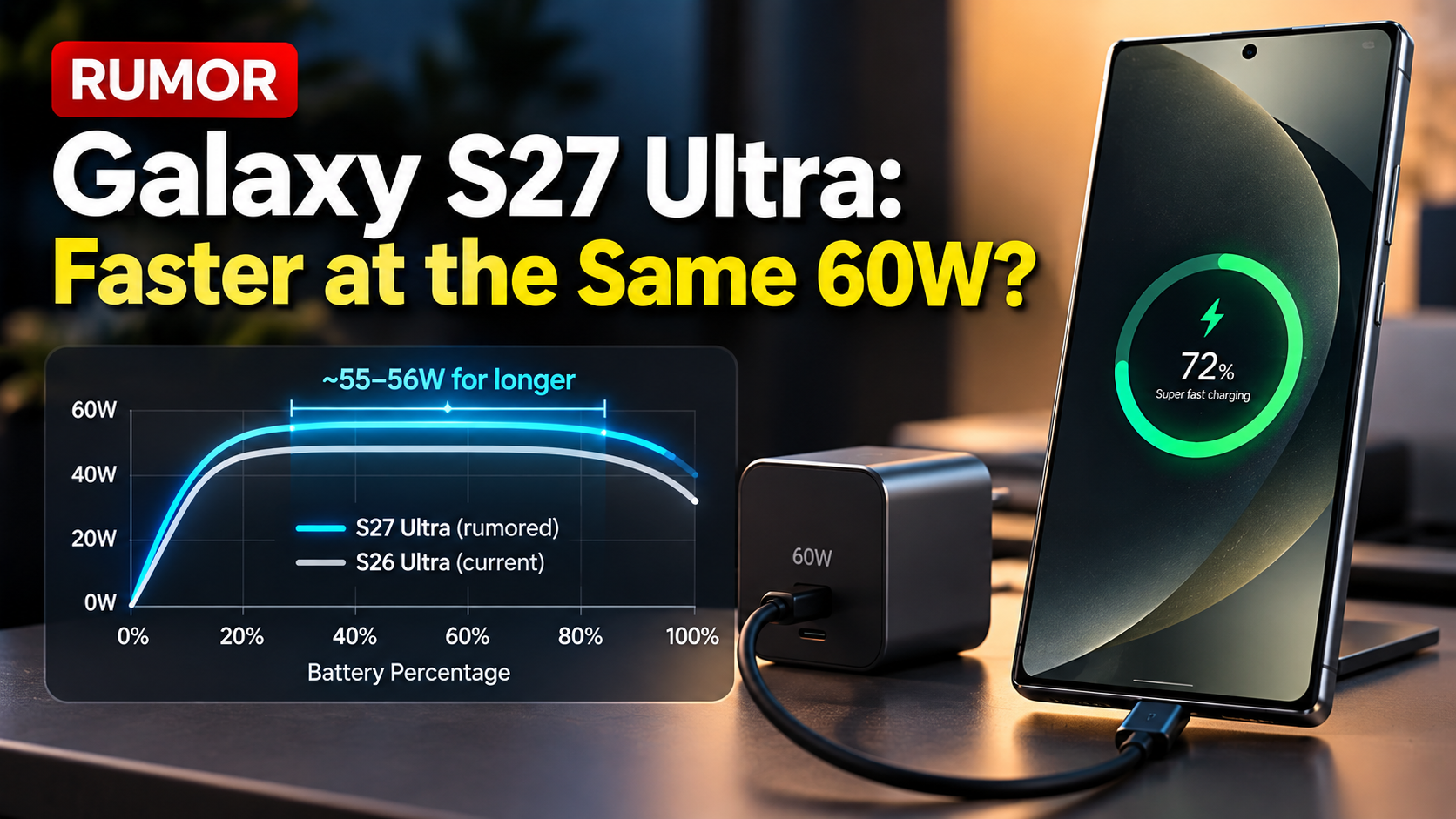
Samsung may be preparing a subtler charging upgrade for the Galaxy S27 Ultra than simply increasing the number printed on the charger. A new leak claims the upcoming Ultra will keep the same 60W wired charging ceiling as the Galaxy S26 Ultra, but could hold near-peak power for longer during the early part of a charge.
If accurate, that would mean the S27 Ultra could finish charging slightly faster even with its rumored larger 5,700mAh battery. Samsung has not announced the Galaxy S27 Ultra or confirmed these charging changes, so the details remain pre-release rumors.
The New Leak Is About the Charging Curve, Not a Higher Wattage
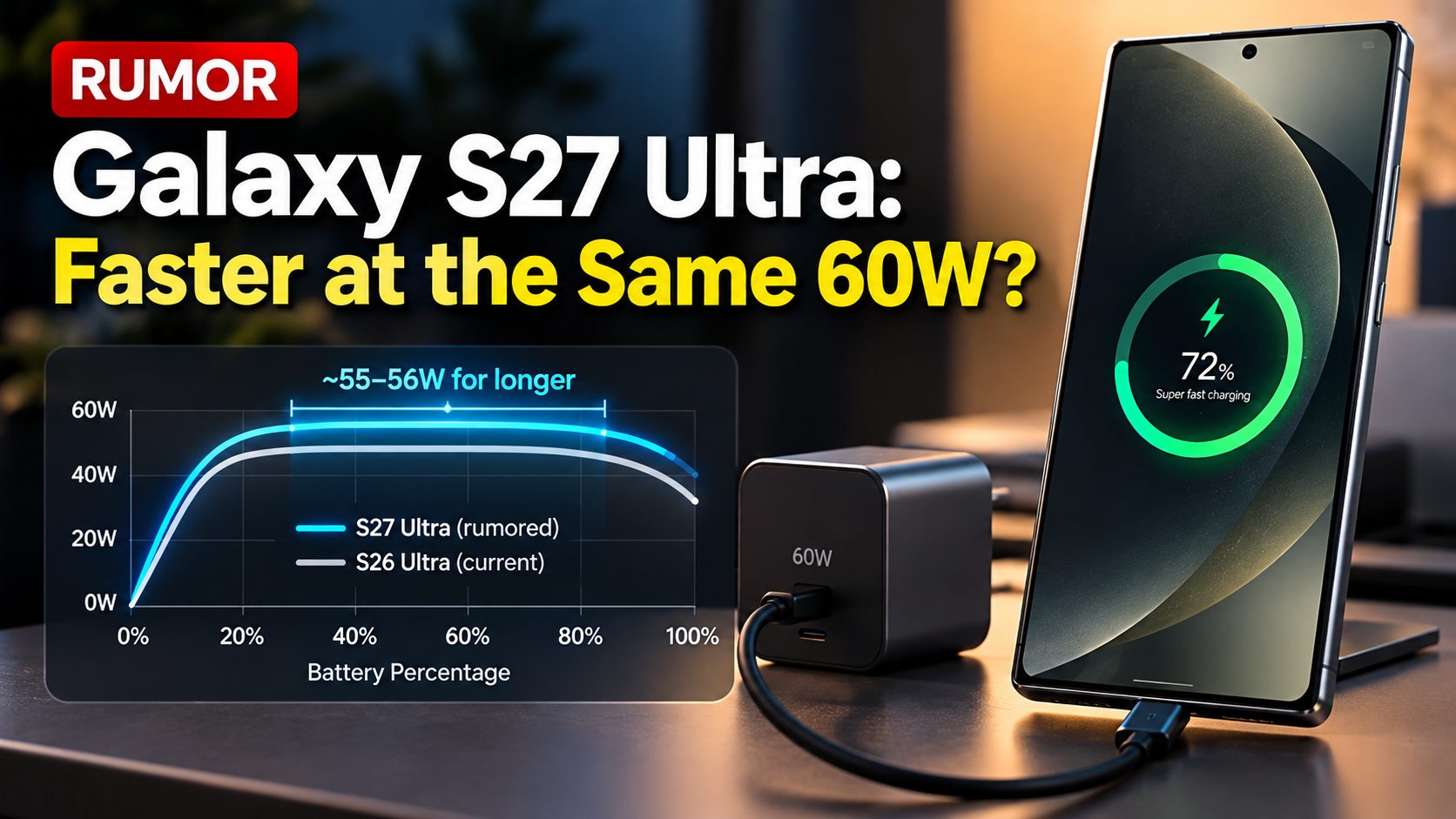 According to a report from Android Authority citing leaker WalleGalaxy, Samsung is testing charging optimizations that may allow the Galaxy S27 Ultra to sustain roughly 55W to 56W for longer at the beginning of a charging session. The phone is still rumored to top out at 60W.
That distinction matters. A phone’s advertised maximum charging wattage is only the peak. Real charging speed depends on how long the device can remain near that peak before heat, battery state of charge and power-management rules force the wattage down. If Samsung can extend the high-power portion of the curve, the same 60W rating can deliver a shorter overall charging time.
How Much Faster Could the S27 Ultra Actually Be?
The leak claims the change could make a full charge around 2% to 3% faster than the Galaxy S26 Ultra. That would be a modest improvement rather than a dramatic leap, and it should be treated cautiously until independent testing is possible.
The interesting part is that the rumored S27 Ultra is also expected to use a larger battery. Previous reports have pointed to a 5,700mAh cell, compared with the 5,000mAh battery in the S26 Ultra. If Samsung can charge a larger battery in roughly the same—or slightly less—time, that would represent a meaningful efficiency improvement even though the headline wattage remains unchanged.
Why Sustained Power Can Matter More Than Peak Power
Charging systems rarely sit at their maximum rating from empty to full. Phones typically pull more power when the battery is low, then reduce power as temperature rises and the battery fills. This tapering protects battery health and manages heat.
That is why two phones with the same maximum wattage can have noticeably different charging times. Thermal design, voltage and current management, charger communication, battery chemistry and software all influence the curve. A longer 55W-to-56W window could therefore matter more in daily use than a brief higher peak that lasts only a few minutes.
The Rumored 5,700mAh Battery Changes the Context
The charging rumor becomes more important when paired with reports of a 5,700mAh battery for the Galaxy S27 Ultra. A larger battery could improve endurance, but without charging optimization it could also take longer to refill.
Samsung appears to be pursuing both sides of that equation: more capacity for runtime and a refined charging curve to keep refill times competitive. That approach would fit Samsung’s historically conservative charging strategy, which has generally emphasized thermal control and battery longevity rather than chasing the highest wattage numbers used by some rivals.
What Galaxy S26 Ultra Owners Should Expect
For Galaxy S26 Ultra owners, this rumor alone would not justify an upgrade. The S26 Ultra already introduced 60W wired charging, and a 2% to 3% improvement would be difficult to notice without side-by-side timing.
The bigger question is whether the charging optimization combines with the rumored 5,700mAh battery to deliver a better overall experience: longer battery life without a charging-time penalty. That combination would be much more meaningful than the charging percentage improvement by itself.
What Is Confirmed and What Is Still Rumor?
Samsung has not officially announced the Galaxy S27 Ultra, its battery capacity, charging curve or final wired charging specification. The sustained 55W-to-56W figure comes from a leak and should not be treated as a confirmed Samsung specification.
Multiple publications have now reported the claim, but they trace back to the same underlying leak. Independent certification data and Samsung’s eventual product specifications will be more important. Real-world charging tests will also be necessary because laboratory or internal test conditions can differ from everyday charging with cases, warm rooms and active phone use.
ReaderSpice Take
Keeping 60W while making 60W work harder would be a sensible Samsung upgrade. Peak wattage is easy to market, but sustained power is what determines whether a phone actually spends less time plugged in.
If the Galaxy S27 Ultra really pairs a 5,700mAh battery with a stronger early charging curve, Samsung could improve both endurance and charging convenience without entering a 100W-plus specification race. For now, the claimed 2% to 3% gain is too small to celebrate on its own, but the larger battery plus improved charging behavior is worth watching.
If you are shopping now rather than waiting for an unannounced phone, the current Samsung Galaxy S26 Ultra remains the relevant available Ultra model on Amazon.
Disclosure: As an Amazon Associate, ReaderSpice earns from qualifying purchases.
Sources
Android Authority — Samsung may have found a smart way to speed up Galaxy S27 Ultra charging
Tech Advisor — Samsung could get clever to achieve faster Galaxy S27 Ultra charging
Tom’s Guide — Galaxy S27 series price and battery reporting