
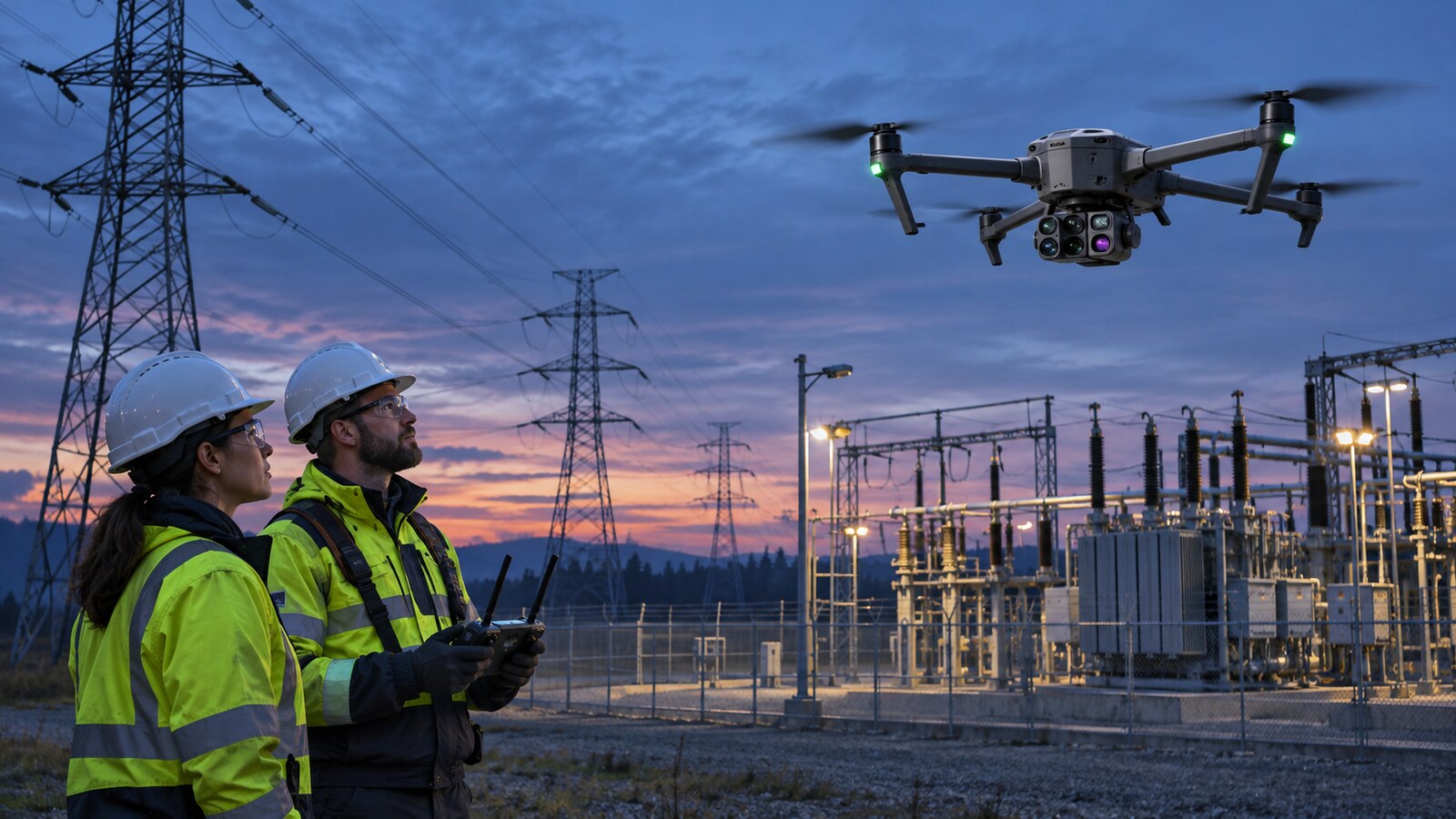
DJI announced the Matrice 5T on November 5, 2026, positioning it as a compact flagship for public safety, energy, infrastructure and surveying teams rather than as a consumer camera drone. Its headline upgrades are unusually broad: a native 1K thermal camera, three 50-megapixel visible-light cameras, LiDAR, millimeter-wave radar, onboard AI and a claimed maximum flight time of 59 minutes.
Those numbers are impressive, but they are not a complete buying case. DJI has not published a universal U.S. price, availability is routed through enterprise dealers, and U.S. buyers need to verify current equipment authorization and procurement rules before committing. The most useful way to read this launch is therefore as a workflow upgrade with real operational limits—not as a promise that every organization can order one immediately or fly it to its advertised range.
DJI Matrice 5T at a glance
- Thermal camera: 1280 × 1024 native resolution, with an Ultra-High Resolution mode up to 2560 × 2048.
- Visible cameras: 50MP wide, 50MP medium telephoto with 3× optical zoom, and 50MP telephoto with 11× optical zoom and up to 176× hybrid zoom.
- Sensing: rotating LiDAR, millimeter-wave radar and multi-directional vision sensors for low-light and difficult-weather awareness.
- Aircraft: 2,239g takeoff weight, 400g maximum payload, IP55 rating under controlled conditions and a -20°C to 50°C operating range.
- Endurance: up to 59 minutes in DJI test conditions, with a 215Wh battery and a claimed 10-second power-on-to-takeoff time.
- Enterprise software: FlightHub 2 integration, text-and-image search, automated routes and support for third-party AI models.
- Availability: sold through authorized enterprise channels; U.S. pricing and authorization status should be confirmed for the exact unit before purchase.
The camera system is the headline upgrade
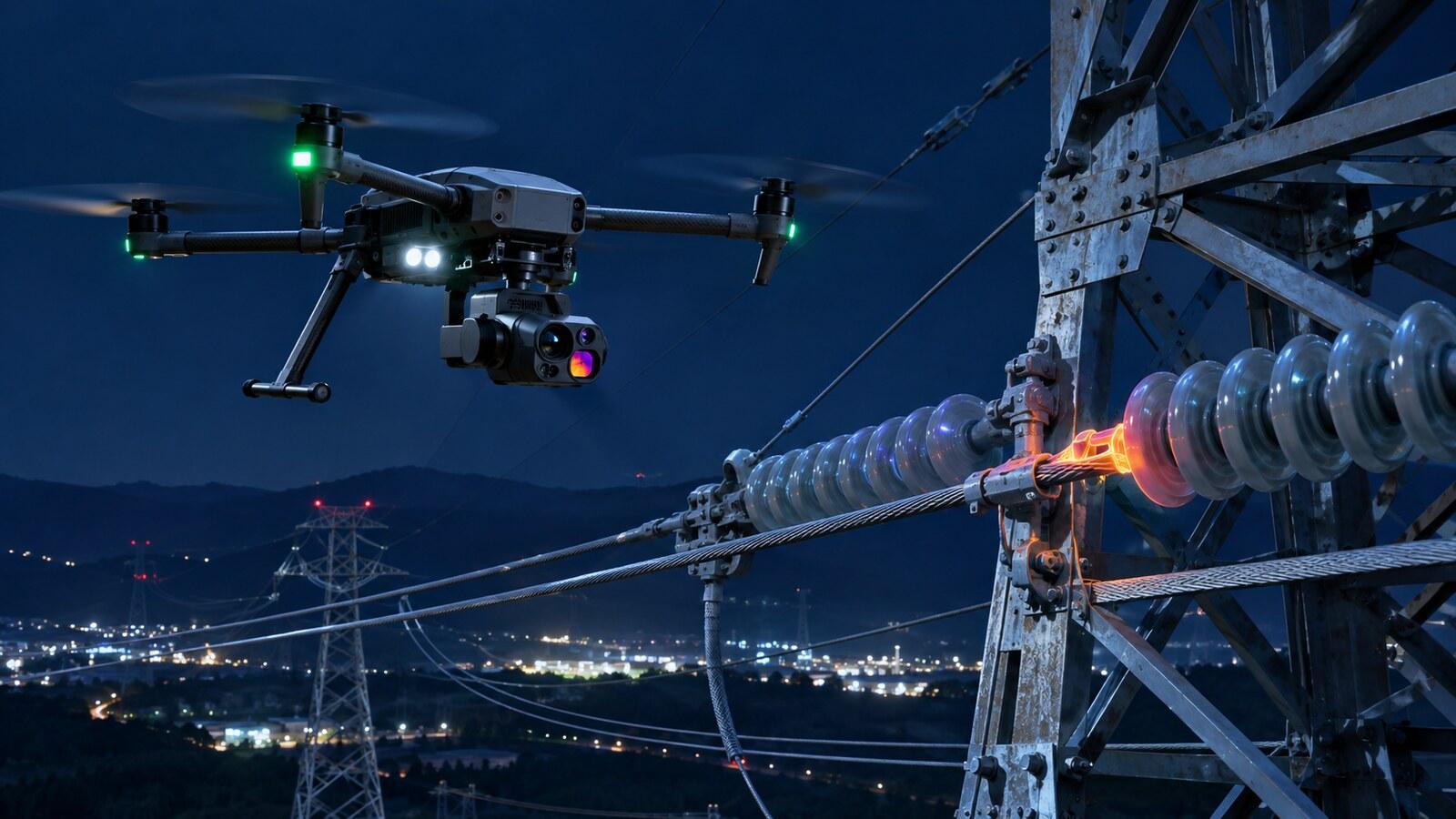
The Matrice 5T’s thermal payload is a meaningful step beyond the 640-class imagers common in compact enterprise drones. DJI lists a native 1280 × 1024 thermal sensor and an enhanced 2560 × 2048 mode. The company specifies a -20°C to 150°C measurement range in high-gain mode and 0°C to 550°C in low-gain mode. That combination is relevant to electrical inspection, search and rescue, roof surveys and incident response because it can reveal smaller thermal patterns while preserving a wider scene.
Resolution does not eliminate the need for disciplined thermography. Apparent temperature can be distorted by emissivity, distance, humidity, reflective surfaces and viewing angle. A sharp thermal image of a metal connector is not automatically an accurate temperature measurement. Organizations should validate camera settings against known targets, document environmental conditions and use qualified interpretation for safety or maintenance decisions.
Three visible cameras cover context, identification and distance
The wide camera uses a 1/0.98-inch sensor with an f/1.8 aperture, while DJI advertises an ISO ceiling of 1,600,000 and operation down to 0.01 lux. The medium telephoto camera provides 3× optical zoom, and the telephoto reaches 11× optical zoom. DJI says the full system can deliver up to 176× hybrid zoom and identify license plates at distances up to 400 meters under suitable conditions.
That last figure should be treated as a controlled-condition capability, not a guaranteed field result. Atmospheric haze, vibration, lighting, target angle and motion all reduce usable detail. For inspection work, the practical advantage is safer standoff distance and the ability to move from broad context to a closer visual check without immediately repositioning the aircraft.
LiDAR and radar improve awareness, not immunity
DJI combines rotating LiDAR, millimeter-wave radar and vision sensing to improve obstacle awareness when ordinary cameras struggle. The company says LiDAR can detect thin obstacles such as power lines at night from up to 32 meters, while radar is intended to help in fog, rain and dust. Those are valuable additions for emergency response and utility work, where black wires, smoke, low contrast and changing weather can defeat vision-only systems.
No sensing stack makes a drone collision-proof. Small wires, moving cables, reflective surfaces, precipitation, sensor contamination and rapidly closing obstacles can still create failure cases. The IP55 rating also comes with DJI’s normal controlled-condition warning and can decline with wear. A serious operator should keep conservative margins, inspect sensors before launch and avoid turning obstacle detection into a reason to fly closer to hazards.
The 59-minute and 40-kilometer claims need context
DJI’s 59-minute endurance figure is a maximum under specified test conditions. Payload weight, wind, temperature, repeated hovering, high-speed flight, battery age and reserve requirements will reduce mission time. The aircraft’s 400g payload capacity and 2,639g maximum takeoff weight also mean every accessory must be included in performance planning.
The O4 Enterprise transmission system is advertised for up to 40 kilometers in favorable conditions. That is a radio-link specification, not legal permission to fly 40 kilometers away. The FAA’s current Part 107 guidance requires the drone to remain within unaided visual line of sight unless the operator has an applicable waiver. Airspace authorization, altitude, operations over people, night rules and local restrictions remain separate from the hardware’s technical range.
Onboard AI could shorten searches and inspections
DJI says the aircraft can detect more than 20 target types and work with FlightHub 2 for text-and-image search. In practice, that could let a team search recorded material for vehicles, people or equipment, create automated routes and trigger actions based on mission logic. Support for third-party AI models matters because utilities, public-safety agencies and industrial operators often need object classes that a general-purpose model does not cover.
AI detections should be treated as leads, not final findings. False positives and missed detections can change with altitude, camera angle, weather, training data and local conditions. Any workflow tied to safety, enforcement or maintenance should retain human review, confidence thresholds, audit logs and a way to reproduce the underlying image or video.
Data handling is improved, but governance still matters
DJI states that sharing photos and videos is opt-in and that U.S. users cannot synchronize flight logs with DJI servers. That may help organizations that have strict data-residency requirements, but it does not replace an internal security review. Buyers should map every data path—including the controller, removable media, FlightHub 2, third-party AI services, mobile-device management and any export workstation—before deployment.
A useful procurement test is whether the organization can operate the system with the network features it actually permits. If a workflow depends on cloud search, remote command or third-party inference, security and legal teams should verify where that processing occurs, who can access it and how long the data is retained.
Surveying and mapping are more than side features
DJI also pitches the Matrice 5T as a mapping platform. It claims centimeter-level accuracy without ground control points under specified conditions, thermal mapping and local processing of 200 photos into point clouds or 2.5D models in about eight minutes on the controller. RTK specifications list horizontal accuracy of 1cm plus 1ppm and vertical accuracy of 1.5cm plus 1ppm.
Those capabilities can reduce time between collection and field decisions, especially for damage assessment or rapid progress checks. They do not eliminate survey control, coordinate-system management or independent accuracy checks where measurements carry contractual, engineering or legal weight. Teams should define whether a mission needs fast situational awareness or defensible survey-grade deliverables before choosing the workflow.
Price and U.S. availability remain the largest unknowns
DJI’s announcement directs buyers to authorized enterprise dealers rather than listing one global price. A non-U.S. dealer has posted a preorder figure, but regional tax, service bundles, accessories and support make that an unreliable proxy for U.S. cost. Enterprise buyers should request a written quote that separates the aircraft, controller, batteries, charging hardware, software licenses, service plan, training and any required payloads.
U.S. availability is also not something to infer from a product launch alone. Independent launch coverage reported that U.S. authorization was not yet confirmed at announcement time. The FCC’s current drone-equipment framework includes covered-list restrictions, exemptions and conditional approvals, so procurement teams should verify the exact model’s current authorization and their own agency or funding restrictions directly before ordering. This is a changing compliance question, not a permanent verdict on the aircraft.
Who should consider the Matrice 5T?
The clearest fits are organizations that can use several sensors in the same mission: utilities tracing a hot connection and then documenting it optically; fire departments combining thermal search with wide-area context; infrastructure teams inspecting towers or bridges; and survey crews that need fast mapping plus detailed imagery. Its compact format is especially attractive when a larger heavy-lift aircraft would add transport and setup time without adding a necessary payload.
It is a poor match for casual aerial photography, buyers seeking a known retail price, or teams without trained operators and a data-governance plan. A consumer drone will be simpler and cheaper for standard video. A larger platform may be better when the mission requires interchangeable heavy payloads, longer redundancy chains or specialized sensors beyond the 400g limit.
A practical procurement checklist
- Confirm the exact model’s current FCC authorization and any federal, state, municipal or funding-based procurement restrictions.
- Get an itemized dealer quote, including batteries, charger, controller, software subscriptions, service coverage, training and delivery date.
- Test thermal accuracy, zoom performance, obstacle sensing and endurance in the environment where the aircraft will actually work.
- Plan missions using real payload weight, weather, reserve battery and visual-line-of-sight requirements—not maximum brochure figures.
- Document where flight logs, images, maps and AI results are stored, processed, shared and deleted.
- Verify that pilots, visual observers and supervisors understand the organization’s Part 107, waiver, airspace and incident-reporting obligations.
- Purchase through an authorized enterprise dealer and confirm warranty terms for the intended country and organization.
A verified storage option for field work
DJI’s support specifications call for a U3, Class 10, V30-or-better microSD card and list the Lexar Professional SILVER PLUS line among recommended options. The Lexar Professional SILVER PLUS 256GB microSDXC card on Amazon matches Lexar part number LMSSIPL256G-BNANU and ASIN B0D4C319D2. Lexar rates it V30/A2 with up to 205MB/s reads and 150MB/s writes, though actual performance depends on the host device and workload.
Disclosure: ReaderSpice may earn a commission from qualifying purchases made through the Amazon link above, at no additional cost to you. Check the seller, exact part number, capacity and current price before ordering; marketplace inventory can change.
Bottom line
The Matrice 5T is a credible generational upgrade for compact enterprise-drone work. Native 1K thermal imaging, three 50MP visible cameras, LiDAR, radar, longer endurance and local AI can collapse several inspection and response steps into one aircraft. The strongest benefit is not any single specification, but the ability to collect thermal, visual, ranging and mapping data in a coordinated mission.
The buying decision still rests on questions that a launch sheet cannot answer: real-world endurance, authorization, total system price, data policy and the quality of dealer support. Treat the Matrice 5T as a professional platform that needs validation and governance. If those checks pass, it could be one of the most capable compact enterprise drones of 2026; if they do not, the spec sheet alone is not a reason to buy.
Sources
DJI: Matrice 5T launch announcement — November 5, 2026
DJI Enterprise: Matrice 5T product page
DJI Support: Matrice 5T specifications and recommended memory cards
DJI Download Center: Matrice 5T manuals and downloads
DJI: Authorized online retailer guidance
Federal Aviation Administration: Part 107 waivers and visual-line-of-sight rules
Federal Communications Commission: 2026 UAS equipment-authorization framework
DroneLife: Matrice 5T launch coverage and U.S. availability context — November 5, 2026
Lexar: Professional SILVER PLUS microSDXC product specifications
Amazon: Lexar Professional SILVER PLUS 256GB microSDXC (ASIN B0D4C319D2)