
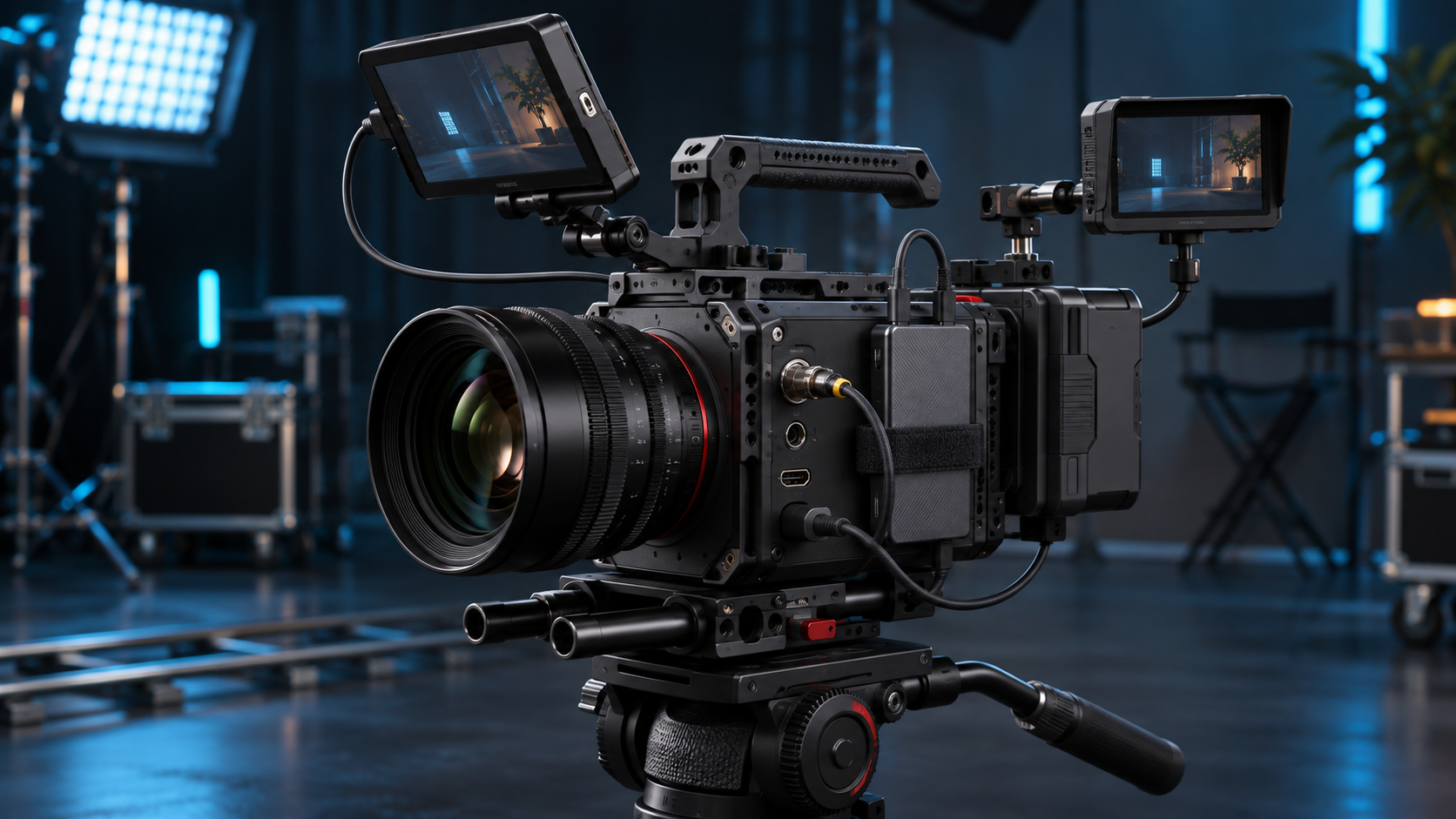
Panasonic has announced the LUMIX SHX1, a $4,699.99 full-frame box-style cinema camera built around a 24.1-megapixel partially stacked sensor, 6K open-gate recording, phase-detection autofocus, five-axis in-body stabilization and professional production connections. The U.S. body is scheduled for January 2027, while a $5,499.99 kit adds Panasonic’s AU-XHU1 XLR handle and AU-GRP1 control grip.
The headline is not simply 6K. The SHX1 records Blackmagic RAW directly to a compatible USB-C SSD, records ProRes RAW internally to CFexpress Type B, includes ARRI LogC3, and captures 32-bit float audio through its 3.5mm microphone input. Those options can simplify a compact crew’s workflow, but each one changes the media, power, cable and post-production plan.
This launch guide separates Panasonic’s confirmed specifications from the practical questions a production should answer before preordering. ReaderSpice has not tested a retail production unit, so autofocus behavior, rolling shutter, stabilization, heat, fan noise, battery life and image quality still require independent testing.
LUMIX SHX1 at a glance
- U.S. price: $4,699.99 for the body; $5,499.99 with the AU-XHU1 XLR handle and AU-GRP1 control grip.
- U.S. availability: January 2027; Panasonic says rollout begins in stages from December 2026 in some regions.
- Sensor: approximately 24.1MP full-frame partially stacked CMOS with an optical low-pass filter.
- Open gate: 6K 30p and 5.1K 60p 4:2:0 10-bit, plus 3.8K 48p 4:2:2 10-bit.
- RAW: Blackmagic RAW 6K 24p open gate to a compatible external SSD and ProRes RAW HQ/ProRes RAW internally to CFexpress Type B.
- Color: V-Log/V-Gamut, ARRI LogC3 and Blackmagic color science when recording Blackmagic RAW.
- Dynamic range: Panasonic claims 15 stops in V-Log with Dynamic Range Boost enabled and 14+ stops with it disabled.
- Focus and stabilization: 779-point Phase Hybrid AF, five-axis B.I.S., Dual I.S. 2, Active I.S. and E.I.S. modes.
- Connections: 12G-SDI, full-size HDMI, BNC timecode input/output, two locking USB-C terminals, CFexpress Type B and SD slots.
- Audio and power: internal 32-bit float through the 3.5mm input, optional four-channel XLR recording, USB PD and micro V-mount battery support.
- Body: approximately 984g without the body cap, with an aluminum-magnesium frame and active cooling for unlimited 4K 120p recording within the guaranteed temperature range.
The box design changes who this camera is for
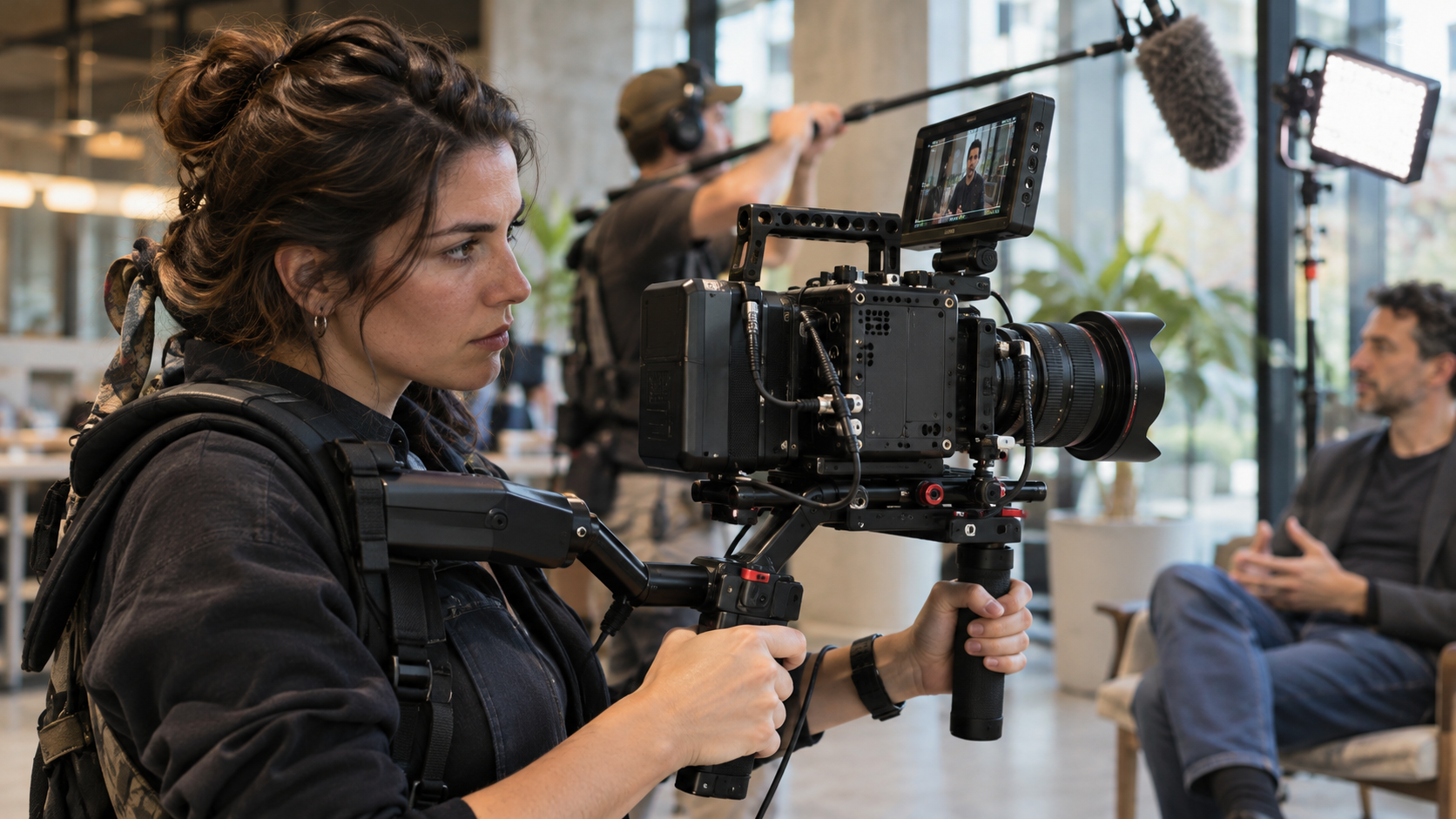
The SHX1 format is designed to move between solo operation, gimbals, tripods, cages and multi-camera production. Illustration: ReaderSpice.
A box camera is an imaging core rather than a complete handheld package. The SHX1 body can sit low on a gimbal, build upward into a cage, mount vertically, or join a synchronized multi-camera system. Panasonic also gives it a top-mounted free-angle monitor that can tilt up or swing sideways, reducing the need for an external screen in simple configurations.
That flexibility is useful only if the rig remains balanced and serviceable. A lens, media, battery, monitor, wireless video system, audio adapter, matte box and cables can turn a compact body into a heavy production package. Before buying, sketch the smallest configuration that can actually record and the largest configuration a tripod, gimbal or operator must carry.
The body itself weighs about 2.17 pounds before a lens, battery or handle. That is light for a cinema system, but it is not a pocket camera. Gimbal buyers should calculate the full center of gravity, not just compare the body weight with a payload limit.
Two RAW paths change the media plan
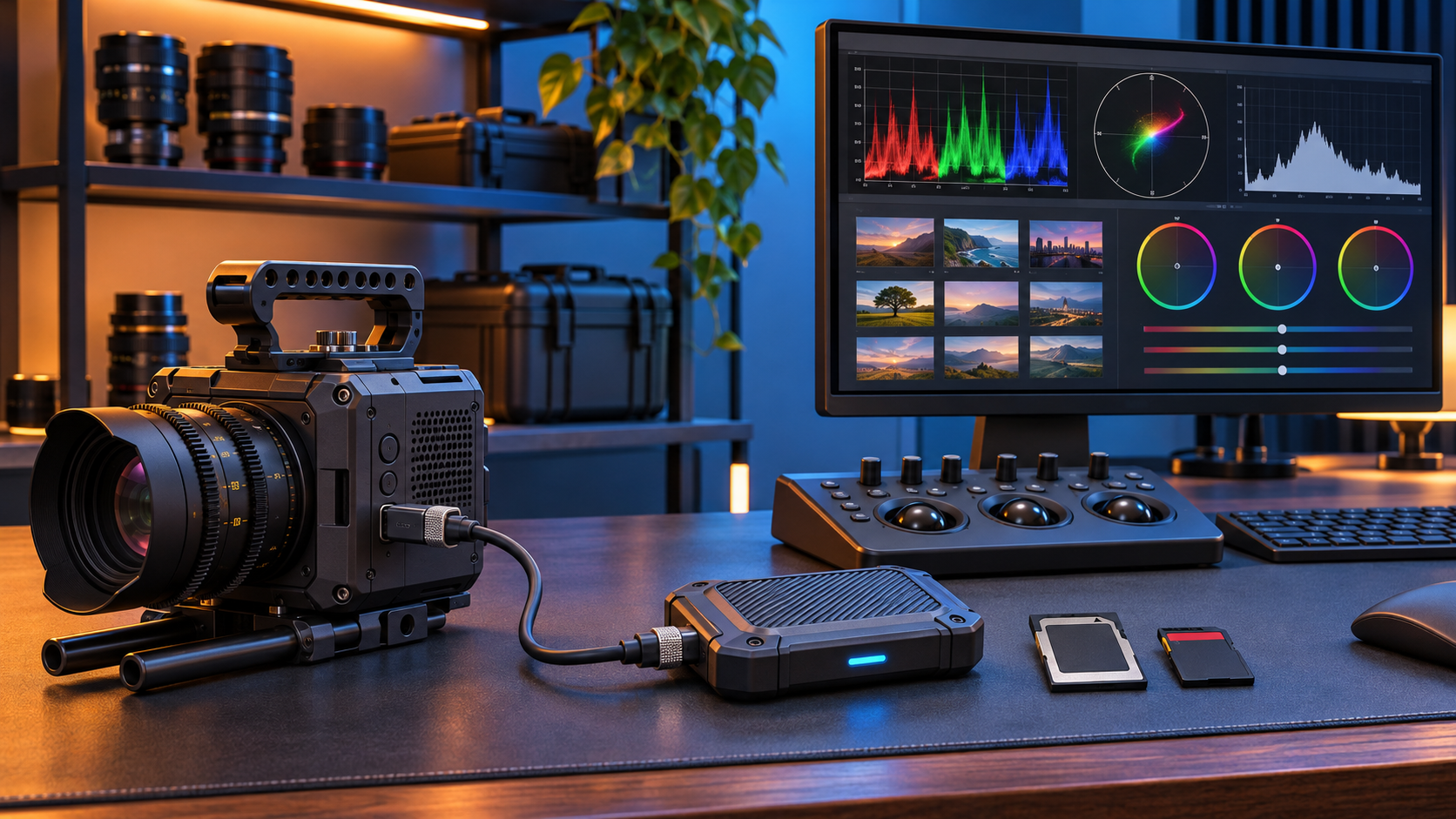
Blackmagic RAW and ProRes RAW use different media and post-production paths, so a production should choose the workflow before buying cards and drives. Illustration: ReaderSpice.
The SHX1 offers two RAW routes without an external recorder, but they are not interchangeable. Blackmagic RAW is written to an external SSD and is aimed at a DaVinci Resolve-centered workflow. ProRes RAW is written to CFexpress Type B inside the camera and fits editing systems that support Apple’s RAW format. The right choice depends on the editor, archive policy, cable tolerance and turnaround requirement rather than the codec name alone.
Blackmagic RAW to an external SSD
Panasonic says the camera records Blackmagic RAW 6K 24p open gate directly to a compatible USB-C SSD. The open-gate BRAW mode applies a slight crop. The SSD must be no larger than 2TB, and Panasonic recommends a drive it has validated; USB-C branding alone does not guarantee sustained recording.
When the main file is going to the SSD, the SHX1 cannot simultaneously write the same main recording to SD or CFexpress. It can, however, write the main video to the SSD and a proxy file to the SD card. That proxy option can speed review and editing, but it is not an in-camera backup of the RAW master.
ProRes RAW to CFexpress Type B
ProRes RAW HQ and ProRes RAW record internally to CFexpress Type B, eliminating the SSD cable and mounting point. A card-based rig can be cleaner for a gimbal or handheld build, but CFexpress capacity, write speed, heat and offload time still need to be tested at the exact resolution and frame rate a production will use.
A sensible media test is longer than a short clip. Record a full expected take, stop and restart repeatedly, fill enough media to expose thermal or write-speed problems, then verify every file in the real editor. Panasonic’s compatibility list and recommended media are the starting point, not a substitute for a production test.
Open gate makes one sensor serve more deliveries
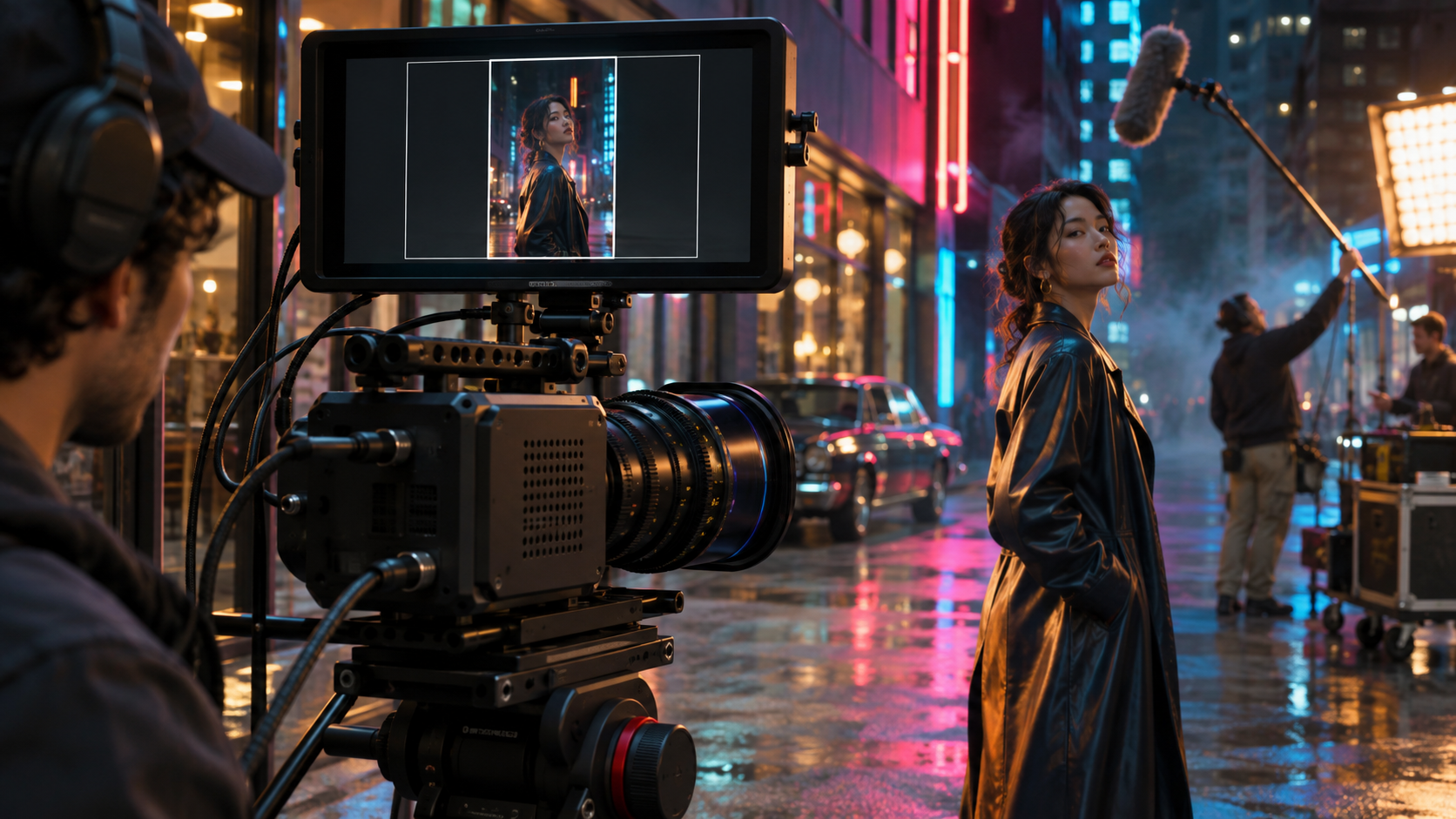
Open-gate capture preserves more sensor area for cinema, widescreen and vertical crops, while the new desqueeze display supports vertical anamorphic framing. Illustration: ReaderSpice.
Open gate uses more of the sensor than a pre-cropped 16:9 recording. That gives an editor room to create widescreen, square and vertical versions from one take, provided the operator protects all intended framing areas. It is especially useful for interviews, branded content and events that must deliver both conventional video and phone-first social clips.
The benefit is not automatic. A boom microphone, light stand or crew member hidden outside the horizontal crop can become visible in a vertical or taller extraction. Productions should load framing guides for every required aspect ratio and review them on set, not discover a contaminated edge in post.
Panasonic also adds vertical anamorphic desqueeze for Vertiscope-style capture. The camera can send a desqueezed view over HDMI or SDI, while phase-detection autofocus remains available. Anamorphic stabilization includes roll correction, but lens breathing, edge quality and desqueeze compatibility still depend on the exact glass and monitoring chain.
Audio, timecode and outputs are built for real crews
Internal 32-bit float recording through the 3.5mm microphone input is a meaningful solo-operator feature. It increases the recoverable level range compared with a conventional fixed-gain track, but it does not repair a clipped microphone capsule, wind noise, RF interference or a badly placed mic. Monitoring and placement remain essential.
The optional AU-XHU1 adds XLR inputs and supports four-channel 32-bit float recording when combined with the body’s stereo mini input, plus 96kHz/24-bit high-resolution recording. The handle and XLR section can separate, so a gimbal operator can keep the audio module without carrying the full top handle.
For multi-camera work, 12G-SDI supports output up to 4K 60p, full-size HDMI covers conventional monitoring, and BNC timecode input/output can synchronize the SHX1 with dedicated generators and other cameras. Bluetooth timecode sync is also listed. Confirm which output carries the required LUT, clean feed, resolution and frame rate before building a switching or wireless-video system.
Stabilization and autofocus make the box body less static
Panasonic is positioning the SHX1 beyond locked-off studio use. Its 779-point Phase Hybrid AF includes eye and face detection, while five-axis B.I.S. works even with lenses that lack optical stabilization. Active I.S. and E.I.S. modes target walking footage, and a cropless electronic mode is available for wide-angle lenses.
Those specifications make handheld and gimbal shooting plausible, but they are not a field result. Subject switching, low-light focus, partially hidden faces, lens choice, stabilization warping and rolling shutter require testing. Panasonic also notes that subject recognition may choose another person when clothing, color or posture is similar or the intended subject remains hidden.
What the $4,699 body price does not include
The body price is the beginning of the system budget. Panasonic’s $5,499.99 kit adds the XLR handle and control grip, but a working package may also need an L-Mount lens, CFexpress cards, SD cards, an approved SSD, micro V-mount batteries, a charger, rails, a cage, a matte box, ND filtration, a monitor and timecode or wireless-video accessories.
Panasonic’s announcement does not list an internal ND system. Instead, it says a firmware update planned for the first half of 2027 will add camera-side control of a Tilta Mirage variable ND through the control grip or Panasonic controllers. That makes an external ND plan important for daylight production, and the promised integration should not be treated as available at launch until the firmware ships.
A separate live-production unit, the AU-LPU1, is also planned for the first half of 2027. It is intended to combine synchronization, connectivity and remote control so the SHX1 can participate in a cinema-quality PTZ configuration. Buyers should separate launch-day functions from roadmap features when quoting a job or approving a purchase.
A preorder and rigging checklist
- Choose the primary editor and confirm whether the production will standardize on Blackmagic RAW, ProRes RAW or a conventional 10-bit codec.
- Build a complete media budget for the longest expected day, including verified CFexpress cards, SD proxy media or a Panasonic-tested SSD no larger than 2TB.
- Mock up the smallest and largest rigs, then calculate total weight, balance, cable strain and gimbal or tripod payload.
- Confirm the lens plan, autofocus needs, stabilization behavior, filter size and external ND method for daylight work.
- Map audio channels, microphone power, monitoring and timecode before deciding whether the XLR handle kit is necessary.
- Test the exact SDI, HDMI, LUT, wireless-video and switcher chain at every required frame rate and resolution.
- Decide whether January 2027 hardware can be purchased for current functions only; do not depend on later ND-control, lens-control or live-production updates.
- Rent or buy one body first, run a full production-day pilot and inspect footage, fan noise, power use, media integrity and post-production time before scaling.
A verified L-Mount zoom on Amazon
The SHX1 uses the L-Mount and supports Dual I.S. 2 with compatible optically stabilized lenses. A relevant current reference is Panasonic’s LUMIX S 24-105mm F4 Macro O.I.S., model S-R24105, an L-Mount zoom with optical stabilization, a constant f/4 aperture and 0.5x maximum magnification. The verified Amazon listing uses ASIN B07N83WBTF. Confirm firmware, seller, warranty, included accessories and current SHX1 compatibility before ordering. View the Panasonic LUMIX S 24-105mm F4 Macro O.I.S. on Amazon
Affiliate disclosure: ReaderSpice may earn a commission from qualifying purchases made through the Amazon link above, at no additional cost to you.
The 24-105mm range is versatile, but it is not a universal cinema answer. A production may prefer faster primes, a power zoom, manual cine glass or an anamorphic set. Lens choice should follow the shot list, focus method, weight limit and filter strategy rather than the convenience of one general-purpose zoom.
Who should consider the SHX1
Makes sense for
- Small crews that want full-frame 6K open gate, internal ProRes RAW and direct-to-SSD Blackmagic RAW in one compact body.
- Documentary, commercial and event teams that need stabilization, phase-detection autofocus and professional timecode or SDI connections.
- Productions already committed to L-Mount lenses, DaVinci Resolve, ProRes RAW or ARRI LogC3 matching.
- Multi-camera and remote-production teams willing to build around roadmap accessories after validating launch-day functions.
Compare alternatives carefully if
- An internal electronic ND system is essential for fast exposure changes.
- The project needs proven global-shutter performance, a built-in shoulder form factor or a turnkey ENG package.
- The budget cannot absorb lenses, media, batteries, filtering, audio and support hardware beyond the body price.
- The workflow does not support Blackmagic RAW or ProRes RAW, making the headline recording options less valuable.
- The purchase depends on a 2027 firmware or live-production feature that is not available when the body ships.
What ReaderSpice has not verified
ReaderSpice has not tested a retail LUMIX SHX1. We have not measured resolution, dynamic range, rolling shutter, autofocus accuracy, stabilization, fan noise, thermal behavior, battery runtime, SSD reliability, media recovery, audio quality, latency, weather resistance or compatibility with third-party lenses and accessories. Panasonic’s figures are manufacturer specifications, and design, firmware, availability and pricing can change before shipment.
Bottom line
The Panasonic LUMIX SHX1 is more than a mirrorless camera reshaped into a cube. It combines full-frame open-gate capture, two internal-or-direct RAW workflows, ARRI LogC3, 32-bit float audio, stabilization, autofocus and production I/O in a body that can move from a solo rig to a synchronized camera system.
Its tradeoffs are equally practical. Blackmagic RAW depends on an external SSD and its cable, ProRes RAW depends on CFexpress and editor support, a complete rig costs far more than $4,699.99, and Panasonic’s future ND-control and live-production plans are not launch-day guarantees. The responsible buying decision is a one-body pilot built around the exact lens, media, power and post-production chain the camera must serve.
Sources
Panasonic Global Newsroom – LUMIX SHX1 announcement and technical footnotes
Panasonic North America – U.S. price and January 2027 availability
Panasonic Shop – LUMIX SHX1 product page and recording details
Panasonic Support – external SSD compatibility information
Panasonic Shop – LUMIX S 24-105mm F4 Macro O.I.S. specifications
Amazon – Panasonic LUMIX S 24-105mm F4 Macro O.I.S., ASIN B07N83WBTF
Inline image 1 metadata: Original 16:9 editorial illustration of a solo documentary operator using a compact box-style cinema rig; title and alt description embedded in the image object.
Inline image 2 metadata: Original 16:9 editorial illustration of external SSD, CFexpress and SD recording media at a color-grading workstation; title and alt description embedded in the image object.
Inline image 3 metadata: Original 16:9 editorial illustration of open-gate anamorphic capture with a vertical delivery frame; title and alt description embedded in the image object.