
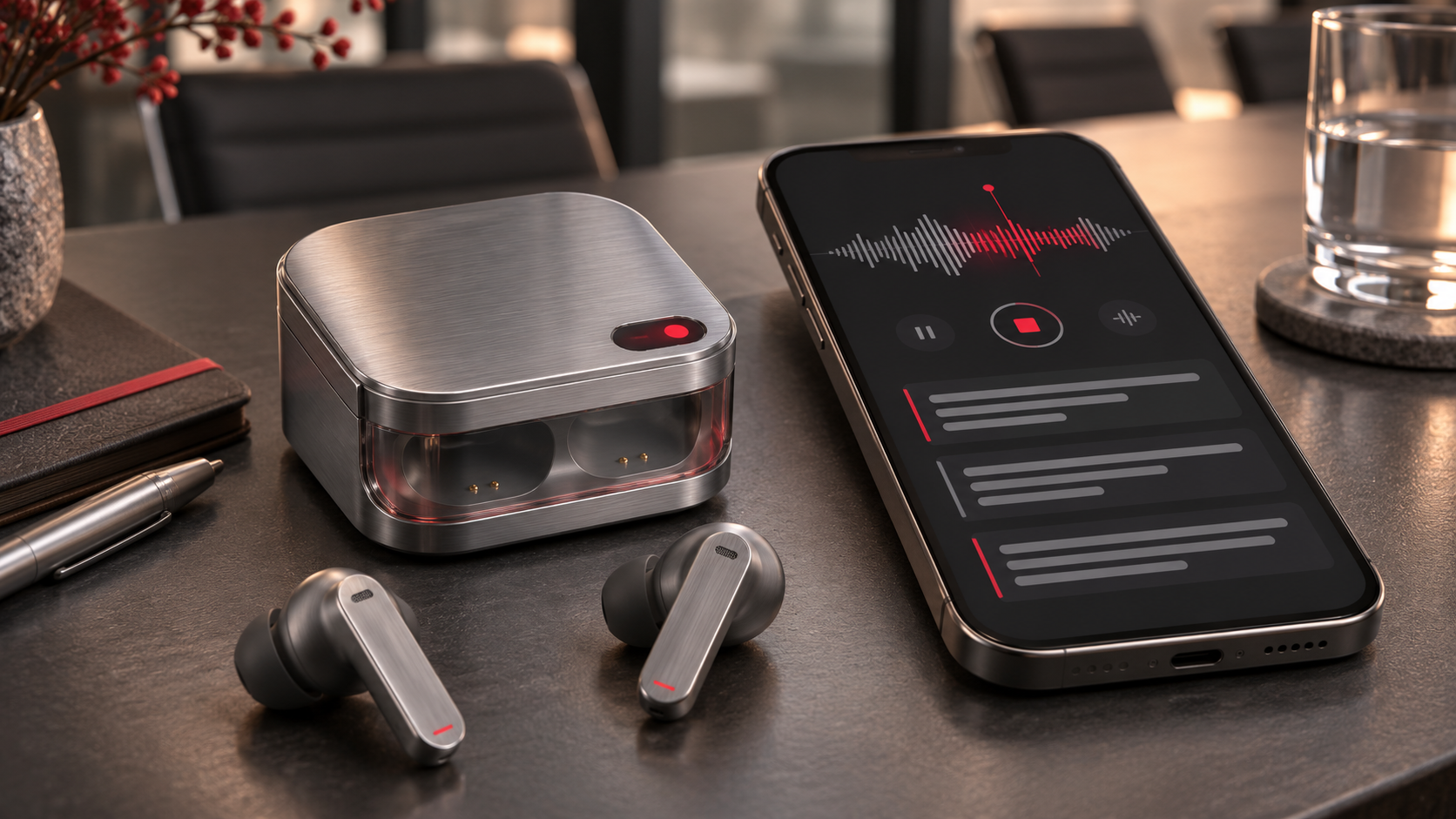
Nothing has named its next audio product Ear (note), a pair of wireless earbuds whose charging case is also designed to record in-person conversations. The company plans to unveil it on December 8, 2026, after showing an aluminum case with separate Talk and Record controls, transparent windows and status lights.
The pitch is broader than voice memos. Nothing says Ear (note) can help users transcribe, summarize and act on in-person conversations, calls, online meetings and spoken thoughts while still delivering its best in-ear audio to date. The company also cites Hi-Res Audio, but it has not published a full specification sheet, price, battery figures, compatibility list or detailed privacy policy for the product.
This is a launch preview based on Nothing’s public teaser, company statements reported by technology publications and a Bloomberg product demonstration. It is not a hands-on review. The confirmed functions are promising, but buyers should wait for the December 8 details before treating Ear (note) as a recorder, an earbud upgrade or both.
Nothing Ear (note) at a glance
- Official name: Nothing Ear (note).
- Reveal date: December 8, 2026; Nothing has not yet confirmed a general on-sale date for every market.
- Core concept: earbuds for calls and listening, plus microphones in the charging case for in-person recording.
- AI workflow: a companion app is expected to manage recordings, transcripts and generated summaries.
- Hardware shown: an aluminum, square-edged case with transparent map-like windows, a Talk button and a separate Record button.
- Audio claims: Hi-Res Audio and Nothing’s best in-ear audio experience to date; independent testing is not yet available.
- Still unannounced: price, battery life, charging time, driver and codec details, ANC performance, water resistance, phone support, storage, AI limits, subscriptions and regional availability.
What Nothing has confirmed
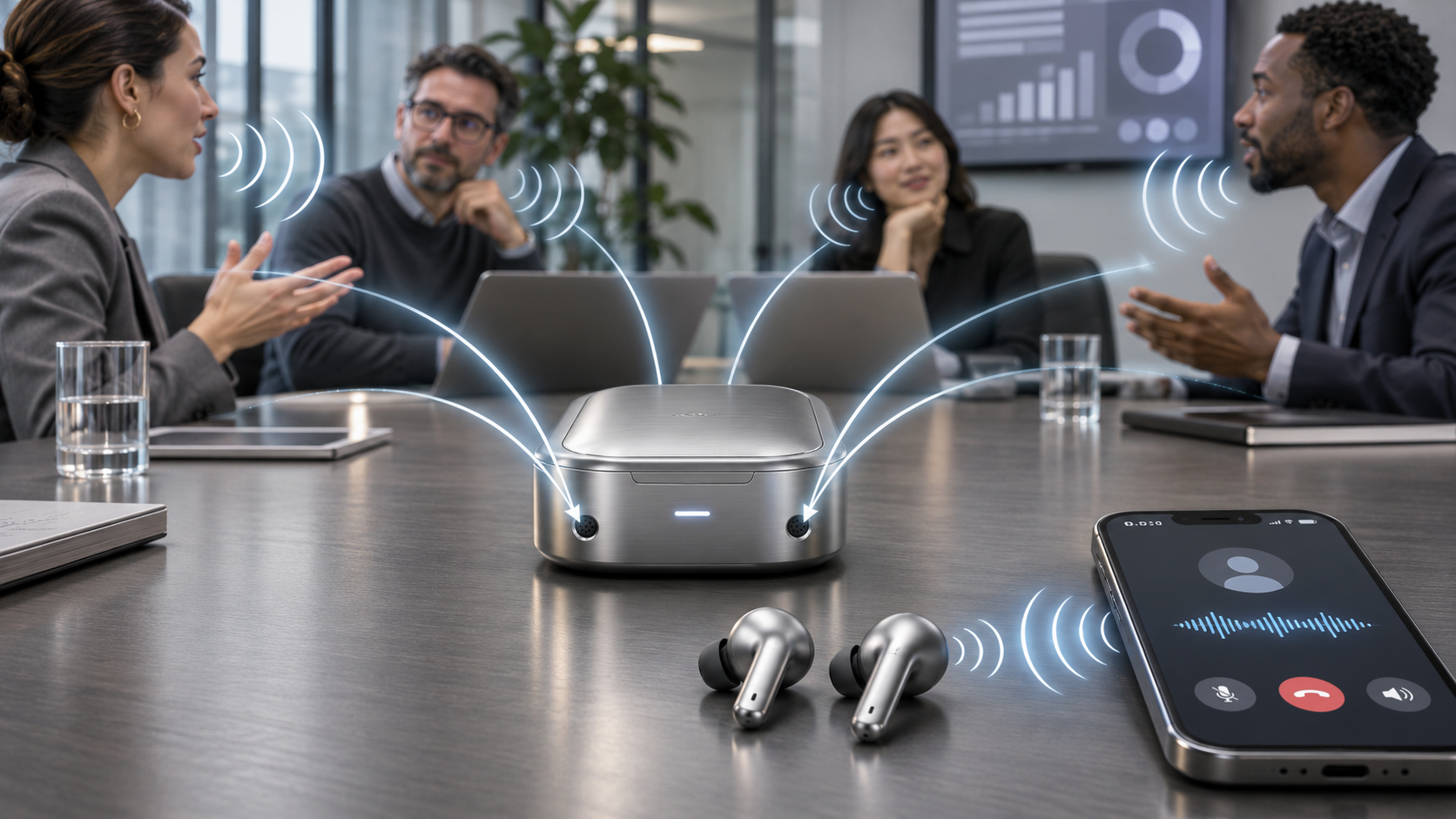
Nothing says the case and earbuds will handle different recording situations. The exact microphones, app behavior and device limits remain to be announced. Original ReaderSpice illustration.
Nothing describes Ear (note) as a personal-productivity device that avoids carrying a separate recorder. The company says the case can capture in-person conversations and thoughts, while the earbuds can support calls and online meetings. Bloomberg’s demonstration, as summarized by several publications, also showed built-in case microphones and an app for recordings, transcripts and summaries.
The earbuds and case have different jobs
Putting room microphones in the charging case changes the normal earbud workflow. A case can sit in the open on a table, closer to several speakers, while the earbuds remain available for private listening or calls. That arrangement may be more practical than holding a phone or wearing earbuds through an entire meeting, but the result will depend on pickup range, noise handling, speaker separation and visible recording indicators.
Nothing has not yet explained whether the case can record independently with the earbuds docked, how long it can record, or whether a phone must remain nearby. Those details will decide whether Ear (note) behaves like a true standalone recorder or an accessory whose usefulness depends on a particular phone and app state.
Talk and Record are separate controls
The metal case includes a Talk button descended from the Ear (3) Super Mic feature and a new Record button marked with a red dot. Nothing says the controls take inspiration from a retro cassette player and provide tactile feedback. The separation suggests that speaking to an AI assistant and recording a conversation are intended to be distinct actions, though Nothing has not documented the complete control map or what each status light means.
What Nothing has not announced
The teaser is not a complete launch. These unanswered questions are more important than the case design for anyone considering a purchase:
- Price, preorder timing, shipping date, countries and warranty terms.
- Earbud and case battery life during normal listening, calls, local recording and AI processing.
- Driver size, Bluetooth version, supported codecs, multipoint behavior, active noise cancellation, transparency mode and microphone layout.
- Ingress-protection ratings for the earbuds and case.
- Android and iPhone requirements, Nothing-phone-only functions and support for Zoom, Teams, Meet and ordinary phone calls.
- Transcription languages, speaker identification, summary accuracy and export formats.
- Whether audio or transcripts are processed on the device, phone or cloud, and whether offline recording works.
- Storage capacity, retention periods, deletion controls, encryption, account recovery and any use of customer data for AI training.
- Free AI allowances, paid plans or subscription requirements. Reports have raised the possibility of a subscription, but Nothing has not published terms.
- How call-recording warnings, consent indicators and regional legal restrictions will work.
Recording consent and privacy matter more than the form factor

A visible light is useful, but it does not replace explicit permission or workplace policy. Original ReaderSpice illustration.
A recorder that looks like an ordinary earbud case can be easy for other people to overlook. Before recording, tell everyone what device is active, what will be captured, why it is needed and where the audio or transcript will go. Obtain clear permission rather than assuming a status light is sufficient.
Recording and wiretapping laws vary by country, state and context. Schools, employers, courts, health-care providers and confidential meetings may impose stricter rules than local recording law. This article is not legal advice. If consent or policy is unclear, stop recording and take written notes instead.
At launch, look for an obvious recording indicator that cannot be disabled accidentally, a fast hardware stop control, per-recording deletion, export and retention settings, encryption details and a clear explanation of cloud processing. Also check whether deleting a transcript removes the original audio and any derived summary.
The Ear (3) Super Mic comparison needs caution
Ear (note) builds on an idea Nothing has already shipped. Ear (3) uses microphones in its case for Super Mic, with a Talk button that can improve voice capture in some situations. That makes Ear (3) useful context, not proof that Ear (note) will work the same way or solve the same problems.
In SoundGuys’ hands-on testing, the Ear (3) case had to be held near the mouth, automatic transcription centered on Nothing phones and app support varied by task. The reviewer also found that distance and angle affected voice quality. Nothing now promises Ear (note) will work without an additional device or new behaviors, so the December 8 demonstration needs to show that a case on a table can capture a real meeting without awkward positioning or an ecosystem lock-in surprise.
What to test at the December 8 launch
- Recording visibility: confirm which light, sound or on-screen notice appears when the case or earbuds are recording.
- Room performance: test several speakers at different distances, side conversations, typing noise and a busy café.
- Transcript quality: compare names, numbers, punctuation, technical terms, accents and speaker labels with the original audio.
- Call limits: identify which phones and calling apps work, what consent warning is provided and whether operating-system restrictions block capture.
- Data controls: find the original audio, transcript and summary; export each one; then delete them and verify what remains in the cloud.
- Offline behavior: determine whether recording continues without internet and which AI functions wait for a connection.
- Battery cost: measure listening and case endurance with repeated room recordings, calls and transcription.
- Plan limits: separate included transcription minutes and storage from any paid subscription or AI-agent fees.
A relevant Amazon alternative
Readers who want Nothing’s current earbud design and Super Mic context before the Ear (note) launch can compare the Nothing Ear (3) wireless earbuds in black (ASIN B0FHWM1D2Y). The indexed Amazon listing identifies the black Ear (3) with its case-based Super Mic feature. Confirm the seller, color, current price, return terms and exact model on Amazon because listings can change.
Ear (3) is not a substitute for Ear (note): it does not prove the new model’s independent meeting recording, transcription workflow, privacy controls or AI plan. It is relevant mainly as the existing product from which the Talk button and case-microphone concept evolved.
Affiliate disclosure: ReaderSpice may earn a commission from qualifying purchases made through the Amazon link above, at no additional cost to you.
Who should watch Ear (note)
- People who already use earbuds for calls and want one device for listening, voice notes and meeting capture.
- Frequent interviewers or project teams willing to obtain explicit consent and review AI transcripts against the audio.
- Nothing users interested in the company’s first purpose-built AI hardware, provided compatibility and plan limits are acceptable.
Who should wait
- Anyone who needs a dependable recorder now and cannot wait for independent tests of pickup range, battery life and transcription accuracy.
- Buyers who require offline processing, a specific export format or a documented no-training privacy policy.
- iPhone or non-Nothing Android users until Nothing confirms feature parity and app requirements.
- People who cannot consistently obtain recording consent or whose workplace, school or profession restricts recording.
- Shoppers choosing primarily on audio quality; Nothing’s “best in-ear audio” statement is a claim, not a measurement.
What ReaderSpice has not verified
ReaderSpice has not used Ear (note) and has not independently verified its sound quality, microphones, transcription, summaries, AI actions, battery life, call capture, recording range, speaker identification, privacy controls, offline behavior or compatibility. Nothing’s Hi-Res Audio and best-in-ear-audio statements are company claims pending a complete specification sheet and independent testing.
ReaderSpice also has not confirmed a retail price, preorder date, universal December 8 on-sale date, subscription requirement, included AI allowance or region-by-region availability. Those items should remain open until Nothing publishes final launch materials.
The bottom line
Ear (note) is a credible attempt to merge a tool many people already carry with a recorder they might otherwise leave at home. The separate Talk and Record controls, room-facing case microphones and transcript workflow could make the product more useful than an ordinary voice-memo feature. The buying decision, however, rests on information Nothing has not released: price, battery cost, phone support, subscription limits, recording transparency and control over audio after it reaches the app or cloud. December 8 should be treated as the start of that evaluation, not the end of it.
Sources
- Nothing official X announcement: Ear (note) and December 8 reveal
- 9to5Google: Nothing Ear (note) design and company feature statement
- The Verge: Ear (note) recording roles and app workflow
- Digital Trends: official teaser and Bloomberg-reported case recording
- SoundGuys: Ear (note) preview and first-person Ear (3) Super Mic context
- Bloomberg report syndicated by Investing.com: product demonstration and unsettled price
- Amazon listing: Nothing Ear (3) wireless earbuds, black (ASIN B0FHWM1D2Y)