
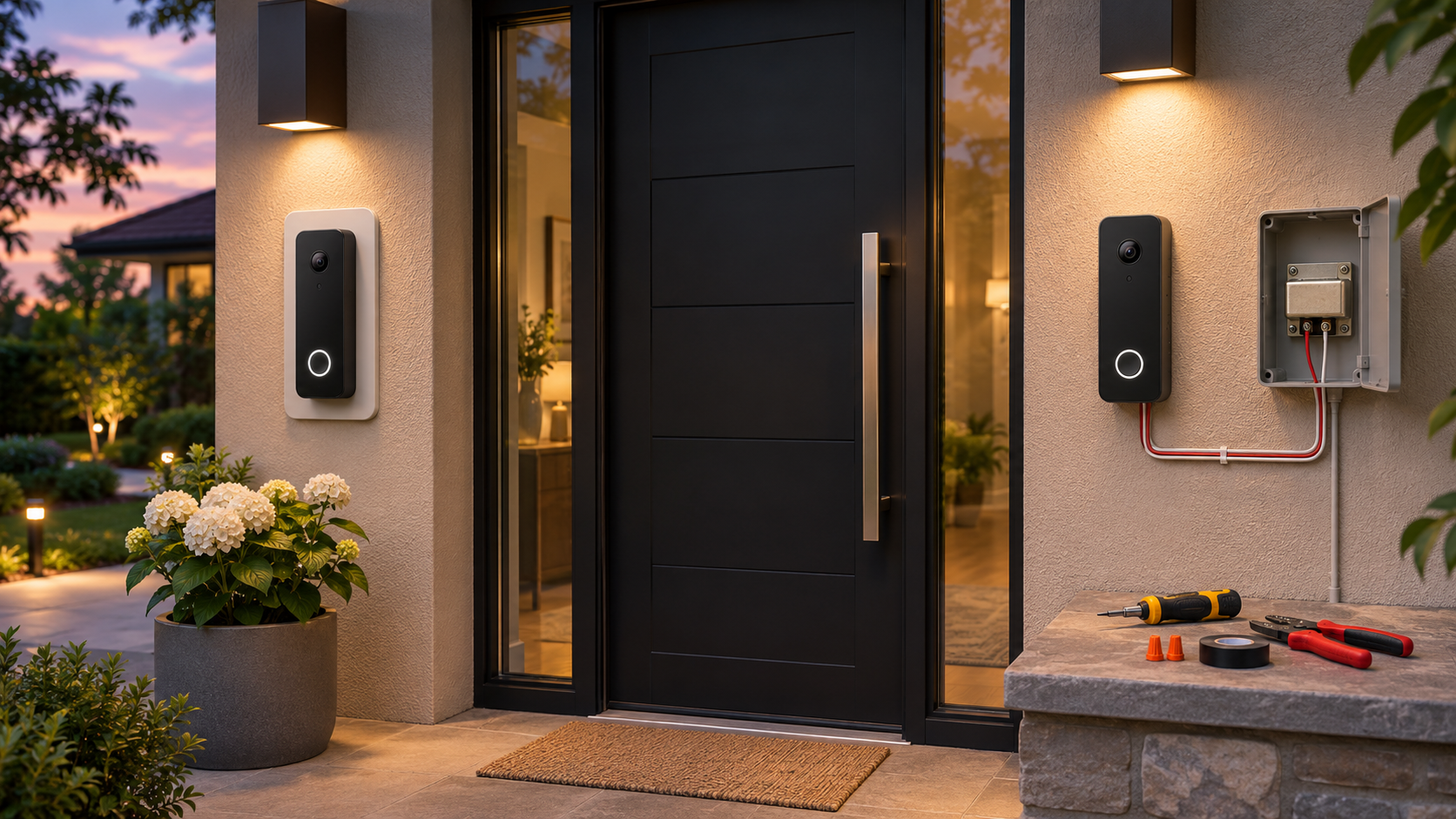
Arlo’s third-generation video doorbells put the battery-powered AVD6001 and hardwired AVD6002 at the same $79.99 preorder price. Both models add 2K square video, HDR, a 180-degree field of view, 12x digital zoom and dual-band Wi-Fi, but their power requirements and recording options make them meaningfully different purchases.
This guide compares the two models using Arlo’s launch announcement, specification sheets, setup documentation and current U.S. subscription page. It also separates the features that continue without a paid plan from cloud history, AI alerts, monitoring and continuous recording that require a subscription.
Confirmed: Arlo announced both models on November 11, 2026, opened preorders at $79.99 and said shipping would begin in late November. An Arlo consumer article gives November 25 as the launch date. ReaderSpice has not independently tested video quality, battery life, notification latency or low-light performance, so this is a sourced buying guide rather than a hands-on review.
Arlo Video Doorbell 3rd Gen at a glance
- Battery and wired 2K models are both listed at $79.99 for preorder in the United States.
- The launch colors are White, Black, Greystone and Sand Dune; availability can vary by model and retailer.
- Both models record up to 1944 x 1944 video with HDR, a 180-degree diagonal view, 12x digital zoom, infrared night vision, two-way audio and a built-in siren.
- Dual-band 2.4GHz and 5GHz Wi-Fi is built in, and Arlo specifies at least 2Mbps upload and download bandwidth per 2K camera.
- Arlo lists Alexa, Google Home, SmartThings and IFTTT integrations. The launch materials reviewed for this guide do not claim Matter or Apple Home compatibility.
- The battery model favors placement flexibility; the wired model adds Foresight pre-roll and eligibility for optional 24/7 recording on Arlo’s Ultra Secure plan.
Battery or wired: choose the power model first
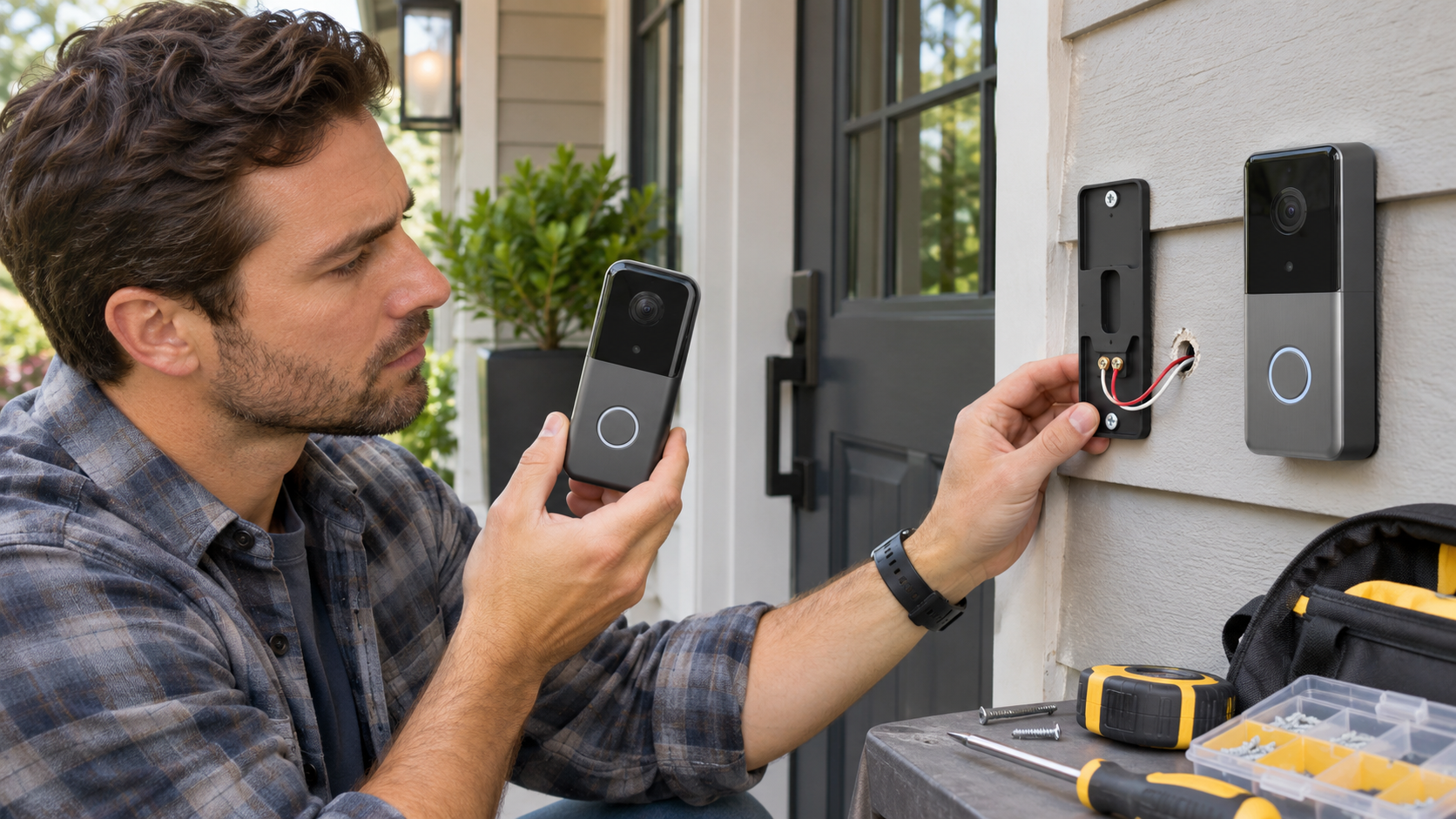
The battery model can use existing doorbell wiring for trickle charging, while the wired model depends on a compatible low-voltage transformer. Illustration: ReaderSpice.
Battery model favors flexible placement
The AVD6001 contains a non-removable rechargeable battery and can be installed without doorbell wiring. If compatible 8–24VAC wiring with at least 10VA is available, Arlo says it can provide trickle charging and chime support. The camera still operates from its internal battery; wiring does not turn it into the wired model or add that model’s always-on features.
That distinction matters for maintenance. A wired trickle charge can reduce how often the unit needs manual charging, but battery life still depends on motion volume, recording length, temperature, Wi-Fi strength and settings. Arlo’s current specification sheet does not provide one guaranteed battery-life figure for every installation.
Wired model unlocks pre-roll and continuous recording
The AVD6002 requires 16–24VAC doorbell wiring with at least 10VA. In return, its constant power supports Foresight, which can capture activity before a motion-triggered event, and makes the camera eligible for optional 24/7 continuous video recording. Arlo ties continuous recording to the Ultra Secure plan rather than including it with the $79.99 hardware.
Choose the wired model only after confirming the transformer’s output and the condition of the existing doorbell circuit. A mechanical or digital chime can also require compatible wiring and in-app configuration. If the voltage is unknown, have a qualified installer test it before mounting the camera.
Shared camera and Wi-Fi specifications
The two 2K models share the core imaging system: a 1:1 1944 x 1944 frame, HDR, H.264 and H.265 video, infrared night vision, a 180-degree diagonal view and 12x digital zoom. The square composition is intended to show a visitor from head to toe and leave more room for packages near the threshold than a narrow landscape frame.
Both models connect directly to 2.4GHz or 5GHz Wi-Fi and have a stated outdoor operating range of -4°F to 113°F (-20°C to 45°C). Arlo recommends at least 2Mbps upload and download bandwidth per 2K camera. Real performance will still depend on the router, wall materials, interference and the doorbell’s signal strength at the entryway.
What works without a subscription
Arlo says live streaming, two-way audio and basic motion notifications remain available after a trial ends. That is enough to answer a live visitor and receive a general alert, but it is not equivalent to a cloud recording plan. A user who needs searchable recordings, advanced classifications or longer evidence retention should budget for a subscription or verify another supported storage path before buying.
- Live view in the Arlo app when the camera is online.
- Two-way talk with a visitor through the doorbell and app.
- Basic motion alerts without Arlo’s paid object classifications.
- The physical doorbell button, siren controls and supported smart-home integrations, subject to account and platform requirements.
What Arlo Secure adds and costs
Arlo’s U.S. plan page currently lists a Single Camera plan at $9.99 month-to-month or $95.88 per year, which is equivalent to $7.99 per month when billed annually. The Unlimited plan is $19.99 monthly or $215.88 annually. Smart Secure is $29.99 monthly or $299.98 annually, and Ultra Secure is $49.99 monthly or $479.88 annually. Taxes, promotions, trial terms and plan details can change, so check the checkout page before relying on these figures.
Paid tiers add features such as cloud video history, person, vehicle, animal and package detection, activity zones, event captions and summaries. Higher tiers add monitoring and dispatch services. The wired model’s optional 24/7 continuous recording is an Ultra Secure feature; buying the wired hardware alone does not include continuous cloud storage.
A single-camera annual plan is the lowest current long-term price shown on Arlo’s site, but an unlimited plan can become more economical for a household adding multiple cameras. Compare the annual total rather than only the monthly equivalent, and verify whether every desired feature is included in the selected tier.
Installation and compatibility checklist
- Stand at the intended mounting location and check both 2.4GHz and 5GHz signal strength before drilling. Arlo recommends mounting about 48 inches above the ground.
- For the battery model, charge the doorbell until its LED is solid blue before setup. Decide whether existing 8–24VAC wiring will be used only for trickle charging and chime support.
- For the wired model, verify 16–24VAC and at least 10VA at the transformer. Turn off the circuit at the breaker before removing the old doorbell.
- Install the Arlo Secure app, enable Bluetooth for onboarding and follow the in-app QR-code flow for the exact model.
- Aim the camera to include the visitor’s face and the package zone without capturing more neighboring property or public sidewalk than necessary.
- Test the button, chime, live view, two-way audio, night image, motion zones and notification delay before discarding packaging or installer notes.
Privacy and reliability checks before relying on it
- Use a unique Arlo password and enable every available account-protection option. Review household and guest access after installers or visitors leave.
- Set activity zones and camera aim to reduce recording of neighbors, shared hallways and public areas that are not relevant to the entry.
- Check local rules and lease or homeowners-association requirements before recording audio or shared spaces.
- Treat object labels, threat assessments and summaries as decision aids, not infallible evidence. Save important clips and verify the underlying video.
- Test doorbell alerts over both Wi-Fi and cellular data. A camera that is offline, poorly powered or outside reliable Wi-Fi range cannot deliver timely notifications.
- Confirm retention and export procedures before using a cloud clip for an insurance, property-management or police report.
A verified Amazon listing for the battery model
The Arlo Video Doorbell 3rd Gen Battery-Powered 2K (ASIN B0HKYM69YH) is a verified Amazon.com listing for the battery model. Seller, price, color and availability can change, so confirm the ASIN, model number and return terms before checkout.
Affiliate disclosure: ReaderSpice may earn a commission from qualifying purchases made through the Amazon link above, at no additional cost to you.
The bottom line
At the same $79.99 hardware price, the decision is about power and recording behavior. The battery AVD6001 is the more flexible choice for renters, side doors and entries without compatible wiring. The wired AVD6002 is the better foundation for Foresight and optional continuous recording, provided the transformer and subscription budget meet Arlo’s requirements.
Neither model should be judged only by its 2K label. Wi-Fi strength, notification latency, low-light detail, battery maintenance and plan cost determine whether a doorbell is useful every day. Verify the installation conditions and free-versus-paid feature split first, then wait for independent testing if image quality or battery endurance is the deciding factor.
Sources
Arlo — Meet the New Arlo Video Doorbell — November 11, 2026
Arlo Support — Arlo Video Doorbell 3rd Gen Specification Sheet — accessed November 15, 2026
Arlo Support — Arlo Wired Video Doorbell 3rd Gen Specification Sheet — accessed November 15, 2026
Arlo Support — Arlo Video Doorbell 3rd Gen FAQ — accessed November 15, 2026
Arlo — Arlo Secure Plans and Pricing — accessed November 15, 2026
Arlo Support — Arlo Subscription Plan Changes September 2026 — accessed November 15, 2026
Arlo — Wired Video Doorbell 3rd Gen Product Page — accessed November 15, 2026
Inline image 1: Battery-powered and hardwired installation comparison