
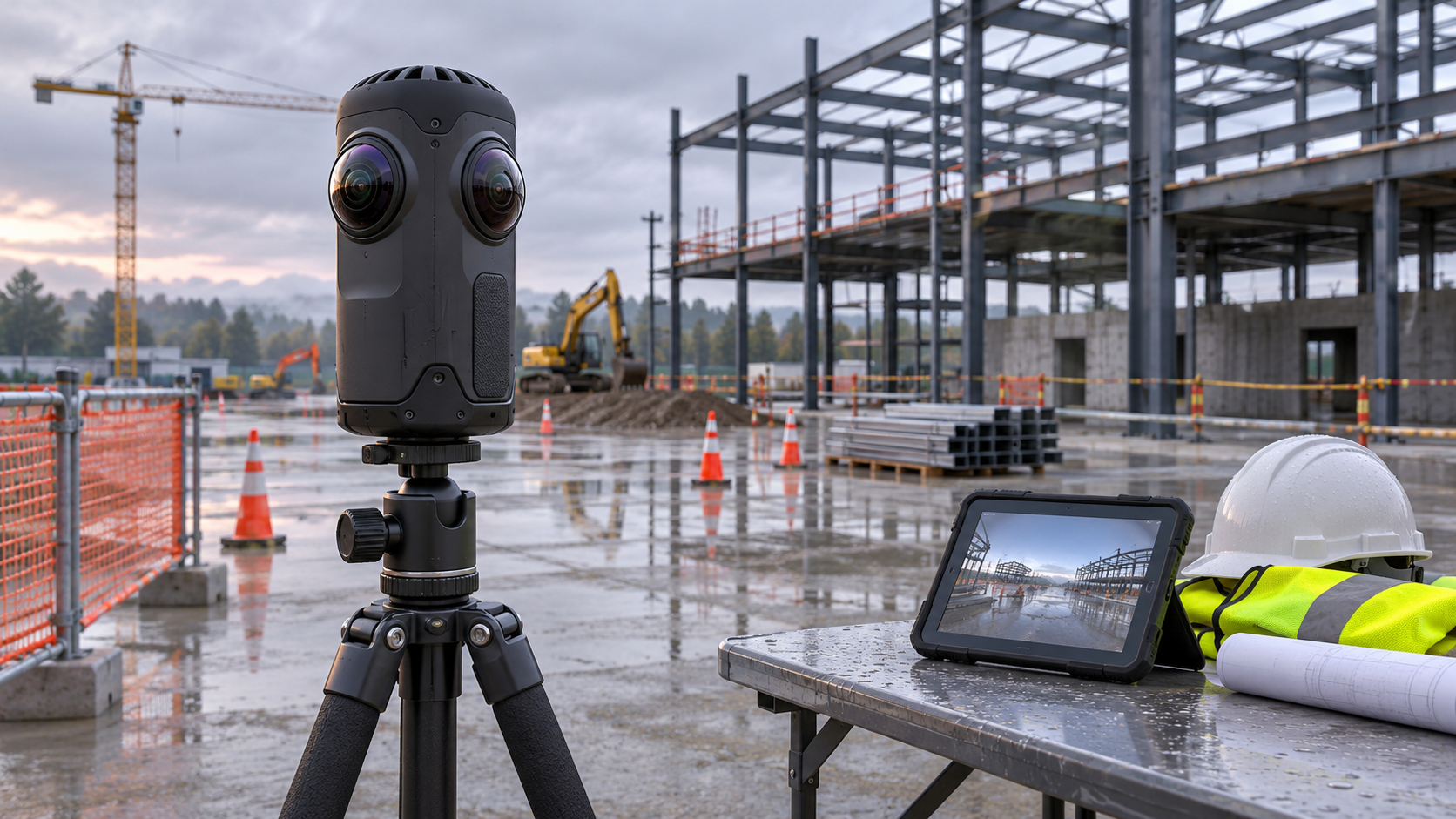
Ricoh has opened U.S. and Canadian sales of the RICOH360 THETA A1, a $799.95 professional 360-degree camera built for construction, facility management, infrastructure inspection and other field-documentation work. The November 16, 2026 rollout expands a model Ricoh first introduced in 2025 rather than announcing an entirely new global camera.
The A1 combines 11K 360-degree still capture, IP64-rated protection, multi-system GNSS, shooting-direction data, a removable battery and direct RICOH360 cloud workflows. Those specifications are useful, but they do not make it an underwater action camera or a smooth 8K production-video camera. Its strongest case is repeatable visual records that a field team can locate, upload and review.
This launch guide separates Ricoh’s documented capabilities from the deployment questions a team should answer before buying multiple cameras, assigning cloud accounts or relying on the A1 for inspection evidence. ReaderSpice has not tested a retail production unit.
RICOH360 THETA A1 at a glance
- U.S. price: $799.95 through Ricoh, authorized channels and Amazon.
- Availability: United States and Canada beginning November 16, 2026.
- Still capture: 11K JPEG at 11,008 by 5,504 pixels, approximately 60 megapixels.
- Video: up to 8K at 10 fps, 5.7K at 10 fps or 4K at 30 fps.
- Durability: IP64-rated dust and splash resistance with a -10 to 40 degrees Celsius operating range.
- Location data: GPS plus SBAS, QZSS, Galileo, BeiDou, GLONASS and A-GPS support, with shooting-direction data.
- Storage: approximately 27.5GB of internal memory; Ricoh lists about 2,670 11K stills or 55 minutes of 4K30 video.
- Battery: removable TB-1 pack rated for approximately 300 stills or 60 minutes of video under Ricoh’s test conditions.
- Weight: about 225g with battery; dimensions are approximately 52.8 by 142 by 29mm.
What the $799.95 field camera is designed to solve
Traditional site documentation often requires many overlapping photographs, careful naming and a second pass to explain what sits outside each frame. A stitched 360-degree capture records the entire surrounding scene from one position. Remote reviewers can pan around the result, compare dates and inspect context that the photographer may not have considered important at capture time.
That benefit is most valuable when the capture process is standardized. A team can define fixed points in a building, repeat them at each milestone and connect every panorama to a location, time and work package. The A1’s GNSS, compass information and cloud workflow support that model, but the camera alone does not create a defensible record. Naming, retention, access control and reshoot rules still belong in the operating procedure.
What IP64 changes on a jobsite
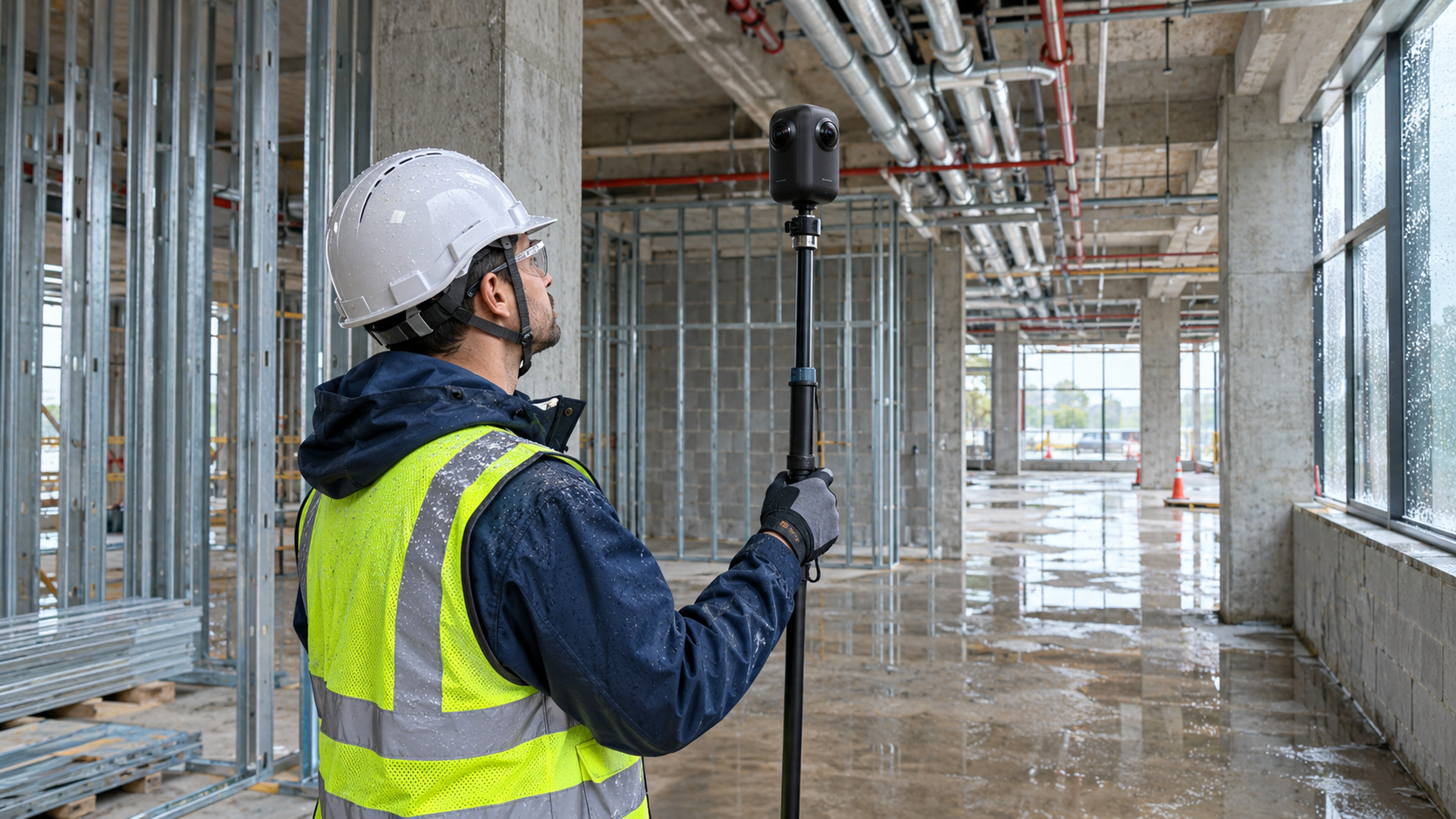
Ricoh calls the A1 its first THETA model with dust- and water-resistance, and the product page lists an IP64 rating. That rating is meaningful for dusty interiors, light rain, splashes and dirty field handling. It is not permission to submerge the camera, pressure-wash it or leave ports and battery areas exposed while water enters.
- Inspect covers, seals and the lens area before each outdoor assignment.
- Keep the camera out of standing water and do not treat IP64 as a swimming or underwater rating.
- Dry the exterior before opening the battery compartment or connecting USB-C.
- Use a stable tripod or monopod in low light; Ricoh specifically recommends support when automatic noise reduction lengthens capture.
- Protect the exposed fisheye lenses. An ingress rating does not prevent scratches, impact damage or stitching artifacts from droplets on the glass.
The listed operating range reaches 14 degrees Fahrenheit at the cold end and 104 degrees Fahrenheit at the hot end. Battery performance, condensation and worker comfort can become limiting factors before the headline temperature range does. Move the camera gradually between cold and warm spaces and follow Ricoh’s care instructions.
11K stills are the headline; 8K video has a major limit
The A1 uses two 1/2-inch-type sensors with approximately 48 megapixels each and f/2.4 lenses. Its highest still mode produces an 11,008 by 5,504 JPEG of about 60 megapixels after the two views are processed into a panorama. A lower 5.5K still mode is available when storage, transfer time or review speed matters more than maximum detail.
Video needs closer reading. The camera records 8K and 5.7K only at 2, 5 or 10 frames per second. Those rates can document slow site changes or create time-based records, but 10 fps is not conventional smooth-motion video. The normal-motion option is 4K at 30 fps, with a listed 64Mbps data rate. Buyers seeking immersive tours, walking footage or action capture should test motion, stabilization, stitching and low-light performance before choosing the A1 over a creator-focused 360 camera.
The specification sheet lists JPEG for stills rather than RAW/DNG. That simplifies fleet workflows but reduces post-production latitude compared with cameras designed for high-end image finishing. Exposure modes include Auto, Shutter Priority, ISO Priority and Manual, with ISO 50 to 3200.
GNSS and direction data make records easier to organize
Ricoh lists GPS, SBAS, QZSS, Galileo, BeiDou, GLONASS and A-GPS support. Location and shooting-direction data can help teams place captures on a map, confirm which way the camera faced and reduce ambiguity when several rooms or assets look similar. This matters in infrastructure, restoration, insurance and facility work where a panorama may be reviewed weeks later by someone who was never on site.
Location metadata is still evidence to validate, not an infallible coordinate. Indoor structures, dense materials, urban canyons and slow satellite acquisition can reduce accuracy. Teams should compare coordinates with site plans, asset IDs or room labels and avoid publishing sensitive facility locations without a clear need.
The RICOH360 cloud workflow and its dependencies
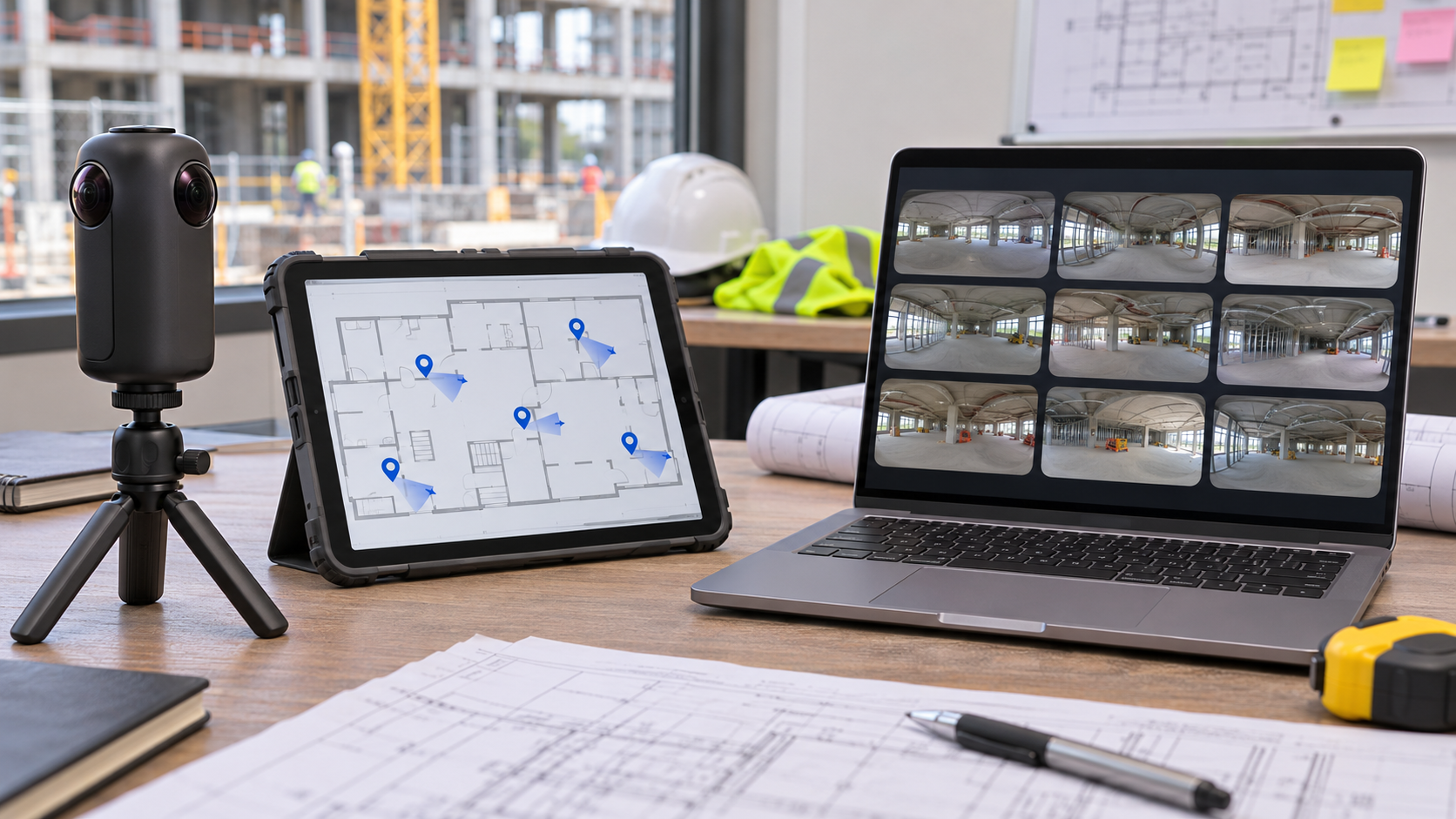
The A1 can operate as a standalone camera, connect to a phone through the RICOH360 app or participate in Ricoh’s cloud workflow. Ricoh’s support guide says automatic uploads can begin after remote shooting when cloud sync has been configured, the camera is powered on, a configured Wi-Fi router is in range and the camera switches to client mode.
That is useful for a field-to-office pipeline, but it depends on account setup, network coverage and correct wireless configuration. Captures will not magically reach the project record when the site has no usable Wi-Fi, the camera remains in access-point mode or credentials change. Define an offline fallback: confirm files locally, transfer by USB-C or phone when necessary, and verify the cloud copy before clearing internal memory.
- Decide who owns the RICOH360 account and who can invite, download or delete project images.
- Test the exact 2.4GHz or 5GHz network used at the site; do not assume corporate guest Wi-Fi allows camera connections.
- Confirm upload completion before leaving a remote site or reformatting the camera.
- Document what happens when a worker leaves, a project closes or a cloud subscription changes.
- Keep a second copy when the panoramas are contractual, safety-related or difficult to recreate.
Storage, battery and fleet logistics
The approximately 27.5GB internal memory is fixed in Ricoh’s U.S. specification; the page does not list a microSD expansion slot. Ricoh estimates about 2,670 11K stills, 6,680 5.5K stills or 55 minutes of 4K30 video. Real capacity varies with scene detail, settings and file-management overhead. A long inspection can fill the camera quickly if video is used heavily.
The removable 1,485mAh TB-1 battery is a practical advantage for teams that cannot stop to recharge. Ricoh rates it at roughly 300 still images or 60 minutes of video, but cold weather, Wi-Fi, repeated cloud uploads, display use and aging can reduce runtime. Spare packs, a labeled charging process and a battery-health log matter more in a fleet than the single-camera laboratory number.
Connectivity includes Wi-Fi 6-class 802.11ax on supported 2.4GHz and 5GHz bands, Bluetooth 5.0 and USB-C with USB 3.2 Gen 1. Ricoh lists WPA2/WPA3-Personal and support for the Open Spherical Camera API Level 2, giving integrators a path to custom control. Integration should be tested with current firmware and the exact software stack before procurement.
A deployment checklist before buying a fleet
- Buy or borrow one camera and capture the exact rooms, assets and lighting conditions the team handles most often.
- Compare 11K and 5.5K stills at the review zoom actually used by inspectors; do not choose file size from the specification alone.
- Test GNSS and direction metadata indoors, outdoors and near steel or concrete structures, then compare it with the project map.
- Configure cloud sync and automatic upload on the real site network, including a no-network fallback and upload verification step.
- Measure a full shift of battery and storage use with the intended Wi-Fi, capture interval and upload behavior.
- Write rules for filenames, capture points, retention, access, privacy, deletion and replacement captures.
- Confirm seller, warranty, spare-battery availability, return terms and support response before scaling beyond the pilot.
Price, Amazon availability and buying checks
Ricoh lists the U.S. price at $799.95 and says the camera is available through authorized channels and its official online store. The company’s U.S. launch release also links directly to Amazon. Buyers can review the RICOH360 THETA A1 listing on Amazon (ASIN B0HNS4QHY1), then confirm the current seller, warranty coverage, included TB-1 battery, return window and delivery date before ordering.
Affiliate disclosure: ReaderSpice may earn a commission from qualifying Amazon purchases made through the link above, at no additional cost to you.
A fleet budget should include more than camera bodies: spare batteries, tripods or monopods, cases, cloud service, network access, staff training and a backup process can exceed the initial hardware difference between competing models.
Who should consider the THETA A1
Makes sense for
- Construction and facility teams that need repeatable whole-room documentation in dusty or damp environments.
- Infrastructure, restoration or insurance workflows that benefit from location and shooting-direction metadata.
- Organizations already using RICOH360 cloud services or building around the Open Spherical Camera API.
- Teams that value removable batteries and a simple standalone capture process more than a large touchscreen.
Look elsewhere or test carefully if
- You need waterproof underwater capture rather than splash resistance.
- Your priority is smooth 8K action video, live streaming or creator-oriented editing tools.
- You require RAW still files, removable memory cards or a high-resolution preview screen on the camera.
- Your sites lack reliable Wi-Fi and your workflow depends entirely on immediate cloud upload.
- You have not defined who controls, retains and deletes sensitive 360-degree images.
What ReaderSpice has not verified
ReaderSpice has not tested a retail THETA A1. We have not measured image detail, stitching, stabilization, GNSS accuracy, water resistance, low-light quality, battery life, wireless range, upload reliability or cloud-service latency. Ricoh’s capacity, durability and battery figures are manufacturer specifications. Price, seller inventory, cloud features and subscription terms can change.
Bottom line
The RICOH360 THETA A1 is a specialized documentation camera, not simply a ruggedized consumer THETA. Its combination of 11K stills, IP64 protection, removable battery, multi-GNSS data and RICOH360 upload support addresses the practical friction of recording jobsites and sharing them with remote teams.
The limits are equally clear: 8K stops at 10 fps, storage is internal, cloud automation depends on network and account setup, and IP64 does not mean submersible. A one-camera pilot with a written capture and retention process is the responsible way to decide whether the $799.95 hardware improves the field record.
Sources
Ricoh Imaging U.S. — RICOH360 THETA A1 price, specifications and included items
Ricoh Company — U.S. and Canada availability announcement, November 16, 2026
Ricoh Global — THETA A1 global availability expansion, October 28, 2026
RICOH360 Support — THETA A1 technical specifications
RICOH360 Support — automatic cloud upload requirements
RICOH360 Support — cautions on use and internal-memory handling
Amazon — RICOH360 THETA A1, ASIN B0HNS4QHY1