
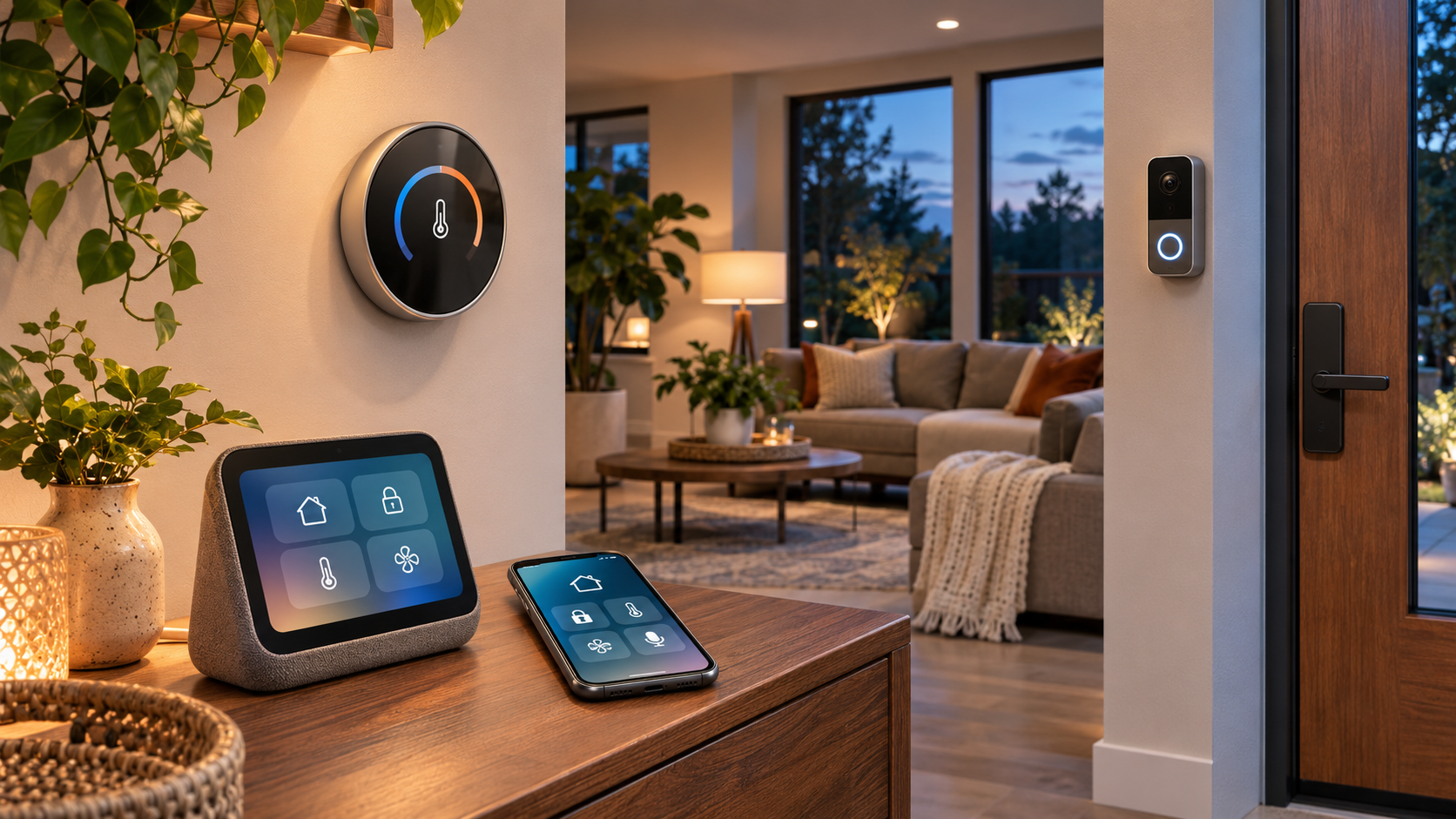
Google’s Fall 2026 Google Home update is not one feature drop. It changes how supported cameras describe an event, adds new ways to evaluate and balance home heating, and makes common Gemini for Home requests faster. The strongest additions are practical, but each comes with a requirement that can disappear in a headline: a paid Advanced plan for camera audio descriptions, a fourth-generation thermostat for third-party room sensors, and regional, device, language and subscription limits for Gemini.
Google announced the update on November 17, 2026. Camera and doorbell event descriptions can now use detected nonverbal audio, such as a barking dog, breaking glass, footsteps or a siren, after a motion, person, animal, vehicle or package event starts. Beginning in December, U.S. and Canadian Nest thermostat owners will see estimated cumulative savings in the Google Home app, while Nest Learning Thermostat (4th gen) owners gain support for compatible third-party Matter temperature sensors.
Gemini for Home is also expanding. Google says common requests, including smart-home control and shopping-list changes, are now up to 20% faster. Support is scheduled to reach India, Taiwan, Singapore, Colombia, South Korea and Brazil next month. This is a software rollout rather than a reason to replace working hardware immediately, and staged availability means the same account, device and country may not receive every feature on the same day.
Google Home Fall 2026 update at a glance
- Camera audio context: Premium Advanced event descriptions can add supported nonverbal sounds after an eligible camera event is triggered.
- Audio requirements: microphone and audio recording must be enabled, and a motion, person, animal, vehicle or package event must start the recording.
- Ask Home search: audio-enriched events can be searched with natural-language questions when the account and camera support the feature.
- Savings estimate: starting in December, Nest thermostat owners in the United States and Canada can see estimated cumulative savings in Google Home.
- Third-party sensors: compatible Matter temperature sensors can work with the Nest Learning Thermostat (4th gen); Google does not extend this announcement to older thermostat models.
- Gemini speed: everyday requests are advertised as up to 20% faster, not every response on every device.
- Country expansion: India, Taiwan, Singapore, Colombia, South Korea and Brazil are scheduled for the next wave.
- Gemini Live: the coming speech-to-speech upgrade requires Google Home Premium Standard or Advanced and a compatible speaker or display.
Camera event descriptions now listen as well as look
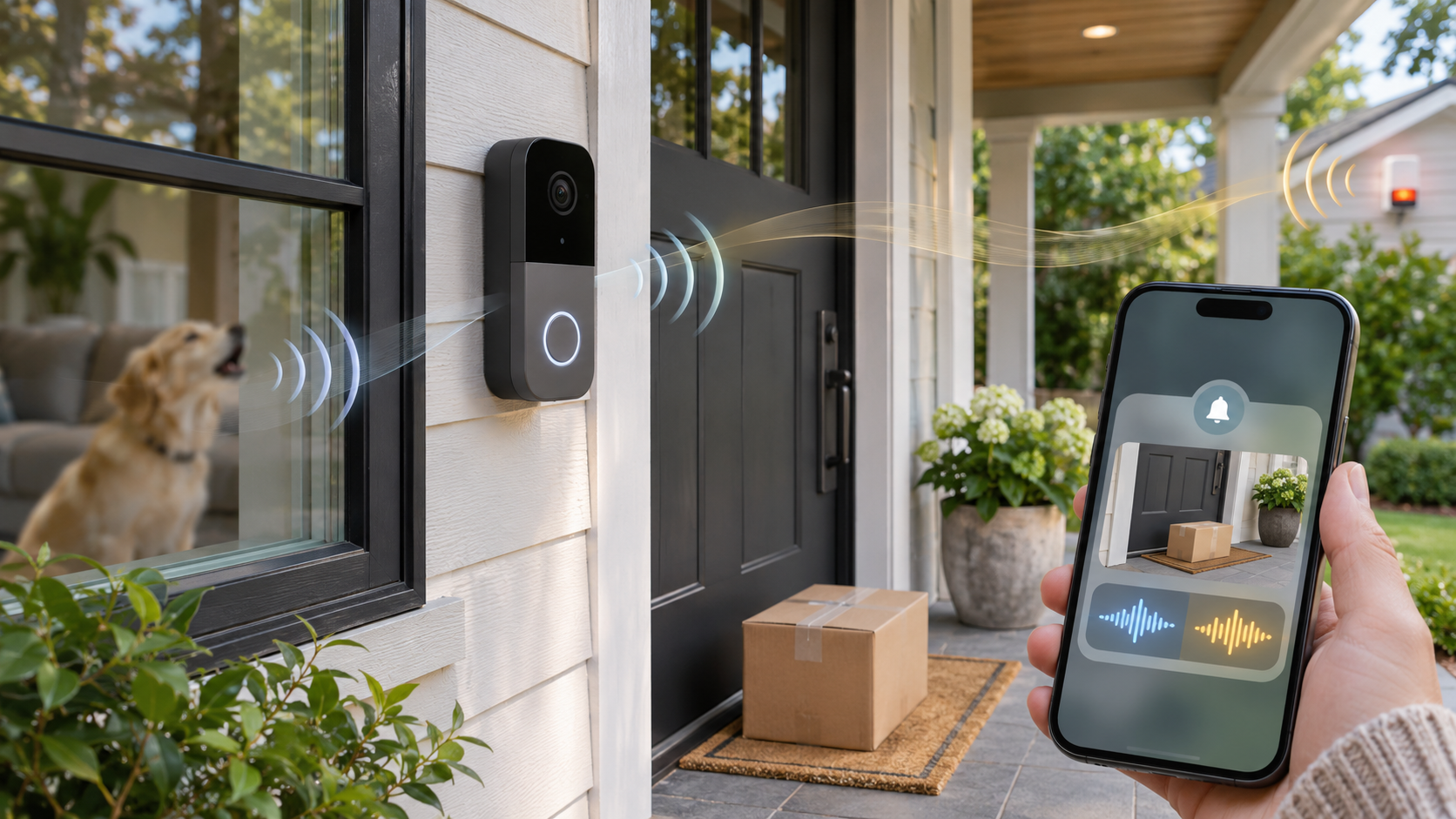
Supported Google Home camera events can add detected nonverbal sounds after a visual event starts.
A camera event summary has traditionally been shaped by what the camera can see. Google now allows a supported Nest camera or doorbell to add important audio context to the same description. A package delivery can mention a dog barking inside; an event can describe footsteps or a siren that occurred outside the frame; and a glass-breaking sound can become part of the searchable history.
The feature is contextual, not an always-on general sound transcript. Google says audio is captured and described only after motion, a person, an animal, a package or a vehicle triggers a recorded camera event. The supported examples are nonverbal sounds. It should not be treated as a promise to transcribe conversations or identify the speaker, and a missing description does not prove a sound did not occur.
The camera, plan and privacy requirements
Audio in event descriptions requires Google Home Premium Advanced, a supported camera, and the camera’s microphone and audio recording settings turned on. Google Home Premium Standard is not enough for this specific Advanced camera feature. Owners should also verify that the camera is set up in Google Home and that event recording works before troubleshooting audio descriptions.
Enabling microphone recording changes the privacy posture of the camera. Review camera placement, household consent, guest expectations and local recording law before turning it on. Keep microphones away from bedrooms, bathrooms and neighboring property, and use Activity Zones and notification settings to reduce unnecessary recording and alerts. Audio classification can be wrong, especially around televisions, construction, pets and alarms with similar tones.
Ask Home can search audio-enriched events
When the account supports Ask Home video-history search, audio context becomes another way to find an event. Google gives examples such as asking when glass broke in a hallway. A more routine use would be asking whether a dog barked during a delivery or whether a siren was heard around a vehicle event. Search results are a review shortcut, not a substitute for watching the relevant clip when safety, damage or identification matters.
Nest savings estimates and third-party sensors arrive in December
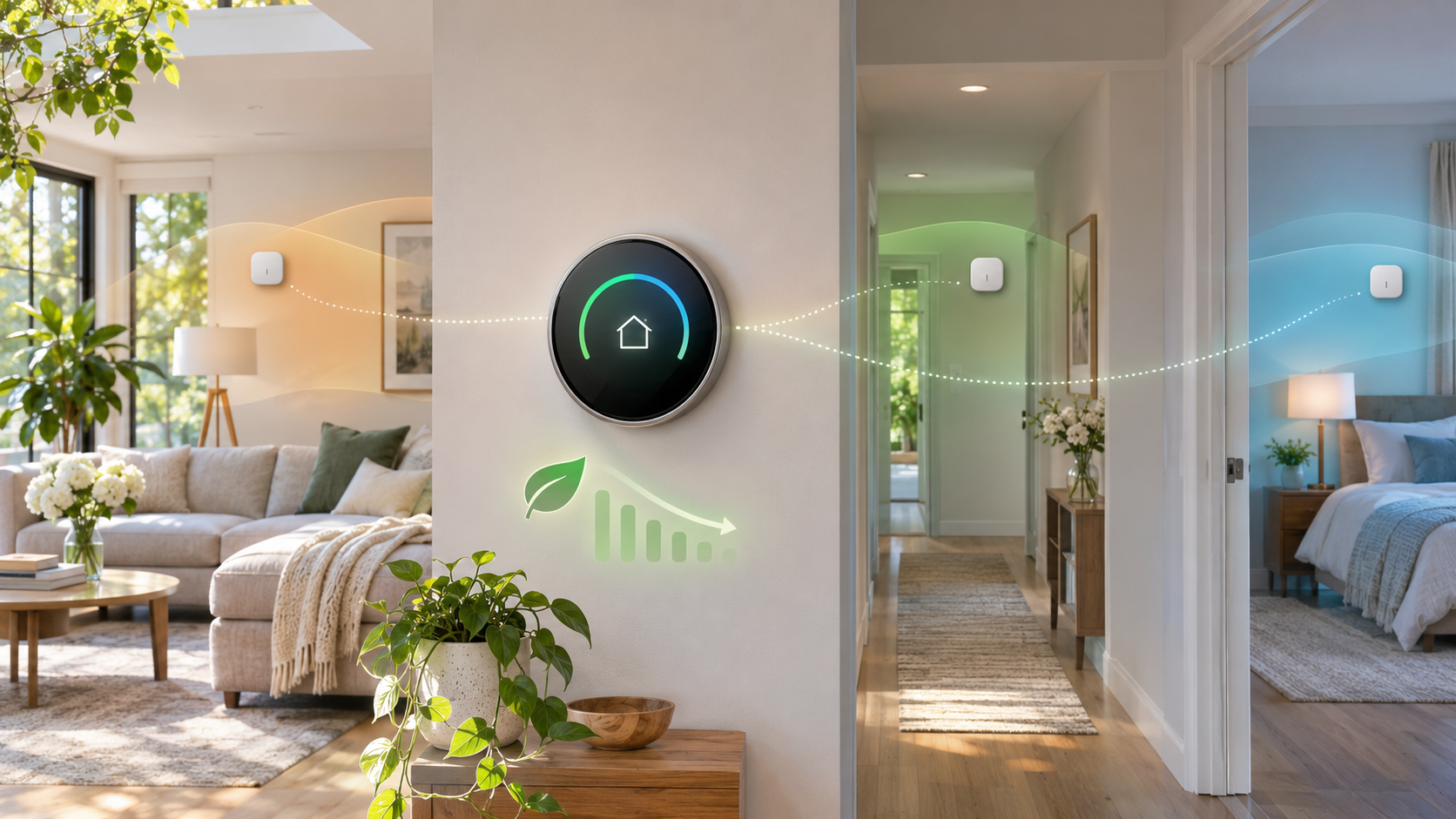
The fourth-generation Nest Learning Thermostat will work with compatible third-party Matter temperature sensors while the Home app adds savings estimates.
Starting in December, Google says Nest thermostat owners in the United States and Canada can see estimated cumulative savings in the Google Home app. That makes the thermostat’s energy story easier to interpret than isolated monthly reports, but it is still an estimate. Google says actual savings vary by home, climate and usage. A displayed total is not a utility-bill credit, an independent energy audit or proof that the thermostat alone caused every reduction.
The useful way to read the estimate is as a trend. Compare similar weather periods, household occupancy and setpoints, and watch for large changes that coincide with schedule adjustments or HVAC work. If energy use rises unexpectedly, inspect equipment health and utility data instead of assuming the app is wrong or that the thermostat can diagnose every mechanical problem.
Compatible Matter sensors broaden room control
The Nest Learning Thermostat (4th gen) will be able to pair with compatible third-party Matter temperature sensors, including supported models from IKEA, Eve and Aqara. Google says the Home app can show live room readings, average temperatures across rooms, prioritize a sensor by time of day and use readings in automations. Matter support by itself is not a guarantee: the exact sensor model, firmware and Google Home rollout must expose the required capability.
Google ties this expansion to the fourth-generation Nest Learning Thermostat. Older Nest thermostats are not included in the announcement. Existing first- and second-generation Nest Temperature Sensors remain a separate compatibility question; Google’s current product page says all Nest Temperature Sensor generations work with the fourth-generation thermostat. Buyers should confirm the exact thermostat and sensor combination before ordering.
Sensor placement matters more than sensor count
A room sensor reports the temperature where it sits. Keep it away from direct sun, supply vents, exterior doors, cooking heat and electronics that run warm. Use one sensor to solve a known comfort problem before adding several. Averaging a cold basement, sunny office and occupied bedroom can create a mathematically tidy number that is uncomfortable everywhere if the zones and schedules are poorly chosen.
Gemini for Home gets faster and reaches six more countries
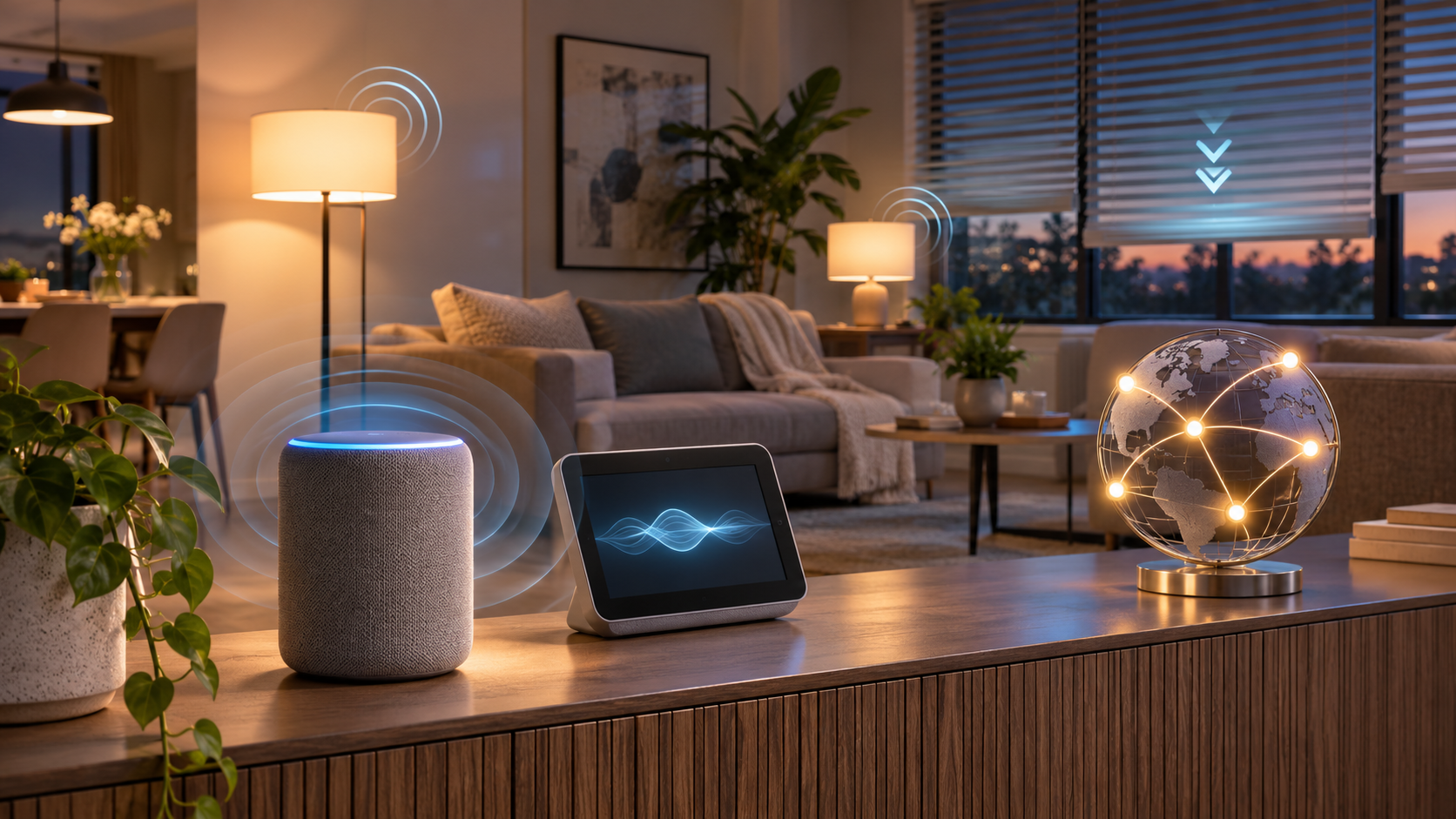
Google says common Gemini for Home requests are up to 20% faster and the service is expanding to six more countries.
Google says the everyday Gemini for Home requests people make most often, such as controlling a smart-home device or adding an item to a shopping list, are now up to 20% faster. The phrase up to matters. Network latency, device load, the complexity of a request, language support and the connected service can all affect the response. The claim should not be read as a 20% improvement to every answer or a guarantee that a slow third-party device will react immediately.
The update also improves focus on voice commands when background chatter is present. That can help in kitchens and family rooms, but microphone placement still matters. Keep a speaker away from a television, loud appliance and corner reflections, and test the same command from normal speaking positions before moving or replacing hardware.
The next country wave
Google plans to expand Gemini for Home next month to India, Taiwan, Singapore, Colombia, South Korea and Brazil. The company says Gemini works on Google Home and Nest speakers and displays released over the last decade, but feature availability and response styles can still vary by country, language, device and subscription tier. A supported country does not mean every language or Premium feature arrives simultaneously.
Gemini Live is a separate subscription decision
Gemini Live is moving to Google’s latest speech-to-speech architecture over the coming weeks for faster, more natural conversation. It supports interruptions and can handle quick actions, such as a reminder or smart-home command, without leaving the conversation. Google requires Google Home Premium Standard or Advanced for Gemini Live, along with the Home app, Wi-Fi and a compatible speaker or display. Households that only want basic device control should compare the plan benefits before paying for a conversational feature they may rarely use.
Home keys are related—but already covered
Google’s fall package also includes digital home keys in Google Wallet. ReaderSpice has a separate verified guide to Google Wallet Home Keys setup, compatible locks and security. That article covers Aliro, NFC and UWB requirements, compatible locks, supported hubs, device-unlock settings and physical-key backups. Keeping those details separate avoids turning this software-update guide into a duplicate smart-lock explainer.
Which features require which hardware or plan
- Audio in camera event descriptions: supported Nest camera or doorbell, microphone/audio recording enabled, eligible event trigger and Google Home Premium Advanced.
- Ask Home audio-event search: an account, camera and history configuration that support the Advanced video-search features.
- Estimated cumulative savings: a supported Nest thermostat in the United States or Canada, with rollout beginning in December.
- Third-party room sensors: Nest Learning Thermostat (4th gen), Google Home app and an exact Matter temperature-sensor model Google Home supports.
- Faster everyday Gemini requests: eligible Google Home or Nest speaker/display in a supported country and language; results vary by request and network.
- Gemini Live speech-to-speech upgrade: compatible speaker/display and Google Home Premium Standard or Advanced.
A practical rollout checklist
- Update the Google Home app and device firmware, then confirm the account is using the intended home structure.
- For camera audio descriptions, verify Premium Advanced, microphone/audio recording and ordinary event recording before waiting for a new summary.
- Review camera placement, consent, Activity Zones and notification settings before enabling microphone recording.
- For thermostat savings, record current schedules and setpoints so the December estimate has context; compare trends with weather and utility data.
- For room sensors, confirm the thermostat is fourth generation and the exact Matter sensor model is supported before buying or resetting hardware.
- For Gemini, test two or three common commands from normal positions and note whether delay comes from the assistant, Wi-Fi or the target device.
- If a promised feature is absent, check country, language, plan and device eligibility, then allow for staged rollout before factory-resetting anything.
A verified thermostat option—after compatibility checks
One current verified listing is the Google Nest Learning Thermostat (4th gen) with Nest Temperature Sensor (2nd gen), Obsidian, ASIN B0D5BBYRJM. The fourth-generation model is the thermostat Google names for compatible third-party Matter temperature-sensor support. The official Google Store says the retail package also includes one second-generation Nest Temperature Sensor.
Check the exact model, seller, condition, included sensor, region, current price and return policy on the live Amazon page. Use Google’s HVAC compatibility checker before purchase. The fourth-generation thermostat works with most 24V systems, but certain configurations can require a C wire, Nest Power Connector or professional installation. A product listing cannot determine compatibility from a photograph of the old thermostat alone.
Affiliate disclosure: ReaderSpice may earn a commission from qualifying Amazon purchases made through the link above, at no additional cost to you.
Who benefits now—and who should wait
Consider the update now
- Premium Advanced camera owners who already record audio and want faster event triage.
- U.S. and Canadian Nest thermostat households that want a clearer long-term savings estimate.
- Fourth-generation thermostat owners with real hot or cold spots and a verified compatible Matter sensor.
- Gemini for Home users whose common commands are slowed by repeated list or device-control interactions.
Wait or test cautiously
- Camera owners who are uncomfortable enabling microphone recording or who cannot justify Premium Advanced.
- Older Nest thermostat owners considering a hardware upgrade only for third-party sensors.
- Households expecting the savings estimate to match a utility bill or prove a guaranteed dollar reduction.
- Users outside the announced country/language rollout or anyone relying on an unsupported third-party device.
The bottom line
The Fall 2026 Google Home update makes existing devices more useful in three concrete ways: camera history can explain selected sounds, thermostat data can show an estimated long-term savings picture and balance more rooms, and common Gemini requests can respond faster. The improvements are meaningful because they reduce time spent reviewing clips, interpreting energy behavior and repeating commands.
The same update is also a reminder that smart-home software is conditional. Audio descriptions require the most expensive Home Premium tier and active microphone recording. Third-party sensors require a fourth-generation thermostat and verified compatibility. Savings remain estimates, and Gemini speed and availability vary. Check the requirement attached to the feature you want, make one change at a time and avoid replacing working hardware until the rollout proves useful in your home.
Sources
Google Blog: New features and updates in Google Home
Google Home: Fall 2026 Google Home update
Google Home & Nest Community: Fall 2026 update details and requirements
Google Home Help: Gemini for Home camera features and audio-event requirements
Google Store: Google Home Premium plan comparison
Google Store: Nest Learning Thermostat (4th gen)
Google Home Help: Nest thermostat technical specifications and compatibility
ReaderSpice: Google Wallet Home Keys setup, compatible locks and security