
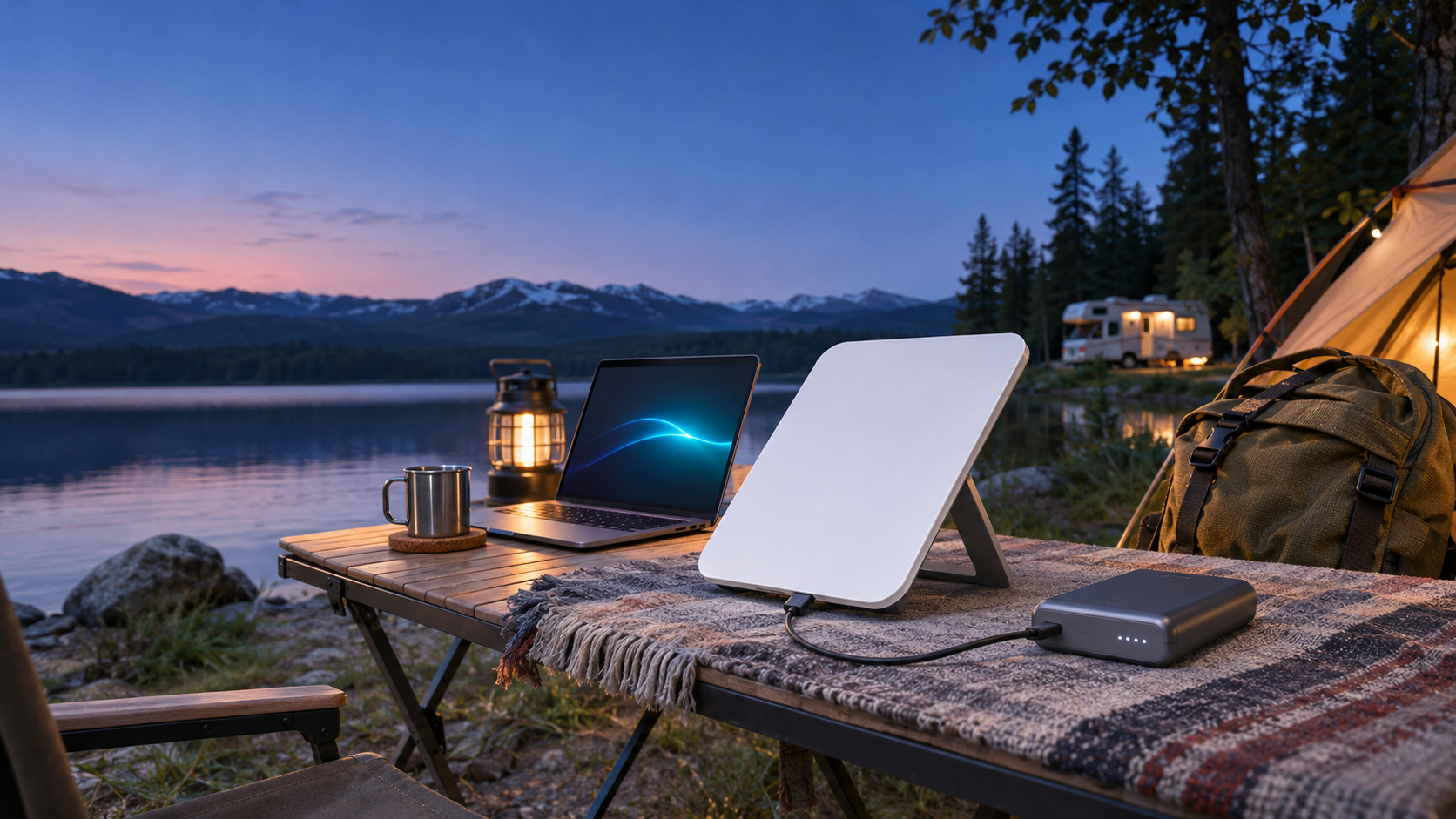
Starlink has opened invitation-only U.S. preorders for Starlink Mini 2, a redesigned portable satellite terminal with a built-in quick-swap battery, USB-C power and an advertised runtime of up to 4.5 hours. The official product page also lists a smaller footprint, Wi-Fi 6 coverage, IP67 protection and a standard tripod thread aimed at travelers, field crews and people who need connectivity away from fixed broadband.
The early preorder is not a normal retail launch. Starlink has not posted a universal public price or a general-availability date on the open Mini 2 page, and the terminal still needs an eligible Starlink Roam plan and a clear view of the sky. This guide separates confirmed hardware details from reported invitation terms, explains the current U.S. service costs, and identifies the battery and travel rules buyers should check before ordering.
Starlink Mini 2 at a glance
- Availability: preorders are by invitation for select U.S. customers; Starlink says broader customer and country availability will follow.
- Battery: a 71Wh removable pack is integrated into the terminal and rated by Starlink for up to 4.5 hours of use.
- Power: USB-C with 60W input and output; the box includes a 60W charger and a 3-meter USB-C cable.
- Size and weight: 263 by 314 by 23.1 millimeters and 1.6 kilograms with the battery and kickstand installed.
- Wireless: Wi-Fi 6 with claimed coverage of up to 1,800 square feet in suitable conditions.
- Outdoor rating: IP67, a 110-degree field of view and a 1/4-20 threaded mount for compatible supports.
- Setup claim: Starlink says the terminal can connect in about 60 seconds, but sky visibility, account activation and network conditions can extend that time.
- Service: hardware alone does not include open-ended connectivity; an eligible Starlink Roam plan and regional service availability are required.
Invitation-only preorder leaves price and timing questions
As of November 28, 2026, Starlink describes Mini 2 as a preorder available only to invited U.S. customers. The public page does not show a single retail price, a shipping window for every invitation, or a date when anyone can buy the terminal. An invitation is therefore the controlling offer: save the checkout page, verify the hardware charge, recurring plan, tax, shipping estimate and cancellation terms, and do not assume another customer received the same bundle.
The Verge reported invitation screens showing a $999 offer bundled with one year of Roam Unlimited. That is useful evidence of at least one early configuration, but it is not a public nationwide price published on Starlink’s open product page. Buyers should treat the reported figure as invitation-specific until Starlink posts general pricing and should check what happens to service after any included period ends.
The invitation may also be tied to the receiving account or service address. Do not buy an invitation, account or unopened kit from a stranger. Starlink can require account ownership, regional activation and a supported country before service begins, while a private resale can leave the new owner unable to activate or transfer the terminal.
What the battery and USB-C design changes
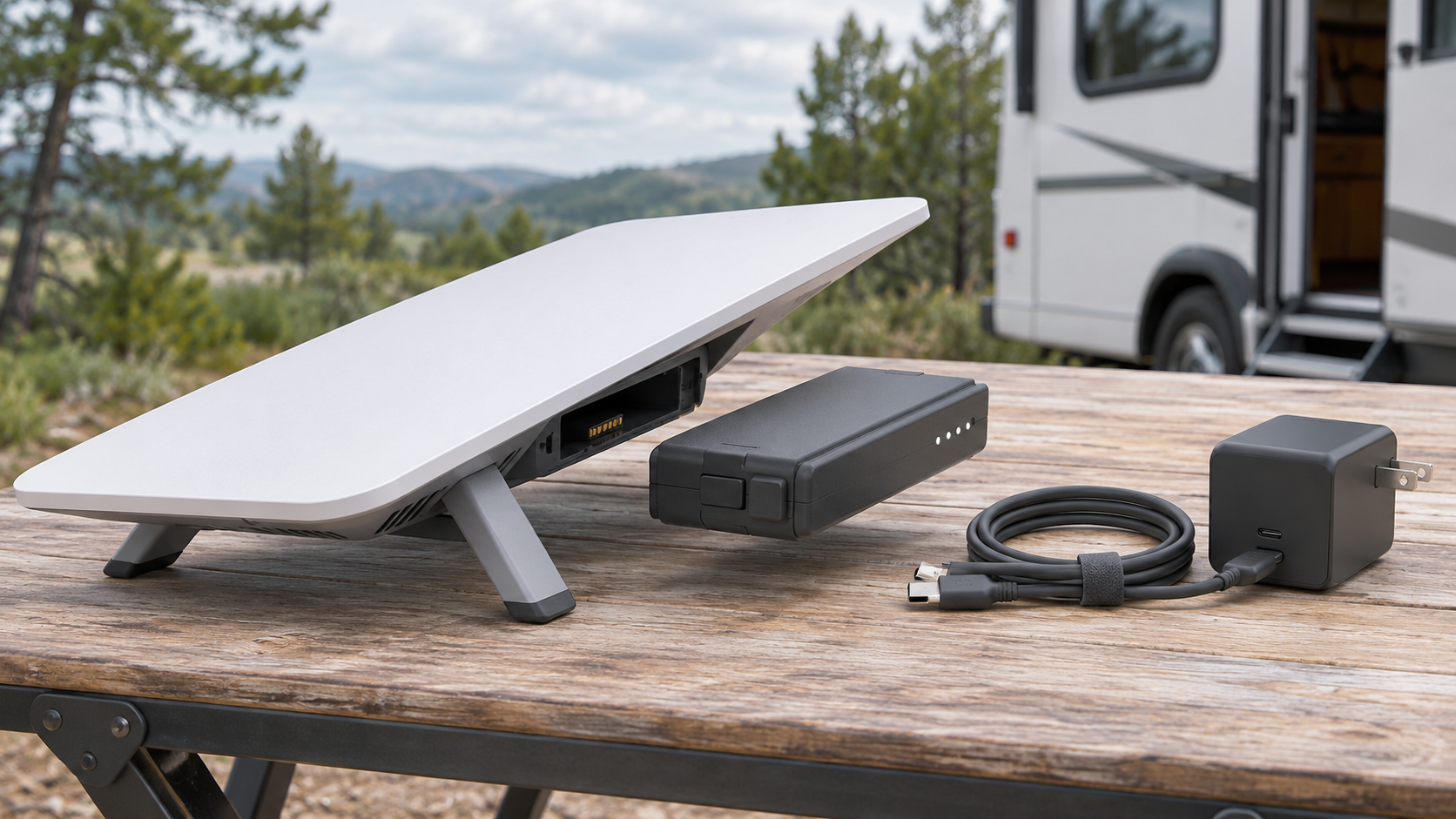
Mini 2 moves portable power into the terminal and adds a removable battery plus 60W USB-C charging. Illustration: ReaderSpice.
The original Mini depends on external DC power. Mini 2 adds a battery inside the terminal and lets the pack be removed quickly, reducing the need to build a separate power-station setup for a short session. The official 71Wh pack weighs 490 grams and supports 60W USB-C charging and output. Starlink includes one battery, a 60W charger and a 3-meter cable in the published box contents.
Starlink’s “up to 4.5 hours” figure is a ceiling, not a guaranteed session length. Runtime can fall with cold weather, high network activity, repeated obstruction searches, battery age, device charging and poor sky visibility. For a workday, emergency kit or multi-night trip, plan around measured runtime in the actual location rather than multiplying the best-case figure.
The product page calls the pack quick-swap, but it does not promise that a battery change is electrically uninterrupted. Save work and expect a brief reconnect unless Starlink explicitly confirms hot-swap behavior for the final production hardware. A second pack could extend field use, but Starlink has not yet published broad retail availability or pricing for spare Mini 2 batteries on the public page.
USB-C makes power sourcing simpler, yet the source still needs to meet the terminal’s requirement. Use an e-marked cable and a power supply that can negotiate the required USB-C Power Delivery profile. A phone charger that has a USB-C plug but tops out below 60W may charge too slowly or fail to support the terminal under load. Starlink’s included charger and cable are the safest baseline for the first tests.
Set it up for the sky you actually have
Starlink’s public Mini 2 page advertises roughly 60-second setup, but the terminal still needs a broad, unobstructed view of the sky. Trees, roofs, canyon walls and a vehicle body can interrupt satellite passes. Use the Starlink app’s obstruction check before choosing a campsite or work position, then keep the terminal away from foot traffic, standing water and places where a cable can become a trip hazard.
Starlink’s current setup guide is written for the first-generation Mini rather than Mini 2. Its basic process remains relevant: choose clear sky, power the terminal, join the Starlink Wi-Fi network and complete account setup in the app. Mini 2 owners should still follow the model-specific instructions delivered with the hardware because battery controls, reset behavior and indicator lights can differ.
- Run the obstruction scan from the exact spot where the terminal will sit, not from the vehicle door or a nearby clearing.
- Secure the kickstand or a compatible 1/4-20 mount against wind, vibration and accidental contact.
- Start with the included charger and cable, then test third-party USB-C supplies one at a time.
- Confirm activation and basic browsing before leaving reliable cellular or Wi-Fi service.
- Download offline maps, reservations and critical documents even when the connection appears stable.
- Measure battery runtime during a realistic video call, upload or work session instead of relying only on an idle test.
Roam service can cost more than the hardware decision

Hardware is only one part of the cost: data allowance, travel region and in-motion terms depend on the selected Roam plan. Illustration: ReaderSpice.
The Mini 2 preorder does not remove the monthly service decision. On November 28, 2026, Starlink’s U.S. Roam page listed 100GB for $55 per month, 300GB for $80 per month and Roam Unlimited for $175 per month. Prices, taxes, plan names and included features can change, so the account checkout page should be treated as current evidence rather than these launch-week figures.
A data cap matters quickly on a travel connection. Operating-system updates, cloud photo uploads, game downloads and 4K streaming can consume tens of gigabytes without an obvious warning. Use device-level metering, pause automatic backups and download large files on fixed broadband before a trip. If Starlink reduces speed after the cap, that does not mean every application will remain usable at the reduced rate.
Starlink advertises speeds up to 300-plus Mbps for Roam, not a guaranteed minimum. Congestion, weather, obstructions, satellite geometry and local network conditions can all lower throughput or increase latency. A clear speed test after setup is useful, but a video call, VPN session and upload test better represent real work.
Roam terms also define where and how the service can be used. Starlink says in-motion use is available only in select areas and that Roam Unlimited includes up to 30 days outside the account’s registered country at a time. Other plans can be limited to the registered country or region. Review the account’s travel and in-motion terms before crossing a border, boarding a vessel or using the terminal while a vehicle is moving.
Flying with the 71Wh removable battery
The published Mini 2 battery capacity is 71Wh, below the FAA’s 100Wh threshold for ordinary consumer lithium-ion batteries on passenger aircraft. That does not make every packing method acceptable. Spare lithium-ion batteries must travel in carry-on baggage, with terminals protected against short circuit, and damaged, swollen or recalled batteries are prohibited.
If the battery remains installed in the terminal, protect the power switch from accidental activation and pack the device against crushing. If the pack is removed or a second pack is carried, treat it as a spare: keep it in the cabin, cover exposed contacts or use an individual protective pouch, and follow the airline’s quantity and packaging rules. Airlines and other countries can impose stricter limits than the FAA.
Do not put a loose spare battery in checked baggage. If a carry-on bag is gate-checked, remove the battery and take it into the cabin. Keep the watt-hour marking visible, carry the product documentation offline, and confirm the carrier’s rule before departure because airport staff may ask for the battery rating.
A relevant first-generation Starlink Mini on Amazon
The first-generation Starlink Mini Kit on Amazon (ASIN B0DH3PLZ6N) is a real listing for the earlier Mini, not Mini 2. It may be relevant for buyers who need hardware now and can supply external power, but it should not be presented as a substitute for the invitation-only battery model. Confirm the exact model in the cart and packaging before opening or activating it.
A marketplace purchase does not guarantee that the terminal is new, transferable or eligible for service at the intended location. Check the seller, serial-number and account-transfer status, kit contents, regional compatibility, warranty and return terms. Do not pay a premium based on a title that says “Mini 2” unless the model number and official Starlink documentation match the new battery-equipped product.
Affiliate disclosure: ReaderSpice may earn a commission from qualifying Amazon purchases made through this link, at no additional cost to you.
Who should preorder and who should wait
Preorder if the battery solves a specific problem
Mini 2 is most compelling for an invited customer who regularly works or travels beyond dependable terrestrial coverage and wants a self-contained terminal for a few hours at a time. The lighter power kit, USB-C input and standard threaded mount can simplify an emergency communications bag, mobile office or short campsite session. The value is practical only if the selected Roam plan, regional terms and expected sky access fit the use case.
Wait if price or reliability is still uncertain
Wait for general availability if the invitation terms are unclear, a spare battery is essential, or the connection must replace a stable home broadband line. A first-generation Mini plus a tested power bank may be easier to price and service today. People who need guaranteed bandwidth, indoor operation, dense-tree performance or continuous in-motion coverage should not treat a portable satellite terminal as a certainty.
Keep an independent emergency plan
Satellite internet is useful redundancy, not a single point of rescue. Keep charged phones, offline maps, local emergency numbers and an appropriate radio or satellite messenger where the trip requires one. Test the account, terminal, battery and charging path before relying on them, and never delay evacuation or medical action while troubleshooting a consumer data link.
What ReaderSpice has not verified
ReaderSpice has not tested production Mini 2 hardware, measured battery life, verified uninterrupted battery swaps, compared Wi-Fi range, or confirmed that every invitation uses the same price and service bundle. Starlink’s public claims and current support pages are the primary evidence for the specifications and plan terms in this guide. The invitation price reported by The Verge is identified as a report rather than an official universal offer.
Early buyers should also expect software and terms to change. Capture the offer, keep order confirmations, check the account before travel and retest after firmware updates. A successful first setup does not prove the same performance in a forest, canyon, crowded event or different country.
The bottom line
Starlink Mini 2 addresses the original Mini’s biggest portability compromise by integrating a removable 71Wh battery and standardizing on 60W USB-C power. The 4.5-hour claim, compact enclosure, Wi-Fi 6 radio and 1/4-20 mount make it a more coherent field kit, while the invitation-only launch leaves important questions about price, delivery and spare batteries.
Do not judge the purchase by terminal specifications alone. Verify the exact invitation, budget for the Roam plan, test sky visibility, measure real battery life, follow airline lithium-battery rules and preserve an offline fallback. Mini 2 can be useful travel infrastructure, but only after hardware, service and operating limits have been checked as one system.
Sources
- Starlink – Mini 2 official product page and specifications
- Starlink – Roam U.S. plans, data allowances and current pricing
- Starlink Support – Roam travel, data and international-use terms
- Starlink Support – Mini setup and obstruction guidance
- Starlink – First-generation Mini specification sheet
- The Verge – Reported Mini 2 invitation price and bundle, November 23, 2026
- FAA PackSafe – Airline passengers and batteries
- FAA PackSafe – Lithium batteries, spare-battery and terminal-protection rules
- Amazon – First-generation Starlink Mini Kit, ASIN B0DH3PLZ6N (affiliate link)