
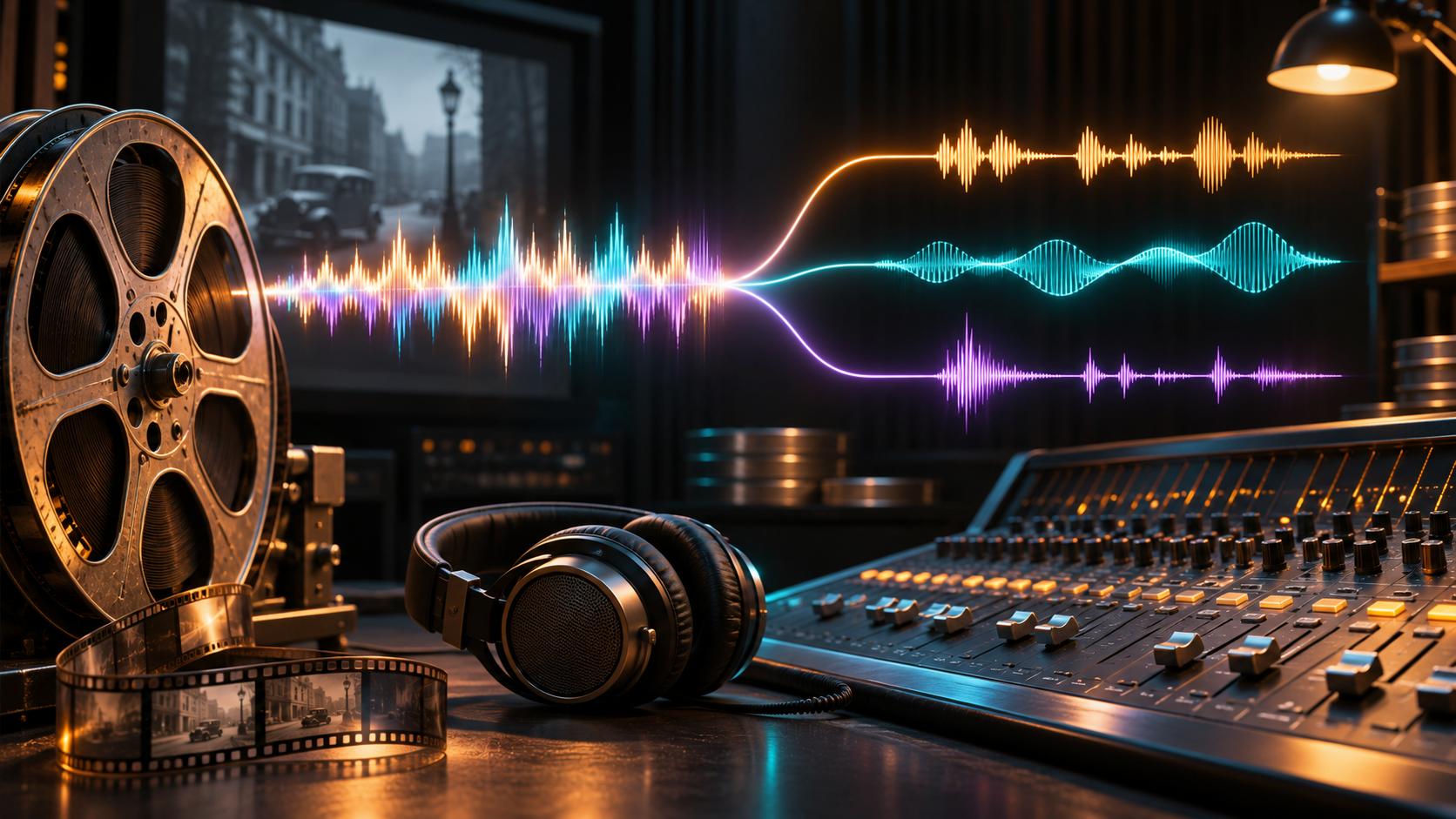
Sony has spent more than a decade teaching neural networks to pull individual sounds out of a finished mix. Its November 2, 2026 technology update shows that the work has moved beyond laboratory demonstrations: engineers have used it to rebuild classic film soundtracks, isolate hard-to-separate synthesizer parts and improve the voice path in consumer audio products.
The practical idea is simple even though the engineering is not. A recording may contain dialogue, music, effects, traffic, room noise and several instruments at once. Sound-separation software estimates the contribution of a chosen source and produces a new stem that can be edited or remixed. It does not recover a magically perfect original track, and Sony has not announced a standalone consumer restoration app. Human engineers still decide which output is usable and how it should be mixed.
For readers, the useful distinction is between Sony’s production technology and features available in current products. Film restoration and research models are specialist workflows. AI beamforming in headphones is a consumer application that uses related principles to emphasize a caller’s voice. Both depend on recognizing patterns in a mixture, but they solve different problems and should not be treated as one universal feature.
ReaderSpice may earn a commission from purchases made through links in this article. As an Amazon Associate, we earn from qualifying purchases.
Sony AI sound separation at a glance
- Sony says it began applying deep learning to sound separation in 2013.
- The technology estimates separate sources such as speech, instruments, sound effects or noise from one mixed recording.
- Sony used separation during 4K UHD work on Lawrence of Arabia and Gandhi, and during the 4K remaster of the animated film Angel’s Egg.
- Research now includes text- and video-guided models that can request a particular sound rather than only a fixed set of stems.
- Consumer examples include AI beamforming for clearer calls, but Sony has not released the film-restoration system as a general consumer tool.
How AI sound separation works
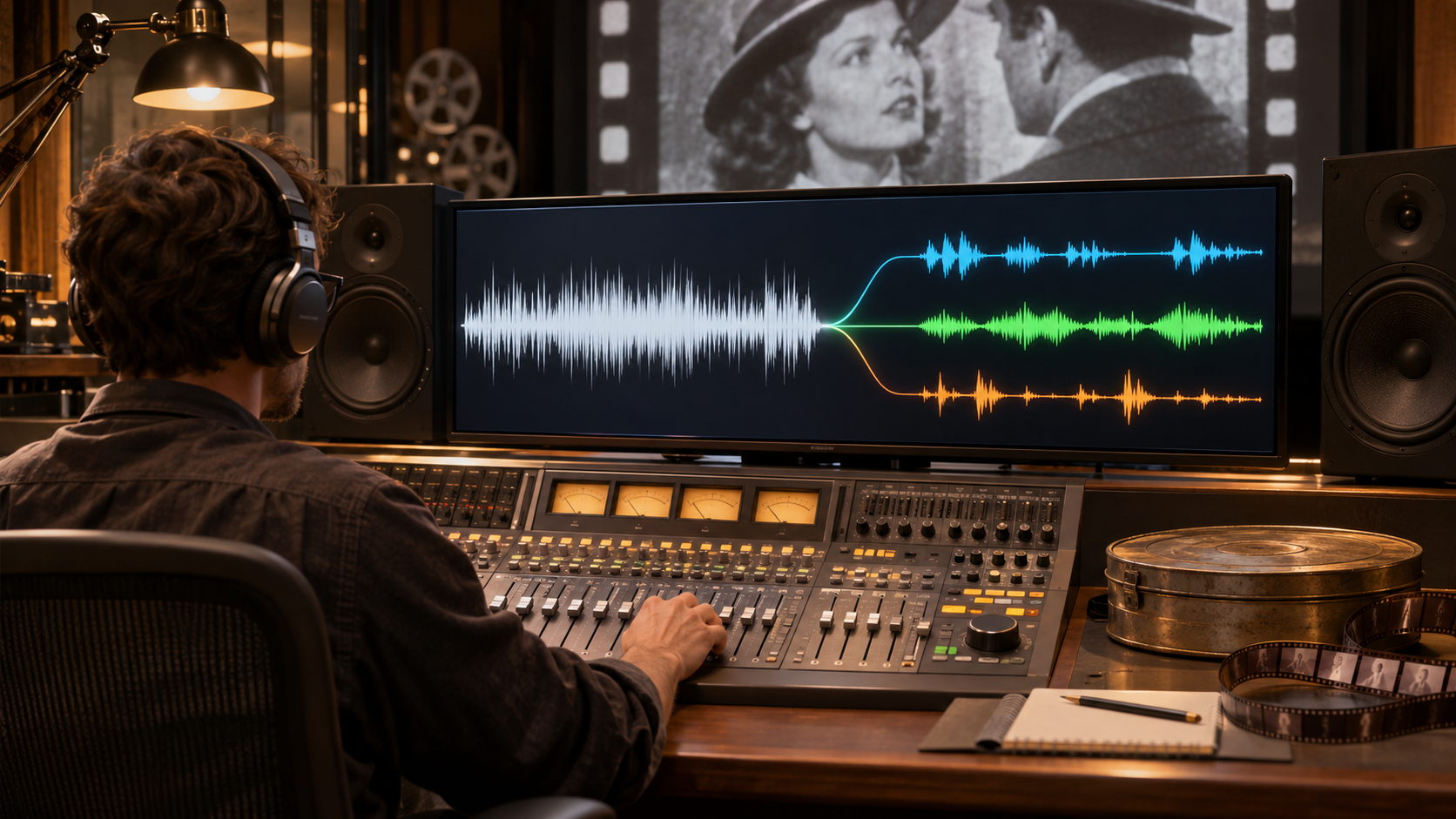
A conventional audio mix adds sources together. Once dialogue, ambience and music share the same waveform, there is no perfect mathematical switch that turns one component off. Modern systems instead learn statistical patterns from training examples. During training, a model sees mixtures along with known target sources and adjusts itself to predict a mask or waveform that preserves the requested source while suppressing the others.
At inference time, the model receives a recording it has never heard before. It analyzes frequency, timing, timbre and other structure, then produces estimated stems. In a movie restoration, those stems might be dialogue and effects. In music, they might be vocals, drums or a particular synthesizer line. In a call, the target is the speaker’s voice and the unwanted components are surrounding conversations, wind or room noise.
Sony’s newer research broadens the cue used to select a target. Its CLIPSep work explored text queries, while the 2026 MMAudioSep project adapts a video-to-audio generative model so a text prompt, video or both can guide separation. That is an important shift: instead of building a different model for every instrument or sound class, one system can be asked for the source that matches a semantic description. The research remains distinct from a shipping consumer editor, and published benchmark gains do not guarantee clean results on every archival recording.
How Sony rebuilt classic film soundtracks
Lawrence of Arabia and Gandhi
Older films often survive with dialogue, effects and music combined in a limited number of channels. That creates a problem for a modern spatial remix: engineers cannot place dialogue at the center and move ambience around the room if all of those elements are locked together. Sony says sound separation was used when creating 4K UHD versions of Lawrence of Arabia and Gandhi so components from the historic masters could be estimated separately and reconstructed in a spatial mix.
This is restoration, not invention. The goal is to give mixers useful control over elements already present in the source while preserving the character of the original performance. The Columbia Classics 4K Ultra HD collection confirms that both films were remastered for the format. Sony’s technology story explains the separation step; the final artistic and quality decisions remained with the restoration and mixing teams.
Angel’s Egg and difficult archival material
Sony also points to Mamoru Oshii’s 1985 animated film Angel’s Egg. The company says separation contributed to its 4K remaster, which premiered in the Cannes Classics program in May 2025 before a later theatrical release. Animation can present the same archival problem as live action: dialogue, score and designed effects may exist only as a finished mix rather than as pristine, synchronized production stems.
The case matters because it shows why source separation can be valuable even when no new scene or sound is being generated. A model can create editing access that was lost when the original mix was printed. That can support cleanup, localization, accessibility and spatial presentation, provided the output is reviewed against the source rather than accepted automatically.
What consumers can use today
AI beamforming for clearer calls
The clearest current consumer example is call processing. Sony’s WH-1000XM6 documentation describes an AI-based beamforming system that uses microphones and voice-pickup processing to emphasize the wearer’s speech. Beamforming uses the timing and level differences between microphones to focus on a direction, while learned processing helps distinguish the voice from competing noise. That is not the same pipeline used to restore a film, but it applies the same broader goal: estimate the wanted source inside a mixture.
Sony advertises the headphones with a dedicated noise-cancelling processor, twelve microphones, multipoint Bluetooth and up to 30 hours of battery life with noise cancellation enabled. Those are manufacturer specifications, not ReaderSpice lab results. Call quality can change with wind, microphone position, firmware, connected device and competing voices, so buyers should still compare independent microphone samples.
Phones, robots and real-time music
Sony’s earlier technology overview cites wind-noise reduction in Xperia phones, voice recognition for aibo and real-time karaoke as other applications. These examples illustrate how widely the task can vary. A phone may need to suppress turbulent wind, a robot may need to find one voice in a room, and karaoke software may estimate vocals quickly enough to work during playback.
Sony also says selected soundbars can analyze stereo material and help create a 3D spatial presentation. That should be understood as an adaptive rendering feature, not proof that the original studio stems have been recovered. A reconstructed or upmixed spatial field may sound convincing, but it is still an interpretation of the mixed input.
Sound separation is not the same as noise cancellation
Active noise cancellation, beamforming and source separation overlap but are not interchangeable. Active noise cancellation measures external sound and creates an opposing signal that reduces what reaches the ear, especially steady low-frequency noise. Beamforming combines multiple microphones to favor sound arriving from a chosen direction. Source separation estimates the content of sources that overlap in one recording.
A headset call can use all three ideas at once: noise cancellation for the listener, beamforming to focus the microphone array and learned separation or suppression to reduce competing sounds in the transmitted voice. Marketing often compresses these into the word “AI,” so the most useful question is what input the system receives, which source it is trying to preserve and whether the processing runs in real time.
Limits and why human mixing still matters
- Separation is an estimate. Leakage, watery transients, missing reverberation or musical artifacts can remain in an isolated stem.
- Results depend on training data. Unusual instruments, degraded tape, overlapping voices and sounds outside the training distribution can be harder to separate.
- A better benchmark score does not guarantee a better restoration. Engineers must compare the output with the original and decide whether an artifact is more distracting than the problem it removes.
- Rights and provenance still matter. Separating a recording does not create permission to remix, republish or train on it.
- Sony’s public demonstrations and product claims are not a substitute for independent evaluation on the exact material or call environment a buyer cares about.
Sony’s own research underlines the data problem. CLIPSep was designed to learn from noisy, unlabeled videos, and later work explores multimodal cues and pretrained generation models. Those approaches aim to generalize to more sounds, but universal separation remains a research direction rather than a solved promise. For archival work, the safest workflow keeps the original untouched, documents every processing step and preserves both the model output and the engineer’s final mix.
A relevant Sony headphone with AI beamforming
The Sony WH-1000XM6 in black on Amazon (ASIN B0FBTYSRQ3) is a directly relevant consumer example because Sony markets its call system around AI beamforming and voice isolation. It is not a film-restoration tool, and shoppers should verify the seller, warranty, current price and return policy before buying.
Disclosure: ReaderSpice may earn a commission from qualifying Amazon purchases made through the link above, at no additional cost to you.
The bottom line
Sony AI sound separation is most compelling when it restores access to audio elements that no longer exist as separate tracks. Its use on classic films shows a practical, high-value application: give expert mixers enough control to rebuild dialogue, music and effects for a modern release without discarding the original master. Research such as MMAudioSep points toward more flexible systems that can isolate a sound selected by text or video cues.
For consumers, the immediate benefits are narrower and easier to evaluate. AI beamforming can improve call pickup, and related processing can suppress wind or support spatial rendering. The bigger promise—a universal tool that cleanly separates any sound from any recording—is still constrained by training data, artifacts and artistic judgment. Treat separation as a powerful editing aid, not an automatic truth machine.
Sources
Sony Group — AI Sound Separation technology story
Sony AI — MMAudioSep research publication, ICASSP 2026
Sony Group — CLIPSep text-queried sound separation publication
Sony Electronics — WH-1000XM6 official product page and specifications
Sony Support — WH-1000XM6 call quality and voice pickup guidance
Sony Pictures — Columbia Classics 4K Ultra HD Collection
Amazon — Sony WH-1000XM6 black (ASIN B0FBTYSRQ3)