
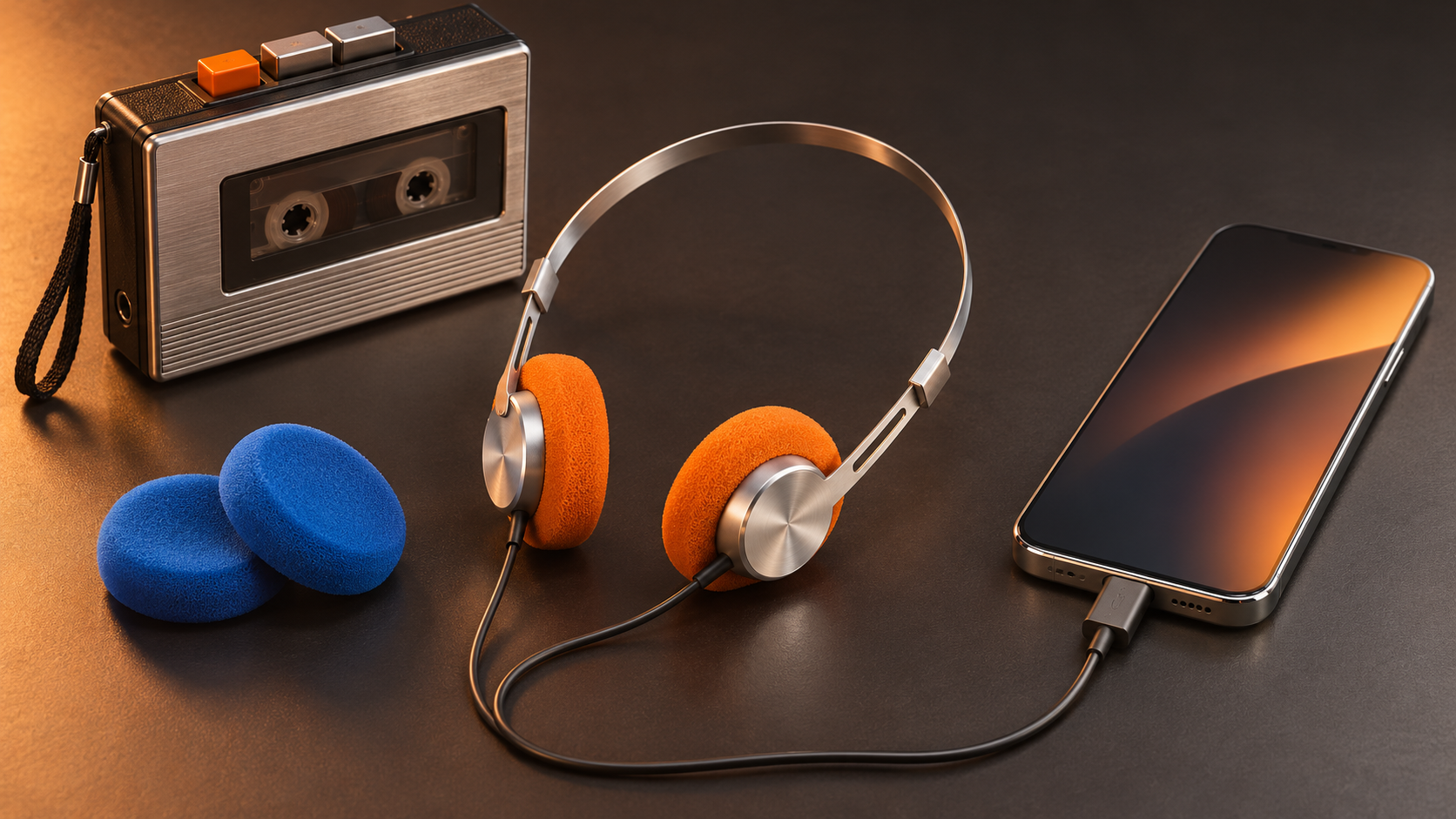
Sony has revived the featherweight headphones associated with the original 1979 Walkman, but the new MDR-3R is not an analog museum piece. The $59.99 on-ear model keeps the thin metal headband, 23mm drivers and bright foam pads while replacing the old plug with USB-C and adding an in-line microphone and remote.
The result is appealing precisely because it avoids the usual wireless-headphone checklist: there is no battery, Bluetooth pairing, app account or codec menu. That simplicity comes with equally clear compromises. The open on-ear design provides almost no isolation, reviewers report limited deep bass, and Sony itself says the USB-C model is not recommended for use with its current Walkman players.
This is a launch guide and review roundup, not a ReaderSpice hands-on test. Confirmed specifications and prices come from Sony; comfort, sound and microphone observations are attributed to reviewers who tested production hardware.
Disclosure: ReaderSpice may earn a commission from qualifying purchases made through Amazon links, at no additional cost to you.
Sony MDR-3R at a glance
- U.S. price: $59.99 for the standard silver model; $79.99 for the Stranger Things limited edition.
- Availability: the standard MDR-3R is on sale now; the limited edition is available for preorder through selected sellers.
- Design: open-air, on-ear construction with interchangeable blue and orange foam pads on the standard model.
- Drivers: 23mm dynamic units; independent testing lists 32-ohm nominal impedance and a stated 20Hz–20kHz response.
- Connection: fixed 1.2-meter USB-C cable compatible with USB Audio Class 1.0 devices.
- Controls: in-line playback and volume controls plus a built-in microphone for calls.
- Weight: approximately 38 grams without the cable.
- Important limits: no Bluetooth, active noise cancellation, 3.5mm plug, folding hinges or carrying case.
Sony includes both blue and orange pads with the standard version, but only one pair can be installed at a time. The Stranger Things edition uses a black headband, red and black pads, an engraved logo and themed packaging; Sony does not describe a different acoustic design.
What Sony changed from the original Walkman headphones
The first-generation Walkman TPS-L2 shipped with the MDR-3L2 in 1979. Sony now uses “MDR-3” as an umbrella reference for the MDR-3, MDR-3L1 and MDR-3L2 family, so buyers should not read the revival name as a claim that every historic variant was identical.
Visually, the new model is unusually faithful. Sliding metal extenders adjust the fit, small circular earcups sit directly on the ear, and the removable open-cell foam pads provide most of the visual identity. The Verge measured the new unit at 38 grams—two grams lighter than the writer’s original MDR-3L2—and found it comfortable for extended listening.
The modern change is digital audio. USB-C carries the signal from a compatible phone, tablet or computer into electronics in the cable. Ecoustics reports a built-in 16-bit/48kHz DAC and amplifier, which explains why this is not a passive analog headset with a differently shaped plug. Its reviewer connected the MDR-3R successfully to Windows 11, macOS, iPad, Chromebook, an iPhone 17 and a Samsung Galaxy S25+.
What the retro design gets right—and where it compromises

The open on-ear format favors light weight and awareness, but it does not isolate a noisy commute.
At 38 grams, the MDR-3R avoids the pressure, heat and bulk of many over-ear headphones. There is no battery to charge and no radio to drop out. A fixed wire also removes the latency and compression questions that follow Bluetooth playback. For calls, the in-line controller is easier to find by touch than a gesture surface.
The tradeoff is the same one that made the original practical on a bicycle or sidewalk: the headphones remain acoustically open. Sound enters from the room and music leaks outward. That can feel airy and keep the wearer aware of nearby activity, but it is a poor fit for airplanes, a loud train, a quiet library or a shared office where others may hear the music.
One early hands-on report found audible leakage even at ordinary listening levels. The Verge also found itself raising volume around traffic. Turning the sound up is not a substitute for isolation; it raises listening risk while ambient noise remains present. Travelers who need quiet should choose sealed earbuds or active-noise-canceling headphones instead.
How the MDR-3R sounds according to early reviews
Sony says it tuned the 23mm drivers to stay close to the original while adding clarity and depth for current listening. Early reviews broadly agree on the character but differ on the degree. Vocals and midrange instruments are described as clear and forward, and the open construction gives treble a sense of space. Deep bass is the obvious limitation.
The Verge heard a sharp upper-midrange emphasis on some snare drums and bass that became plucky rather than weighty. Ecoustics similarly reported little meaningful sub-bass below roughly 70Hz, with cleaner punch higher in the bass range. The Shortcut was more positive about the perceived bass, while still noting shrill highs and a thin mid-bass. Those differences underline how fit, music choice and listening level can shape impressions from a small on-ear driver.
These are not studio monitors and should not be bought as a neutral reference. They make more sense for vocal, acoustic, pop, rock, podcasts and casual listening than for someone who wants deep electronic bass or strong cinematic impact. The $60 price buys the design, low weight and convenience as much as it buys sound quality.
USB-C compatibility needs a careful check
Sony specifies compatibility with USB Audio Class 1.0 devices, but USB-C describes a connector, not a guarantee that every phone, tablet, game system or player will route audio the same way. Sony warns that some devices may require a setting such as “Detect USB device” or “Enable USB On-The-Go connection,” and that remote functions can vary by operating system or application.
The most surprising limitation is within Sony’s own ecosystem. The product page says the MDR-3R is not recommended for use with a Walkman. SoundGuys points to Sony support guidance describing possible USB-headphone behavior problems on current Walkman players, including volume-control issues. Anyone buying the revival specifically for a modern Walkman should treat that warning as a stop sign and verify the exact player before ordering.
The fixed USB-C plug also prevents direct use with a 3.5mm airplane jack, older laptop or analog audio interface. A common passive adapter will not necessarily convert analog output into the digital USB audio the headset expects. If analog flexibility matters, a conventional 3.5mm headphone remains the safer choice.
Microphone and controls: useful indoors, exposed outdoors
The in-line remote handles playback and volume on compatible devices, while the microphone turns the MDR-3R into a simple call headset. The Verge found speech understandable indoors but more muffled and distorted outside, improving when the reviewer moved the microphone closer to the mouth. Wind, traffic and fabric rubbing against the cable are predictable problems for a single in-line microphone without a boom or advanced noise processing.
For remote meetings in a quiet room, the microphone is a meaningful upgrade over the 1979 design. For field reporting, gaming chat or calls while walking beside traffic, buyers should expect less consistent pickup. Test both the buttons and microphone with the exact calling app during the return window because support can differ by platform.
Standard versus Stranger Things edition
The $20 premium for the Stranger Things version pays for the collaboration, not a published performance upgrade. It replaces silver, blue and orange with a black frame, red and black pads, an engraved Stranger Things logo and themed packaging. Sony lists the limited edition at $79.99 in the United States and $129.99 in Canada, compared with $59.99 and $99.99 for the standard version.
Choose the limited edition only if the design or collectibility is worth the difference. Foam pads are wear items, packaging can be damaged in shipping and a collaboration logo does not improve comfort or sound. Buyers who plan to use the headphones daily may get more value from the standard pair and its lower replacement cost.
Who should buy Sony MDR-3R?
Consider them if:
- You want extremely light headphones for casual listening at home or in a relatively quiet space.
- You prefer a wired connection with no charging, pairing, firmware updates or companion app.
- The original Walkman design and interchangeable foam colors are part of the appeal.
- Your phone, tablet or computer supports USB Audio Class 1.0 and you do not need an analog plug.
Skip them if:
- You need active noise cancellation, strong isolation or deep bass for travel and commuting.
- You want Bluetooth, multipoint switching, a detachable cable or a foldable carrying design.
- You listen in a quiet shared room where sound leakage will bother other people.
- You plan to use them with a current Sony Walkman without first verifying compatibility.
What to test during the return window
- Connect the headphones to every phone, tablet, laptop and console you expect to use.
- Verify volume, play/pause and call controls in the actual apps that matter to you.
- Listen at a safe level in a quiet room and on a normal commute; do not compensate for noise by pushing volume higher.
- Ask someone nearby whether leakage is acceptable at your usual listening level.
- Make a call indoors and outdoors, checking wind, cable rubbing and microphone position.
- Wear them continuously for at least an hour and inspect the foam pads for pressure, heat or irritation.
- Confirm the seller, exact model, color, return deadline and warranty before discarding packaging.
Verified Amazon listings
The standard Sony MDR-3R/S is listed on Amazon under ASIN B0HMJSKKRT. Check the Sony MDR-3R/S listing on Amazon. Verify that the seller, model number, silver finish and included blue/orange pads match Sony’s description before buying.
The Stranger Things edition is listed under ASIN B0HMJNSGLN. Check the limited-edition listing on Amazon. Marketplace inventory and pricing can change, so do not assume the collaboration premium or delivery date is fixed.
Bottom line
Sony’s MDR-3R is a disciplined revival. The 38-gram frame, colorful foam pads and open 23mm drivers preserve the character of the Walkman-era headset, while USB-C, a microphone and in-line controls make it useful with current phones and computers. At $59.99, it is affordable enough to be more than a display-piece nostalgia purchase.
Its limitations are not hidden technicalities. It leaks sound, blocks little outside noise, lacks deep bass and abandons the analog plug that would have made it broadly compatible with old equipment and current Walkman players. Buy it for light, simple listening and the design—not as a replacement for noise-canceling travel headphones or a full-range audiophile model.
Sources
Sony Electronics — MDR-3R launch announcement, November 5, 2026
Sony Electronics — MDR-3R product page and compatibility notes
Sony Electronics — MDR-3R Stranger Things Edition product page
The Verge — Sony MDR-3R review, November 5, 2026
Ecoustics — Sony MDR-3R review and digital-audio specifications, November 6, 2026
SoundGuys — MDR-3R Walkman compatibility warning, November 5, 2026
Amazon — Sony MDR-3R/S, ASIN B0HMJSKKRT
Amazon — Sony MDR-3R Stranger Things Edition, ASIN B0HMJNSGLN