
iPhone 18 Pro Camera Code Leak Reveals Manual Focus, Exposure Scopes and Variable-Aperture Processing

iPhone 18 Pro camera leak featured image highlighting manual focus, exposure scopes and variable aperture

Updated: September 7, 2026

Fresh clues inside the iOS 27 beta may reveal where Apple is taking the iPhone camera next. A new code analysis points to a group of advanced shooting tools that are not currently available to users, including manual focus, focus peaking, exposure scopes, overexposure warnings, repeated self-timer shots, and image correction that changes according to aperture position.

The most important detail is the aperture-aware processing. On its own, software code does not prove that Apple will ship a mechanical variable-aperture camera. But the finding arrives after months of supply-chain reports and leaker claims that the iPhone 18 Pro generation—especially the iPhone 18 Pro Max—could introduce exactly that kind of hardware.

This makes the discovery more meaningful than a typical social-media rumor. The evidence appears to come from Apple’s own beta software, while the hardware connection is still unconfirmed and should be treated as a credible rumor rather than fact.

Five Advanced Camera Tools Found in iOS 27 Beta Code

MacRumors reported on September 7 that forum member “pdfu” identified references to five camera-related capabilities while examining iOS 27 beta code. None of these functions is enabled for regular users in the current beta, so Apple could still change, delay, or remove them before release.

1. Exposure scopes

The code reportedly contains support for exposure-analysis tools such as a histogram or waveform. These displays can help photographers and videographers judge whether a scene is too dark, too bright, or unevenly exposed without relying only on the on-screen preview.

2. Focus peaking and highlight warnings

Focus peaking appears to be another hidden capability. This type of overlay marks areas that are sharply focused, making manual focusing easier. Separate warning overlays could also identify clipped highlights or overexposed parts of the frame with visual patterns or color indicators.

3. Repeated self-timer photos

Apple also appears to have experimented with a self-timer option that can automatically begin another countdown after each shot. That could make it easier to capture several timed photos in sequence without restarting the timer manually.

4. Manual focus

The beta reportedly includes underlying controls for setting and locking focus manually. A similar focus slider appeared during earlier iOS development before being removed, but MacRumors says the newer code is restricted to devices that ship with iOS 27 or later. That restriction makes upcoming iPhone hardware especially relevant.

5. Aperture-aware image correction

This is the most notable discovery. The software reportedly contains lens-correction logic that can adjust processing as an aperture changes, using multiple calibration points rather than assuming one fixed lens opening.

That behavior would make sense for a physical variable-aperture system, where the lens can open wider or stop down depending on lighting conditions or shooting intent.

Why the Aperture Code Matters for iPhone 18 Pro Max

Variable aperture has been one of the more persistent iPhone 18 Pro camera rumors. Supply-chain analyst Ming-Chi Kuo previously said Apple was planning the feature for the iPhone 18 Pro generation. In April, ETNews reporting cited by MacRumors said suppliers were beginning production work for components associated with the new camera mechanism.

The model split remains less certain. Earlier reports pointed to both Pro models, while Ice Universe later claimed that variable aperture would be exclusive to the iPhone 18 Pro Max. Bloomberg’s Mark Gurman also drew attention to the possibility after commenting that Apple’s September event artwork could be a nod to a mechanical aperture on the Pro Max.

The new iOS 27 code does not settle that disagreement. It does, however, create a new software link between the long-running hardware rumor and Apple’s camera-processing pipeline.

What a Variable Aperture Could Change

Recent Pro iPhones use a fixed aperture on the main camera, meaning the physical lens opening does not change from shot to shot. A variable-aperture system would give Apple another way to control how much light reaches the sensor.

A wider aperture can be useful when more light is needed, while a narrower aperture can help control bright scenes and potentially provide different depth-of-field behavior. The practical benefit will depend heavily on Apple’s implementation, sensor size, lens design, and how much control the company gives users.

If Apple combines variable-aperture hardware with manual focus, exposure scopes, focus peaking, and highlight warnings, the bigger story could be a more creator-oriented Camera app rather than one isolated camera upgrade.

Confirmed, Credible and Still Speculative

  • Direct software evidence: According to the published code analysis, iOS 27 beta contains references to the advanced camera tools described above. The features are not currently exposed to users.
  • Credible rumor: Multiple established sources have reported that Apple is developing a variable-aperture main camera for the iPhone 18 Pro generation, with more recent reporting leaning toward the Pro Max as the likely recipient.
  • Still uncertain: Apple has not announced these hidden camera tools, and beta code can point to experiments that never ship. It is also not confirmed whether variable aperture will be exclusive to the iPhone 18 Pro Max or appear on both Pro models.

Why This Leak Stands Out

Most pre-launch iPhone rumors originate with suppliers, accessory makers, analysts, or social-media leakers. This report is different because the newest evidence comes from software code tied to Apple’s own operating system.

That still does not make every hidden feature a launch guarantee. Software development regularly includes unfinished, disabled, or abandoned functions. But aperture-dependent processing appearing just before an iPhone generation already linked to mechanical-aperture hardware is a notable convergence of software and supply-chain evidence.

Final Thoughts

The iPhone 18 Pro camera story is increasingly about direct control. If even part of this hidden camera toolkit reaches the final release, future iPhones could offer photographers and creators a more technical shooting experience with manual focus aids, better exposure monitoring, and processing designed to work with changing lens behavior.

The biggest remaining question is whether Apple reserves variable aperture for the iPhone 18 Pro Max. With Apple’s September 9 event approaching, the answer may be close.

Related ReaderSpice Coverage

Sources

MacRumors — Five iPhone 18 Pro Camera Features Seemingly Leak in Code (September 7, 2026)
MacRumors — iPhone 18 Pro Variable Aperture Camera Enters Production (April 16, 2026)
MacRumors — Only iPhone 18 Pro Max Rumored to Get Variable Aperture Camera (August 27, 2026)

Editorial note: This article was independently written from reported facts and source material. It does not reproduce source articles or copyrighted passages.
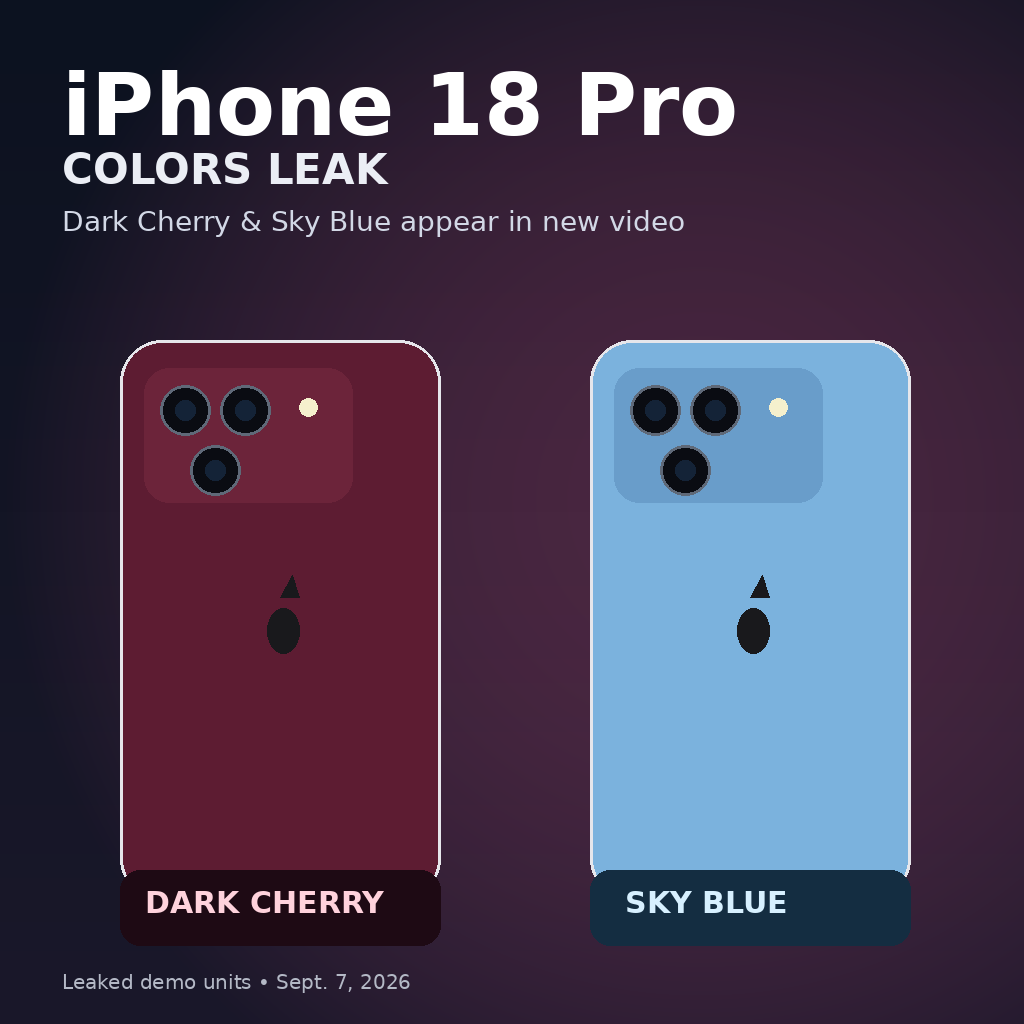
iPhone 18 Pro Colors Leak in New Video: Dark Cherry and Sky Blue Seen Ahead of Apple Event

iPhone 18 Pro Dark Cherry and Sky Blue color leak concept featured image

Updated: September 7, 2026

A fresh video leak appears to show iPhone 18 Pro demo units in two of Apple’s most-rumored new finishes: Dark Cherry and Sky Blue. The clip, attributed to Korean leaker yeux1122, was reportedly filmed in what looks like a retail environment and shows an iPhone 18 Pro Max in Dark Cherry beside an iPhone 18 Pro in Sky Blue.

The footage is not official and the devices could still be demo or pre-production units, but the leak meaningfully strengthens earlier color reports from several established Apple sources just two days before Apple’s September 9 event.

What the New Video Shows

The newly surfaced clip appears to show two devices side by side. One is presented as an iPhone 18 Pro Max in a deep red-purple finish being called Dark Cherry, while the other is presented as an iPhone 18 Pro in a lighter blue finish commonly referred to as Sky Blue.

Frames from the alleged iPhone 18 Pro Dark Cherry and blue video posted by yeux1122 on Naver
Frames from the alleged iPhone 18 Pro color leak. Original video attributed to yeux1122 on Naver; image preview via Macworld. Click the image to view the original Naver post.

Authenticity note: The footage is unverified. Macworld and Notebookcheck reported it as an apparent demo-unit leak, while AppleInsider argued that the clip is fake. ReaderSpice is therefore treating the video as disputed visual evidence rather than confirmation of Apple’s final hardware.

The leak was attributed to yeux1122, a Korean source with a mixed but often useful Apple track record. Frandroid and Notebookcheck both reported the video on September 7 and described the units as apparent demo models rather than confirmed retail hardware.

Dark Cherry Looks Increasingly Likely

Dark Cherry is now the most consistently reported signature color for the iPhone 18 Pro generation.

Bloomberg’s Mark Gurman previously described Apple as testing a “deep red” finish. MacRumors later reported that Dark Cherry had surfaced repeatedly in supply-chain and accessory leaks, while longtime leaker Sonny Dickson shared SIM tray photos that he said corresponded to Dark Cherry, Sky Blue, and Silver.

The color appears somewhere between burgundy, plum, and deep red depending on lighting, and is widely expected to replace Cosmic Orange as the standout Pro finish for this generation.

Sky Blue Also Gains More Credibility

Sky Blue has also appeared in multiple previous leaks, including reports from Fixed Focus Digital, Sonny Dickson, and other accessory-chain sources.

The newly leaked video is the strongest visual evidence so far that Apple may actually ship the color on production hardware. The shade appears noticeably brighter than some of Apple’s more muted recent blues and is closer to the light-blue finishes seen on products like MacBook Air.

The Third Color Is Still Unclear

One part of the iPhone 18 Pro color story remains unresolved.

Sonny Dickson has said the three colors he has seen most recently are Dark Cherry, Sky Blue, and Silver. However, Fixed Focus Digital has claimed that Apple will instead offer Dark Cherry, Sky Blue, and Black, while dropping Silver.

That disagreement has not been resolved by the new video, because only two colors appear in the clip. At this point, Dark Cherry and Sky Blue look increasingly credible, while the final third option remains uncertain.

How Credible Is This Leak?

High confidence:

  • Dark Cherry is likely to be one of the iPhone 18 Pro colors.
  • Sky Blue is also increasingly likely based on multiple independent leaks.

Low-to-medium confidence:

  • The video may show demo or display units, but its authenticity has not been independently verified and at least one Apple-focused publication has challenged it as fake.

Still uncertain:

  • Whether Apple will choose Silver or Black as the third Pro color.
  • Whether the exact shades shown in the leaked video match final retail units.

What Else Is Expected at Apple’s September 9 Event?

Apple has officially confirmed an event for Wednesday, September 9, 2026. Current reporting points to the iPhone 18 Pro, iPhone 18 Pro Max, and Apple’s first foldable iPhone as the major iPhone announcements.

Other widely reported iPhone 18 Pro upgrades include Apple’s 2nm A20 Pro chip, a smaller Dynamic Island, the C2 modem, improved vapor-chamber cooling, larger batteries, and possible variable-aperture camera hardware.

The standard iPhone 18, iPhone 18e, and iPhone Air 2 are currently expected to follow in spring 2027 rather than launch this week.

Final Thoughts

With only two days left before Apple’s event, leaks are becoming less about broad concepts and more about production-adjacent details. This new video does not confirm the final retail color lineup, but it adds meaningful weight to the two finishes that have appeared most consistently throughout the rumor cycle.

Dark Cherry now looks especially likely to be Apple’s headline iPhone 18 Pro color, while Sky Blue appears increasingly credible as the second major option.

The remaining question is whether Apple keeps Silver or brings back a darker Black finish for the third slot. We should know for certain on September 9.

Sources

Frandroid — iPhone 18 Pro Dark Cherry and Sky Blue video leak (September 7, 2026)
Notebookcheck — Video of apparent iPhone 18 Pro (Max) in Dark Cherry and Sky Blue (September 7, 2026)
AppleInsider — Report disputing the authenticity of the leaked retail video (September 7, 2026)
MacRumors — Leaked iPhone 18 Pro parts point to three colors (September 2, 2026)
MacRumors — iPhone 18 Pro colors could include Black but skip Silver (September 1, 2026)

Galaxy S27 Ultra charging is now showing up in certification — 60W wired charging spotted

Samsung Galaxy S27 Ultra 60W wired charging certification leak

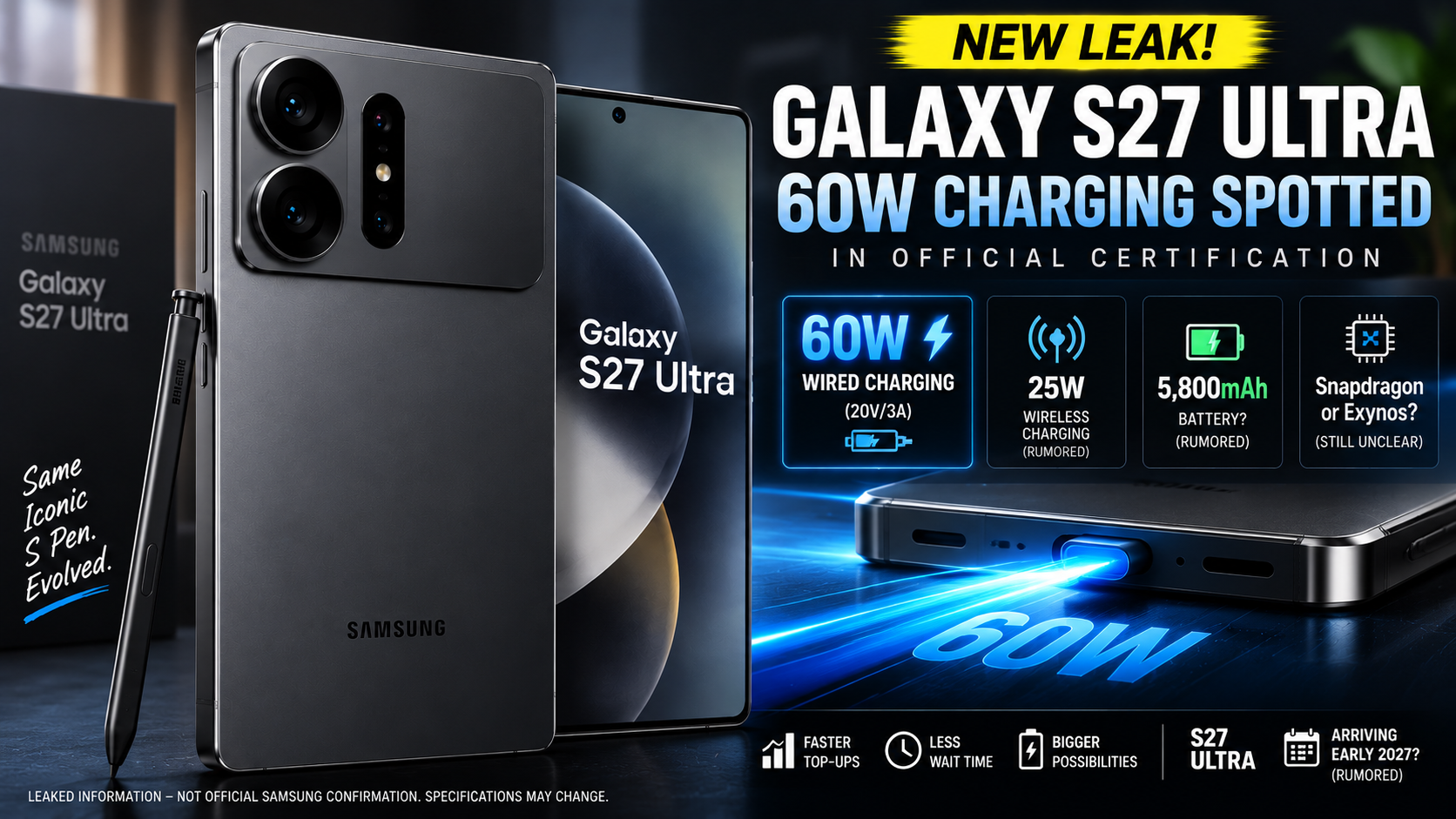
A meaningful new Samsung Electronics Galaxy S27 Ultra development has surfaced. On September 6, 2026, SamMobile reported that Galaxy S27-series variants have appeared in China’s CCC certification database, with the Galaxy S27 Ultra listed for 60W wired charging (20V/3A).

This is more significant than a typical social-media rumor because the information reportedly comes from a regulatory certification listing. However, Samsung itself has not announced the Galaxy S27 Ultra or confirmed its final charging specifications.

What the certification reveals

The reported S27 charging lineup is:

Galaxy S27: 25W

Galaxy S27+: 45W

Galaxy S27 Pro: 60W

Galaxy S27 Ultra: 60W

Interestingly, this would mean the S27 Ultra doesn’t increase wired charging speed over the S26 Ultra. Instead, Samsung appears to be bringing its highest charging tier to the rumored S27 Pro as well.

The same reporting associates the Ultra with 25W wireless charging, although that detail should still be considered part of the pre-release leak picture rather than an official Samsung specification.

Battery rumor gets more interesting

The report also repeats a claim that the Galaxy S27 Ultra could use a 5,800mAh battery, potentially using silicon-carbon anode technology.

I’d treat that capacity with substantially more caution than the 60W charging figure. Earlier reporting has been inconsistent: Ice Universe previously pushed back strongly on unsupported claims of batteries above roughly 5,500mAh.

So at this point:

60W wired charging: relatively strong evidence because of the reported CCC certification.

5,800mAh battery: still a rumor and currently less reliable.

No major new Ice Universe Ultra leak today

I didn’t find a newer Ice Universe disclosure today that materially changes the S27 Ultra camera, S Pen, Qi2, display or processor picture.

His recent case leak remains important because it supports the new raised camera-plateau design on the S27 Ultra and S27 Pro.

Samsung still hasn’t officially announced the Galaxy S27 series, so the design, battery capacity, processor split, cameras and release timing remain subject to change.

Bottom line: the genuinely new development is regulatory evidence pointing to 60W charging for the Galaxy S27 Ultra. That’s credible enough to report, but it also suggests Samsung may focus its S27 Ultra upgrades elsewhere rather than increasing peak wired charging beyond the S26 Ultra.

Read the September 6 SamMobile report⁠

iOS 27’s New “iPhone Handoff” Could Be Built for Apple’s Foldable iPhone — Plus a New Case Leak Hints at the Final Design

iPhone 18 lineup and Apple foldable iPhone roadmap concept

Apple’s upcoming foldable iPhone just became more interesting for a reason that has less to do with hardware and more to do with how people may actually use it.

A newly demonstrated iOS 27 feature called “iPhone Handoff” will let users switch between two iPhones while keeping the same phone number, using a main eSIM on one iPhone and a companion eSIM on another. Apple briefly referenced the feature at WWDC 2026, but a new demonstration through Xcode 27’s Device Hub has now revealed how it works in practice.

At the same time, accessory maker MagBak has listed a case for Apple’s still-unannounced foldable iPhone, offering another clue that the book-style hardware design may now be largely finalized.

Together, the two developments provide a clearer picture of how Apple may position its first foldable iPhone.

iPhone Handoff Lets Two iPhones Share One Number

The newly demonstrated iOS 27 setup allows users to designate one device as their main iPhone and another as a companion iPhone.

The main device retains the primary eSIM, while the second iPhone receives a companion eSIM. Users can then move their active phone service between the two devices without repeatedly transferring their number. Cellular settings remain controlled from the primary phone.

This is significantly different from Apple’s traditional Handoff feature, which simply lets users continue apps and tasks across Apple devices.

The new feature is specifically focused on cellular service.

Why This Makes So Much Sense for the Foldable iPhone

The timing is particularly interesting.

Apple is widely expected to unveil its first foldable iPhone alongside the iPhone 18 Pro and iPhone 18 Pro Max. Reports have suggested that the foldable could cost more than $2,000, making it a premium device that some users may not want to carry everywhere.

iPhone Handoff could solve that problem.

Someone could theoretically use the foldable iPhone as their main device during work, travel, entertainment or multitasking, then switch to a smaller conventional iPhone when heading to the gym, going outdoors or simply wanting something lighter.

The Verge specifically notes that the timing of iPhone Handoff makes sense with Apple’s foldable iPhone launch approaching.

There Is One Important Limitation: Carrier Support

iPhone Handoff will apparently require participating carriers.

Code references currently point to T-Mobile in the United States and Deutsche Telekom in Germany, although broader carrier availability has not yet been announced.

That means AT&T, Verizon and other networks may or may not support the feature immediately.

Apple has not yet published a final carrier compatibility list.

New MagBak Case Listing Adds More Evidence for Foldable Design

A second noteworthy development arrived on September 6.

Accessory company MagBak has listed an $89 MagBak Elite case for an “iPhone Fold,” despite Apple not having officially announced such a device. The listing depicts a two-piece case designed for a book-style folding phone.

The case shows:

  • a horizontal dual-camera opening
  • MagSafe/Qi2 compatibility
  • a side-mounted button arrangement
  • a two-piece foldable construction
  • a built-in kickstand and finger loop

The listing’s page title reportedly even refers to an “iPhone Fold Ultra,” combining two of the names that have circulated in recent rumors.

Does This Confirm the Name “iPhone Fold”?

No.

This should still be considered a credible accessory leak rather than confirmation from Apple.

Case manufacturers routinely build accessories based on dimensions supplied through manufacturing and accessory channels, but product names can remain placeholders until launch.

Current reporting has used several possible names, including:

  • iPhone Fold
  • iPhone Ultra
  • iPhone Fold Ultra

Apple could still use something completely different.

The Case Design Matches Earlier Leaks

What makes the MagBak listing more interesting is how closely its design matches earlier foldable iPhone leaks.

Previous reports and accessory renders have repeatedly pointed to:

  • approximately a 5.5-inch outer screen
  • approximately a 7.8-inch inner display
  • book-style folding
  • dual rear cameras
  • Touch ID instead of Face ID
  • extremely thin construction when unfolded

Multiple independent accessory designs converging on the same layout suggests that Apple’s physical design may now be close to production-ready.

MagSafe Also Looks Increasingly Likely

The MagBak case includes support for MagSafe and Qi2 charging, which aligns with recent comments attributed to Bloomberg’s Mark Gurman.

Gurman said indications he had heard suggested MagSafe was expected to be included on Apple’s foldable phone, despite the device’s extremely thin body.

MacRumors

That is another useful piece of corroboration.

What Is Confirmed vs. Rumored?

Confirmed / Strongly Supported

Apple has included iPhone Handoff functionality in iOS 27 development, allowing two iPhones to use the same phone number through a main and companion setup.

iOS 27 is expected later this month.

Credible Rumors

Apple is expected to unveil a foldable iPhone alongside the iPhone 18 Pro generation.

The foldable is widely reported to use a roughly 5.5-inch exterior display and 7.8-inch interior screen, with Touch ID and a premium price exceeding $2,000.

MagSafe support is also looking increasingly likely.

Still Speculative

The final product name remains unknown.

The MagBak case listing should not be taken as confirmation that Apple will call the device “iPhone Fold.”

Carrier availability for iPhone Handoff is also not yet finalized.

Final Thoughts

The biggest new development is not simply another specification leak.

iPhone Handoff may reveal how Apple expects customers to live with a $2,000+ foldable iPhone.

Instead of forcing buyers to choose between their foldable and a smaller iPhone, Apple appears to be creating an ecosystem where both devices can share the same number and be swapped depending on the situation.

Meanwhile, MagBak’s early case listing adds another piece of evidence that Apple’s foldable hardware design is nearing its final form.

With Apple’s September event only days away, the software and accessory leaks are now beginning to tell the same story: Apple’s foldable iPhone looks increasingly close to launch.

DJI Neo Hits Record-Low $139 on Amazon as New U.S. Drone Tariffs Take Effect

If you’ve been waiting for a cheap way to get into DJI drones, this could be one of the best buying opportunities we’ve seen. The DJI Neo has dropped to just $139 on Amazon, down from its regular $199 price — a 30% discount and a record-low price.

The timing of this deal is especially interesting because new U.S. tariffs on imported drones have just taken effect, potentially putting upward pressure on drone prices as retailers replenish their inventories.

DJI Neo Drops to Just $139

Amazon is currently offering the controller-free DJI Neo Mini Drone with 4K UHD Camera for $139.


Amazon deal:

“Check the DJI Neo $139 deal on Amazon” https://amzn.to/4qWsV9j

Price and availability can change at any time.

At $139, the Neo is $60 below its $199 regular price, representing a 30% discount. Recent deal tracking and reporting identify this as the lowest price seen for the drone.

The sale isn’t limited to the basic configuration either. Amazon deal listings have recently shown:

– DJI Neo — $139

– DJI Neo Three-Battery Combo — $199

– DJI Neo Fly More Combo with RC-N3 — $239

– DJI Neo Motion Fly More Combo with Goggles N3 — $369

For buyers who want to fly with a traditional controller, the $239 Fly More Combo may offer the strongest overall value because it includes the RC-N3 controller, three Intelligent Flight Batteries and a two-way charging hub.

Why the $139 DJI Neo Is Such a Good Deal

Despite its low price, the DJI Neo isn’t simply a toy drone.

It weighs only about 135 grams and can record stabilized 4K/30fps video. It’s designed particularly well for beginners, travelers, vloggers and creators who want aerial footage without carrying a larger drone.

Some of its biggest features include palm takeoff and landing, AI subject tracking, QuickShots, full propeller guards and multiple control options.

You don’t even need a conventional remote controller to start using the basic Neo. It can work with DJI’s mobile app and automated flight modes, making it especially convenient as a compact flying camera.

Why the Timing Matters: New U.S. Drone Tariffs

There’s another reason this particular sale deserves attention.

New U.S. Section 232 tariffs covering unmanned aircraft systems went into effect for covered imports beginning September 3, 2026.

Under the presidential proclamation, covered drones with a maximum takeoff weight of 25 kilograms or less can face an additional 25% ad valorem duty, subject to the classifications and exceptions established by the proclamation.

Certain larger drones, thermal-imaging UAS, docking stations and specified critical components can face duties as high as 100%.

The U.S. Customs and Border Protection implementation guidance confirms that the new UAS duties became effective September 3. An additional 25% duty covering certain other UAS components is scheduled to become effective February 9, 2027.

Does That Mean the DJI Neo Will Become 25% More Expensive?

Not necessarily.

A 25% import tariff doesn’t mean Amazon simply takes today’s $139 price and adds another 25% at checkout.

The tariff applies at the import level to covered products. Retail prices depend on several factors, including import value, existing inventory, distributor costs, retailer margins and how much of the additional cost manufacturers or sellers decide to absorb.

There’s also an important inventory consideration.

Drones that were already imported before the new tariff took effect aren’t suddenly charged the new tariff simply because they’re sitting on a retailer’s shelf.

That means some of the DJI drones currently being sold in the United States could effectively represent pre-tariff inventory.

The bigger question is what happens when retailers need to replace that inventory with newly imported units subject to the new duty structure.

There is no guarantee that DJI Neo prices will increase, but the additional import costs create a legitimate risk of higher retail pricing once inventory turns over.

Is the DJI Neo Worth Buying at $139?

At $139, the DJI Neo becomes extremely compelling for someone buying their first DJI drone or a creator looking for an inexpensive secondary drone.

Its combination of 4K recording, subject tracking, palm launch, compact size and DJI’s stabilization technology is difficult to match at this price.

For casual users, the $139 base model makes sense.

For someone planning to fly regularly, however, the $239 Fly More Combo deserves serious consideration because the additional batteries, charging hub and RC-N3 controller significantly expand what you can do with the Neo.

Should You Buy Before Drone Prices Rise?

Nobody can guarantee that the DJI Neo will become more expensive after the current inventory sells out.

What we do know is that the Neo has reached a record-low $139 price at the same time new U.S. drone import tariffs are beginning to affect incoming products.

That’s an unusual combination.

If you’ve already been planning to buy a DJI Neo, waiting specifically for a substantially lower price may therefore carry more risk than usual.


Check the current Amazon price here:


“DJI Neo on Amazon”

https://amzn.to/4qWsV9j

Disclosure: If you use an affiliate link on your website, Prices and availability are subject to change.

Galaxy S27 Ultra Snapdragon leak: Samsung is already testing Qualcomm’s next flagship chip in the U.S., Korea and Asia-Pacific

Galaxy S27 Ultra Snapdragon leak and Qualcomm flagship chip testing

A meaningful new Samsung Galaxy S27-series processor leak surfaced on September 5, and it adds an important twist to the recent Exynos 2700 story.

According to a leaked Qualcomm project-portal screenshot obtained by Notebookcheck, Samsung Electronics is already validating Galaxy S27 hardware using Qualcomm’s unreleased SM8975 flagship processor across at least three regional builds: Asia-Pacific, South Korea and Verizon in the United States.

Snapdragon testing is further along than we knew

The leaked project entries are reportedly:

SS_SM8975_GS27_AP — Asia-Pacific
SS_SM8975_GS27_KOR — South Korea
SS_SM8975_GS27_VZW — Verizon/U.S.

All three reportedly use Qualcomm’s internal “Snapdragon_Premium_High_2026” software distribution. The existence of a Verizon-specific build is particularly interesting because it suggests Samsung is already doing carrier-specific RF/software validation for the upcoming Galaxy generation.

The SM8975 is expected to become Qualcomm’s highest-end next-generation Snapdragon chip, currently reported under the Snapdragon 8 Elite Extreme Gen 6 name. Qualcomm is expected to formally introduce its next Snapdragon flagship family at Snapdragon Summit, scheduled for September 22–24, 2026.

What does this mean for the Exynos 2700 S27 Ultra leak?

This is where today’s leak becomes particularly important.

Earlier reports said Samsung had begun preparing an Exynos 2700 Galaxy S27 Ultra motherboard for South Korea, potentially bringing Exynos back to an Ultra phone after a five-year absence. Those reports do not necessarily conflict with today’s information.

The new evidence shows that Samsung is simultaneously testing an SM8975 Snapdragon Galaxy S27 build for Korea.

That suggests Samsung may currently be evaluating multiple chipset configurations rather than having finalized which processor every S27 Ultra market will receive.

So claims that the South Korean S27 Ultra is definitely getting Exynos 2700 are premature.

What we can say with higher confidence

The strongest new evidence is that real Galaxy S27 development builds using SM8975 now appear to exist for the U.S./Verizon, Korea and Asia-Pacific regions. That’s more substantial than a generic rumor saying Samsung “plans to use Snapdragon,” although the leaked portal screenshot is still unofficial information.

It also strengthens the likelihood that the U.S. Galaxy S27 Ultra will continue using Qualcomm silicon, particularly given the presence of a dedicated Verizon project.

What it does not establish is whether every Galaxy S27 model represented by those projects uses SM8975, whether Samsung will ultimately ship both Snapdragon and Exynos S27 Ultras, or which regions would receive each processor.

Where the rest of the S27 Ultra leaks stand

There is no comparably strong new development today concerning the S27 Ultra’s cameras, battery, S Pen, Qi2 magnets, display or pricing.

Recent reporting still points toward the dramatic camera-plateau redesign, an integrated S Pen, potential native Qi2 magnets, a possible larger battery, and a reduced three-camera configuration. Those remain leaks rather than confirmed specifications.

Likewise, the experimental 50MP 4x telephoto with a roughly 1/1.9-inch sensor remains something Samsung is reportedly evaluating rather than a finalized retail camera configuration.

Current expectations still place the Galaxy S27 family in early 2027, but Samsung has not announced an Unpacked date or retail launch date.

Confirmed vs. leaked

Confirmed: Samsung has not officially announced the Galaxy S27 Ultra, its processor, specifications, price, cameras, battery capacity or release date.

Leaked: Qualcomm project information reportedly shows Samsung testing SM8975-powered Galaxy S27 hardware in Asia-Pacific, Korea and on Verizon.

Still uncertain: whether the S27 Ultra will ship with Snapdragon everywhere, return to a Snapdragon/Exynos regional split, or whether Samsung is simply evaluating both platforms before making its final decision.

For now, the most interesting takeaway is that Samsung appears to have both Snapdragon and Exynos options in development—and Snapdragon testing is already occurring even in Korea.

Read the September 5 Notebookcheck report

Apple’s iPhone Roadmap Leaks Through 2028: Foldable iPhone Above $2,000, iPhone Air 2 Upgrades and Major 2027 Redesign

iPhone 18 rumors and Apple iPhone roadmap concept

Apple appears to be preparing its biggest iPhone lineup shake-up in years. A new report attributed to Bloomberg’s Mark Gurman lays out Apple’s iPhone roadmap through 2028, including new details about the first foldable iPhone, the iPhone Air 2, the delayed standard iPhone 18, and an even more ambitious redesign planned for 2027.

The most important takeaway is that Apple’s first foldable iPhone is increasingly looking like a permanent new branch of the iPhone family rather than a one-off experiment.

Foldable “iPhone Ultra” Could Cost More Than $2,000

Gurman’s latest reporting says Apple’s first foldable iPhone will be roughly the size of a passport when folded and is expected to cost more than $2,000. The device is said to use an advanced hinge and Touch ID rather than Face ID, with both light and dark finishes reportedly planned.

Earlier reporting has pointed to roughly a 5.5-inch external display and 7.8-inch internal display, along with the A20 Pro chip, two rear cameras and MagSafe support.

The final product name remains unconfirmed. “iPhone Ultra” is increasingly being used in reports, but Apple has not publicly announced the name.

Apple May Release a New Foldable Every Year

One of today’s most significant new revelations is that Apple reportedly already has a second-generation foldable iPhone well into testing for 2027.

That model is expected to receive a newer chip, while a third-generation foldable planned for 2028 could increase both the exterior and interior display sizes.

If this roadmap holds, Apple would effectively establish an annual foldable upgrade cycle alongside its conventional iPhones.

iPhone Air 2 Gets Three Important Upgrades

Gurman’s roadmap also provides fresh information about the second-generation iPhone Air.

The iPhone Air 2 is now expected to gain:

  • an Ultra Wide camera
  • a faster processor
  • longer battery life

The Air 2 is reportedly part of Apple’s spring 2027 iPhone wave rather than the September 2026 Pro launch.

That could address two of the biggest compromises associated with ultra-thin phone designs: camera flexibility and battery endurance.

Standard iPhone 18 Moves to Spring 2027

Today’s report further reinforces Apple’s unusual split-launch strategy.

The expected fall 2026 lineup is centered on the iPhone 18 Pro, iPhone 18 Pro Max and foldable iPhone, while the regular iPhone 18 and iPhone 18e are reportedly scheduled for spring 2027.

Importantly, the latest credible roadmap does not identify an iPhone 18 Plus. Older rumors or concept images that include an iPhone 18 Plus should therefore be treated cautiously.

iPhone 18 Pro and Pro Max Still Expected Next Week

The iPhone 18 Pro and Pro Max remain expected to headline Apple’s September launch alongside the foldable.

Current credible rumors include:

A20 Pro chip: Apple is expected to move its Pro models to a 2nm-generation processor.

Smaller Dynamic Island: Apple reportedly plans to reduce the front display cutout.

Improved vapor-chamber cooling: Both Pro phones could receive better thermal management.

Larger battery: The Pro Max in particular is expected to become slightly thicker to accommodate additional battery capacity.

Variable aperture: The Pro Max may receive a mechanically adjustable main-camera aperture, although reports still disagree on whether the feature will also appear on the smaller Pro.

The Bigger Story Could Arrive in 2027

Perhaps the most interesting part of Gurman’s roadmap concerns Apple’s 20th-anniversary iPhone generation.

The 2027 Pro models are reportedly being developed with curved glass around the corners and edges, significantly thinner bezels and a substantially redesigned appearance.

Gurman describes it as Apple’s biggest Pro-line redesign since the iPhone X era.

That means the iPhone 18 Pro generation may serve as an evolutionary step before Apple makes a much larger visual change one year later.

Credibility Check

Higher confidence: The split iPhone launch schedule, fall 2026 Pro models, spring 2027 standard iPhone 18, development of a foldable iPhone, and continued work on iPhone Air are now supported by repeated reporting from established Apple sources.

Credible but still unofficial: The $2,000+ foldable price, Touch ID, yearly foldable refreshes, Air 2 Ultra Wide camera and specific 2027 redesign details come from reporting attributed to Gurman but remain unconfirmed by Apple.

Still speculative: Exact foldable naming, final retail pricing, exact screen dimensions, launch-day availability and some camera configurations could still change.

Final Thoughts

Apple’s rumored strategy is becoming much clearer.

Instead of launching every iPhone together each September, the company appears ready to divide its lineup into premium fall releases and mainstream spring releases. Meanwhile, the foldable iPhone could become a yearly product family of its own, while the Air line evolves into a more capable ultra-thin alternative.

The most significant new detail today is therefore not a single iPhone 18 specification—it is the emerging roadmap for three consecutive generations of foldable iPhones, combined with a substantially upgraded Air 2 and a major 20th-anniversary redesign in 2027.

SEO Title: Apple iPhone Roadmap Leaks: $2,000+ Foldable, iPhone Air 2 Upgrades & 2027 Redesign

Meta Description: New Apple leaks reveal a $2,000+ foldable iPhone, yearly foldable upgrades through 2028, iPhone Air 2 camera and battery improvements, a spring 2027 iPhone 18 launch and a major Pro redesign.

Sources include Bloomberg reporting as summarized by 9to5Mac and other current Apple coverage.

Galaxy S27 Ultra could bring Exynos back to the Ultra — a major strategy shift

Galaxy S27 Ultra Exynos leak and Samsung chipset strategy

A meaningful new Samsung Electronics Galaxy S27 Ultra leak has emerged from South Korea. According to a September 1 report from MoneyToday, Samsung has started preparing an Exynos 2700 version of the Galaxy S27 Ultra for selected markets, including South Korea. More significantly, the report says Samsung has already placed an initial order for S27 Ultra motherboards designed around the Exynos 2700.

Exynos could return to the Ultra after five years

This would be a substantial change in Samsung’s flagship strategy. The Galaxy S22 Ultra was the last Ultra generation offered with an Exynos processor. Galaxy S Ultra models from 2023 through 2026 have instead relied exclusively on Snapdragon silicon.

The report claims Samsung originally intended to use Qualcomm’s next-generation Snapdragon platform across the S27 Ultra lineup. Development of that Snapdragon model is reportedly already well advanced, but Samsung’s MX and System LSI divisions are now coordinating development of an additional Exynos 2700 motherboard.

That means the S27 Ultra could once again become a region-dependent phone:

United States: Snapdragon is still expected.
South Korea: Exynos 2700 is now reportedly being prepared.
Other regions: not yet firmly established for the Ultra.

Samsung has not confirmed this regional configuration, so reports claiming that Europe will definitely receive an Exynos S27 Ultra are currently getting ahead of the strongest source.

Exynos 2700 itself just received another interesting leak

A newly reported Exynos 2700 die shot provides additional clues about what Samsung may be developing. The analysis points toward Samsung’s second-generation 2nm SF2P process, a 10-core CPU arrangement with two high-performance tiers, a large NPU, 24MB system-level cache, Xclipse 970 graphics and LPDDR6 support.

The leaked architecture could be especially important for sustained performance and efficiency. However, these are engineering-stage processor details, not confirmed Galaxy S27 Ultra specifications. Support for technologies such as LPDDR6 does not automatically mean the retail S27 Ultra will actually use LPDDR6 memory.

What Ice Universe is saying

There isn’t a new Ice Universe specification leak today that overrides the previous camera, design, battery or S Pen reporting. A September 2 post attributed to Ice Universe instead criticized the S27 series as feeling “tired, bored, exhausted”, suggesting disappointment with the direction of the lineup rather than revealing another hardware specification.

Current S27 Ultra leak picture

The Exynos 2700 Ultra variant is the meaningful new development. The other major reports remain largely where they were: a dramatically redesigned rear camera area, three-camera direction, integrated S Pen, potential native Qi2 magnets, and a larger battery remain under discussion. The recently reported experimental 4x telephoto configuration also remains just that—something reportedly being evaluated rather than a finalized retail camera specification.

Pricing also remains unknown. Reports estimating a price based on the current Ultra should not be treated as an actual S27 Ultra price leak. Current launch expectations remain around early 2027, but Samsung has not announced the Galaxy S27 Ultra, its launch date, pricing, processors or specifications.

The strongest evidence behind today’s development is the Korean supply-chain report about Samsung ordering Exynos 2700 S27 Ultra motherboards. That makes this considerably more interesting than a generic specification rumor, while still stopping short of proving that Exynos-powered retail S27 Ultras will actually ship.

Meaningful new Galaxy S27 Ultra camera leak

Samsung Galaxy S27 Ultra camera leak and rumored rear camera redesign

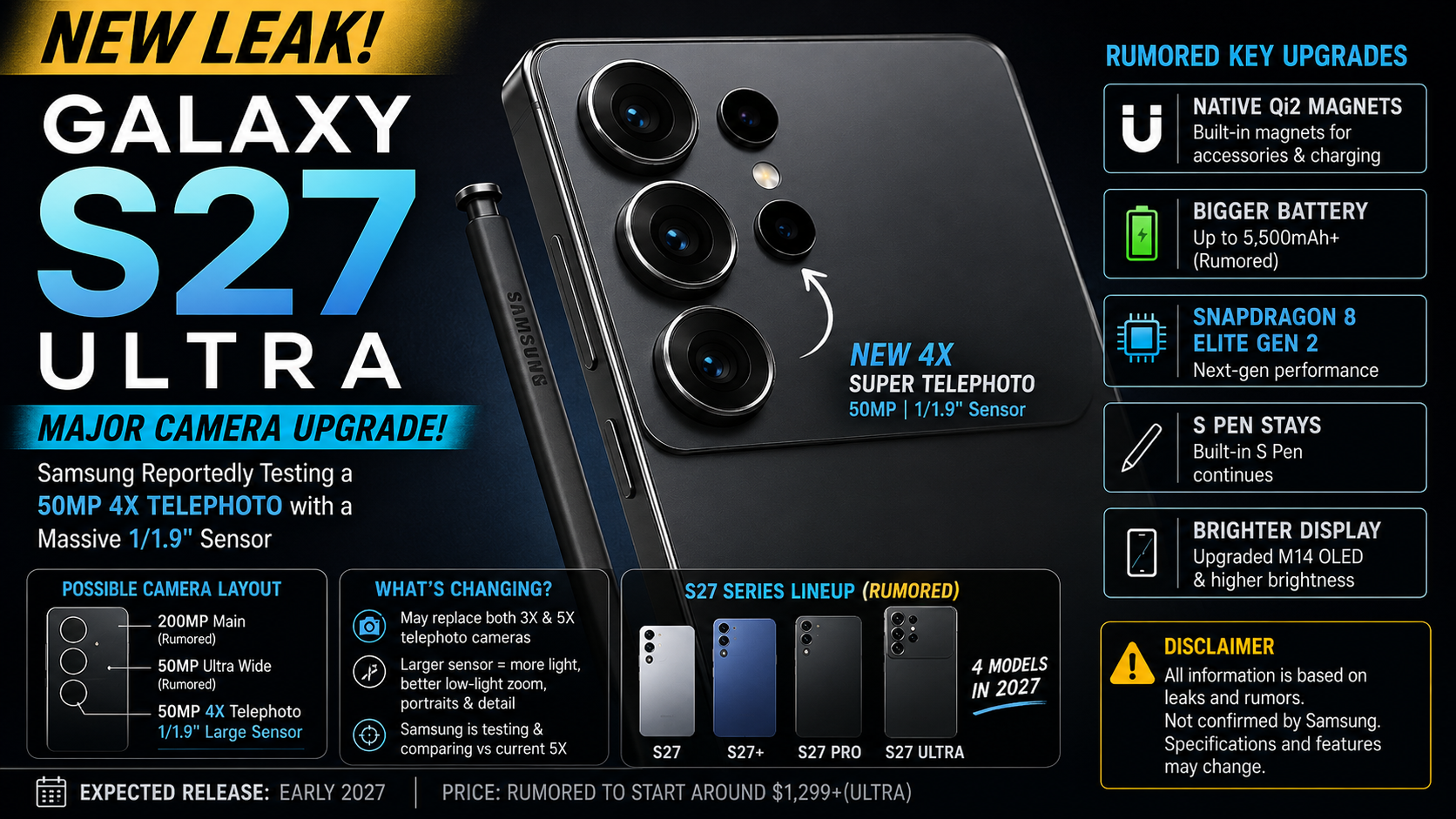
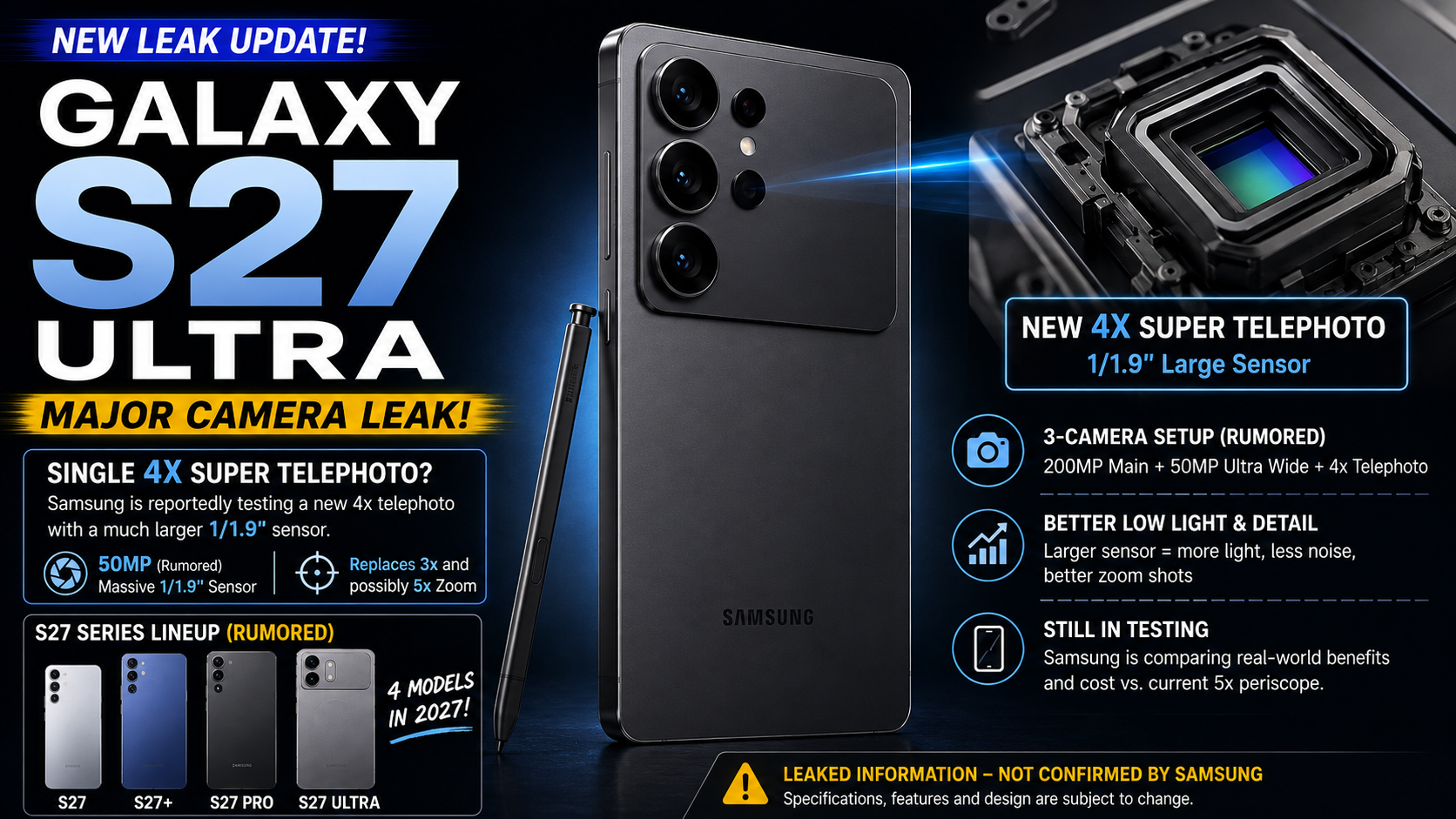
Samsung is reportedly testing a major change to the S27 Ultra zoom system: a single 4x “super telephoto” camera with a much larger 1/1.9-inch sensor. This could replace not only the rumored-to-be-removed 3x telephoto, but potentially the existing 5x periscope as well.

The new 4x sensor is reportedly 50MP in some reports and substantially larger than the current 5x telephoto’s roughly 1/2.52-inch sensor. The idea would be fewer dedicated zoom cameras but a significantly larger sensor capable of gathering more light, potentially improving low-light zoom, portraits, detail and noise.

This also fits the recently leaked CAD design surprisingly well: those renders appear to provide space for three rear cameras total, supporting the possibility of a 200MP main + ultrawide + single high-quality telephoto architecture.

Important: this configuration is not finalized. The originating leak says Samsung is testing the 4x solution and comparing its real-world benefit and cost against retaining the existing 5x design. Reports claim multiple S27 Ultra prototypes are still being evaluated.

There is no new official confirmation from Samsung, and I found no meaningful new Ice Universe disclosure today that supersedes his recent design/battery information. So I would currently label the 4x super-telephoto as a notable new leak, but medium confidence rather than a near-final specification.

A meaningful new Galaxy S27 Ultra battery/S Pen leak surfaced

Samsung Galaxy S27 Ultra battery and S Pen leak

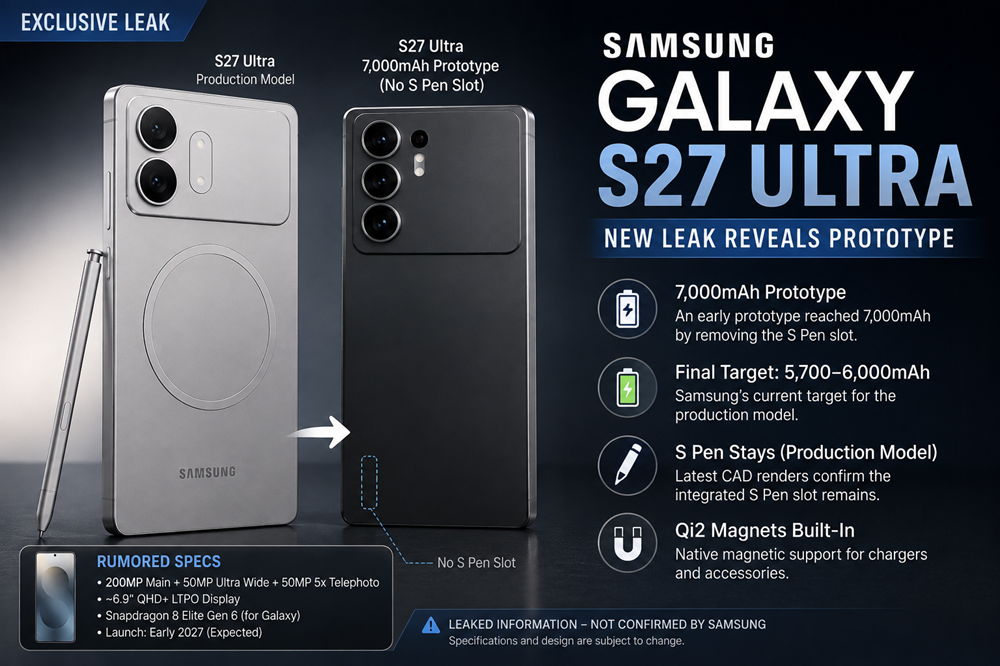
Samsung reportedly tested several S27 Ultra prototypes, including an extreme version with a 7,000mAh battery that removed the built-in S Pen slot to create additional internal space. More importantly for the likely production phone, the same leak says Samsung’s current battery target has settled around 5,700–6,000mAh, potentially using silicon-carbon technology. Android Authority

This does not mean Samsung is removing the S Pen. In fact, the latest CAD renders still show an integrated S Pen slot, suggesting the 7,000mAh/S-Pen-less configuration was an experimental prototype that Samsung decided against.

There is also newer CAD information putting the S27 Ultra at roughly 163.76 × 78.25 × 7.97 mm, with the substantial new camera plateau reaching approximately 12.53 mm thick at its highest point. That means the main body could remain around 8mm despite the rumored battery increase, but the camera bump would become noticeably thicker.

The other major leaks remain consistent with the previous update: a three-camera arrangement potentially consisting of 200MP main + 50MP ultrawide + 50MP 5x telephoto, removal of the dedicated 3x camera, native Qi2 magnetic support, approximately 6.9-inch display, and an early-2027 launch.

Confirmed by Samsung: none of these S27 Ultra specifications yet. The 7,000mAh prototype in particular should be treated as an interesting development-history leak—not the expected retail specification.