The burden of reconstruction

Dinesh Karki
Dinesh Karki
The legislative parliament has passed the Reconstruction Authority Bill for executing the rebuilding program by disseminating the targeted $2 billion reconstruction fund plus $ 4.4 billion pledged by foreign governments and donors as grants and soft loans. The National Planning Commission (NPC) estimates the cost of reconstruction to be as high as $ 6.7 billion. The obvious question to ask now is ‘Who is going to bear all this cost?’ The obvious answer is us – the taxpayers. And if so, why is there a need for such huge government assistance in the first place? One plausible answer is that protective measures like buying insurance could have lowered the fund needed for reconstruction. However, such voluntary adoption of protective measures as buying insurance is very low in Nepal. In fact, some serious regulatory hurdles have constrained the growth of insurance industry!

Insurance penetration is very low in Nepal – a mere 1.42% of the GDP as per the Insurance Board of Nepal (IBN) data. The same for emerging markets averages 1.75% of the GDP. The compensation amount post-earthquake from insurers stands at Rs. 3.519 billion, a mere fraction of the required reconstruction costs. Apparently, there would be no need for such costly reconstruction assistance from the government had there been more structures been insured against earthquake-induced damages.

Rigid Solvency and Investment Requirements

In the name of prudential regulation for protecting consumers in case of insolvency, the IBN heavily regulates the insurance companies. There are strict solvency requirements and rigid investment requirements that limit the insurance companies from devising their own risk-management strategies.

The board has laid out solvency ratios and their consequent corrective actions. These solvency controls are uniform rule-based quantitative requirements without incorporating the risks undertaken by the insurers. It leads to a restrictive atmosphere where insurers are forced to meet inappropriate capital requirements even when the riskiness of their portfolio is low. Swiss Solvency Test (SST) in Switzerland and Solvency II Directive in the EU, for instance, align capital requirements with their specific risk profile.

The IBN has also laid out quantitative (mandatory minimum) requirements for investment in limited asset classes (for example, government securities, treasury bills, fixed or short term deposits of commercial banks, etc.) in the name of minimizing risks from uncertain losses. As per the recent IBN data, only 16.4% of the actual investments made by non-life insurers are under unregulated category which further proves how restrictive the requirements are. Such highly restrictive solvency and investment requirements are detrimental to the insurance industry as they stifle product development, innovation and competition.

Price-setting and Confidentiality of Premiums

The premiums charged for different categories of houses are set by the Insurance Tariff Advisory Committee (ITAC). The tariff and the premium rates are rendered confidential and are not available to consumers even when demanded. Such provision of price setting and confidentiality creates a problem of asymmetric information and further distorts the coordination of the insurance market through prices. Further, such price setting could lead to ‘cartel-type market arrangement’ imposing higher costs to insurers as well as consumers. Another problem is that they are not based on any actuarial methodologies; meaning, they are not based on specific risks of the policyholder. The basic principle of insurance dictates that equal risks must be treated equally while unequal risks must be treated differently. When unequal risks are pooled together and levied a uniform premium rate, this gives rise to the classic problem of ‘adverse selection’. In other words, such policies become more attractive to high risk consumers and unattractive to low risk consumers.

Disincentives for Purchasing Insurance: Earthquake Deductible and Low Claim Settlement

As far as the purchase-decisions are concerned, one clear disincentive for people while buying insurance is not being eligible for compensation. According to the latest IBN data, about 20% of the claims (i.e. 3499 out of 17,400 claims are ‘no claim’) related to earthquake are either ineligible or withdrawn by the homeowners. One of the reasons for the case of ‘no claim’ is because the claims are either equal or lower than the amount that insurers are allowed to deduct while settling claims. When we compare this to Japan’s case for instance, insurers are required to reimburse 100% of the insured amount. Another constraint for purchase and post-purchase decision can be attributed to the ineffective claim settlement process. The probability that an insurance claim will receive some compensation after being evaluated by a supervisor stands at just 3.28%.

The Reconstruction Bill and the Moral Hazard Problem

Even before people decide to purchase an insurance policy, they should recognize the need for it and evaluate other alternatives. When there is a strong assumption that the government will provide grants and soft-loans in case of an earthquake, there would be no financial incentive for people to purchase insurance. Inference from history suggests that post-disaster government responses play the role of the substitute to disaster preparedness. For example, loans provided during the reconstruction and rehabilitation program after the earthquake of 1988 were later converted into grants. Further, lobbying for total loan forgiveness in the past is a testimony for rent-seeking and vote-bank-securing behavior from politicians and interest groups. Though meeting immediate needs of the earthquake victims can be justified from the humanitarian aspect, outright grants and low-interest loans would only make things worse in the present and the future.

Tying It All Together

Removing these regulatory supply constraints will create room for the disaster insurance market to expand and thus cover more properties. This expansion will shift the risks of disasters like earthquakes to the homeowners themselves. The government will not have to redirect huge amounts of taxpayers’ funds to rebuilding efforts. Removing these constraints should in no way be viewed as a magic-wand; insurers will not magically cover all nooks and crannies of the country right away. Like all market processes, this will be a continuous process and will see scores of adjustments along the way. Having said that, this is in every way, a move in the right direction – letting the market thrive, giving choices to the people, and most importantly, reducing the burden to the government – the government that has not been very efficient in handling the relief and reconstruction activities to say the absolute least.

(Karki is a researcher at Samriddhi Foundation.Views expressed are personal. dinesh@samriddhi.org)


Who will be the winner of $1.5 Billion Powerball Tonight?

PowerballOn Saturday, Powerball jackpot amount rises to $900 million. Many people have hope and expectation to win this jackpot. People started to dream about the huge amount of money, that they will receive if they win. However, no one won this jackpot on Saturday. This is the very huge jackpot in the history. Today, Wednesday Powerball will be drawn at 11 PM EST and the jackpot has rises to $1.5 Billion. Many people cannot imagine what they can do with this huge amount of dollar in front of their eyes. It’s all about luck to win this jackpot.
Continue reading “Who will be the winner of $1.5 Billion Powerball Tonight?”

Powerball Lottery Rises $900 million, the largest jackpot in the US History

powerballA head of tonight’s draw, the Powerball lottery has been rises to $900 million. 2016 will be the great start for the person, who wins $900 million dollar. Powerball has a 5 numbers with 1 Powerball number. To win this jackpot, you have to have all 6 numbers matched with the draws number. Tonight, Powerball will be drawn tonight, Saturday. People play this jackpot from 44 states including Washington DC, the U.S. Virgin Islands and Puerto Rico, all but six states require lottery winners to come forward publicly. Therefore, good luck being anonymous if you win.
Continue reading “Powerball Lottery Rises $900 million, the largest jackpot in the US History”

Why the President Obama is taking action today to reduce gun violence

We called him the custodian of all living things. If an ant had crawled its way into our kitchen, he’d gently pick it up and carry it out outside to rejoin its family. If he saw a classmate sitting alone, he’d be the first to provide company and comfort. At 7 years old, he cared, he listened, and he loved more deeply than many adults I know.
Continue reading “Why the President Obama is taking action today to reduce gun violence”

The Culture of Disrespecting Time

Arun Budhathoki
Arun Budhathoki
If you are a Nepali or know Nepali people and have lived in Nepal then you probably know what it means to wait for petrol, gas, and interviews. While the long queues for petrol, gas and even medicines (hospitals) are a new phenomena resulting from human-made disaster, the culture of making people wait for interviews is perhaps not a new thing, but the result of the culture of disrespecting time. Patience is a virtue people say, but maybe not when it comes to us. I have had the experience while waiting for interviews.

Time is important for all of us, irrespective of who we are, employer or employees. I think it is very rude to make people wait for more than fifteen minutes to do an interview. The employers should keep in mind that the prospective employees are busy too and making them wait only defines their work ethics and attitude towards the unemployed and employed people. This has to change to transform the image of a company and also influence the mind-set of its employers. If the time taken for interviews is such, then the employers shouldn’t accept its employees to be on time and work under pressure for them. Both attitudes of employers and employees should match as none of them are robots and humans can err, which we know, from experiences and research. On the other hand, Nepali people are collectively to be blamed.

In the last three months, we have witnessed how patient Nepalis are when it comes to buying petrol for as high as Rs 300 to 500. They don’t even complain or protest against the government. We patiently wait in the long dull sad queues before the dreary looking petrol pump. We do not even go to Singha Durbar but creatively point at the hundreds of problems but do not provide a single solution. We have become a master of problem finders but a loser in seeking solutions. That’s the key difference between us and people in the western world. However, I disagree to dissuade implementing western solutions—we can at least start repairing our breaking frontiers by respecting time. The culture of disrespecting time is rampant in the governmental sector and everywhere else. It is deeply entrenched in our psyche: yestai cha yaha (It is like this here). And we do nothing about it. We calmly wait for the interviewer to call us and don’t ask when the interview is going to start. We don’t even care to ask the foreign country going ministers who send their kids and relatives to China about their ethical values.

Two days earlier there was twenty fours power-cut hiatus in my locality, Shantinagar, New Baneshwor and I was wondering where I could complain about it. With no idea about it, finally the power came back around 23:30 and it was only the next day I came to know that few people from the locality had gone to the concerned authorities to complain on it. If they hadn’t gone and complained, it seems the government employees would have delayed repairing it. That is the culture here—taking time lightly and delaying everything for tomorrow, next year. While other countries are busy planning space exploration, we are postponing works and delaying important projects.

The psyche of disrespecting time can be seen among our leaders too. Although they are smart enough to make sure that they don’t go hungry and sick after they quit politics. But the same leaders took so much time to pass the Reconstruction Authority bill which was vital to forward the post-quake relief and reconstruction works. There’s no time to wait for the earthquake-hit people who are facing extreme winter. Those living in the capital city already know how it feels to be cold. Do we have extra time to read about our fellow people including the quake-affected, dying of cold?

The culture of disrespecting time needs to change. We need to eradicate it first in our psyche and work for changes in every sector of this country. Or else, with our Human Development Index (HDI) nosediving, we will continue to be one of the poorest countries in South Asia and the rest of the world. Others will move ahead in time, whereas we will continue to live in the time where everything is delayed. Time waits for none.

(Budhathoki is a graduate of International Relations)

Kachin-Gorkhas

Sushma Joshi
Sushma Joshi
On my second day in Myitkyina, Olivier, a French biker who I’ve met at a restaurant, mentioned in a state of high excitement that he’s seen a train full of Burmese soldiers going in the other direction. The rebels are 25 km away, in the Southern part, just where he needs to go to get the boat to Bhamo. He doesn’t know if he will be able to leave the next morning, whether the boat will take off or not. Olivier is going around the world in his motorcycle—Burma is the only country that didn’t allow him to bring in his bike, so he had to fly in. In Pakistan, he was escorted by eight Army officers. He left the country as quickly as possible, he says. We agree this army escort is not the best idea.

“A guy on a bike may draw attention, people may notice that I am white if I drive slowly. But with eight Army officers following me, they definitely noticed!” he says, rather dryly.
Continue reading “Kachin-Gorkhas”

Winter of discontent

Dr. Roshan Bhakta Bhandari
Despite the losses and disruptions wrought by the Nepal Earthquake 2015, it became increasingly apparent that people and communities could cope with the immediate challenges by drawing upon their own resources. A prominent example was the rising number of self- help groups and community volunteers who positively influenced quick response and relief efforts. This highlighted the potential of people and communities to be resilient. Most recently, the Sendai Framework for Action 2015-2030 developed by the International Strategy for Disaster Risk Reduction, also identified the need to develop this resilient capacity as the key element of a disaster risk reduction (DRR) strategy. Nepal Earthquake provided an opportunity to understand how local capabilities at an individual and societal level helped to overcome the immediate challenges encountered during a massive disaster.
Continue reading “Winter of discontent”

Lost in Transition

Kul Chandra Gautam print
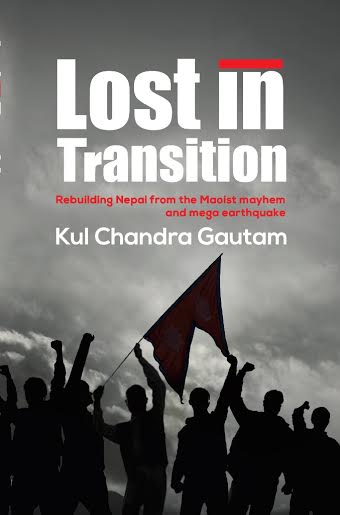
‘Lost in Transition: Rebuilding Nepal from Maoist Mayhem and Mega Earthquake’, a book penned by former senior official of the United Nations Kul Chandra Gautam, was launched at Nepalaya in the capital, on Saturday. Below are excerpts from the book.

Kofi Annan on Madi incident
Although Nepal was not a high priority among the many international crises Secretary-General Kofi Annan had to deal with, he did occasionally show some interest and concern. Among other occasions, I vividly remember meeting him at a reception on 6 June 2005. Earlier that day the UN had issued a press statement expressing deep concern about the Maoist attack the previous day (5 June 2005) on a public passenger bus in Madi in Chitwan district where a large number of innocent passengers were killed and mutilated. Although it was one of many brutal and barbaric acts committed by the Maoists against innocent civilians, I had thought that the UN press statement was probably one of those many pro-forma routine statements that are issued in the name of the Secretary-General, which the UN leader might not even personally know about.
Continue reading “Lost in Transition”

The Man Who Ate Himself To Death

Ricky Naputi
The tragic story of Ricky Naputi, one of the world’s fattest men. At nearly 65 stone, bedridden and confined to his home on the Pacific island of Guam, Ricky had limited access to obesity medical care. Even finding a doctor to give him the weight-loss surgery he so desperately needed would prove to be a massive challenge. Ricky lived with Cheryl, his wife of ten years, on a beautiful tropical island, but for the last five years of his life he never would never be able to appreciate it.
Continue reading “The Man Who Ate Himself To Death”