
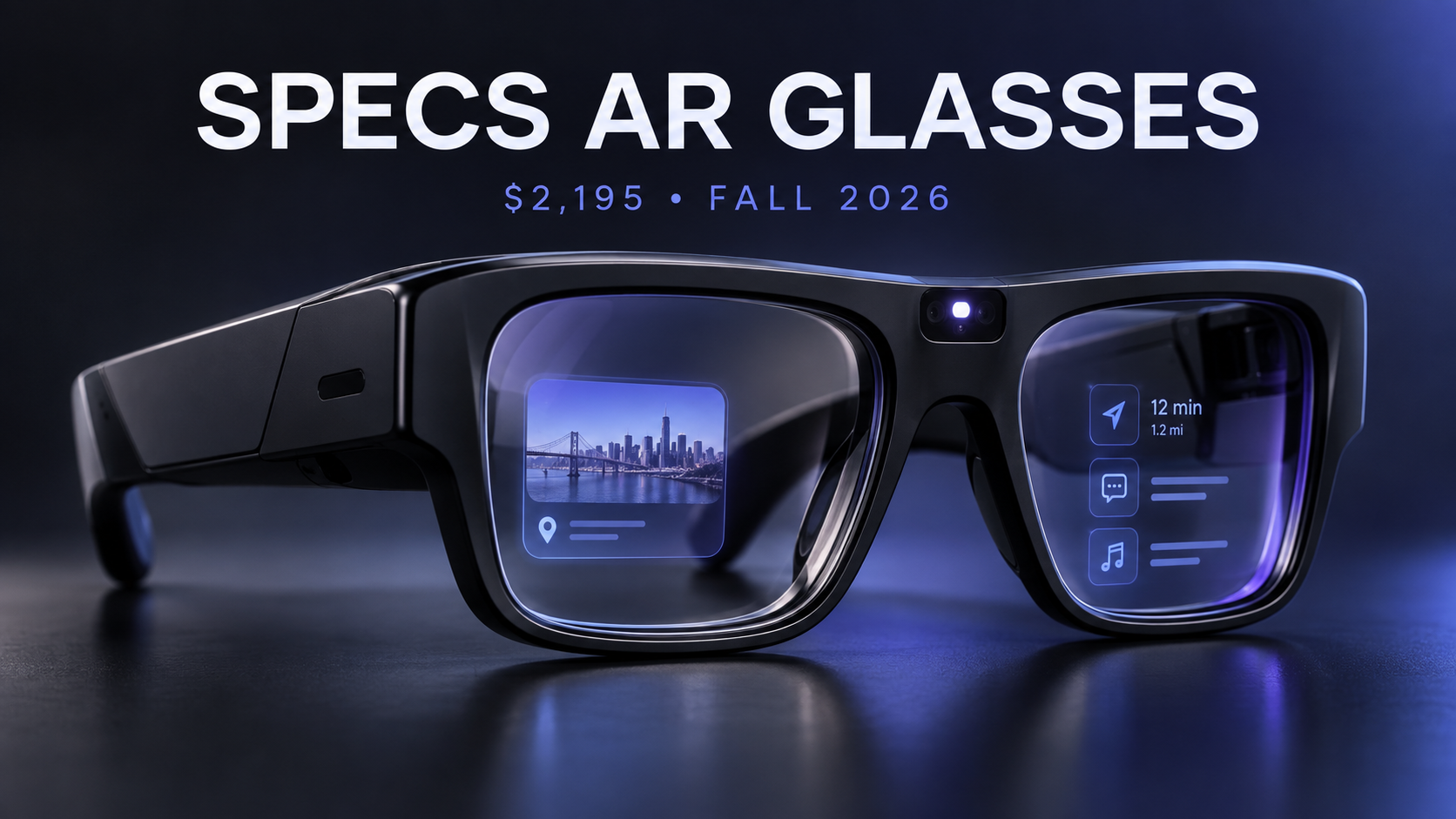
Snap has officially opened preorders for SPECS, its first consumer augmented-reality glasses. The new wearable costs $2,195, puts a transparent display and self-contained computing hardware inside the frame, and is expected to start shipping later in fall 2026 in the United States, United Kingdom and France.
This is not another lightweight pair of camera glasses. SPECS are closer to a compact spatial computer: they can place navigation, translation, entertainment, work tools and AI-generated information into the wearer’s field of view. That ambition also explains the unusually high price and the much bulkier frame.
Here is what Snap has confirmed, what SPECS Intelligence adds, and who should—or should not—consider preordering.
What Snap officially announced
Snap’s September 16 announcement expands SPECS from a previously revealed hardware project into a complete commercial platform. Preorders are now available in the U.S., UK and France with a $200 refundable deposit. Shipping is expected later this fall, although Snap has not provided a specific delivery date.
The company also confirmed an in-person SPECS First Look experience at Westfield Century City in Los Angeles beginning October 1. That is important for a device this expensive and unusual: buyers can see how the display looks, test the fit and judge the weight before committing.
SPECS hardware: what you get
The glasses use see-through waveguide displays with a 51-degree field of view. Snap compares the perceived size to a 115-inch screen viewed from about 10 feet away. The frame contains the computing hardware itself, so SPECS do not require a separate processing puck or tethered battery pack.
Confirmed hardware and design details include:
- Two frame sizes: 47mm Narrow Fit and 52mm Wide Fit
- A weight of 132 grams for the 47mm model or 136 grams for the 52mm model
- Custom stereo speakers and six high-signal-to-noise MEMS microphones
- Bluetooth phone pairing for calls, notifications and music
- Hand and voice interaction through Snap’s AI-native operating system
- A prominent external LED that illuminates or flashes during photo, video or audio recording
At well over 130 grams, SPECS are substantially heavier than ordinary eyeglasses and many camera-first smart glasses. The hardware is technically ambitious, but comfort will be one of the biggest questions for early buyers.
SPECS Intelligence extends beyond the glasses
SPECS Intelligence is Snap’s new “anticipatory” AI service. Instead of only waiting for a question, it is designed to organize information from accounts and tools a user chooses to connect, then surface relevant context at useful moments.
Snap’s examples include preparing decisions and reminders before a meeting, combining flight, hotel and dinner details for a trip, and flagging a work deadline that overlaps with travel. On the glasses, that information can appear directly in view. The service can reportedly connect to tools such as Gmail and Slack.
The preview is already available through the SPECS iOS app in the U.S. for users 18 and older. A fuller invitation-only experience is planned for Mac, with access offered through a waitlist. Snap has not announced an Android version.
Beyond AI, the glasses support visual translation in 60 languages, walking navigation, a browser for streaming services, Bluetooth calling, a virtual workspace, and shared augmented-reality experiences. Snap is also working with the NBA, WNBA, Spotify, Tripadvisor, Shopify and HBO Max on specialized experiences.
What the $2,195 price includes
The standard SPECS price is $2,195. Snap requires a $200 refundable deposit at preorder, with the remaining balance collected closer to shipment. A $2,395 Connected Case bundle adds a charging case that provides four additional charges and cellular connectivity.
In the U.S., Verizon plans start at $10 per month for existing Verizon customers and $20 per month for non-Verizon customers. Snap is also partnering with Orange in France and EE in the UK, with local pricing to be announced.
This positioning makes SPECS an early-adopter and professional tool rather than a mass-market replacement for a phone. The base model costs far more than Meta’s camera-focused smart glasses, but SPECS also include true see-through AR displays and onboard spatial computing.
Privacy: what Snap says
Smart glasses raise immediate privacy questions, especially when cameras and microphones are pointed at people nearby. Snap says SPECS do not use facial recognition to identify people and do not continuously record or save audio, video or photos. The center LED is designed to alert bystanders whenever recording is active.
For SPECS Intelligence, Snap says users choose which accounts and services to connect. The company states that Snap personnel cannot view personal content used with the service, and that content from connected accounts will not be used to train or fine-tune its AI models or to deliver personalized ads.
Those are meaningful commitments, but buyers should still review the final privacy settings and permissions before connecting email, calendars, workplace tools or travel accounts. An assistant that anticipates needs must process substantial personal context to be useful.
Who SPECS are really for
Snap is pitching SPECS to both consumers and businesses. For individuals, the strongest use cases are hands-free navigation, live translation, large virtual displays, interactive learning and creative AR. For enterprises, Snap is partnering with Salesforce, NVIDIA, Amazon Web Services, Trifork and Hololight for hands-free tasks on store floors, in factories and in the field.
The enterprise angle may be more convincing at launch. A company can justify a premium device if it reduces training time, overlays repair instructions or gives workers real-time access to inventory and customer data. Most consumers will need a clearer daily benefit before spending more than $2,000 on glasses.
Should you preorder?
SPECS are one of the most technically interesting consumer wearables announced in 2026, but preorder caution is sensible. The price is high, the frame is heavy, the software ecosystem is still developing and the exact shipping date remains unconfirmed.
Interested buyers should try the Los Angeles demo if possible, verify which frame size fits, and wait for independent battery-life, display-quality and comfort testing. The $200 deposit is refundable, but early access still means accepting first-generation compromises.
A more affordable smart-glasses alternative
If you want hands-free photos, calls and audio without a full AR display, you can compare Ray-Ban Meta smart glasses on Amazon. They are not a direct substitute for SPECS, but they represent the more established camera-and-audio category at a much lower price.
Disclosure: ReaderSpice may earn a commission from qualifying Amazon purchases at no additional cost to you.
Sources
Snap Newsroom — Making Computing More Human with SPECS
SPECS official product page and FAQ
Reuters — Snap targets enterprises with Salesforce, NVIDIA and AWS tools
The Verge — SPECS Intelligence comes to iOS and Mac