
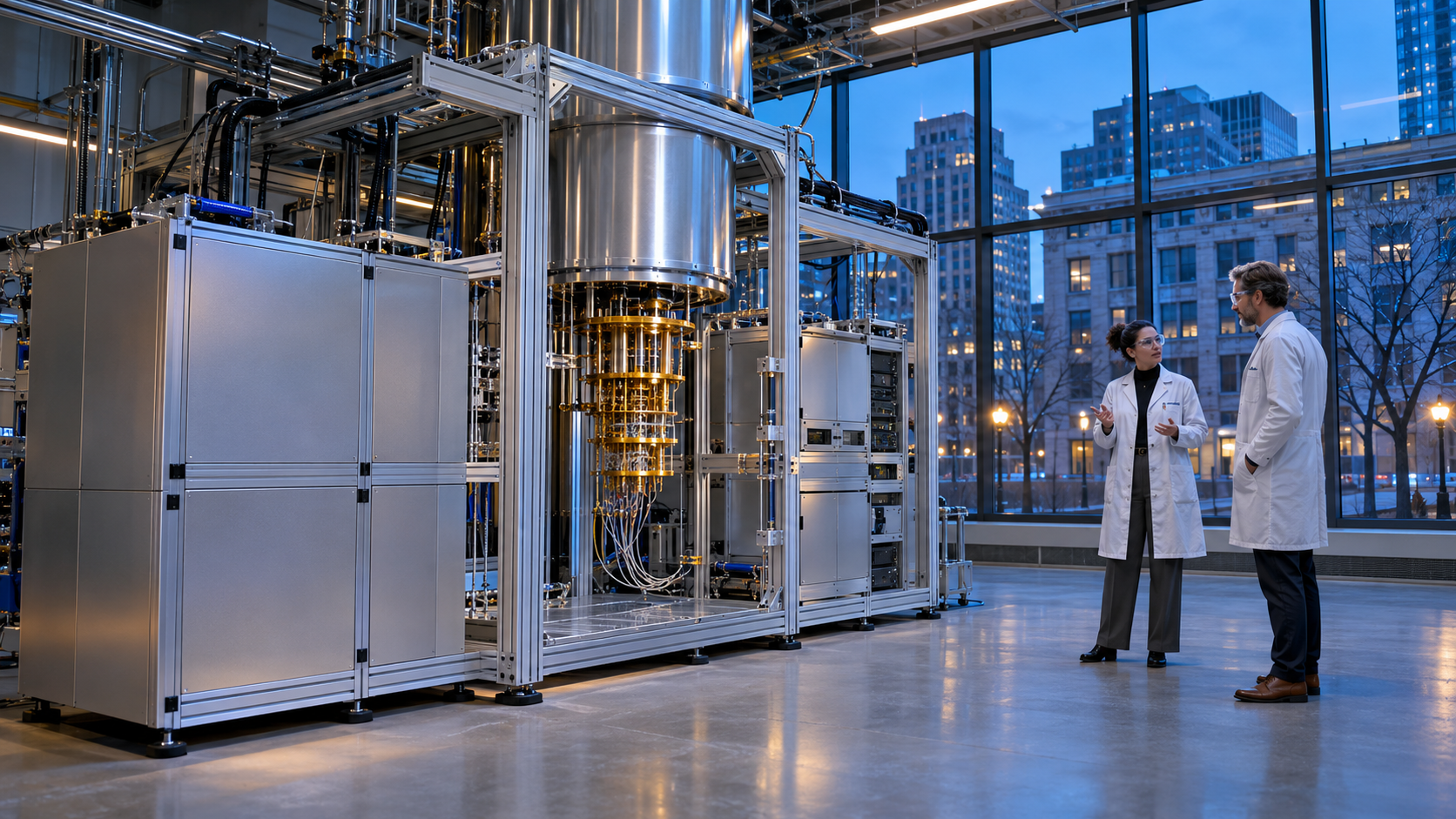
IBM, the University of Chicago, the State of Illinois and the Illinois Quantum and Microelectronics Park unveiled an operational IBM Quantum System Two at Hyde Park Labs on November 6, 2026. It is IBM’s first quantum computer in Illinois, and its cloud identifier, ibm_chicago, is now listed for Premium, Flex and Pay-As-You-Go customers on IBM Quantum Platform.
The machine is powered by IBM Quantum Nighthawk r2, a processor with 120 programmable qubits, 218 tunable couplers and 120 independent reset elements. Those supporting components bring the processor to 458 physical quantum elements, but users program 120 qubits. Keeping that distinction clear prevents a common specification error: 458 is not a claim that customers can run 458-qubit circuits.
This is also not a consumer computer, a completed fault-tolerant system or proof that quantum machines now beat classical computers on every useful problem. The Chicago deployment is research infrastructure. It expands access to a fast, highly connected quantum processor and gives Illinois researchers, companies and national-laboratory partners a shared platform for developing algorithms and testing where quantum-classical workflows may become useful.
The Chicago launch at a glance
- Status: operational at the University of Chicago’s Hyde Park Labs as of November 6, 2026.
- Processor: IBM Quantum Nighthawk r2 with 120 programmable qubits and square-lattice connectivity.
- Physical elements: 120 programmable qubits, 218 couplers and 120 reset elements, for 458 physical quantum elements in total.
- Cloud resource: ibm_chicago in IBM’s us-east region.
- Eligible platform plans: Premium, Flex and Pay-As-You-Go; IBM’s changelog does not list Open Plan access for this QPU.
- Research role: anchor system for the National Quantum Algorithm Center in Chicago.
- Long-term location: planned relocation to the Illinois Quantum and Microelectronics Park when that campus is complete.
- What is not published: a public walk-in program, a fixed completion date for the move, a dedicated-system purchase price or application-specific performance results from the Chicago installation.
Where the system fits in Chicago’s quantum plan
Quantum System Two currently sits on the ground floor of Hyde Park Labs, a research building near the University of Chicago. University reporting says the system can be seen through street-level windows, giving the public a view of the installation even though operating it remains a controlled research and cloud-computing activity.
The permanent destination is the Illinois Quantum and Microelectronics Park on Chicago’s Southeast Side. IBM is an anchor partner of the National Quantum Algorithm Center, which is intended to bring university researchers, laboratories, startups and companies together around algorithm development. Moving the system later would place it inside the larger campus rather than change the processor into a public-access exhibit.
The location matters because quantum research depends on more than a refrigerator and a chip. Researchers need classical computing, networking, control electronics, cryogenic support, software, skilled operators and organizations willing to test real workloads. The Chicago project concentrates those ingredients in one regional ecosystem.
What Nighthawk r2 changes
Nighthawk uses a square-lattice layout in which each programmable qubit can connect to four nearest neighbors through tunable couplers. IBM documents 218 couplers, compared with 176 on its Heron architecture. Denser connectivity can reduce the routing overhead required to map some circuits onto the hardware, although it does not remove noise or guarantee that every algorithm will run better.
The r2 revision adds an independent high-speed reset element for every programmable qubit. IBM says the design can execute more than 100,000 circuits per second, up to 25 times the throughput of Heron, while reducing initialization error by roughly the same factor and maintaining Heron-class gate fidelity. Faster reset matters because quantum experiments repeat circuits many times to estimate results; time spent waiting for qubits to return to a known state directly limits useful throughput.
IBM also reports accurate observable estimation on circuits containing more than 7,500 gates. That is an engineering milestone, not a universal application benchmark. Gate count alone does not describe circuit structure, error sensitivity, classical comparison cost or whether a run produced business value.
Why 120 programmable qubits are not the same as 458 physical elements
The ibm_chicago listing shows 120 programmable qubits and 458 physical quantum elements. The larger number includes hardware that supports connectivity and reset: 218 couplers and 120 reset elements alongside the 120 qubits that carry circuit operations. Users should therefore compare Nighthawk with other processors by looking at programmable-qubit count, connectivity, error metrics and throughput together—not by presenting 458 as the circuit width.
This distinction also differs from logical-qubit accounting. A future error-corrected machine may encode one logical qubit across multiple physical qubits and supporting operations. The Chicago launch does not announce a bank of 120 fault-tolerant logical qubits. Nighthawk r2 remains a noisy quantum processor intended for current research, including experiments that may help improve error correction.
How researchers access the Chicago quantum system
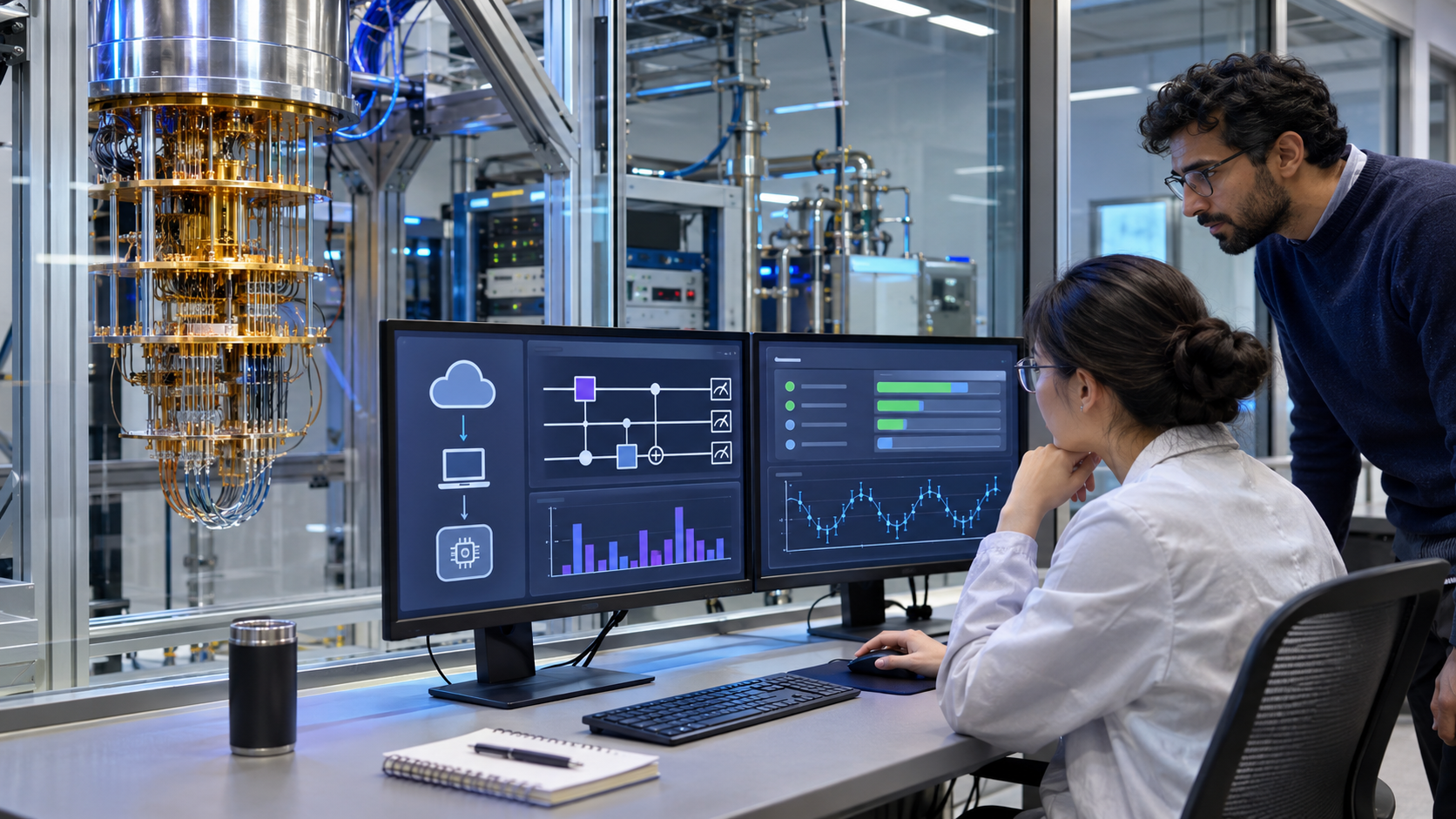
Concept illustration of cloud software access to a university-hosted quantum system.
IBM’s November service changelog says Premium, Flex and Pay-As-You-Go plans can access ibm_chicago. Users submit workloads through IBM Quantum Platform and Qiskit rather than visiting the laboratory to operate the machine directly. The resource is listed in the us-east region, so organizations should review account entitlements, data-handling rules, queue behavior and spending controls before assigning production research to it.
The launch announcement does not publish a single sticker price for a Chicago job. Pay-As-You-Go usage is billed according to QPU consumption, while Flex and Premium are paid plans with different subscription and enterprise arrangements. IBM recommends configuring cost limits and monitoring workload usage. The practical cost of an experiment depends on circuit execution, reserved session time, repetitions, queueing strategy and any failed or canceled work that still counts under the service rules.
IBM also changed its job-serialization requirement in November: jobs using QPY versions older than 13 are rejected. IBM notes that QPY 13 arrived with Qiskit 1.3 and recommends upgrading to a current qiskit-ibm-runtime release when older jobs fail. That is a software compatibility issue, not a hardware limitation of Nighthawk itself.
What researchers plan to study
Molecular simulation and drug discovery
IBM says Deloitte and AbbVie are working with IBM and Northwestern University on quantum molecular-simulation approaches for drug-discovery research. Quantum chemistry is a natural research target because molecules are quantum systems, but today’s hardware still faces noise, circuit-depth and validation limits. A useful study must compare quantum results with established classical methods and disclose the accuracy, resources and assumptions behind the result.
Power-grid optimization
EPRI and the University of Illinois Urbana-Champaign are exploring whether quantum optimization algorithms can contribute to more efficient power grids. Grid planning includes large combinations of generation, storage, transmission and demand constraints. A quantum experiment may be valuable as a research comparison even when a classical solver remains faster or cheaper for the operational problem.
Algorithm and workforce development
The National Quantum Algorithm Center is also intended to support startups, universities, laboratories and enterprises working beside IBM researchers. The system can help teams learn how to design circuits, benchmark error mitigation, measure throughput and integrate quantum jobs with classical workflows. Those skills and reproducible evaluation methods may be more immediately useful than claims of a near-term universal speedup.
How this differs from the Oak Ridge error-correction platform
ReaderSpice recently covered a separate IBM, AMD and Oak Ridge National Laboratory co-design platform. That project places IBM quantum hardware beside Oak Ridge’s Umbra high-performance computing system to study decoders, codes, orchestration and other quantum-error-correction problems. The Chicago deployment instead establishes an operational Nighthawk r2 resource for the National Quantum Algorithm Center and IBM Quantum Platform customers.
The two projects overlap in hardware family and quantum-classical philosophy, but they are not duplicate announcements. Oak Ridge emphasizes the co-design of error-correction workflows with AMD CPUs and GPUs. Chicago emphasizes a regional algorithm center, broader cloud capacity and an installed system that will later move to IQMP. Results from one may inform the other without making them the same facility or research program.
What the launch does not prove
- No universal quantum advantage: the announcements do not publish an independently validated application in which ibm_chicago beats the best practical classical method on cost, accuracy and time.
- No fault-tolerant computer: Nighthawk r2 supports error-correction research but is not described as a fully error-corrected system.
- No public walk-up access: street-level visibility does not mean visitors can submit jobs or operate the hardware without an eligible IBM Quantum account and authorization.
- No guaranteed commercial outcome: drug, energy and optimization projects are research programs, not promises of a new medicine, lower electric bill or finished product.
- No fixed relocation date: IBM and UChicago say the system will move to IQMP when the campus is complete, but the launch materials do not give a specific transfer date.
- No single published job price: access depends on the user’s plan, QPU consumption and account configuration.
A useful quantum-computing primer
Readers who want a non-specialist foundation can consider Quantum Computing for Everyone by Chris Bernhardt on Amazon (paperback ISBN-10/ASIN 0262539535). MIT Press describes the book as an accessible introduction to qubits, measurement, entanglement, algorithms and quantum cryptography for readers comfortable with high-school mathematics. It is background reading, not documentation for IBM’s current cloud service or a guide to running ibm_chicago.
Affiliate disclosure: ReaderSpice may earn a commission from qualifying Amazon purchases made through the link above, at no additional cost to you. Verify the edition, seller, price and current listing before ordering.
The bottom line
IBM Quantum System Two is now operating in Chicago with a 120-programmable-qubit Nighthawk r2 processor. The system gives Illinois researchers and eligible IBM Quantum customers another high-throughput quantum resource, anchors the National Quantum Algorithm Center and creates a visible physical center for the state’s quantum investment.
The useful interpretation is narrower than the launch-day superlatives. Chicago adds real hardware, cloud capacity, partnerships and an environment for testing algorithms. It does not by itself establish fault tolerance, universal quantum advantage or a consumer-ready quantum computer. The next meaningful evidence will be reproducible workload results, transparent classical comparisons and clear access and cost data from projects using the system.
Sources
IBM Newsroom: IBM Quantum System Two becomes operational in Chicago — November 6, 2026
IBM Quantum: Chicago’s bid to lead the country in quantum computing — November 6, 2026
IBM Quantum: Nighthawk r2 architecture, throughput and reset capabilities — August 31, 2026
IBM Quantum documentation: Quantum Compute Service November 2026 changelog and ibm_chicago access
IBM Quantum Platform: ibm_chicago compute-resource listing
IBM Quantum documentation: Plans overview
IBM Quantum documentation: Processor types and Nighthawk revisions
ReaderSpice: IBM, AMD and Oak Ridge quantum error correction platform explained
MIT Press: Quantum Computing for Everyone by Chris Bernhardt
Amazon: Quantum Computing for Everyone paperback (ASIN 0262539535)