

Microsoft has announced Maia 300, a third-generation custom AI accelerator that the company expects to become its primary inference system across Microsoft products and services. Production deployments are scheduled to begin in 2027 as Azure expands the Maia platform to multi-gigawatt scale.
The numbers are substantial, but the most important detail is what this chip is—and what it is not. Maia 300 is cloud infrastructure built to serve AI models after they have been trained. It is not a processor consumers will buy for a PC, and Microsoft’s performance figures are forward-looking claims rather than independent benchmark results.
Maia 300 at a glance
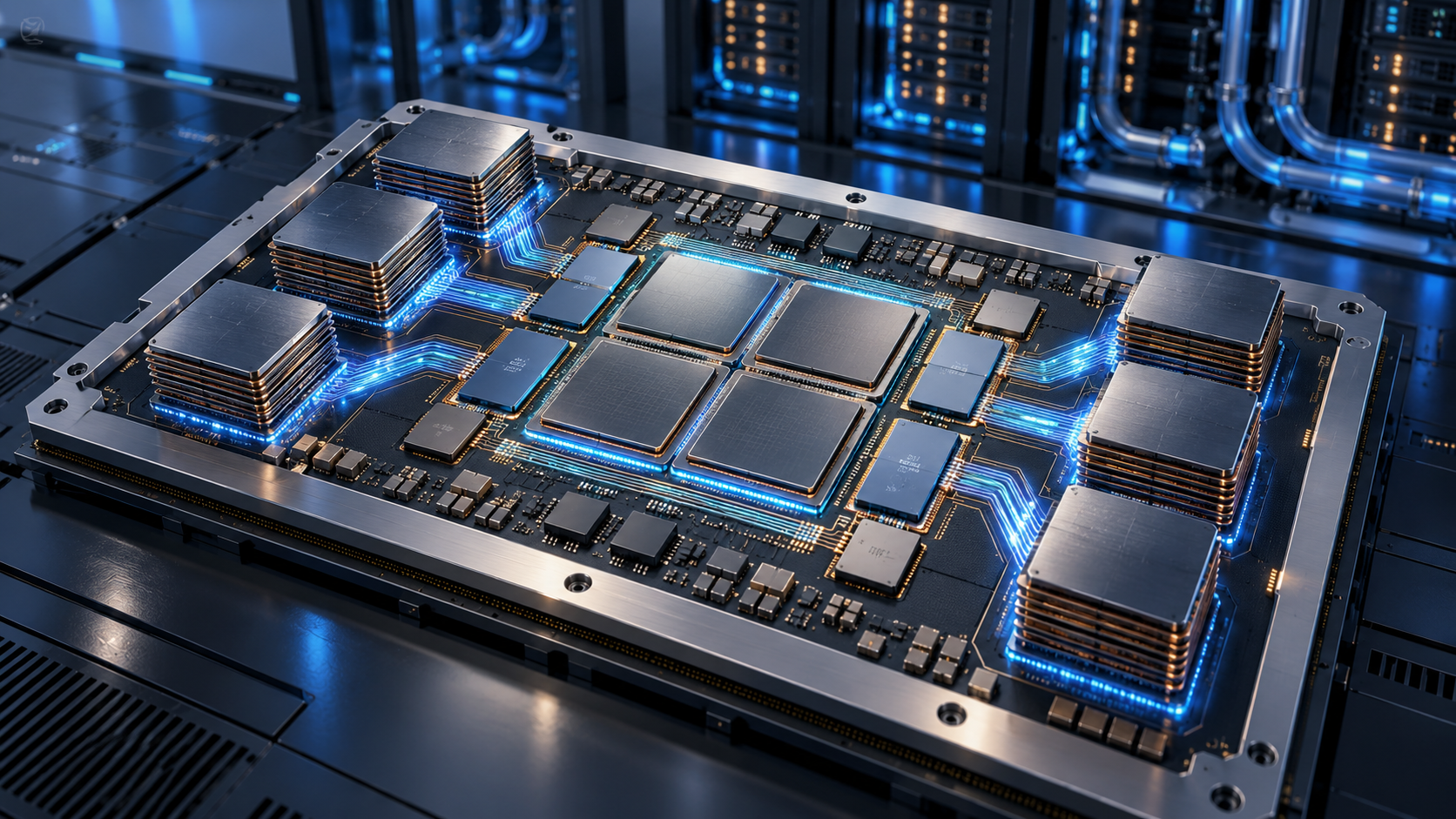
Microsoft’s official specifications and projections include:
- Production deployments beginning in 2027, with Maia planned as the primary inference platform for Microsoft products and services.
- Up to seven times the rack-scale token throughput of Maia 200 in a full 96-accelerator configuration.
- An expected 40% increase in tokens per megawatt compared with leading GPU-based systems.
- Eight HBM4 stacks per accelerator, providing 288GB of memory and 18TB/s of peak bandwidth within a 950-watt TDP.
- A 96-accelerator rack using a 167-kilowatt power envelope, with 27.6TB of HBM capacity and 1.7PB/s of aggregate memory bandwidth.
- A two-tier Ethernet-based scale-up network designed to connect as many as 12,288 accelerators in a superpod.
Microsoft says Maia 300 is optimized for long-context reasoning, latency-sensitive conversations and sustained multi-step agent workloads. Those tasks can be bottlenecked by memory movement and networking as much as raw arithmetic, which is why the design focuses heavily on data locality, memory bandwidth and rack-scale communication.
Why the chiplet design matters
Maia 300 splits major functions across several chiplets instead of building every component on one monolithic die. Microsoft says the compute chiplets use TSMC’s N2P process, while memory-controller and I/O functions sit on dies chosen for bandwidth, connectivity and cost.
That separation lets Microsoft spend its most advanced manufacturing budget where it produces the largest performance-per-watt benefit. Software then manages locality across the package so model data can stay closer to the compute engines that use it. Microsoft attributes a 36% increase in compute FLOPs, 2.5 times the HBM bandwidth and 14% more scale-up bandwidth to the new approach compared with Maia 200.
The accelerator also supports enhanced MXFP4 and sub-3-bit storage formats. Lower-precision formats can reduce the amount of memory and bandwidth required for inference, although actual answer quality and workload performance depend on how a model and its software stack use those formats.
Microsoft’s efficiency claims need independent proof
Microsoft’s headline comparisons are useful directional targets, not neutral test results. The company expects Maia 300 to produce 40% more tokens per megawatt than leading GPU-based systems and more than 2.5 times the performance per watt of Maia 200, but it has not published a broad set of third-party application benchmarks.
The comparison is also system-level. A Maia 300 rack combines accelerators, hosts, switches, networking, power delivery, cooling and software. Microsoft says liquid cooling removes more than 80% of the rack’s thermal load. That integrated design may improve efficiency, but it means a simple chip-to-chip comparison cannot capture the whole result.
The careful conclusion is that Maia 300 looks technically ambitious and purpose-built for Microsoft’s own workloads. Whether its real-world economics outperform the newest Nvidia and AMD platforms across many models will require deployment data and independent testing after systems enter production.
What Maia 300 could change for Copilot and Azure users
Most people will never see a Maia 300 chip, but they may use services running on it. Microsoft says Maia 200 already supports production workloads including Microsoft Copilot and the company’s MAI model team, with GitHub Copilot and Microsoft Foundry support planned by the end of 2026.
Maia 300 is intended to scale those experiences further. Higher inference capacity could help Microsoft serve more simultaneous requests, support longer context windows and run multi-step agents with less pressure on power and datacenter space. For users, the visible benefits could be faster responses, more reliable availability during demand spikes and lower operating costs that make advanced features easier to offer at scale.
None of those outcomes is guaranteed to appear as an immediate product upgrade. Microsoft has not promised that Maia 300 will reduce subscription prices, and cloud efficiency savings can be absorbed by larger models, more users or new features. The rollout begins in 2027 and will expand over time rather than switch every Microsoft AI service at once.
Does Maia 300 replace Nvidia GPUs?
No. Microsoft describes Azure as an open, heterogeneous platform, and Reuters reports that the company continues to buy large quantities of Nvidia and AMD hardware. Maia gives Microsoft another option for workloads it understands well and may reduce its dependence on any single supplier, but it does not eliminate the need for general-purpose GPUs.
That distinction matters because Maia 300 is designed primarily for inference. Training frontier models, supporting many customer frameworks and handling unusual workloads can favor different hardware. Microsoft’s advantage is the ability to co-design chips, racks and software around its own high-volume services, then choose other accelerators where they remain a better fit.
What readers should do now
There is nothing to preorder and no consumer Maia 300 device to wait for. If you use Copilot, Teams, GitHub Copilot or Azure AI services, the practical move is to judge those products on current price, privacy, speed and usefulness rather than on a 2027 infrastructure promise.
Shoppers who want Microsoft’s current on-device AI experience can browse Microsoft Copilot+ PCs on Amazon. Those computers use consumer processors from companies such as Qualcomm, Intel and AMD; they do not contain Maia 300, which remains a datacenter accelerator.
ReaderSpice may earn a commission from qualifying purchases made through affiliate links, at no additional cost to you.
Bottom line
Maia 300 shows how aggressively Microsoft is moving from buying AI accelerators to designing a larger share of its own inference stack. The combination of chiplets, 288GB of HBM4 per accelerator, 96-accelerator racks and a planned 12,288-accelerator superpod is built for a future in which long-context agents run continuously at enormous scale.
The 2027 rollout could make Microsoft’s AI services faster and more power-efficient, but the strongest claims still belong to Microsoft. Treat the architecture as confirmed, the deployment plan as official and the performance advantages as projections that need real-world validation.
Sources
Microsoft official blog: Azure Maia 300 announcement and 2027 deployment plan
Microsoft Azure Blog: Deep dive into Maia 300 architecture
Microsoft Maia 300 media resources and product imagery
Reuters: Microsoft’s deployment scale, cost strategy and supplier context
The Verge: Maia 300 rollout and Microsoft’s custom-chip strategy
Inline image: Concept visualization of a chiplet-based AI accelerator with high-bandwidth memory stacks